Paper II — Q1
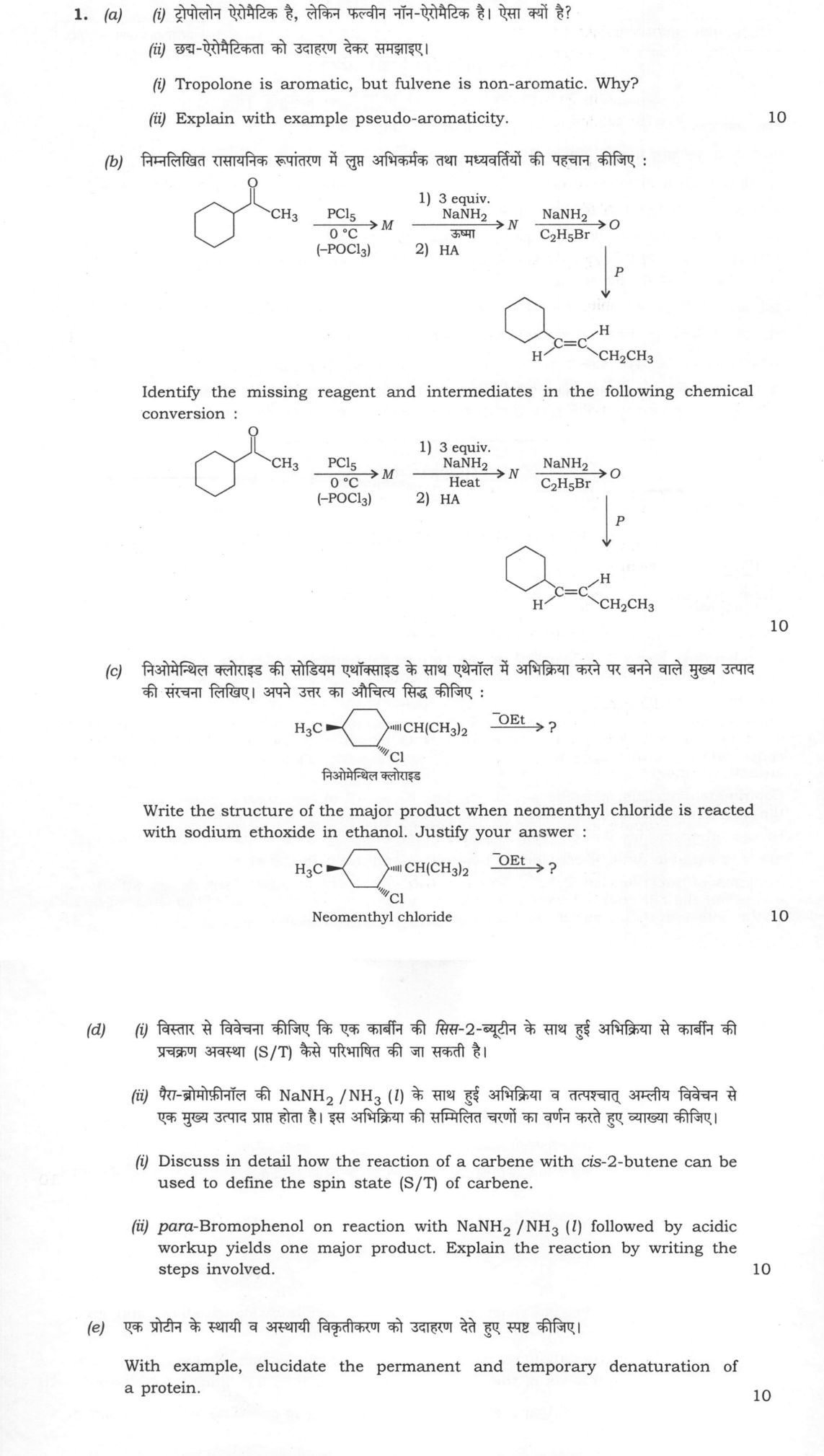
(a) (i) Tropolone is aromatic, but fulvene is non-aromatic. Why? (ii) Explain with example pseudo-aromaticity. (b) Identify the…
Tropolone is aromatic, but fulvene is non-aromatic. Why?
Explain with example pseudo-aromaticity.
Identify the missing reagent and intermediates in the following chemical conversion :
Write the structure of the major product when neomenthyl chloride is reacted with sodium ethoxide in ethanol. Justify your answer :
Discuss in detail how the reaction of a carbene with cis-2-butene can be used to define the spin state (S/T) of carbene.
para-Bromophenol on reaction with NaNH₂/NH₃ (l) followed by acidic workup yields one major product. Explain the reaction by writing the steps involved.
With example, elucidate the permanent and temporary denaturation of a protein.
हिंदी में प्रश्न पढ़ें
ट्रोपोलोन ऐरोमैटिक है, लेकिन फल्वीन नॉन-ऐरोमैटिक है। ऐसा क्यों है?
छद-ऐरोमैटिकता को उदाहरण देकर समझाइए।
निम्नलिखित रासायनिक रूपांतरण में लुप्त अभिकर्मक तथा मध्यवर्तियों की पहचान कीजिए :
निओमेथिल क्लोराइड की सोडियम एथॉक्साइड के साथ एथेनॉल में अभिक्रिया करने पर बनने वाले मुख्य उत्पाद की संरचना लिखिए। अपने उत्तर का औचित्य सिद्ध कीजिए :
विस्तार से विवेचना कीजिए कि एक कार्बिन की सिस-2-ब्यूटीन के साथ हुई अभिक्रिया से कार्बिन की प्रचक्रण अवस्था (S/T) कैसे परिभाषित की जा सकती है।
पैरा-ब्रोमोफिनोल की NaNH₂/NH₃ (l) के साथ हुई अभिक्रिया व तत्पश्चात् अम्लीय विवेचन से एक मुख्य उत्पाद प्राप्त होता है। इस अभिक्रिया की सम्मिलित चरणों का वर्णन करते हुए व्याख्या कीजिए।
एक प्रोटीन के स्थायी व अस्थायी विकृतीकरण को उदाहरण देते हुए स्पष्ट कीजिए।
Model answer
Written by UPSC Answer Check against this question's marking rubric, to the expected length. UPSC does not publish answers for Mains — this is one way to score well, not an official key.
Aromaticity and Pseudo-Aromaticity
(a)(i) Tropolone is aromatic because it is a planar, cyclic, conjugated system with 10 π-electrons, satisfying Hückel’s 4n+2rule (n=2). Although it is a neutral molecule, its aromatic character is best understood through significant dipolar resonance contributors where the oxygen bears a positive charge and the ring carbons bear negative charges, creating a continuous cyclic delocalization of 10 π-electrons. In contrast, fulvene is non-aromatic. While it possesses 6 π-electrons in the ring, the exocyclic double bond disrupts the cyclic conjugation required for aromaticity. The dominant resonance structure is dipolar, placing a positive charge on the exocyclic carbon and a negative charge on the ring, but this does not result in a stable, closed-shell aromatic sextet within the ring itself. The ring in fulvene behaves more like a diene than an aromatic system, lacking the thermodynamic stability and bond-length equalization characteristic of aromatic compounds.
(a)(ii) Pseudo-aromaticity refers to the temporary aromatic stabilization exhibited by systems that do not strictly satisfy Hückel’s rule in their ground state, often due to geometric constraints or electron count, but achieve aromatic character in transition states, excited states, or specific conformations. A classic example is the transition state of the Diels-Alder reaction, where the cyclic array of electrons in the transition state exhibits aromatic character (Hückel aromaticity for 6 π-electrons), lowering the activation energy. Another example is the cyclooctatetraene dianion (C_8H₈²⁻), which has 10 π-electrons. While neutral cyclooctatetraene is non-aromatic (tub-shaped, 8 π-electrons), the dianion becomes planar and aromatic, demonstrating pseudo-aromatic stabilization in a charged species.
(b) [(b)] The figure printed on the original question paper for this part could not be recovered from the scan, so this part is not answered here.
(c) The reaction of neomenthyl chloride with sodium ethoxide in ethanol proceeds via an E2 elimination mechanism. Neomenthyl chloride is the 3-chloro-1-methyl-4-isopropylcyclohexane isomer where the chlorine atom is in the axial position in the most stable chair conformation. For E2 elimination to occur, the β-hydrogen must be anti-periplanar to the leaving group (chlorine). In the chair conformation of neomenthyl chloride, the axial chlorine at C3 is anti-periplanar to the axial hydrogens at C2 and C4.
Elimination towards C2 yields 2-menthene (2-p-menthene), while elimination towards C4 yields 3-menthene (3-p-menthene). The major product is 2-menthene. This is determined by the Zaitsev rule, which states that the more substituted alkene is the major product. 2-menthene is a trisubstituted alkene, whereas 3-menthene is a disubstituted alkene. Although steric hindrance from the isopropyl and methyl groups can influence the transition state, the thermodynamic stability of the more substituted double bond in 2-menthene drives the reaction to favor this product. The anti-periplanar geometry is readily satisfied for the C2-H bond, allowing for efficient elimination to form the more stable internal alkene.
(d)(i) The reaction of a carbene with cis-2-butene serves as a stereochemical probe to distinguish between singlet and triplet carbenes.
- Singlet Carbene: A singlet carbene has a filled sp² hybrid orbital (lone pair) and an empty p-orbital. It reacts with alkenes in a concerted, stereospecific manner. The carbene adds to the double bond in a single step, preserving the stereochemistry of the alkene. When a singlet carbene (e.g., :CH₂) reacts with cis-2-butene, it yields exclusively cis-1,2-dimethylcyclopropane. The orbital interaction involves the overlap of the alkene π-orbital with the empty p-orbital of the carbene and the alkene π^*-orbital with the filled sp² orbital of the carbene, leading to simultaneous bond formation on the same face.
- Triplet Carbene: A triplet carbene has two unpaired electrons in orthogonal orbitals (one in an sp²-like orbital and one in a p-orbital). It reacts via a stepwise mechanism. First, one electron pairs with one electron from the alkene π-bond to form a single bond, generating a 1,3-diradical intermediate. This intermediate has a single bond between the former carbene carbon and the alkene carbon, allowing for free rotation around this C-C bond before the second bond forms. Consequently, the stereochemistry of the starting alkene is lost. The reaction of a triplet carbene with cis-2-butene yields a mixture of cis- and trans-1,2-dimethylcyclopropane. The lack of stereospecificity is the key diagnostic feature of triplet carbenes.
(d)(ii) The reaction of para-bromophenol with NaNH₂ in liquid ammonia followed by acidic workup proceeds via a benzyne (aryne) mechanism.
- Deprotonation: The strong base NaNH₂ deprotonates the phenolic -OH group to form a phenoxide ion.
- Elimination: The phenoxide oxygen donates electron density into the ring, facilitating the elimination of the bromide ion from the para-position. This elimination is driven by the formation of a highly strained triple bond in the ring, known as 4-oxidobenzyne (or 3,4-dehydrophenoxide). The intermediate is a benzyne with a triple bond between C3 and C4 (numbering the oxygen as position 1, or C4 and C5 if numbering the ring carbons 1-6 with OH at 1).
- Nucleophilic Attack: The amide ion (NH₂⁻) attacks the benzyne intermediate. The attack is regioselective. The phenoxide oxygen (or the resulting anionic character in the ring) exerts an inductive/field effect that stabilizes the negative charge developing in the transition state. Attack at the carbon meta to the oxygen (C3 or C5 relative to OH) is favored over attack at the carbon ortho to the oxygen because the resulting carbanion intermediate places the negative charge closer to the electron-withdrawing oxygen, which is destabilizing. More accurately, the nucleophile attacks the position that allows the negative charge in the intermediate to be delocalized onto the oxygen atom. In 4-oxidobenzyne, attack at C3 (meta to OH) leads to an intermediate where the negative charge can be delocalized to the oxygen, whereas attack at C4 (ortho to OH) does not allow for such stabilization. Thus, NH₂⁻ attacks at C3.
- Protonation: The resulting anion is protonated by ammonia to form the amine. Acidic workup protonates the phenoxide back to the phenol. The major product is m-aminophenol (3-aminophenol). The reaction demonstrates the elimination-addition mechanism characteristic of aryl halides with strong bases.
(e) Protein denaturation is the disruption of the native three-dimensional structure of a protein, leading to the loss of biological activity.
- Temporary (Reversible) Denaturation: This occurs when the secondary and tertiary structures are disrupted, but the primary structure (peptide bonds) remains intact, and the conditions allowing refolding are restored. Example: Heating a protein (like egg albumin) to moderate temperatures or adding low concentrations of urea (e.g., 4-6 M) can disrupt hydrogen bonds and hydrophobic interactions. If the denaturant is removed and the temperature is normalized, the protein can refold into its native conformation, regaining activity. This is because the information for the native structure is encoded in the amino acid sequence.
- Permanent (Irreversible) Denaturation: This occurs when the denaturation process involves chemical changes that prevent refolding, often due to aggregation or covalent modification. Example: Boiling an egg (high temperature) causes the proteins to unfold and then aggregate extensively due to exposed hydrophobic patches, forming a solid gel. This aggregation is irreversible because the proteins are trapped in a non-native, aggregated state. Similarly, the addition of strong denaturants like 8 M urea or β-mercaptoethanol (which breaks disulfide bonds) can lead to permanent denaturation if the protein aggregates or if the disulfide bonds do not reform correctly upon removal of the reagent. In such cases, the biological activity is lost permanently.
What "Explain" is asking you to do
Make the working of something clear — what sets it off, what follows from what, and what it produces. Explain is the Commission's mechanism word: it dominates the technical papers and the “explain why” stems, where the marks sit in the causal chain and not in the label.
Structure that answers it
State what it is → the initiating condition → the chain of cause, step by step → an instance where it plays out → what the chain produces
Where marks are lost
Describing what something looks like instead of why it works that way. Naming the stages without linking them reads as description too.
How this answer will be evaluated
Approach
(a(i)) explain: definition/context > points in order > small example > short close | (a(ii)) explain: definition/context > points in order > small example > short close | (b) trace: start point > the stages in sequence > end point > what changed | (c) justify: claim > 3-4 reasons > evidence > conclusion | (d(i)) discuss: intro > 3-4 dimensions > example > balanced close | (d(ii)) explain: definition/context > points in order > small example > short close | (e) explain: definition/context > points in order > small example > short close Full marks: Accurate mechanisms, correct stereochemistry, clear reasoning, and specific examples.
Key points expected
- Tropolone: 6π electron delocalization in ring
- Tropolone: resonance structure with O⁻ and C⁺
- Fulvene: 4π electrons in ring (antiaromatic)
- Fulvene: exocyclic double bond prevents ring aromaticity
- Definition: 4n+2 π electrons in a non-planar system
- Example: 1,3,5-hexatriene or 1,3,5-cycloheptatriene
- Explanation of why it is not truly aromatic (non-planar)
- Mention of partial delocalization
Evaluation rubric
Each sub-part is marked on its own, against the marks and word limit printed on the paper.
- (a(i)) Contrast the aromaticity of tropolone versus fulvene.
explain— definition/context → points in order → small example → short close
Must cover
- Tropolone: 6π electron delocalization in ring
- Tropolone: resonance structure with O⁻ and C⁺
- Fulvene: 4π electrons in ring (antiaromatic)
- Fulvene: exocyclic double bond prevents ring aromaticity
Loses marks
- Claiming fulvene is aromatic
- Ignoring the exocyclic double bond in fulvene
Earns more
- Mention of Hückel's rule (4n+2 vs 4n)
- Drawing of resonance structures for both
Extra mark
- Mention of dipole moment in tropolone
- (a(ii)) Define pseudo-aromaticity and provide a specific example.
explain— definition/context → points in order → small example → short close
Must cover
- Definition: 4n+2 π electrons in a non-planar system
- Example: 1,3,5-hexatriene or 1,3,5-cycloheptatriene
- Explanation of why it is not truly aromatic (non-planar)
- Mention of partial delocalization
Loses marks
- Confusing pseudo-aromaticity with antiaromaticity
- Failing to provide a specific example
Earns more
- Drawing of the example structure
- Comparison with true aromaticity
Extra mark
- Mention of specific bond length equalization
- (b) Identify intermediates M, N, O, and reagent P in the reaction sequence. 10 marks
trace— start point → the stages in sequence → end point → what changed
Must cover
- M: 1-chloro-1-cyclohexylethene (vinyl chloride)
- N: 1-cyclohexyl-1-propyne (alkyne)
- O: 1-cyclohexyl-1-propene (alkene)
- P: HBr (or HX) for hydrohalogenation
Loses marks
- Identifying M as an alkane
- Identifying N as an alkene
- Failing to identify reagent P
Earns more
- Mechanism for PCl5 conversion to vinyl chloride
- Mechanism for alkyne formation (double dehydrohalogenation)
- Mechanism for alkyne reduction to alkene
Extra mark
- Mention of Lindlar's catalyst for partial reduction
- (c) Determine the major product of neomenthyl chloride with NaOEt and justify. 10 marks
justify— claim → 3-4 reasons → evidence → conclusion
Must cover
- Product: 1-isopropyl-3-methylcyclohexene (Zaitsev product)
- Mechanism: E2 elimination
- Stereochemistry: anti-periplanar requirement
- Justification: formation of more substituted alkene
Loses marks
- Proposing an SN1 product
- Ignoring the stereochemical requirement for E2
- Proposing the less substituted alkene as major
Earns more
- Drawing of chair conformation of neomenthyl chloride
- Showing the anti-periplanar H and Cl
- Comparison with menthyl chloride (less substituted product)
Extra mark
- Mention of Saytzeff's rule
- (d(i)) Explain how carbene reaction with cis-2-butene defines spin state.
discuss— intro → 3-4 dimensions → example → balanced close
Must cover
- Singlet carbene: concerted, stereospecific addition
- Triplet carbene: stepwise, non-stereospecific addition
- cis-2-butene + singlet carbene -> cis-cyclopropane
- cis-2-butene + triplet carbene -> mixture of cis/trans
Loses marks
- Confusing singlet and triplet behavior
- Failing to mention stereospecificity
Earns more
- Drawing of the reaction mechanisms
- Explanation of orbital interactions
Extra mark
- Mention of specific carbene examples (e.g., :CH2)
- (d(ii)) Explain the reaction of p-bromophenol with NaNH2/NH3 followed by acid.
explain— definition/context → points in order → small example → short close
Must cover
- Step 1: Deprotonation of phenol to phenoxide
- Step 2: Benzyne intermediate formation (elimination of Br)
- Step 3: Nucleophilic attack by NH2- on benzyne
- Step 4: Protonation to form p-aminophenol
Loses marks
- Proposing direct SNAr substitution
- Failing to show the benzyne intermediate
Earns more
- Drawing of the benzyne intermediate
- Explanation of why benzyne forms (strong base)
Extra mark
- Mention of the 'elimination-addition' mechanism
- (e) Explain permanent and temporary protein denaturation with examples. 10 marks
explain— definition/context → points in order → small example → short close
Must cover
- Definition of denaturation (loss of secondary/tertiary structure)
- Temporary denaturation: reversible (e.g., heat, mild pH)
- Permanent denaturation: irreversible (e.g., strong acid, heavy metals)
- Example for each type
Loses marks
- Confusing denaturation with hydrolysis
- Failing to provide examples
Earns more
- Explanation of the structural changes (H-bonds, hydrophobic interactions)
- Mention of specific proteins (e.g., egg white, hemoglobin)
Extra mark
- Mention of renaturation
Practice this exact question
Write your answer and it is marked point by point against the model answer above — what you covered, what you missed, what you got wrong.
Evaluate my answer →More from Chemistry 2025 Paper II
- Q1 (a) (i) Tropolone is aromatic, but fulvene is non-aromatic. Why? (ii) Explain with exampl…
- Q2 (a) (i) In the presence of sodium ethoxide, the following transformation occurs. Explain…
- Q3 (a) (i) Write the structure of the product formed in the following reactions: (1) (2) (10…
- Q4 (a) (i) After polymerization of p-hydroxybenzoic acid, IR analysis shows 0·2% unreacted —…