Paper II — Q6
(a) (i) Elucidate the structure of the product and the intermediate (if any) in the following reactions: (A) [structure…
Elucidate the structure of the product and the intermediate (if any) in the following reactions: (A) [structure: H(Me)C(CO₂Et)(CH₂CO₂H)] 1) BH₃ 2) H⁺ → ? (B) [structure: cyclohexyl-CH=CH-CHO] NaBH₄ → ? (5+5=10 marks)
Describe the role of NMO during the dihydroxylation of an alkene using catalytic amount of OsO₄ in the presence of N-methylmorpholine N-oxide (NMO). 5 marks
Calculate the frequency of radiation required for a transition of J = 4 to J = 5 in the rotational spectrum of HCl. The rotation constant B = 10·6 cm⁻¹. 5 marks
The fundamental vibrational frequency of HCl is 2990 cm⁻¹. Calculate the fundamental vibrational frequency of DCl assuming the same bond strength. 5 marks
The molecular formula of a compound is C₃H₃N. The IR absorption frequencies are 1650 cm⁻¹, 2250 cm⁻¹ and 3100 cm⁻¹. Assign a structure for the compound. 5 marks
Write the mechanism for the following photochemical transformation: [structure not shown in transcript] 5 marks
Photobromination of cinnamic acid was carried out by using light of wavelength 480 nm with a light intensity of 1·5×10⁻³ J-s⁻¹. An exposure of 10 minutes showed a decrease of 0·05 millimole of Br₂. Calculate the quantum yield assuming that 80% of radiation is absorbed by cinnamic acid. (Planck's constant h = 6·627×10⁻³⁴ J-s and velocity of light c = 3×10⁸ m-s⁻¹) 5 marks
Predict the major and minor products for the following photoreaction. Give the logic: [structure not shown in transcript] 5 marks
Assign A, B and C in the following reaction: (Major) [reaction not fully shown in transcript] 5 marks
हिंदी में प्रश्न पढ़ें
निम्नलिखित अभिक्रियाओं में बनने वाले उत्पाद और मध्यवर्ती (यदि हो) की संरचना को स्पष्ट कीजिए: (A) [संरचना: H(Me)C(CO₂Et)(CH₂CO₂H)] 1) BH₃ 2) H⁺ → ? (B) [संरचना: साइक्लोहेक्सिल-CH=CH-CHO] NaBH₄ → ? (5+5=10 अंक)
N-मेथिलमॉर्फोलिन N-ऑक्साइड (NMO) की उपस्थिति में OsO₄ की उत्प्रेरक मात्रा का उपयोग करके एक ऐल्कीन के डाइहाइड्रॉक्सिलेशन अभिक्रिया में NMO की भूमिका का वर्णन कीजिए। (5 अंक)
HCl के घूर्णनात्मक स्पेक्ट्रम में J = 4 से J = 5 के संक्रमण के लिए आवश्यक विकिरण की आवृत्ति की गणना कीजिए। घूर्णक स्थिरांक B = 10·6 cm⁻¹। (5 अंक)
HCl की मूल कंपन आवृत्ति 2990 cm⁻¹ है। समान आबंध सामर्थ्य मानते हुए DCl की मूल कंपन आवृत्ति की गणना कीजिए। (5 अंक)
एक यौगिक का अणुसूत्र C₃H₃N है। इसकी IR अवशोषण आवृत्तियाँ 1650 cm⁻¹, 2250 cm⁻¹ और 3100 cm⁻¹ हैं। यौगिक के लिए एक संरचना निर्दिष्ट कीजिए। (5 अंक)
निम्नलिखित प्रकाश-रासायनिक रूपांतरण के लिए क्रियाविधि लिखिए: [संरचना प्रतिलिपि में नहीं दिखाई गई] (5 अंक)
सिनेमिक अम्ल का फोटोब्रोमिनेशन 480 nm तरंगदैर्घ्य के प्रकाश का उपयोग करके किया गया था, जिसकी प्रकाश तीव्रता 1·5×10⁻³ J-s⁻¹ थी। 10 मिनट के उद्भासन से Br₂ में 0·05 मिलीमोल की कमी देखी गई। यह मानते हुए क्वांटम लब्धि की गणना कीजिए कि सिनेमिक अम्ल द्वारा 80% विकिरण अवशोषित किया जाता है। (प्लांक स्थिरांक h = 6·627×10⁻³⁴ J-s और प्रकाश का वेग c = 3×10⁸ m-s⁻¹) (5 अंक)
निम्नलिखित प्रकाश-अभिक्रिया में बनने वाले प्रमुख तथा अल्प उत्पादों की प्रागुक्ति कीजिए। तर्क दीजिए: [संरचना प्रतिलिपि में नहीं दिखाई गई] (5 अंक)
निम्नलिखित अभिक्रिया में A, B और C निर्देश कीजिए: (Major) [अभिक्रिया प्रतिलिपि में पूर्ण रूप से नहीं दिखाई गई] (5 अंक)
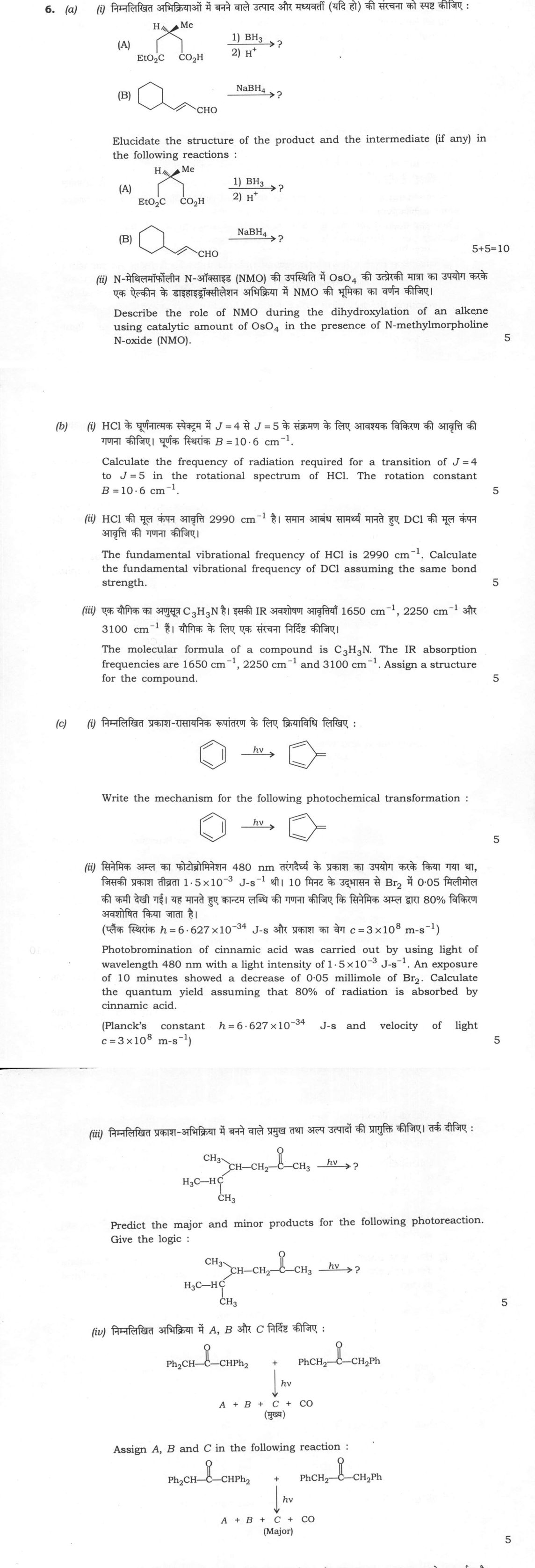
The figure this question refers to, in words
The question paper is a scan and the diagram did not survive as text. This is the figure as read from the original page — every component, value and label — so the question can be worked from the text below.
(a) Reaction (B): A cyclohexane ring is bonded to a carbon-carbon double bond, which is bonded to an aldehyde group (CHO). The structure is 3-cyclohexylprop-2-enal. The reagent is NaBH4. The product is indicated by a question mark.
(c) A chemical reaction scheme showing the photolysis of two different ketones. The reactants are benzyl 2-benzyl-2-oxoacetate (Ph2CH-C(=O)-CHPh2) and benzyl 2-benzyl-2-oxoacetate (PhCH2-C(=O)-CH2Ph). They react under light (hv) to form products A, B, C, and CO. Product C is labeled as the major product.
(c(i)) A chemical reaction scheme showing a benzene ring (six-membered aromatic ring with alternating double bonds) on the left, an arrow pointing to the right labeled with 'hv' (indicating photochemical conditions), and a cyclopentadiene ring (five-membered ring with two double bonds) on the right. The cyclopentadiene ring has a double bond extending from one of its carbons to a terminal carbon (an exocyclic double bond), forming a methylene group (=CH2).
Model answer
Written by UPSC Answer Check against this question's marking rubric, to the expected length. UPSC does not publish answers for Mains — this is one way to score well, not an official key.
Chemoselectivity, reduced-mass scaling, and excited-state radical pathways control the answers.
(a)(i) In (A), BH₃ is selective for the free carboxylic acid. The acid first forms a monoacyloxyborane, RCOO–BH₂, with evolution of H₂; hydride transfer to the acyl carbon and aqueous work-up give the primary alcohol, while the ester is unchanged. Product: CH₃CH(CO₂Et)CH₂CH₂OH. In (B), NaBH₄ reduces the aldehyde faster than the C=C bond. The immediate intermediate is an alkoxyborohydride adduct, RCH₂O–BH₃⁻, which hydrolyses to the allylic alcohol cyclohexylCH=CHCH₂OH.
(a)(ii) OsO₄ adds to the alkene to form a cyclic osmate(VI) ester. NMO is the co-oxidant: it oxidises Os(VI) back to Os(VIII), releasing the cis-diol and regenerating OsO₄. NMO is reduced to N-methylmorpholine, so only catalytic OsO₄ is needed and stoichiometric osmium is avoided.
(b)(i) For a rigid rotor, Δν~ = 2B(J+1). For J=4 to 5, Δν~ = 2×10.6×5 = 106 cm⁻¹. Frequency = cν~ = 3×10¹⁰ cm s⁻¹ × 106 = 3.18×10¹² s⁻¹.
(b)(ii) ν is proportional to the square root of k/μ. With the same force constant, ν(DCl)/ν(HCl) = square root of μ(HCl)/μ(DCl). μ(HCl) = 35.5×1/36.5 and μ(DCl) = 35.5×2/37.5, so the ratio is 0.717. Hence ν(DCl) = 2990×0.717 ≈ 2144 cm⁻¹.
(b)(iii) C₃H₃N has three degrees of unsaturation. 3100 cm⁻¹ is sp² =C–H stretch, 2250 cm⁻¹ is C≡N stretch, and 1650 cm⁻¹ is C=C stretch. The compound is CH₂=CH–CN, acrylonitrile.
(c)(i) Benzene absorbs hν to S₁ and intersystem crosses to T₁. The triplet undergoes formal [2+2] cycloaddition of two opposite double bonds to give Dewar benzene. Cleavage of the central bond gives a 1,4-diradical; a 1,2-H shift and radical recombination contract the ring to methylenecyclopentadiene (fulvene).
(c)(ii) E per photon = hc/λ = 6.627×10⁻³⁴×3×10⁸/(480×10⁻⁹) = 4.14×10⁻¹⁹ J. The 600 s exposure at 1.5×10⁻³ J s⁻¹ with 80% absorption corresponds to about 2.4×10⁻⁵ mol photons. Br₂ consumed = 0.05 mmol = 5×10⁻⁵ mol. Quantum yield φ = moles Br₂ reacted/moles photons absorbed = 5×10⁻⁵/2.4×10⁻⁵ ≈ 2.1.
(c)(iii) and (c)(iv) The ketone photolysis is Norrish type I. Excited carbonyl α-cleavage gives an acyl radical and an aryl or alkyl radical; the acyl radical loses CO. The radical pair recombines in the solvent cage. The aryl–alkyl cross dimer is major because the two radicals are generated together and cross recombination is favoured over homodimerisation. Thus C (major) is PhCH₂Ph, diphenylmethane; A is PhPh, biphenyl; B is PhCH₂CH₂Ph, bibenzyl. The same logic gives the major and minor products in (c)(iii).
Thus the structures, frequencies, and photochemical products follow directly from selective reduction, reduced-mass scaling, and Norrish-type I radical recombination.
What "Elucidate" is asking you to do
Make a stated proposition plain and then prove it with instances. Elucidate stems almost always carry a claim or a named concept, and very often the words “with examples” or “with suitable diagrams” — the illustration is part of the directive, not decoration.
Structure that answers it
Plain-language statement of what the proposition means → the part that is obscure, resolved → first illustration → second illustration → why the proposition holds
Where marks are lost
Adding terminology; elucidate rewards removing it. The commoner loss is a clean explanation with no example, when the stem asked for examples.
How this answer will be evaluated
Approach
Framework: Organic Reaction Mechanism & Spectroscopic Analysis. (a) explain: definition/context > points in order > small example > short close | (b) derive: given > assumptions > stepwise derivation > result > check | (c) explain: definition/context > points in order > small example > short close Full marks: Correct structures with stereochemistry; full working for calculations; clear mechanisms.
Key points expected
- BH3 reduces carboxylic acid to alcohol
- NaBH4 reduces aldehyde to alcohol
- NMO is a co-oxidant for OsO4
- Rotational transition energy formula
- Vibrational frequency depends on reduced mass
- IR peaks for nitrile and alkene
- Benzene photoisomerization to Dewar benzene
- Quantum yield calculation
- Norrish Type II photoreaction
Evaluation rubric
Each sub-part is marked on its own, against the marks and word limit printed on the paper.
- (a) Draw products/intermediates for (A) and (B); explain NMO's role in OsO4 catalysis. 10 marks
explain— definition/context → points in order → small example → short close
Must cover
- Product (A): Diol from BH3 reduction of CO2H
- Product (B): Allylic alcohol from NaBH4 reduction of CHO
- NMO role: Re-oxidizes Os(VI) to Os(VIII)
- Catalytic cycle: OsO4 + Alkene -> Os(VI) ester
Loses marks
- Missing stereochemistry in product structures
- Confusing NMO with stoichiometric oxidant
Earns more
- Stereochemistry of diol formation (syn)
- Mechanism of hydroboration (concerted)
- Structure of osmate ester intermediate
Extra mark
- Mention of Upjohn dihydroxylation conditions
- (b) Calculate rotational frequency, vibrational frequency of DCl, and assign C3H3N structure.
derive— given → assumptions → stepwise derivation → result → check
Must cover
- Rotational: Use ΔE = 2B(J+1) for J=4->5
- Vibrational: Use ν ∝ 1/√μ (reduced mass)
- IR: 2250 cm-1 indicates C≡N stretch
- IR: 1650 cm-1 indicates C=C stretch
Loses marks
- Skipping reduced mass calculation
- Assigning 2250 cm-1 to C=O
Earns more
- Correct calculation of reduced mass for DCl
- Structure: Propionitrile (CH3CH2CN)
- 3100 cm-1 assigned to =C-H stretch
Extra mark
- Explicit formula for rotational energy levels
- (c) Mechanism for benzene photochemistry; calculate quantum yield; predict photoreaction products.
explain— definition/context → points in order → small example → short close
Must cover
- Mechanism: Benzene -> Dewar benzene (valence isomer)
- Quantum Yield: Φ = (Moles reacted) / (Moles photons absorbed)
- Photoreaction: Norrish Type II (1,5-H shift)
- Products: Major/Minor ketones from cyclization
Loses marks
- Confusing Norrish Type I and II
- Missing the 80% absorption factor in calculation
Earns more
- Step-by-step calculation of photons absorbed
- Logic for major product: more stable radical
- Mechanism for Norrish Type II (n,π* state)
Extra mark
- Drawing the 1,4-biradical intermediate
Practice this exact question
Write your answer and it is marked point by point against the model answer above — what you covered, what you missed, what you got wrong.
Evaluate my answer →More from Chemistry 2025 Paper II
- Q3 (a) (i) Write the structure of the product formed in the following reactions: (1) (2) (10…
- Q4 (a) (i) After polymerization of p-hydroxybenzoic acid, IR analysis shows 0·2% unreacted —…
- Q5 (a) Write the structure of the product(s) and the intermediate formed in the following re…
- Q6 (a) (i) Elucidate the structure of the product and the intermediate (if any) in the follo…
- Q7 (a) (i) Acetone shows a weak absorption at 280 nm and a strong absorption at 190 nm in th…
- Q8 (a) (i) Estimate the expected splitting (coupling constant J in Hz) for the lettered prot…