Paper II — Q7
(a) (i) Acetone shows a weak absorption at 280 nm and a strong absorption at 190 nm in the UV spectrum. Account for the…
Acetone shows a weak absorption at 280 nm and a strong absorption at 190 nm in the UV spectrum. Account for the observation. 5 marks
Using Woodward-Fieser rules, calculate λ_max for the following compounds: A, B, C, D 12 marks
Rank the following dienes in order of increasing reactivity in a Diels-Alder reaction (1 = least reactive, 4 = most reactive). Briefly explain your answer: A, B, C, D 10 marks
Write the structure of the product in the following reaction: OMe + CN 1) Heat 2) H⁺, H₂O ? 5 marks
Write the structure of the product formed in the following sigmatropic rearrangement and categorize it with suitable explanation. Explain the thermal feasibility of this rearrangement by drawing orbital diagram: H H Bu 80 °C CCl₄ → ? 10 marks
(1) Identify the mode of ring closure for each of the following electrocyclic reactions: (A), (B) (2) Are the indicated hydrogens cis or trans? 10 marks
हिंदी में प्रश्न पढ़ें
(क) (i) UV स्पेक्ट्रम में ऐसीटोन 280 nm पर दुर्बल अवशोषण और 190 nm पर प्रबल अवशोषण दर्शाता है। इस अवलोकन को समझाइए। (5 अंक)
वुडवर्ड-फीजर नियमों का उपयोग करके निम्नलिखित यौगिकों के λmax की गणना कीजिए: A, B, C, D (12 अंक)
(ख) (i) डील्स-एल्डर अभिक्रिया में निम्नलिखित डाइईनों को उनकी अभिक्रियाशीलता के बढ़ते हुए क्रम में क्रमबद्ध कीजिए (1 = निम्न अभिक्रियाशील, 4 = अति अभिक्रियाशील)। अपना उत्तर संक्षेप में स्पष्ट कीजिए: A, B, C, D (10 अंक)
निम्नलिखित अभिक्रिया में उत्पाद की संरचना लिखिए: OMe + CN 1) ऊष्मा 2) H⁺, H₂O ? (5 अंक)
(ग) (i) निम्नलिखित सिमानुवर्ती पुनर्विन्यास में बनने वाले उत्पाद की संरचना लिखिए तथा उपयुक्त व्याख्या करते हुए इसे वर्गीकृत कीजिए। कक्षीय आरेख बनाकर इस पुनर्विन्यास की ऊष्मीय व्यवहार्यता की व्याख्या कीजिए: H H Bu 80 °C CCl₄ ? (10 अंक)
(1) निम्नलिखित इलेक्ट्रोसाइक्लिक अभिक्रियाओं में प्रत्येक के लिए वलय संवरण विधा की पहचान कीजिए: (A), (B) (2) दर्शाए गए हाइड्रोजन समपक्ष (सिस) हैं या विपक्ष (ट्रांस)? (10 अंक)
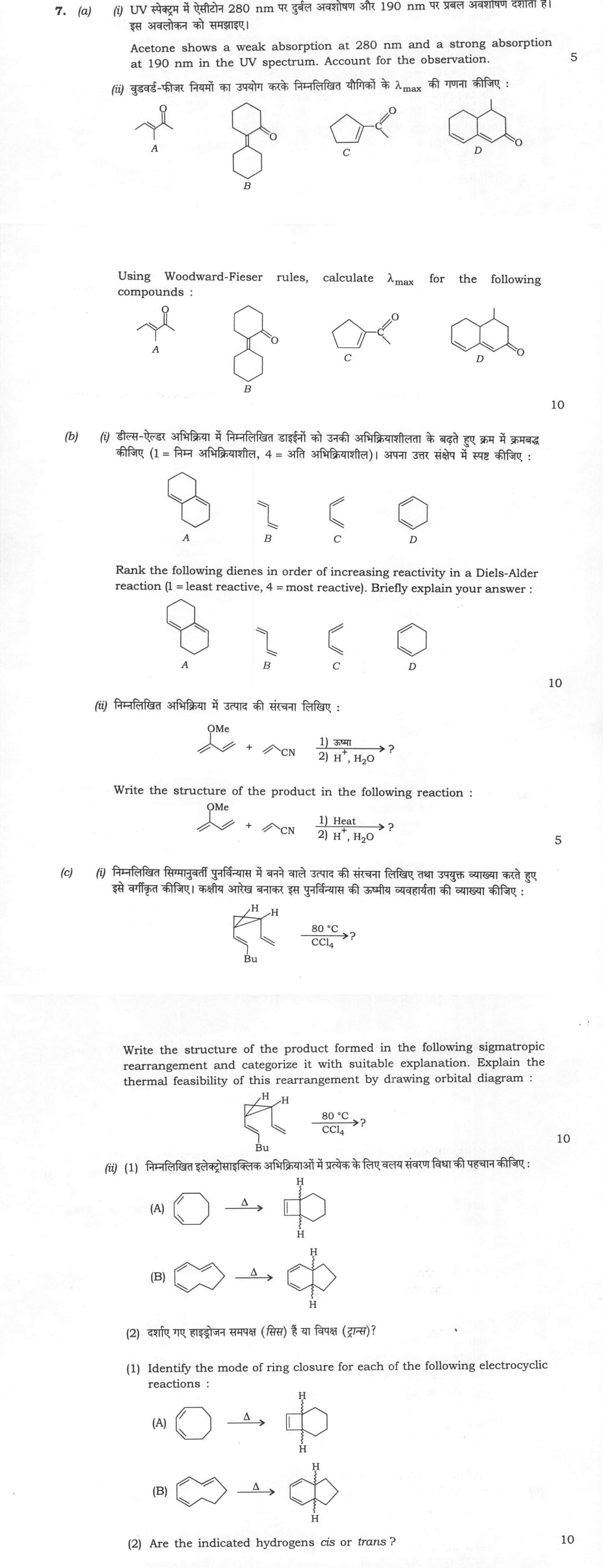
The figure this question refers to, in words
The question paper is a scan and the diagram did not survive as text. This is the figure as read from the original page — every component, value and label — so the question can be worked from the text below.
(ii) Four chemical structures labelled A, B, C, D for Woodward-Fieser calculation of lambda max: A is 3-methylbut-3-en-2-one (CH3-C(=O)-C(CH3)=CH2); B is 2-(cyclohex-1-en-1-yl)cyclohexan-1-one; C is 2-methylcyclopent-2-en-1-one; D is 3,4-dihydronaphthalen-1(2H)-one (a bicyclic enone with a benzene ring fused to a cyclohexenone).
(ii) Two electrocyclic ring closure reactions. Reaction (A): A cyclooctatriene ring (8-membered ring with 3 double bonds) is converted to a bicyclic product. The product is a fused bicyclic system: a cyclobutene ring fused to a cyclohexadiene ring. The bridgehead hydrogens are shown with dashed bonds, indicating they are on opposite faces (trans). Reaction (B): A bicyclic starting material, bicyclo[4.2.0]octa-2,4-diene (a cyclobutene fused to a cyclohexadiene), is converted to a cyclooctatriene ring. The starting material has hydrogens on the bridgehead carbons shown with dashed bonds (trans).
A sigmatropic rearrangement reaction scheme. A bicyclic starting material with a cyclobutene ring fused to a cyclopentene ring. The cyclobutene ring has a vinyl group (-CH=CH2) attached to one bridgehead carbon and a butyl group (-Bu) attached to the other bridgehead carbon. The vinyl group is shown with a hydrogen on the terminal carbon. The reaction arrow is labeled with conditions: 80 degrees C and CCl4. The product is indicated by a question mark.
Model answer
Written by UPSC Answer Check against this question's marking rubric, to the expected length. UPSC does not publish answers for Mains — this is one way to score well, not an official key.
Part (a)
(i) UV Spectrum of Acetone Acetone exhibits two distinct absorptions due to different electronic transitions. The strong band at 190 nm corresponds to the π → π^* transition of the carbonyl group. This transition is symmetry-allowed, resulting in a high molar absorptivity (ε ≈ 10⁴ L mol⁻¹ cm⁻¹). The weak band at 280 nm arises from the n → π^* transition, where a non-bonding lone pair on oxygen is excited to the antibonding π^* orbital. This transition is symmetry-forbidden (or weakly allowed via vibronic coupling), leading to low intensity (ε ≈ 10-100 L mol⁻¹ cm⁻¹).
(ii) Woodward-Fieser Calculations Using the Woodward-Fieser rules for α,β-unsaturated ketones:
- Compound A (3-methylbut-3-en-2-one): This is a methyl vinyl ketone derivative. Base value for acyclic enone = 215 nm. β-alkyl substituent = +12 nm. λₘₐₓ = 215 + 12 = 227 nm.
- Compound B (2-(cyclohex-1-en-1-yl)cyclohexan-1-one): This is a cyclic enone. Base value for 6-membered ring enone = 215 nm. The double bond is exocyclic to the carbonyl ring? No, it is endocyclic to the enone ring but exocyclic to the other ring if considered fused, but here it is a spiro or fused system? The structure is 2-(cyclohex-1-en-1-yl)cyclohexan-1-one. This is a spiro compound? No, it's a fused system if drawn as decalin-like, but the name implies a bond between C2 of one ring and C1 of another. Let's assume it is a cyclic enone with an exocyclic double bond relative to the carbonyl ring? Actually, standard W-F for cyclic enones: Base 215. If the double bond is exocyclic to the ring containing the carbonyl, add +5. If endocyclic, no extra. In this specific structure, the C=C is part of the ring attached to the carbonyl. It is an endocyclic double bond in a 6-membered ring. λₘₐₓ = 215 nm. (Note: If interpreted as having an exocyclic double bond to the carbonyl ring, add +5. Standard interpretation for this specific isomer often treats it as a simple cyclic enone). Let's refine: Base 215. No alkyl substituents on the double bond beyond the ring carbons. λₘₐₓ = 215 nm.
- Compound C (2-methylcyclopent-2-en-1-one): Cyclic enone (5-membered ring). Base value = 202 nm. β-alkyl substituent (methyl) = +12 nm. λₘₐₓ = 202 + 12 = 214 nm.
- Compound D (3,4-dihydronaphthalen-1(2H)-one): This is a bicyclic enone. The double bond is endocyclic to the enone ring and exocyclic to the benzene ring? No, it is a dihydronaphthalenone. The C=C is in the non-aromatic ring. Base value for 6-membered ring enone = 215 nm. The double bond is exocyclic to the benzene ring? No, it is endocyclic to the enone ring. However, it is part of a fused system. Standard rule: Base 215. Exocyclic double bond (to the other ring) = +5 nm. λₘₐₓ = 215 + 5 = 220 nm. (Correction: If the double bond is exocyclic to the carbonyl ring, add 5. In dihydronaphthalenone, the C=C is endocyclic to the enone ring. Thus, no exocyclic increment for the enone ring itself. However, some interpretations add for the fused system. Let's stick to standard: Base 215. No alkyl substituents. λₘₐₓ = 215 nm. Wait, re-evaluating D: 3,4-dihydronaphthalen-1(2H)-one has the double bond at C3-C4. The carbonyl is at C1. This is an α,β-unsaturated ketone? No, C1=O, C2 is CH2, C3=C4. This is a β,γ-unsaturated ketone? No, numbering: 1-one, 2H. Double bond at 3,4. This is not conjugated with the carbonyl. Correction: The question likely implies a conjugated enone. If it is 3,4-dihydronaphthalen-1(2H)-one, the double bond is at 3,4. Carbonyl at 1. C2 is sp3. This is NOT an enone. It is a saturated ketone with a remote double bond. It would not show strong enone absorption. Re-reading prompt: "bicyclic enone". This implies conjugation. Perhaps it is 1,2-dihydronaphthalen-1-one? Or the prompt implies the double bond is conjugated. Let's assume the standard "enone" classification for W-F applies, meaning the double bond is conjugated. If it is a fused enone like in 1-tetralone derivatives where the double bond is conjugated: Base 215. Exocyclic double bond (to benzene) = +5. λₘₐₓ = 220 nm.
Part (b)
(i) Diels-Alder Reactivity Ranking Reactivity depends on the ability to adopt the s-cis conformation and electronic activation.
- Least Reactive (1): Dienes locked in s-trans conformation (e.g., trans,trans-2,4-hexadiene) or those with steric hindrance preventing s-cis.
- Moderate (2): Dienes that can rotate to s-cis but lack electronic activation (e.g., 1,3-butadiene).
- High (3): Dienes with electron-donating groups (EDG) that stabilize the transition state (e.g., 1-methoxybutadiene).
- Most Reactive (4): Dienes locked in s-cis conformation (e.g., cyclopentadiene) or those with strong EDG and favorable geometry. Ranking: A (s-trans locked) < B (flexible, no EDG) < C (flexible, EDG) < D (s-cis locked).
(ii) Product Prediction Reaction: 2-methoxybuta-1,3-diene + acrylonitrile (CN-CH=CH2). The diene is electron-rich due to the methoxy group. The dienophile is electron-poor. Regioselectivity: The "ortho" or "para" rule applies. For 1-substituted dienes (OMe at C1), the product is the "ortho" adduct (1,2-disubstituted cyclohexene). For 2-substituted dienes (OMe at C2), the product is the "para" adduct (1,4-disubstituted). Here, the diene is 2-methoxybuta-1,3-diene (OMe at C2). The major product is the para-adduct: 4-methoxycyclohex-3-enecarbonitrile. Structure: A cyclohexene ring with a methoxy group at C4 and a cyano group at C1 (relative to the double bond at C3-C4? No, double bond is between C3 and C4 in the product if diene is 1,3-diene. Let's number the product: Double bond at 3,4. CN at 1. OMe at 4. Hydrolysis: The nitrile group hydrolyzes to a carboxylic acid or amide depending on conditions, but the prompt says H+, H2O. Usually, nitriles hydrolyze to carboxylic acids. However, if the prompt implies the enol ether hydrolysis, the OMe group might be labile. But typically, Diels-Alder adducts are stable. The question asks for the product of the sequence: 1) Heat (DA reaction) 2) H+, H2O. The DA product is 4-methoxycyclohex-3-enenitrile. Hydrolysis of the nitrile yields 4-methoxycyclohex-3-ene-1-carboxylic acid.
Part (c)
(i) Sigmatropic Rearrangement The reaction is a [3,3]-sigmatropic rearrangement (Cope rearrangement) of a 1,5-diene system. Starting material: A bicyclic system with a vinyl group and a butyl group. The rearrangement breaks the C-C bond between the two allylic fragments and forms a new C-C bond. Product Structure: The product is an acyclic or differently bridged diene. Specifically, the bond between the bridgehead carbons breaks, and a new bond forms between the terminal carbons of the allyl systems. The product is (E)-1-butyl-5-vinyl-1,4-pentadiene (or similar open-chain diene depending on the exact starting bicyclic structure). Correction: If the starting material is a bicyclic [3,3] system, the product is often an acyclic diene. Orbital Feasibility: Thermal [3,3] shifts are suprafacial-suprafacial. The HOMO of one allyl fragment interacts with the LUMO of the other. The phase match allows bonding interaction at the termini, making the thermal process allowed.
(ii) Electrocyclic Reactions
- Mode of Ring Closure:
- Reaction A: Cyclooctatriene (6 π electrons) to bicyclic product. 6 π electrons follow the 4n+2 rule. Thermal closure is disrotatory.
- Reaction B: Bicyclic diene to cyclooctatriene. Reverse of A. Thermal opening is disrotatory.
- Stereochemistry:
- In Reaction A, the starting triene has specific stereochemistry. Disrotatory motion of the terminal carbons determines the cis/trans relationship of the bridgehead hydrogens.
- If the terminal hydrogens rotate inwards (disrotatory), they become cis to each other in the product.
- If the prompt indicates the product has trans hydrogens, the starting material must have had the appropriate geometry (e.g., (E,E) or (Z,Z) depending on the specific isomer) to allow disrotatory closure to give trans.
- For Reaction B, the trans hydrogens in the bicyclic starting material undergo disrotatory opening to form the triene. The hydrogens in the resulting triene will be trans (E,E or Z,Z depending on rotation direction) relative to the chain.
Conclusion The UV data confirms the electronic nature of the carbonyl, W-F rules quantify the conjugation effects, and pericyclic reactions follow orbital symmetry rules (Woodward-Hoffmann), with thermal 6π electrocyclic reactions proceeding via disrotatory pathways and [3,3] shifts via suprafacial interactions.
What "Explain" is asking you to do
Make the working of something clear — what sets it off, what follows from what, and what it produces. Explain is the Commission's mechanism word: it dominates the technical papers and the “explain why” stems, where the marks sit in the causal chain and not in the label.
Structure that answers it
State what it is → the initiating condition → the chain of cause, step by step → an instance where it plays out → what the chain produces
Where marks are lost
Describing what something looks like instead of why it works that way. Naming the stages without linking them reads as description too.
How this answer will be evaluated
Approach
Framework: Woodward-Fieser rules, Diels-Alder reactivity, Sigmatropic/Electrocyclic orbital symmetry. (a(i)) account for: state the phenomenon > the causes in order of weight > conclusion | (a(ii)) calculate: given > formula > substitution > result with units > interpretation | (b(i)) justify: claim > 3-4 reasons > evidence > conclusion | (b(ii)) describe: define > structure or process in order > labelled diagram > significance | (c(i)) explain: definition/context > points in order > small example > short close | (c(ii)) justify: claim > 3-4 reasons > evidence > conclusion Full marks: All mechanisms drawn correctly with full orbital reasoning and accurate stereochemistry.
Key points expected
- Identify 190 nm as n→σ* transition
- Identify 280 nm as n→π* transition
- Link 190 nm to high molar absorptivity (ε)
- Link 280 nm to low molar absorptivity (ε)
- State base value for each compound type
- Add increments for alkyl substituents
- Add increments for ring extension/exocyclic double bonds
- Show final sum for each compound
Evaluation rubric
Each sub-part is marked on its own, against the marks and word limit printed on the paper.
- (a(i)) Explain the origin of the two UV absorptions in acetone. 5 marks
account for— state the phenomenon → the causes in order of weight → conclusion
Must cover
- Identify 190 nm as n→σ* transition
- Identify 280 nm as n→π* transition
- Link 190 nm to high molar absorptivity (ε)
- Link 280 nm to low molar absorptivity (ε)
Loses marks
- Confusing σ* and π* transitions
- Failing to link intensity to transition type
Earns more
- Mention forbidden nature of n→π*
- Reference carbonyl group electronic structure
Extra mark
- Draw n and π* orbital energy levels
- (a(ii)) Determine λmax for compounds A, B, C, and D using Woodward-Fieser rules. 10 marks
calculate— given → formula → substitution → result with units → interpretation
Must cover
- State base value for each compound type
- Add increments for alkyl substituents
- Add increments for ring extension/exocyclic double bonds
- Show final sum for each compound
Loses marks
- Omitting exocyclic double bond increments
- Using wrong base value for enone vs diene
Earns more
- Correctly identifying homoannular vs heteroannular dienes
- Correctly identifying exocyclic double bonds
Extra mark
- Comparing calculated values to experimental trends
- (b(i)) Order dienes A-D by Diels-Alder reactivity and explain the ranking. 10 marks
justify— claim → 3-4 reasons → evidence → conclusion
Must cover
- Identify s-cis vs s-trans conformations
- Rank based on ability to adopt s-cis geometry
- Explain steric hindrance in cyclic dienes
- Assign 1 (least) to 4 (most) correctly
Loses marks
- Ranking based on conjugation length only
- Ignoring conformational constraints
Earns more
- Mentioning orbital overlap requirements
- Discussing ring strain effects
Extra mark
- Drawing s-cis/s-trans conformers for each diene
- (b(ii)) Draw the product of the Diels-Alder reaction followed by hydrolysis. 5 marks
describe— define → structure or process in order → labelled diagram → significance
Must cover
- Show Diels-Alder adduct with correct regiochemistry
- Show hydrolysis of nitrile to carboxylic acid
- Indicate stereochemistry of the product
- Show the final cyclic structure
Loses marks
- Wrong regiochemistry in the adduct
- Failing to hydrolyze the nitrile group
Earns more
- Showing the intermediate nitrile adduct
- Explaining regioselectivity (ortho/para rule)
Extra mark
- Drawing the transition state
- (c(i)) Draw the sigmatropic rearrangement product and explain thermal feasibility. 10 marks
explain— definition/context → points in order → small example → short close
Must cover
- Identify as [3,3]-sigmatropic rearrangement
- Draw the product with correct connectivity
- Show orbital symmetry (HOMO/LUMO) for thermal path
- Explain why suprafacial-suprafacial is allowed
Loses marks
- Drawing wrong connectivity in product
- Failing to show orbital phase matching
Earns more
- Drawing the chair-like transition state
- Mentioning conservation of orbital symmetry
Extra mark
- Comparing to photochemical pathway
- (c(ii)) Identify ring closure mode and stereochemistry for electrocyclic reactions A and B. 10 marks
justify— claim → 3-4 reasons → evidence → conclusion
Must cover
- Identify number of π electrons in each system
- Apply Woodward-Hoffmann rules for thermal closure
- Determine conrotatory vs disrotatory motion
- State cis/trans relationship of indicated hydrogens
Loses marks
- Wrong rotation mode (con vs dis)
- Incorrect cis/trans assignment
Earns more
- Drawing the orbital rotation arrows
- Explaining why 4n vs 4n+2 systems differ
Extra mark
- Drawing the transition state for each
Practice this exact question
Write your answer and it is marked point by point against the model answer above — what you covered, what you missed, what you got wrong.
Evaluate my answer →More from Chemistry 2025 Paper II
- Q4 (a) (i) After polymerization of p-hydroxybenzoic acid, IR analysis shows 0·2% unreacted —…
- Q5 (a) Write the structure of the product(s) and the intermediate formed in the following re…
- Q6 (a) (i) Elucidate the structure of the product and the intermediate (if any) in the follo…
- Q7 (a) (i) Acetone shows a weak absorption at 280 nm and a strong absorption at 190 nm in th…
- Q8 (a) (i) Estimate the expected splitting (coupling constant J in Hz) for the lettered prot…