Paper II — Q3
(a) (i) Write the structure of the product formed in the following reactions: (1) (2) (10 marks) (ii) Describe the synthesis of…
Write the structure of the product formed in the following reactions: (1) (2) 10 marks
Describe the synthesis of ketone (A) when only isobutanol is available as the starting material: 5 marks
Write the steps involved in the following conversion: 10 marks
Elucidate the structure of C and D in the following conversion: 5 marks
Provide the structure of missing reagents and intermediates in the following synthesis: [diagram] 10 marks
Write the structure of the product formed and the steps involved in the following reaction: [diagram] 10 marks
हिंदी में प्रश्न पढ़ें
निम्नलिखित अभिक्रियाओं में बनने वाले उत्पाद की संरचना लिखिए : (1) (2) 10 marks
कीटोन (A) के संश्लेषण का वर्णन कीजिए जब केवल आइसोब्यूटेनॉल प्रारंभिक पदार्थ के रूप में उपलब्ध हो : 5 marks
निम्नलिखित रूपांतरण में सम्मिलित चरणों को लिखिए : 10 marks
निम्नलिखित रूपांतरण में C तथा D की संरचना को स्पष्ट कीजिए : 5 marks
निम्नलिखित संश्लेषण में लुप्त अभिकर्मकों तथा मध्यवर्तियों की संरचना उपलब्ध कराइए : [diagram] 10 marks
निम्नलिखित अभिक्रिया में बने उत्पाद की संरचना तथा सम्मिलित चरणों को लिखिए : [diagram] 10 marks
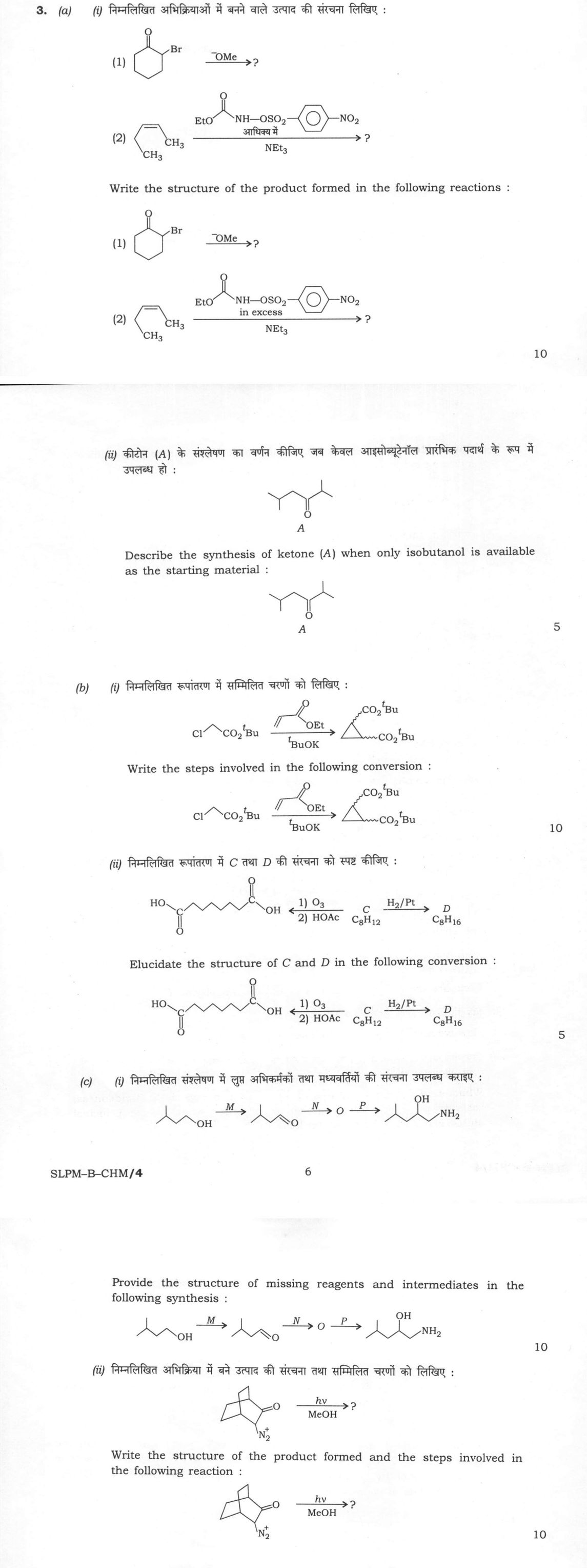
The figure this question refers to, in words
The question paper is a scan and the diagram did not survive as text. This is the figure as read from the original page — every component, value and label — so the question can be worked from the text below.
(a) A chemical structure labeled 'A' is shown. It is a ketone with the structure: (CH3)2CH-CH2-C(=O)-CH(CH3)2. The molecule consists of a central carbonyl group (C=O) flanked by two isobutyl groups. The text above it asks to describe the synthesis of this ketone (A) when only isobutanol is available as the starting material.
(b) A reaction scheme involving an unknown compound C (molecular formula C8H12). Compound C reacts with 1) O3 and 2) HOAc to form a dicarboxylic acid: HOOC-(CH2)6-COOH (suberic acid). Compound C also reacts with H2/Pt to form an unknown compound D (molecular formula C8H16). The question asks to elucidate the structures of C and D.
(c) A reaction scheme starting from a central ketone molecule: 1-cyclohexylethanone (a cyclohexane ring attached to a carbonyl group, which is attached to a methyl group). The reaction splits into two paths. Path 1 (left): Reagents are 1) LDA/THF, 2) D2O, leading to product Q. Path 2 (right): Reagents are 1) Excess NaOH, 2) D2O, leading to product P.
(c(i)) A reaction scheme showing a multi-step synthesis. The starting material is 3-methyl-1-butanol (a primary alcohol with a methyl branch on the beta-carbon). An arrow labeled 'M' points to an intermediate aldehyde, 3-methylbutanal. A second arrow labeled 'N' points to an intermediate labeled 'O'. A third arrow labeled 'P' points to the final product, 1-amino-2-methyl-1-butanol (a primary amine with a hydroxyl group on the adjacent carbon and a methyl branch on the beta-carbon).
(c(ii)) A reaction scheme showing a bicyclic organic molecule. The structure is a norbornane derivative (bicyclo[2.2.1]heptane skeleton) with a ketone group (C=O) and a diazonium group (N2+) attached to the same carbon atom. An arrow points to the right with reaction conditions 'hv' (light) and 'MeOH' (methanol) written above and below the arrow, respectively. The product is indicated by a question mark.
What "Elucidate" is asking you to do
Make a stated proposition plain and then prove it with instances. Elucidate stems almost always carry a claim or a named concept, and very often the words “with examples” or “with suitable diagrams” — the illustration is part of the directive, not decoration.
Structure that answers it
Plain-language statement of what the proposition means → the part that is obscure, resolved → first illustration → second illustration → why the proposition holds
Where marks are lost
Adding terminology; elucidate rewards removing it. The commoner loss is a clean explanation with no example, when the stem asked for examples.
How this answer will be evaluated
Approach
(a(i)) explain: definition/context > points in order > small example > short close | (a(ii)) describe: define > structure or process in order > labelled diagram > significance | (b(i)) explain: definition/context > points in order > small example > short close | (b(ii)) map: locate accurately > label > one line on why it matters | (c(i)) explain: definition/context > points in order > small example > short close | (c(ii)) explain: definition/context > points in order > small example > short close Full marks: All products/structures correct with complete mechanisms, named reactions identified, stereochemistry justified, and reagents specified with conditions.
Key points expected
- Product of 2-bromocyclohexanone with methoxide (Favorskii rearrangement)
- Product of 2,3-dimethyl-1,3-butadiene with the specified reagent
- Correct regiochemistry and stereochemistry in both products
- Identification of the named reaction mechanism
- Correct retrosynthetic analysis of ketone A
- All carbon atoms traced back to isobutanol
- Stepwise forward synthesis with reagents and conditions
- Correct functional group interconversions
Evaluation rubric
Each sub-part is marked on its own, against the marks and word limit printed on the paper.
- (a(i)) Draw the product structures for the two specified reactions. 10 marks
explain— definition/context → points in order → small example → short close
Must cover
- Product of 2-bromocyclohexanone with methoxide (Favorskii rearrangement)
- Product of 2,3-dimethyl-1,3-butadiene with the specified reagent
- Correct regiochemistry and stereochemistry in both products
- Identification of the named reaction mechanism
Loses marks
- Product without mechanism or reasoning
- Wrong regiochemistry in Favorskii product
- Incorrect diene addition pattern
Earns more
- Arrow-pushing mechanism for Favorskii rearrangement
- Explanation of diene reactivity (1,4-addition vs 1,2-addition)
- Correct IUPAC nomenclature of products
- Stereochemical justification for product formation
Extra mark
- Named reaction explicitly stated (Favorskii)
- Alternative mechanism pathway shown
- (a(ii)) Outline the synthesis of ketone A from isobutanol as the sole starting material. 5 marks
describe— define → structure or process in order → labelled diagram → significance
Must cover
- Correct retrosynthetic analysis of ketone A
- All carbon atoms traced back to isobutanol
- Stepwise forward synthesis with reagents and conditions
- Correct functional group interconversions
Loses marks
- Using starting materials other than isobutanol
- Missing key synthetic steps
- Incorrect carbon skeleton construction
Earns more
- Named reactions used in synthesis
- Yield considerations mentioned
- Stereochemical control addressed
- Alternative synthetic routes considered
Extra mark
- Green chemistry considerations
- Industrial scale feasibility noted
- (b(i)) Write the stepwise mechanism for the conversion of the chloroester to the cyclopropane product. 10 marks
explain— definition/context → points in order → small example → short close
Must cover
- Deprotonation step with t-BuOK
- Intramolecular SN2 ring closure mechanism
- Correct stereochemistry in cyclopropane product
- Arrow-pushing for each mechanistic step
Loses marks
- Missing deprotonation step
- Incorrect ring closure mechanism
- Wrong stereochemistry in product
Earns more
- Transition state drawing
- Regioselectivity explanation
- Stereochemical outcome justification
- Side reactions discussed
Extra mark
- Kinetic vs thermodynamic control noted
- Spectroscopic confirmation of product
- (b(ii)) Determine the structures of compounds C and D from the given molecular formulas and reactions. 5 marks
map— locate accurately → label → one line on why it matters
Must cover
- Structure of C (C₈H₁₂) consistent with ozonolysis product
- Structure of D (C₈H₁₆) from hydrogenation of C
- Degree of unsaturation calculation for both
- Consistency with the dicarboxylic acid product
Loses marks
- Wrong molecular formula interpretation
- Inconsistent structures with reaction conditions
- Missing degree of unsaturation analysis
Earns more
- Ozonolysis mechanism shown
- Hydrogenation selectivity explained
- Alternative isomers considered and ruled out
- Spectroscopic data interpretation
Extra mark
- NMR assignment for C and D
- IR characteristic peaks identified
- (c(i)) Provide the structures of missing reagents M, N, P and intermediate O in the synthesis sequence. 10 marks
explain— definition/context → points in order → small example → short close
Must cover
- Reagent M for alcohol to aldehyde oxidation
- Reagent N and intermediate O structure
- Reagent P for final transformation to amino alcohol
- Correct functional group transformations at each step
Loses marks
- Wrong oxidation state changes
- Missing intermediate structure
- Incompatible reagent choices
Earns more
- Specific reagent names and conditions
- Mechanism for key transformations
- Selectivity considerations
- Alternative reagents mentioned
Extra mark
- Green chemistry reagent choices
- Industrial process comparison
- (c(ii)) Draw the product structure and write the stepwise mechanism for the photochemical reaction. 10 marks
explain— definition/context → points in order → small example → short close
Must cover
- Correct product structure after photolysis in MeOH
- Stepwise mechanism with all intermediates
- Arrow-pushing for each step
- Stereochemistry in product correctly shown
Loses marks
- Product without mechanism
- Missing key intermediate
- Wrong stereochemical outcome
Earns more
- Photochemical excitation state shown
- Radical or ionic intermediate identified
- Regioselectivity explained
- Side products discussed
Extra mark
- Wavelength of light specified
- Quantum yield mentioned
Model answer coming soon
Every evaluation on this site is marked against a verified model answer. This question's answer is still being written; evaluation opens the moment it lands.
More from Chemistry 2025 Paper II
- Q1 (a) (i) Tropolone is aromatic, but fulvene is non-aromatic. Why? (ii) Explain with exampl…
- Q2 (a) (i) In the presence of sodium ethoxide, the following transformation occurs. Explain…
- Q3 (a) (i) Write the structure of the product formed in the following reactions: (1) (2) (10…
- Q4 (a) (i) After polymerization of p-hydroxybenzoic acid, IR analysis shows 0·2% unreacted —…
- Q5 (a) Write the structure of the product(s) and the intermediate formed in the following re…
- Q6 (a) (i) Elucidate the structure of the product and the intermediate (if any) in the follo…