Paper II — Q4
(a) (i) After polymerization of p-hydroxybenzoic acid, IR analysis shows 0·2% unreacted —COOH. Calculate the molecular weight of…
After polymerization of p-hydroxybenzoic acid, IR analysis shows 0·2% unreacted —COOH. Calculate the molecular weight of the polymer and categorize it. 7 marks
Write the structure of the polymer formed when p-hydroxybenzoic acid is polymerized. 3 marks
What is the precursor of the main component of natural rubber? Draw the structures of both monomer and polymer. 5 marks
Compare the salient properties of Nylon 6 and Nylon 6,6. 5 marks
How would you prepare syndiotactic polystyrene? 5 marks
What are the salient features of alpha helix in regards to handedness, residues per turn and elongation per residue? What are the principal stabilizing factors for an alpha helix? 5 marks
Compounds 1 and 2 on reaction with NaN₃ yield same product but compound 1 reacts at room temperature while compound 2 reacts at 200 °C. Identify the product formed and explain the reasons for different reactivities of compounds 1 and 2: 10 marks
Identify the major product in the following reactions and justify your answer: 10 marks
हिंदी में प्रश्न पढ़ें
p-हाइड्रॉक्सीबेंजोइक अम्ल के बहुलकन के बाद IR विश्लेषण 0·2% बचा हुआ —COOH दर्शाता है। बहुलक के आण्विक भार की गणना कीजिए और उसे वर्गीकृत कीजिए। 7 marks
p-हाइड्रॉक्सीबेंजोइक अम्ल के बहुलकन में बने बहुलक की संरचना लिखिए। 3 marks
प्राकृतिक रबर के मुख्य घटक का पूर्वगामी क्या है? एकलक तथा बहुलक, दोनों की संरचनाएं बनाइए। 5 marks
नाइलॉन 6 तथा नाइलॉन 6,6 के मुख्य गुणधर्मों की तुलना कीजिए। 5 marks
सिंडियोटैक्टिक पॉलिस्टाइरीन का निर्माण कैसे करेंगे? 5 marks
ऐल्फा हेलिक्स के वर्तिता, प्रति मोड अवशिष्ट तथा प्रति अवशिष्ट दीर्घन के संबंध में मुख्य लक्षण क्या हैं? ऐल्फा हेलिक्स के प्रमुख स्थिरीकरण कारक क्या हैं? 5 marks
यौगिक 1 तथा 2 की NaN₃ के साथ हुई अभिक्रिया में समान उत्पाद बनता है जबकि यौगिक 1 कमरे के तापमान पर अभिक्रिया करता है लेकिन यौगिक 2 की अभिक्रिया 200 °C पर होती है। बनने वाले उत्पाद की पहचान कीजिए तथा यौगिक 1 एवं 2 की विभिन्न अभिक्रियाशीलता के कारणों की व्याख्या कीजिए : 10 marks
निम्नलिखित अभिक्रिया में मुख्य उत्पाद की पहचान कीजिए तथा अपने उत्तर का औचित्य सिद्ध कीजिए : 10 marks
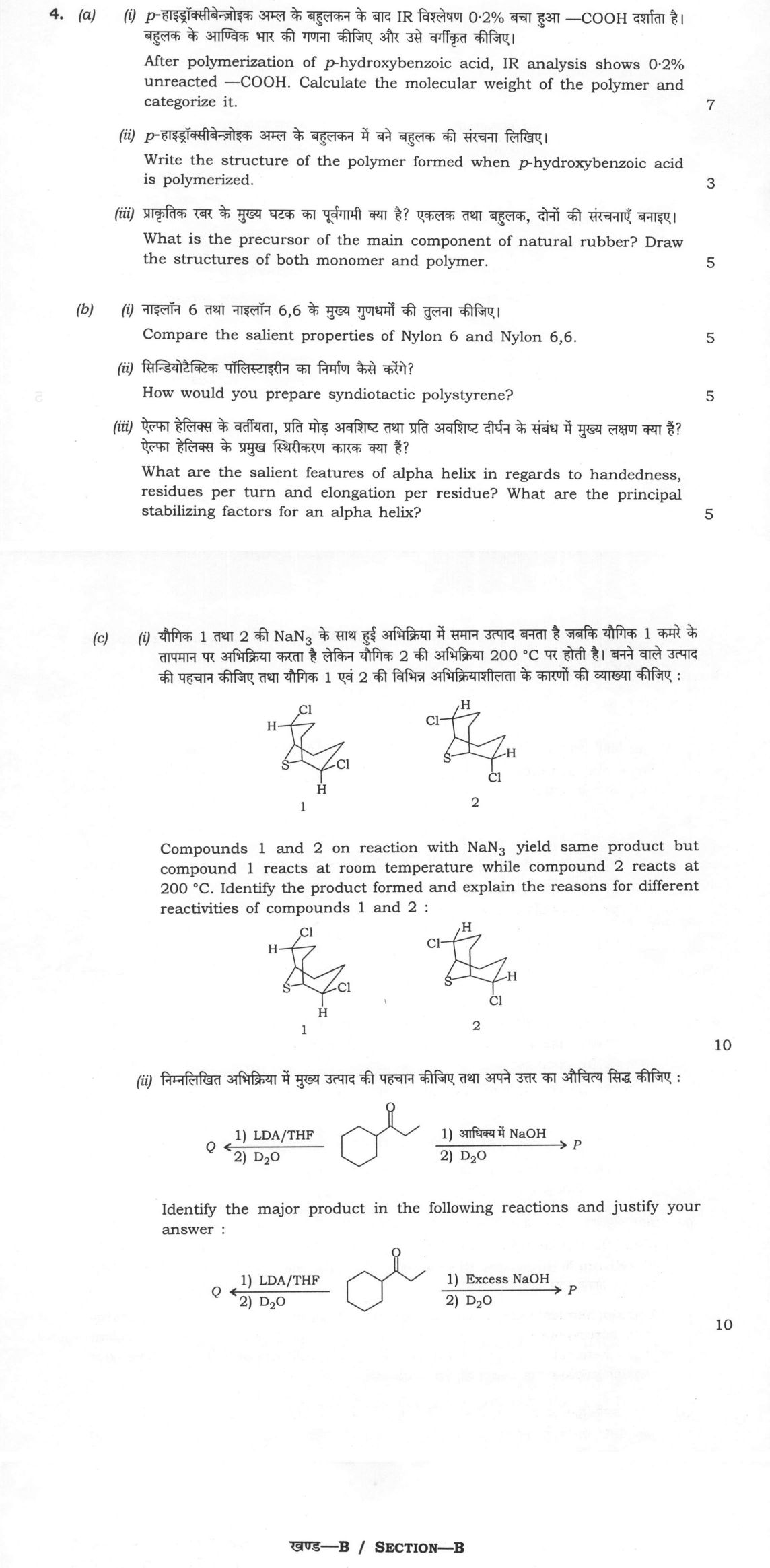
The figure this question refers to, in words
The question paper is a scan and the diagram did not survive as text. This is the figure as read from the original page — every component, value and label — so the question can be worked from the text below.
(a) Two chemical structures labeled (1) and (2). Structure (1) is 2-chlorobutane. It shows a central carbon atom bonded to a methyl group (line to the left), a chlorine atom (Cl) with a solid wedge bond (pointing out of the page), a hydrogen atom (implied), and an ethyl group (line to the right). Structure (2) is 1,2-dimethylbenzene (o-xylene). It shows a benzene ring with two methyl groups (Me) attached to adjacent carbons. The bond to the top methyl group is a solid wedge, and the bond to the bottom methyl group is a solid wedge.
(c) A reaction scheme starting from a central molecule: 1-cyclohexylethanone (a cyclohexane ring attached to a carbonyl group, which is attached to a methyl group). The scheme branches into two paths. The left path shows reagents '1) LDA/THF' and '2) D2O' leading to product 'Q'. The right path shows reagents '1) Excess NaOH' and '2) D2O' leading to product 'P'.
What "Calculate" is asking you to do
Apply the standard formula or schedule to data the question has already supplied — a table of readings, cost records, a balance sheet — and produce the number. The method is rarely in doubt; the marks sit in the named intermediate quantities, each of which has to appear as a labelled line.
Structure that answers it
Data as given → formula or standard treatment, named → substitution → each intermediate, labelled → result with units
Where marks are lost
Omitting an intermediate the marking scheme pays for separately, or rounding at an intermediate line so the final figure drifts. In commerce and accountancy, any figure in a statement that no numbered working note supports is treated as unearned.
How this answer will be evaluated
Approach
(a(i)) calculate: given > formula > substitution > result with units > interpretation | (a(ii)) describe: define > structure or process in order > labelled diagram > significance | (a(iii)) describe: define > structure or process in order > labelled diagram > significance | (b(i)) compare: paired headings or table > key differences > significance > conclusion | (b(ii)) explain: definition/context > points in order > small example > short close | (b(iii)) highlight: name the salient points > one line of substance each > close | (c(i)) explain: definition/context > points in order > small example > short close | (c(ii)) justify: claim > 3-4 reasons > evidence > conclusion Full marks: All parts answered with correct structures, mechanisms, and justifications. Numerical parts show full working. No errors in nomenclature or stereochemistry.
Key points expected
- Use formula M = (M_monomer - M_water) / (fraction unreacted)
- Substitute 0.2% as 0.002 in the calculation
- State the calculated molecular weight value
- Categorize the polymer based on the calculated weight
- Draw the repeating unit of the polymer
- Show the ester linkage (-COO-) in the backbone
- Indicate the para-substitution on the benzene ring
- Identify isoprene (2-methyl-1,3-butadiene) as the monomer
Evaluation rubric
Each sub-part is marked on its own, against the marks and word limit printed on the paper.
- (a(i)) Calculate molecular weight of the polymer and categorize it. 7 marks
calculate— given → formula → substitution → result with units → interpretation
Must cover
- Use formula M = (M_monomer - M_water) / (fraction unreacted)
- Substitute 0.2% as 0.002 in the calculation
- State the calculated molecular weight value
- Categorize the polymer based on the calculated weight
Loses marks
- Using 0.2 instead of 0.002 in the denominator
- Failing to subtract water mass from monomer mass
Earns more
- Show step-by-step substitution of values
- Mention the specific category name (e.g., high molecular weight)
Extra mark
- Mention the specific IR peak for unreacted -COOH
- (a(ii)) Write the structure of the polymer formed from p-hydroxybenzoic acid. 3 marks
describe— define → structure or process in order → labelled diagram → significance
Must cover
- Draw the repeating unit of the polymer
- Show the ester linkage (-COO-) in the backbone
- Indicate the para-substitution on the benzene ring
Loses marks
- Drawing the monomer instead of the polymer
- Incorrect linkage (e.g., amide instead of ester)
Earns more
- Label the repeating unit clearly
Extra mark
- Mention the polymer name (poly(p-hydroxybenzoic acid))
- (a(iii)) Identify the precursor of natural rubber and draw monomer and polymer structures. 5 marks
describe— define → structure or process in order → labelled diagram → significance
Must cover
- Identify isoprene (2-methyl-1,3-butadiene) as the monomer
- Draw the structure of the isoprene monomer
- Draw the structure of the polyisoprene polymer
- Indicate the cis-1,4 configuration in the polymer
Loses marks
- Drawing trans-1,4-polyisoprene (gutta-percha) instead of cis
- Incorrect monomer structure
Earns more
- Mention the precursor (e.g., dimethylallyl pyrophosphate)
Extra mark
- Mention the specific name of natural rubber (cis-1,4-polyisoprene)
- (b(i)) Compare the salient properties of Nylon 6 and Nylon 6,6. 5 marks
compare— paired headings or table → key differences → significance → conclusion
Must cover
- Compare the monomers (caprolactam vs. hexamethylenediamine + adipic acid)
- Compare the repeating unit structure
- Compare physical properties (e.g., melting point, strength)
- Compare the synthesis method (ring-opening vs. condensation)
Loses marks
- Describing one nylon without comparing to the other
- Incorrect monomer identification
Earns more
- Use a table format for comparison
- Mention specific values for melting points
Extra mark
- Mention the specific applications of each nylon
- (b(ii)) Explain how to prepare syndiotactic polystyrene. 5 marks
explain— definition/context → points in order → small example → short close
Must cover
- Identify the catalyst (e.g., metallocene or Ziegler-Natta)
- Specify the monomer (styrene)
- Describe the polymerization process (coordination polymerization)
- Explain the role of the catalyst in controlling tacticity
Loses marks
- Describing free radical polymerization (which gives atactic)
- Failing to mention the catalyst
Earns more
- Name a specific catalyst (e.g., Et(Ind)2ZrCl2)
- Mention the solvent used
Extra mark
- Draw the structure of the syndiotactic polymer
- (b(iii)) Highlight salient features of alpha helix and its stabilizing factors. 5 marks
highlight— name the salient points → one line of substance each → close
Must cover
- State the handedness (right-handed)
- State the number of residues per turn (3.6)
- State the elongation per residue (1.5 Å)
- Identify the principal stabilizing factor (hydrogen bonding)
Loses marks
- Incorrect number of residues per turn
- Failing to mention hydrogen bonding
Earns more
- Mention the specific hydrogen bond pattern (i to i+4)
- Mention the role of side chains
Extra mark
- Draw a diagram of the alpha helix
- (c(i)) Identify the product and explain the different reactivities of compounds 1 and 2. 10 marks
explain— definition/context → points in order → small example → short close
Must cover
- Identify the product (azide substitution product)
- Explain the reaction mechanism (SN1 or SN2)
- Explain why compound 1 reacts at room temperature
- Explain why compound 2 reacts at 200 °C
Loses marks
- Failing to identify the product
- Incorrect mechanism (e.g., E2 instead of substitution)
Earns more
- Draw the mechanism with arrow pushing
- Mention the role of the leaving group
- Discuss the steric hindrance in compound 2
Extra mark
- Mention the specific name of the reaction
- (c(ii)) Identify the major product in the reactions and justify the answer. 10 marks
justify— claim → 3-4 reasons → evidence → conclusion
Must cover
- Identify the major product for reaction Q
- Identify the major product for reaction P
- Justify the regioselectivity of the LDA reaction
- Justify the regioselectivity of the NaOH reaction
Loses marks
- Incorrect product identification
- Failing to justify the regioselectivity
Earns more
- Draw the enolate intermediates
- Explain the kinetic vs. thermodynamic control
- Mention the role of the solvent (THF vs. excess NaOH)
Extra mark
- Draw the transition states
Model answer coming soon
Every evaluation on this site is marked against a verified model answer. This question's answer is still being written; evaluation opens the moment it lands.
More from Chemistry 2025 Paper II
- Q1 (a) (i) Tropolone is aromatic, but fulvene is non-aromatic. Why? (ii) Explain with exampl…
- Q2 (a) (i) In the presence of sodium ethoxide, the following transformation occurs. Explain…
- Q3 (a) (i) Write the structure of the product formed in the following reactions: (1) (2) (10…
- Q4 (a) (i) After polymerization of p-hydroxybenzoic acid, IR analysis shows 0·2% unreacted —…
- Q5 (a) Write the structure of the product(s) and the intermediate formed in the following re…
- Q6 (a) (i) Elucidate the structure of the product and the intermediate (if any) in the follo…
- Q7 (a) (i) Acetone shows a weak absorption at 280 nm and a strong absorption at 190 nm in th…