Paper II — Q8
(a) (i) Estimate the expected splitting (coupling constant J in Hz) for the lettered protons in the ¹H NMR spectrum of the…
Estimate the expected splitting (coupling constant J in Hz) for the lettered protons in the ¹H NMR spectrum of the following compounds: (1) A, (2) B, (3) C 5 marks
Compare the chemical shifts of the labelled protons Hᵃ and Hᵇ in the ¹H NMR spectrum of the following compounds and justify your answer. 10 marks
Count the number of peaks observed in the ¹H NMR spectrum of the following compounds. Justify your answer: (1), (2) 5 marks
A halogenated ester shows M⁺ peak at m/z 166 (10%) and M+2 peak at m/z 168 (9·8%) in mass spectrum. ¹H NMR spectrum of this compound shows two triplets and a singlet at δ 2·9, 3·6 and 3·8 ppm, respectively in the intensity ratio 1:1:1·5. Deduce the structure of the compound. Justify your answer. 10 marks
Two isomeric alkenes with same molecular formula C₆H₁₂ show strong peaks at m/z 42 and 56 in the mass spectrum. Propose fragmentation pattern for both the peaks. 5 marks
(1) Phthalic acid diethyl ester shows a characteristic peak at m/z 149 in the mass spectrum. Account for the observance of this peak by fragmentation pattern. (2) The mass spectrum of ethylbenzene shows a characteristic peak at m/z 91 while n-propylbenzene shows strong peak at m/z 92. Explain with the help of fragmentation pattern. 10 marks
An unknown organic compound with molecular formula C₄H₅NO₂ displays a band at 2250 cm⁻¹ and a strong band at 1740 cm⁻¹ in the IR spectrum. The compound shows only two signals in 3:2 ratio in the ¹H NMR spectrum. Find out the structure of the compound. Justify your answer. 10 marks
हिंदी में प्रश्न पढ़ें
(क) (i) निम्नलिखित यौगिकों के ¹H NMR स्पेक्ट्रम में अक्षरित प्रोटोनों के लिए अपेक्षित विपाटन (युग्मन स्थिरांक J, Hz में) का अनुमान लगाइए: (1) A, (2) B, (3) C (5 अंक)
निम्नलिखित यौगिकों के ¹H NMR स्पेक्ट्रम में Hᵃ एवं Hᵇ अंकित प्रोटोनों की रासायनिक सृति की तुलना कीजिए तथा अपने उत्तर का औचित्य सिद्ध कीजिए। (10 अंक)
निम्नलिखित यौगिकों के ¹H NMR स्पेक्ट्रम में दिखने वाले शिखरों की संख्या की गणना कीजिए। अपने उत्तर का औचित्य सिद्ध कीजिए: (1), (2) (5 अंक)
(ख) (i) एक हैलोजीनेटेड एस्टर द्रव्यमान स्पेक्ट्रम में M⁺ शिखर m/z 166 (10%) पर और M+2 शिखर m/z 168 (9·8%) पर दर्शाता है। ¹H NMR स्पेक्ट्रम में यह यौगिक दो त्रिक व एक एकल क्रमशः δ 2·9, 3·6 और 3·8 ppm पर तीव्रता अनुपात 1:1:1·5 में दर्शाता है। यौगिक की संरचना का निगमन कीजिए। अपने उत्तर का औचित्य सिद्ध कीजिए। (10 अंक)
दो समावयवी एल्कीन, जिनका समान आणविक सूत्र C₆H₁₂ है, द्रव्यमान स्पेक्ट्रम में प्रबल शिखर m/z 42 तथा 56 पर दर्शाते हैं। दोनों शिखरों के खण्ड प्रतिरूप को प्रस्तावित कीजिए। (5 अंक)
(ग) (i) (1) थैलिक एसिड डाइएथिल एस्टर द्रव्यमान स्पेक्ट्रम में एक अभिलाक्षणिक शिखर m/z 149 पर दर्शाता है। खंडन प्रतिरूप दर्शाते हुए इस शिखर के प्रेक्षण का कारण बताइए। (2) एथिलबेंज़ीन द्रव्यमान स्पेक्ट्रम में एक अभिलाक्षणिक शिखर m/z 91 पर दर्शाता है, जबकि n-प्रोपिलबेंज़ीन m/z 92 पर प्रबल शिखर दर्शाता है। खंडन प्रतिरूप की सहायता से इसे समझाइए। (10 अंक)
एक अज्ञात कार्बनिक यौगिक, जिसका आण्विक सूत्र C₄H₅NO₂ है, IR स्पेक्ट्रम में 2250 cm⁻¹ पर एक बैंड तथा 1740 cm⁻¹ पर एक प्रबल बैंड दर्शाता है। यह यौगिक ¹H NMR स्पेक्ट्रम में केवल दो सिग्नल 3:2 के अनुपात में दर्शाता है। यौगिक की संरचना का पता लगाइए। अपने उत्तर का औचित्य सिद्ध कीजिए। (10 अंक)
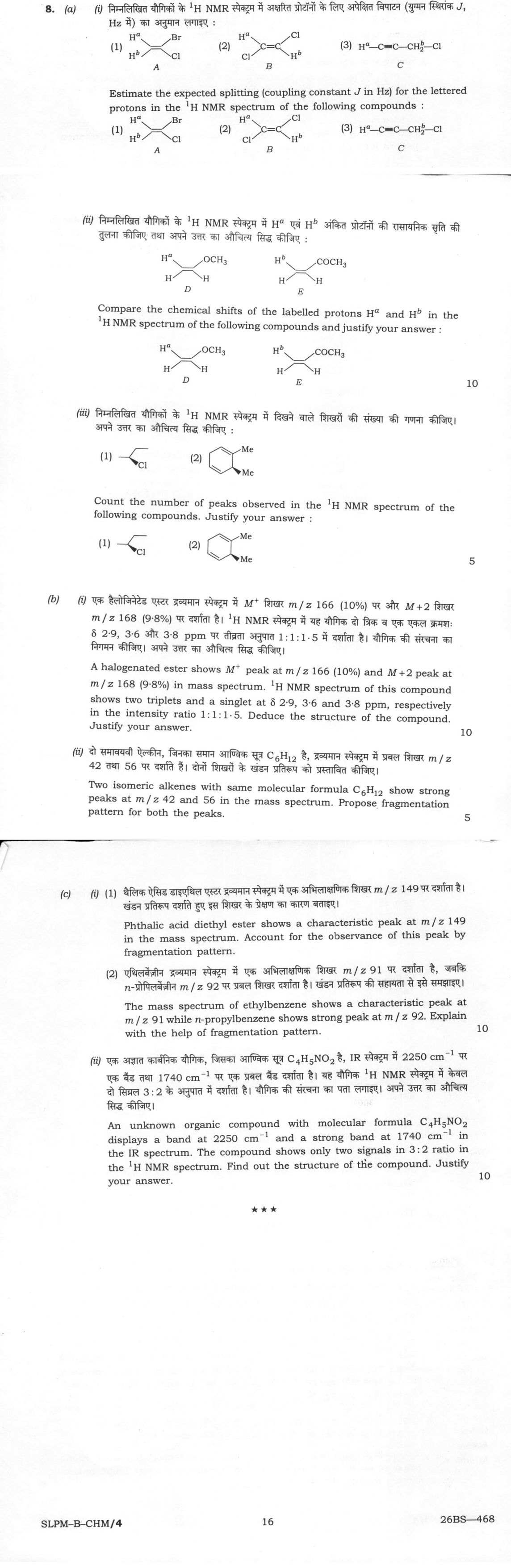
The figure this question refers to, in words
The question paper is a scan and the diagram did not survive as text. This is the figure as read from the original page — every component, value and label — so the question can be worked from the text below.
(a) Two chemical structures labeled (1) and (2). Structure (1) is a skeletal formula of a chiral alkyl chloride. It shows a central carbon atom bonded to a chlorine atom (Cl) via a solid wedge bond, a methyl group, and an ethyl group. Structure (2) is a benzene ring substituted with two methyl groups (Me) at adjacent positions (ortho). The bond to the lower methyl group is drawn as a solid wedge.
Model answer
Written by UPSC Answer Check against this question's marking rubric, to the expected length. UPSC does not publish answers for Mains — this is one way to score well, not an official key.
Part (a). For the drawn 2-chlorobutane, taking A, B and C as the C-1 methyl, C-2 methine and C-3 methylene protons, and using the n+1 rule, A is a quartet with ³JAB ≈ 6–8 Hz; B is a multiplet coupled to A (6–8 Hz) and to the two diastereotopic C protons (6–8 Hz each), with possible long-range ⁴J ≤ 0–3 Hz; each C proton is a ddq, showing geminal ²JCC ≈ 12–14 Hz, vicinal ³J to B and to the terminal CH₃ ≈ 6–8 Hz, and ⁴J to A ≈ 0–3 Hz. The Hᵃ/Hᵇ pair on the C-3 methylene is diastereotopic because of the adjacent stereocentre; the proton nearer the C–Cl bond is more downfield because of Cl inductive withdrawal and the anisotropic deshielding cone of C–Cl, while the other is slightly upfield. In o-xylene, both labelled aromatic protons are deshielded by the aromatic ring current (≈7 ppm); the proton para to a methyl group is slightly more shielded than one only ortho/meta to methyl because methyl donates electron density to ortho/para positions. Peak counts: 2-chlorobutane gives five signals: the two methyl groups are constitutionally different, the methine is unique, and the two methylene protons are diastereotopic. o-Xylene gives three signals: a symmetry plane makes the two methyl groups equivalent, H-3/H-6 equivalent, and H-4/H-5 equivalent.
Part (b). (i) M⁺ 166 and M+2 168 of almost equal intensity indicate one Br. The formula is C₄H₇BrO₂. The two 2H triplets at δ 2.9 and 3.6 are a –CH₂CH₂– unit, and the 3H singlet at δ 3.8 is OCH₃; the structure is therefore methyl 3-bromopropanoate, BrCH₂CH₂CO₂CH₃. (ii) For C₆H₁₂ alkenes, M⁺• is 84. m/z 56 is C₄H₈⁺•, formed by a McLafferty-type/retro-ene rearrangement in which γ-H transfer and C–C cleavage expel ethene (28 u). m/z 42 is C₃H₆⁺•, formed by allylic cleavage next to the double bond followed by 1,2-H transfer; it is not C₃H₅⁺ (m/z 41). The hexene isomers can give both ions by these allylic and retro-ene pathways.
Part (c). (i) Diethyl phthalate (M⁺• 222) gives m/z 149 by a McLafferty-type rearrangement of one ethoxycarbonyl group: γ-H transfer to the ester carbonyl oxygen, C–O cleavage and loss of C₄H₉O• (73 u) allow the ring to cyclise to phthalic anhydride. The resulting C₈H₅O₃⁺ ion, phthalic anhydride plus H, is m/z 149. Ethylbenzene (M⁺• 120) undergoes benzylic cleavage to C₇H₇⁺ (tropylium, m/z 91) plus CH₃•. n-Propylbenzene (M⁺• 134) gives strong m/z 92, C₇H₈⁺, by a McLafferty rearrangement: the γ-H from the terminal methyl transfers to the benzylic carbon/charge site, the α–β C–C bond cleaves, ethene is lost, and the charge remains on the toluene fragment, which appears as protonated toluene/tropylium hydride. (ii) C₄H₅NO₂ with 2250 cm⁻¹ (C≡N) and 1740 cm⁻¹ (ester C=O) has two NMR signals in 3:2 ratio: a 3H OCH₃ singlet and a 2H singlet for CH₂ between CN and CO. The structure is methyl cyanoacetate, NC–CH₂–COOCH₃. The formula, three degrees of unsaturation, IR bands and 3:2 integration justify it. The assignments are therefore justified by isotope pattern, multiplicities, symmetry, anisotropy and characteristic fragmentation; NMR, MS and IR together fix the structures.
What "Justify" is asking you to do
Defend a position with reasons that carry evidence, and show why the contrary view does not hold. Where the stem runs as a question and asks you to justify your answer, the position is yours to choose and the marks lie wholly in the defence.
Structure that answers it
Position stated plainly → reason 1 with evidence → reason 2 with evidence → strongest objection, met → position restated as qualified
Where marks are lost
Reasons stated and none of them evidenced. The other standard loss is fence-sitting — an answer that finds merit on both sides and commits to neither has justified nothing.
How this answer will be evaluated
Approach
(a(i)) calculate: given > formula > substitution > result with units > interpretation | (a(ii)) compare: paired headings or table > key differences > significance > conclusion | (a(iii)) enumerate: list the items in order > one line each > no commentary | (b(i)) justify: claim > 3-4 reasons > evidence > conclusion | (b(ii)) explain: definition/context > points in order > small example > short close | (c(i)) explain: definition/context > points in order > small example > short close | (c(ii)) justify: claim > 3-4 reasons > evidence > conclusion Full marks: Complete mechanisms with correct structures, all data interpreted, proper justification
Key points expected
- Identify coupling type (geminal, vicinal, trans, cis, long-range)
- Provide J values in Hz for each labeled proton
- Distinguish between cis and trans alkene coupling
- Identify long-range coupling in alkyne (C)
- Identify Ha and Hb in both structures
- Compare chemical shifts based on substituent effects
- Explain electronic effects of OCH3 vs COCH3
- Justify which proton is more deshielded
Evaluation rubric
Each sub-part is marked on its own, against the marks and word limit printed on the paper.
- (a(i)) Estimate coupling constants (J) for protons in A, B, and C.
calculate— given → formula → substitution → result with units → interpretation
Must cover
- Identify coupling type (geminal, vicinal, trans, cis, long-range)
- Provide J values in Hz for each labeled proton
- Distinguish between cis and trans alkene coupling
- Identify long-range coupling in alkyne (C)
Loses marks
- Confusing cis and trans coupling constants
- Missing long-range coupling in alkyne
Earns more
- Correctly identifies geminal coupling in A
- Distinguishes trans (12-18 Hz) from cis (6-12 Hz) in B
- Notes long-range coupling in C
Extra mark
- Provides specific literature values for J
- (a(ii)) Compare chemical shifts of Ha and Hb in D and E with justification. 10 marks
compare— paired headings or table → key differences → significance → conclusion
Must cover
- Identify Ha and Hb in both structures
- Compare chemical shifts based on substituent effects
- Explain electronic effects of OCH3 vs COCH3
- Justify which proton is more deshielded
Loses marks
- Failing to justify with electronic effects
- Confusing the two structures
Earns more
- Correctly identifies anisotropic effects
- Explains inductive effects of substituents
- Provides approximate chemical shift values
Extra mark
- Draws structures with labeled protons
- (a(iii)) Count number of peaks in 1H NMR for two compounds. 5 marks
enumerate— list the items in order → one line each → no commentary
Must cover
- Identify symmetry elements in each compound
- Count distinct proton environments
- Justify based on molecular symmetry
- Provide correct peak count for each
Loses marks
- Failing to consider molecular symmetry
- Counting non-equivalent protons as equivalent
Earns more
- Correctly identifies equivalent protons
- Explains symmetry breaking or preservation
Extra mark
- Draws structures with labeled equivalent protons
- (b(i)) Deduce structure of halogenated ester from MS and NMR data. 10 marks
justify— claim → 3-4 reasons → evidence → conclusion
Must cover
- Interpret M+ and M+2 peaks for halogen identification
- Analyze NMR splitting patterns (triplets, singlet)
- Correlate chemical shifts with functional groups
- Propose consistent structure with all data
Loses marks
- Ignoring M+2 peak for halogen identification
- Proposing structure inconsistent with NMR data
Earns more
- Correctly identifies bromine from M+2 pattern
- Explains triplet splitting from adjacent CH2 groups
- Assigns singlet to isolated methyl group
Extra mark
- Draws complete structure with labeled protons
- (b(ii)) Propose fragmentation patterns for m/z 42 and 56 in C6H12 isomers. 5 marks
explain— definition/context → points in order → small example → short close
Must cover
- Identify possible C6H12 isomers
- Show fragmentation to m/z 42 (C3H6+)
- Show fragmentation to m/z 56 (C4H8+)
- Explain stability of resulting carbocations
Loses marks
- Failing to show actual fragmentation steps
- Ignoring carbocation stability
Earns more
- Draws fragmentation arrows
- Identifies allylic or benzylic stabilization
- Considers different isomer structures
Extra mark
- Provides multiple fragmentation pathways
- (c(i)) Explain m/z 149 peak in phthalate and m/z 91/92 in alkylbenzenes. 10 marks
explain— definition/context → points in order → small example → short close
Must cover
- Show fragmentation to m/z 149 in phthalate ester
- Explain McLafferty rearrangement or similar
- Show formation of tropylium ion (m/z 91)
- Explain m/z 92 in n-propylbenzene
Loses marks
- Failing to show actual fragmentation steps
- Confusing m/z 91 and 92 origins
Earns more
- Draws fragmentation mechanisms
- Identifies tropylium ion structure
- Explains why n-propyl gives m/z 92
Extra mark
- Provides complete fragmentation schemes
- (c(ii)) Deduce structure of C4H5NO2 from IR and NMR data. 10 marks
justify— claim → 3-4 reasons → evidence → conclusion
Must cover
- Interpret IR bands at 2250 and 1740 cm-1
- Analyze NMR signal ratio (3:2)
- Propose structure consistent with all data
- Justify with functional group identification
Loses marks
- Ignoring IR data for functional groups
- Proposing structure inconsistent with NMR ratio
Earns more
- Identifies nitrile from 2250 cm-1
- Identifies ester or amide from 1740 cm-1
- Explains NMR splitting pattern
Extra mark
- Draws complete structure with labeled protons
Practice this exact question
Write your answer and it is marked point by point against the model answer above — what you covered, what you missed, what you got wrong.
Evaluate my answer →More from Chemistry 2025 Paper II
- Q5 (a) Write the structure of the product(s) and the intermediate formed in the following re…
- Q6 (a) (i) Elucidate the structure of the product and the intermediate (if any) in the follo…
- Q7 (a) (i) Acetone shows a weak absorption at 280 nm and a strong absorption at 190 nm in th…
- Q8 (a) (i) Estimate the expected splitting (coupling constant J in Hz) for the lettered prot…