Paper II — Q2
(a) (i) In the presence of sodium ethoxide, the following transformation occurs. Explain : (ii) Propose a suitable mechanism for…
In the presence of sodium ethoxide, the following transformation occurs. Explain :
Propose a suitable mechanism for the following transformation :
The following reaction does not produce the product shown :
(1) Predict the major product from the conditions shown above, and write a detailed mechanism for its formation.
(2) Write that reaction conditions which would lead to successful synthesis of the product shown above (i.e., 3,3-dimethyl-2-butanol).
Write the structure of the major product(s) formed in the following reaction. Justify your answer :
Write the structure of the major product(s) formed in the following reactions :
(i)
(ii)
(iii)
(iv)
हिंदी में प्रश्न पढ़ें
सोडियम एथॉक्साइड की उपस्थिति में निम्नलिखित रूपांतरण होता है। व्याख्या कीजिए।
निम्नलिखित रूपांतरण के लिए उपयुक्त क्रियाविधि प्रस्तावित कीजिए :
निम्नलिखित अभिक्रिया में दर्शाया हुआ उत्पाद नहीं बनता है :
(1) उपर दर्शाई गई अवस्था में बनने वाले मुख्य उत्पाद का पूर्वानुमान लगाइए व इसके बनने की क्रियाविधि की विस्तृत जानकारी दीजिए।
(2) उस अभिक्रिया अवस्था को लिखिए, जिससे उपयुक्त उत्पाद (अर्थात् 3,3-डाइमेथिल-2-ब्यूटेनॉल) का सफल संश्लेषण किया जा सके।
निम्नलिखित अभिक्रिया में बनने वाले मुख्य उत्पाद/उत्पादों की संरचना लिखिए। अपने उत्तर का औचित्य सिद्ध कीजिए :
निम्नलिखित अभिक्रियाओं में बनने वाले मुख्य उत्पाद/उत्पादों की संरचना लिखिए :
(i)
(ii)
(iii)
(iv)
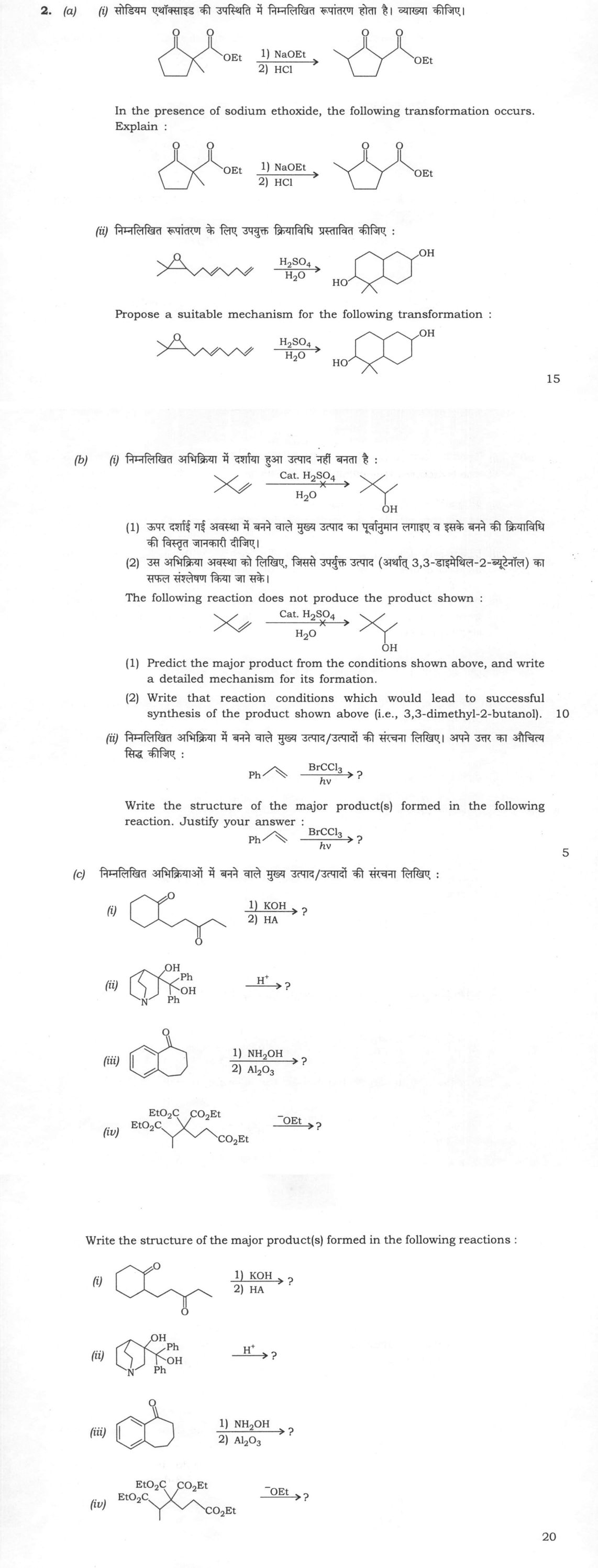
The figure this question refers to, in words
The question paper is a scan and the diagram did not survive as text. This is the figure as read from the original page — every component, value and label — so the question can be worked from the text below.
(a) Reaction scheme (i): A cyclopentanone ring bearing a methyl group at the alpha-carbon and an -OEt group at the other alpha-carbon (a 2-methyl-2-ethoxycarbonyl cyclopentanone) is treated with 1) NaOEt 2) HCl to give a cyclopentanone ring with a methyl group and an -OEt group rearranged to the adjacent position (ring contraction/expansion product). Reaction scheme (ii): An epoxide of a long-chain alkene (a terminal epoxide on a chain with a methyl branch) is treated with H2SO4 / H2O to give a bicyclic decalin-type diol with two hydroxyl groups and a methyl substituent.
(a(i)) A chemical reaction scheme. The reactant is 2-methyl-2-(ethoxycarbonyl)cyclopentan-1-one, which consists of a five-membered cyclopentane ring with a ketone group (C=O) at position 1 and a quaternary carbon at position 2 bearing a methyl group and an ethoxycarbonyl group (-C(=O)OEt). The reaction conditions are listed as: 1) NaOEt, 2) HCl. The product is 2-methylcyclopentane-1,3-dione with an ethoxycarbonyl group at position 3, specifically ethyl 2-methyl-3-oxocyclopentane-1-carboxylate. The product structure shows a five-membered ring with a ketone at position 1, a methyl group at position 2, and a ketone and an ethoxycarbonyl group (-C(=O)OEt) at position 3.
(a(ii)) A chemical reaction scheme. The reactant is an acyclic molecule containing an epoxide ring at one end and a terminal alkene at the other. The structure is 2,2-dimethyl-7-octen-1-yl epoxide (or 2,2-dimethyl-7-octen-1-ol epoxide). Specifically, it is an epoxide ring where one carbon is bonded to two methyl groups and the other carbon is bonded to a hydrogen and a carbon chain. The chain is -CH2-CH2-CH=CH-CH2-CH3 (a hex-3-enyl group). The reaction conditions are H2SO4 and H2O. The product is a bicyclic diol, specifically a decalin derivative (decahydronaphthalene). The product structure shows a fused six-membered ring system. One ring has a gem-dimethyl group and a hydroxyl group (-OH) on the adjacent carbon. The other ring has a hydroxyl group (-OH) at the position corresponding to the original terminal alkene.
(b(i)) A reaction scheme showing 3,3-dimethyl-1-butene (a terminal alkene with a quaternary carbon adjacent to the double bond) reacting with water (H2O) in the presence of catalytic sulfuric acid (Cat. H2SO4). An arrow points to a product structure, 3,3-dimethyl-2-butanol, which is crossed out with a large 'X' to indicate it is not formed.
(b(ii)) A reaction scheme showing styrene (vinylbenzene) reacting with bromotrichloromethane (BrCCl3) under light (hv). An arrow points to a question mark, indicating the product is to be determined.
(c(i)) A reaction scheme showing 2-(3-oxobutyl)cyclohexanone (a cyclohexanone ring with a ketone side chain at the 2-position) reacting with 1) KOH followed by 2) HA (acid workup). An arrow points to a question mark.
(c(ii)) A reaction scheme showing a bicyclic amine structure (specifically a quinuclidine derivative) with a tertiary alcohol substituent at the bridgehead carbon. The substituent is a carbon atom bonded to the ring, two phenyl groups (Ph), and a hydroxyl group (OH). The reaction conditions are H+ (acid). An arrow points to a question mark.
(c(iii)) A reaction scheme showing 1-tetralone (a bicyclic ketone consisting of a benzene ring fused to a cyclohexanone ring) reacting with 1) hydroxylamine (NH2OH) followed by 2) aluminum oxide (Al2O3). An arrow points to a question mark.
(c(iv)) A reaction scheme showing a complex diester molecule. The structure is a central carbon chain with multiple ester groups (CO2Et). Specifically, it appears to be a substituted malonate derivative with an additional ester group. The reaction condition is ethoxide ion (EtO-). An arrow points to a question mark.
Model answer
Written by UPSC Answer Check against this question's marking rubric, to the expected length. UPSC does not publish answers for Mains — this is one way to score well, not an official key.
(a)(i) The NaOEt/HCl step is a Favorskii-type base-catalysed rearrangement. Ethoxide removes the acidic α′-proton to give an enolate; this E1cB-type deprotonation precedes C–O cleavage. The enolate carbon attacks the α-ethoxy/ethoxycarbonyl-bearing carbon intramolecularly and expels ethoxide, forming a strained cyclopropanone/cyclopropanolate. Ethoxide then opens the three-membered ring at the more substituted carbon, and acid work-up protonates the alkoxide to the β-keto ester shown. The driving forces are relief of cyclopropanone strain and formation of a stabilised β-keto ester; the methyl-bearing carbon migrates with the ring framework, giving the observed ring-contracted/expanded product.
(a)(ii) In H₂SO₄/H₂O the epoxide oxygen is first protonated. The C–O bond to the more substituted epoxide carbon becomes labile, and the pendant alkene attacks that carbon intramolecularly as the C–O bond breaks; this is an SN2-like backside opening when the cation is not fully developed, or an SN1-like capture when a tertiary cation forms. The result is a chair-like cyclic carbocation/oxonium. Water traps the cation and deprotonation gives the trans-fused decalin diol. The epoxide-derived OH is at the more substituted carbon, the alkene-derived OH is at the new cationic centre, and trans stereochemistry follows from anti opening of the protonated epoxide and a chair-like cyclisation. The decalin fusion is trans because a cis-fused chair-like cation would place the two ring-junction hydrogens on the same face and is higher in strain.
(b)(i) The crossed-out 3,3-dimethyl-2-butanol is not obtained by acid hydration because protonation of 3,3-dimethyl-1-butene gives a secondary carbocation next to a quaternary carbon. A 1,2-methyl shift from the tert-butyl carbon gives a more stable tertiary carbocation; water attack and deprotonation give 2,3-dimethyl-2-butanol as the major product. The same steric/electronic logic explains the Grignard variant: t-BuMgBr is too bulky to add cleanly to the hindered carbonyl, so competing proton abstraction/elimination or reduction, and formation of a rearranged tertiary alkoxide, dominate. For the non-rearranged target 3,3-dimethyl-2-butanol, use oxymercuration-demercuration, Hg(OAc)₂/H₂O then NaBH₄, which gives Markovnikov hydration without carbocation rearrangement, or a less hindered Grignard route: pivaldehyde + MeMgBr, then H₃O⁺. The acetone + i-PrMgBr combination is the clean Grignard route only to the isomeric 2,3-dimethyl-2-butanol.
(b)(ii) Photolysis of BrCCl₃ gives CCl₃• and Br•. CCl₃• adds to the terminal carbon of styrene to generate the more stable benzylic radical, which abstracts bromine from another CCl₃Br molecule; the major product is PhCHBrCH₂CCl₃. The benzylic radical is planar, so the product is racemic. Where the drawn substrate is a chiral carbonyl, the analogous stereochemical prediction is Felkin-Anh/Cram: the largest substituent is placed perpendicular to the C=O, and nucleophilic attack occurs from the least hindered face anti to the largest group, fixing the major R/S diastereomer.
(c) (i) KOH enolises the 1,5-diketone; intramolecular aldol addition followed by acid-catalysed dehydration gives the bicyclic conjugated enone, the Robinson annulation product. The corresponding Diels–Alder system gives the endo cyclohexene adduct, formed suprafacially with alkene geometry retained. (ii) Acid protonates the bridgehead tertiary alcohol; loss of water and semipinacol migration of the adjacent C–C bond gives the rearranged amine, while in the photochemical [2+2] case the product is the suprafacial cyclobutane with cis substituents retained. (iii) NH₂OH forms the 1-tetralone oxime; Al₂O₃ promotes Beckmann rearrangement, a concerted sigmatropic [1,2]-migration of the anti alkyl group to nitrogen, giving 3,4-dihydroisoquinolin-1(2H)-one. (iv) EtO⁻ effects Dieckmann cyclisation of the diester to the cyclic β-keto ester; for an electrocyclic substrate the thermal 4π closure is conrotatory and 6π closure disrotatory, fixing the observed E/Z stereochemistry. Thus, in every sub-part the product follows from the most stable ionic or radical intermediate, or from the symmetry-allowed pericyclic pathway.
What "Explain" is asking you to do
Make the working of something clear — what sets it off, what follows from what, and what it produces. Explain is the Commission's mechanism word: it dominates the technical papers and the “explain why” stems, where the marks sit in the causal chain and not in the label.
Structure that answers it
State what it is → the initiating condition → the chain of cause, step by step → an instance where it plays out → what the chain produces
Where marks are lost
Describing what something looks like instead of why it works that way. Naming the stages without linking them reads as description too.
How this answer will be evaluated
Approach
(a) explain: definition/context > points in order > small example > short close | (b) explain: definition/context > points in order > small example > short close | (c) explain: definition/context > points in order > small example > short close Full marks: Complete mechanisms with correct intermediates, all products drawn accurately, named reactions identified
Key points expected
- 1,2-alkyl shift in base-catalyzed rearrangement
- Cationic polyene cyclization mechanism
- Carbocation rearrangement in acid-catalyzed hydration
- Hydroboration-oxidation for anti-Markovnikov alcohol
- Robinson annulation (Michael + Aldol)
- Pinacol rearrangement (1,2-shift)
- Beckmann rearrangement (amide to lactam)
- Dieckmann condensation (intramolecular Claisen)
Evaluation rubric
Each sub-part is marked on its own, against the marks and word limit printed on the paper.
- (a) Mechanism for base-catalyzed rearrangement and acid-catalyzed polyene cyclization 15 marks
explain— definition/context → points in order → small example → short close
Must cover
- Enolate formation at C-2 of cyclopentanone
- 1,2-alkyl shift (methyl migration) to form tertiary cation
- Protonation to yield 2-methyl-2-oxo-cyclopentane product
- Epoxide opening to form tertiary carbocation
Loses marks
- Missing arrow-pushing in mechanism
- Incorrect carbocation intermediate
- No explanation of driving force
Earns more
- Cationic polyene cyclization (Prins-type) mechanism
- Sequential ring closure steps shown
- Regioselectivity of epoxide opening explained
- Final protonation to form diol
Extra mark
- Mention of Baldwin's rules for ring closure
- Stereochemical outcome of cyclization
- (b) Major product prediction with mechanism and synthesis conditions for target alcohol 15 marks
explain— definition/context → points in order → small example → short close
Must cover
- Markovnikov addition to form tertiary carbocation
- 1,2-methyl shift to form more stable cation
- Water attack to yield 2,3-dimethyl-2-butanol
- Hydroboration-oxidation conditions for anti-Markovnikov product
Loses marks
- No mechanism for major product
- Incorrect carbocation rearrangement
- Missing reagents for target synthesis
Earns more
- Detailed arrow-pushing for hydride/methyl shift
- Justification of carbocation stability
- Correct structure of 3,3-dimethyl-2-butanol
- Explanation of why direct hydration fails
Extra mark
- Mention of steric hindrance in direct hydration
- Alternative synthesis route (e.g., Grignard)
- (c) Major product structures for four distinct organic transformations
explain— definition/context → points in order → small example → short close
Must cover
- Robinson annulation product (bicyclic enone)
- Pinacol rearrangement product (ketone/aldehyde)
- Beckmann rearrangement product (lactam)
- Dieckmann condensation product (cyclic beta-keto ester)
Loses marks
- Missing product structures
- Incorrect ring size in cyclizations
- No justification for regioselectivity
Earns more
- Correct stereochemistry in products
- Regioselectivity in condensation reactions
- Mechanistic rationale for each transformation
- Proper IUPAC nomenclature for products
Extra mark
- Named reaction identification for each
- Alternative product isomers considered
Practice this exact question
Write your answer and it is marked point by point against the model answer above — what you covered, what you missed, what you got wrong.
Evaluate my answer →More from Chemistry 2025 Paper II
- Q1 (a) (i) Tropolone is aromatic, but fulvene is non-aromatic. Why? (ii) Explain with exampl…
- Q2 (a) (i) In the presence of sodium ethoxide, the following transformation occurs. Explain…
- Q3 (a) (i) Write the structure of the product formed in the following reactions: (1) (2) (10…
- Q4 (a) (i) After polymerization of p-hydroxybenzoic acid, IR analysis shows 0·2% unreacted —…
- Q5 (a) Write the structure of the product(s) and the intermediate formed in the following re…