Paper II — Q5
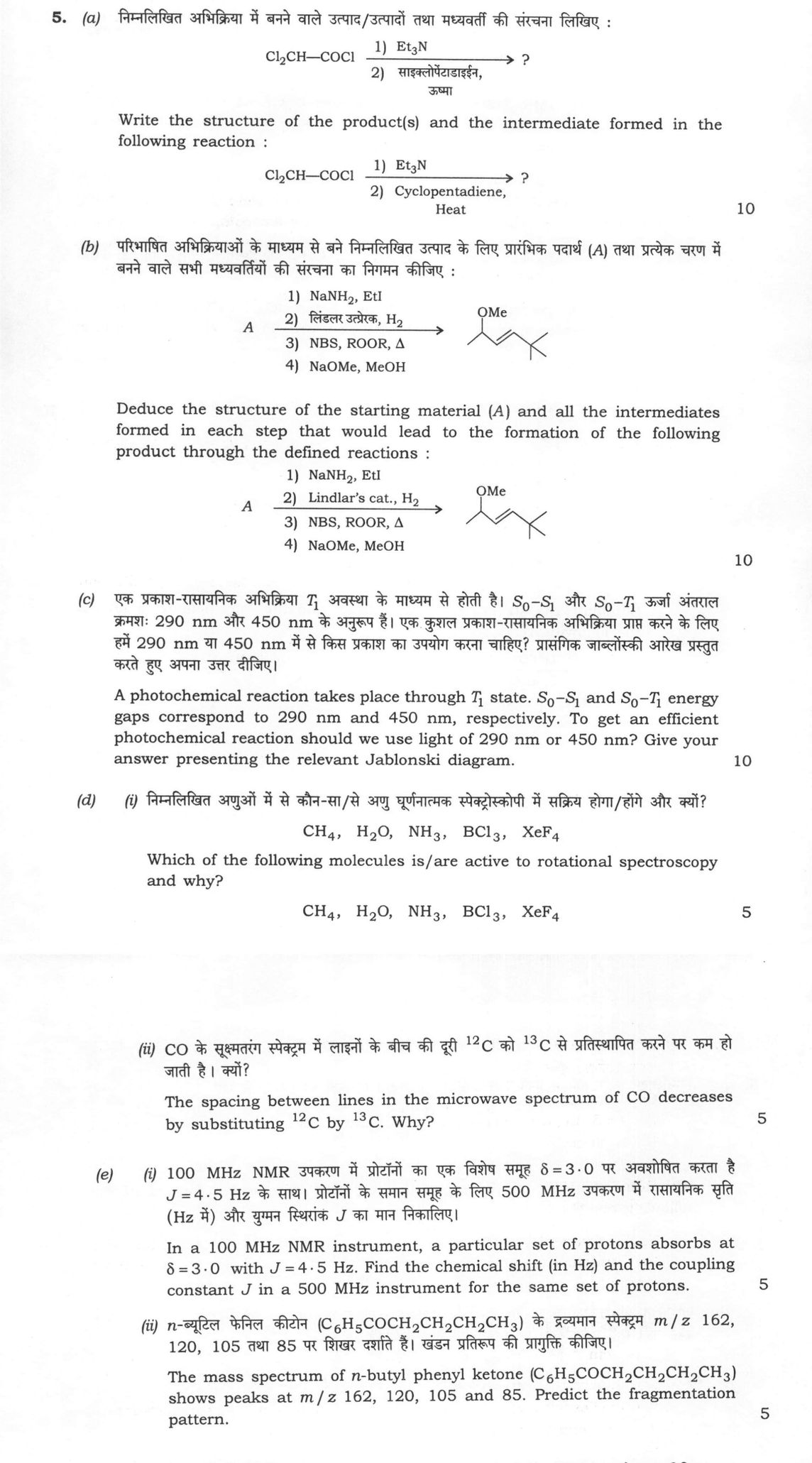
(a) Write the structure of the product(s) and the intermediate formed in the following reaction: Cl₂CH—COCl 1) Et₃N → ? 2)…
Write the structure of the product(s) and the intermediate formed in the following reaction: Cl₂CH—COCl 1) Et₃N → ? 2) Cyclopentadiene, Heat 10 marks
Deduce the structure of the starting material (A) and all the intermediates formed in each step that would lead to the formation of the following product through the defined reactions: 1) NaNH₂, EtI A 2) Lindlar's cat., H₂ → OMe 3) NBS, ROOR, Δ 4) NaOMe, MeOH 10 marks
A photochemical reaction takes place through T₁ state. S₀–S₁ and S₀–T₁ energy gaps correspond to 290 nm and 450 nm, respectively. To get an efficient photochemical reaction should we use light of 290 nm or 450 nm? Give your answer presenting the relevant Jablonski diagram. 10 marks
Which of the following molecules is/are active to rotational spectroscopy and why? CH₄, H₂O, NH₃, BCl₃, XeF₄ 5 marks
The spacing between lines in the microwave spectrum of CO decreases by substituting ¹²C by ¹³C. Why? 5 marks
In a 100 MHz NMR instrument, a particular set of protons absorbs at δ = 3.0 with J = 4.5 Hz. Find the chemical shift (in Hz) and the coupling constant J in a 500 MHz instrument for the same set of protons. 5 marks
The mass spectrum of n-butyl phenyl ketone (C₆H₅COCH₂CH₂CH₂CH₃) shows peaks at m/z 162, 120, 105 and 85. Predict the fragmentation pattern. 5 marks
हिंदी में प्रश्न पढ़ें
निम्नलिखित अभिक्रिया में बनने वाले उत्पाद/उत्पादों तथा मध्यवर्ती की संरचना लिखिए: Cl₂CH—COCl 1) Et₃N → ? 2) साइक्लोपेंटाडाइईन, ऊष्मा (10 अंक)
परिभाषित अभिक्रियाओं के माध्यम से बने निम्नलिखित उत्पाद के लिए प्रारंभिक पदार्थ (A) तथा प्रत्येक चरण में बनने वाले सभी मध्यवर्तियों की संरचना का निगमन कीजिए: 1) NaNH₂, EtI A 2) लिंडलर उत्प्रेरक, H₂ → OMe 3) NBS, ROOR, Δ 4) NaOMe, MeOH (10 अंक)
एक प्रकाश-रासायनिक अभिक्रिया T₁ अवस्था के माध्यम से होती है। S₀–S₁ और S₀–T₁ ऊर्जा अंतराल क्रमशः: 290 nm और 450 nm के अनुरूप हैं। एक कुशल प्रकाश-रासायनिक अभिक्रिया प्राप्त करने के लिए हमें 290 nm या 450 nm में से किस प्रकाश का उपयोग करना चाहिए? प्रासंगिक जाब्लोंस्की आरेख प्रस्तुत करते हुए अपना उत्तर दीजिए। (10 अंक)
निम्नलिखित अणुओं में से कौन-सा/से अणु घूर्णनात्मक स्पेक्ट्रोस्कोपी में सक्रिय होगा/होंगे और क्यों? CH₄, H₂O, NH₃, BCl₃, XeF₄ (5 अंक)
CO के सूक्ष्मतरंग स्पेक्ट्रम में लाइनों के बीच की दूरी ¹²C को ¹³C से प्रतिस्थापित करने पर कम हो जाती है। क्यों? (5 अंक)
100 MHz NMR उपकरण में प्रोटोनों का एक विशेष समूह δ = 3.0 पर अवशोषित करता है J = 4.5 Hz के साथ। प्रोटोनों के समान समूह के लिए 500 MHz उपकरण में रासायनिक सृति (Hz में) और युग्मन स्थिरांक J का मान निकालिए। (5 अंक)
n-ब्यूटिल फेनिल कीटोन (C₆H₅COCH₂CH₂CH₂CH₃) के द्रव्यमान स्पेक्ट्रम m/z 162, 120, 105 तथा 85 पर शिखर दर्शाते हैं। खंडन प्रतिरूप की प्रागुक्ति कीजिए। (5 अंक)
Model answer
Written by UPSC Answer Check against this question's marking rubric, to the expected length. UPSC does not publish answers for Mains — this is one way to score well, not an official key.
(a)
- Cl₂CH–C(=O)Cl has an acidic α-H because the conjugate base is stabilised by two Cl atoms and by the carbonyl group.
- Et₃N removes the α-proton: Cl₂CH–C(=O)Cl + Et₃N → [Cl₂C⁻–C(=O)Cl] + Et₃NH⁺.
- The enolate is represented by the resonance form: [Cl₂C⁻–C(=O)Cl] ↔ [Cl₂C=C(O⁻)–Cl].
- Collapse of the enolate reforms C=O and expels Cl⁻: [Cl₂C=C(O⁻)–Cl] → Cl₂C=C=O + Cl⁻.
- Overall step 1: Cl₂CH–COCl + Et₃N → Cl₂C=C=O + Et₃NH⁺Cl⁻. The intermediate that enters step 2 is dichloroketene, Cl₂C=C=O.
- In step 2, cyclopentadiene is the 4π diene and dichloroketene is the 2π dienophile. Heating allows a concerted Diels–Alder [4+2] cycloaddition. The C=C bond of the ketene adds to the terminal carbons of cyclopentadiene; the C=O bond remains as a ketone carbonyl.
- The product is the norbornene-type ketone in which the carbonyl carbon and the CCl₂ carbon form the two-carbon bridge. In IUPAC form: 3,3-dichlorobicyclo[2.2.1]hept-5-en-2-one. It has a bicyclo[2.2.1]hept-5-ene skeleton, a ketone at C-2, and two chlorine atoms on C-3.
(b) [(b)] The figure printed on the original question paper for this part could not be recovered from the scan, so this part is not answered here.
(c)
- Photon energy is E = hc/λ. Using h = 6.626×10⁻³⁴ J s and c = 2.998×10⁸ m s⁻¹: E(290 nm) = (6.626×10⁻³⁴ × 2.998×10⁸)/(290×10⁻⁹) = 6.85×10⁻¹⁹ J = 4.27 eV. E(450 nm) = (6.626×10⁻³⁴ × 2.998×10⁸)/(450×10⁻⁹) = 4.42×10⁻¹⁹ J = 2.76 eV.
- Jablonski diagram to be drawn: put energy on the vertical axis. Place S₀ at the bottom. Place T₁ above S₀ at the energy corresponding to 450 nm. Place S₁ above T₁ at the energy corresponding to 290 nm. Draw a solid vertical arrow from S₀ to S₁ labelled 290 nm; this is the spin-allowed singlet–singlet absorption. Draw a dashed vertical arrow from S₀ to T₁ labelled 450 nm; this is the spin-forbidden singlet–triplet absorption. From S₁ draw short downward wavy arrows for vibrational relaxation, a wavy arrow to S₀ for fluorescence, and a dashed arrow to T₁ for intersystem crossing. From T₁ draw an arrow to products for the photochemical reaction and a dashed wavy arrow to S₀ for phosphorescence.
- The reaction is specified to occur from T₁. The 450 nm photon matches the S₀→T₁ gap, but that transition is spin-forbidden and usually has a small absorption cross-section. The 290 nm photon excites the allowed S₀→S₁ band; after vibrational relaxation, intersystem crossing can populate T₁, from which reaction occurs. The excess energy, 4.27 − 2.76 = 1.51 eV, is lost as vibrational energy before reaction.
- For an efficient reaction, use 290 nm if S₁→T₁ intersystem crossing is efficient; use 450 nm only when direct S₀→T₁ absorption is appreciable.
(d) (i)
- Pure rotational microwave spectroscopy requires a permanent electric dipole moment, μ ≠ 0, so that rotation changes the dipole and couples to the radiation field. The rotational selection rule is ΔJ = ±1.
- CH₄ is tetrahedral (T_d). The four C–H bond dipoles cancel exactly; μ = 0; inactive.
- H₂O is bent (C₂v). The O–H bond dipoles do not cancel; μ ≠ 0; active.
- NH₃ is pyramidal (C₃v). The N–H bond dipoles give a net dipole along the C₃ axis; μ ≠ 0; active.
- BCl₃ is trigonal planar (D₃h). The three B–Cl bond dipoles cancel in the plane; μ = 0; inactive.
- XeF₄ is square planar (D₄h). The four Xe–F bond dipoles cancel; μ = 0; inactive.
- Active molecules: H₂O and NH₃.
(d) (ii)
- For a rigid diatomic rotor, the rotational term in frequency units is F(J) = B J(J+1), with B = h/(8π²I). The transition J→J+1 has frequency ν = 2B(J+1), so the spacing between adjacent lines is 2B.
- The moment of inertia is I = μ r_e², where μ is the reduced mass. Isotopic substitution changes μ but, to an excellent approximation, leaves r_e unchanged.
- For ¹²C¹⁶O, using integer mass numbers: μ₁₂ = (12×16)/(12+16) = 192/28 = 48/7 u.
- For ¹³C¹⁶O: μ₁₃ = (13×16)/(13+16) = 208/29 u.
- Since B ∝ 1/I ∝ 1/μ, the line spacing is also proportional to 1/μ. Therefore: spacing(¹³CO)/spacing(¹²CO) = μ₁₂/μ₁₃ = (48/7)/(208/29) = 87/91 ≈ 0.956.
- Thus the spacing in ¹³CO is smaller by the factor 87/91, about 4.4%, because the heavier carbon increases the reduced mass and the moment of inertia, decreasing the rotational constant. The same ratio holds whether the spacing is reported in Hz or cm⁻¹.
(e) (i)
- Chemical shift in ppm is field independent: δ = (Δν/ν₀)×10⁶, where ν₀ is the spectrometer frequency and Δν is the offset from the reference in Hz.
- At 100 MHz, 1 ppm corresponds to 100 Hz. For δ = 3.0 ppm: Δν = 3.0×100 = 300 Hz.
- At 500 MHz, 1 ppm corresponds to 500 Hz. For the same δ = 3.0 ppm: Δν = 3.0×500 = 1500 Hz.
- The scalar coupling constant J is a property of the spin–spin interaction and, for first-order spectra, does not depend on the external field. Therefore J remains 4.5 Hz.
- Chemical shift in Hz: 1500 Hz; J: 4.5 Hz.
(e) (ii)
- n-Butyl phenyl ketone is C₆H₅COCH₂CH₂CH₂CH₃, formula C₁₁H₁₄O. Its nominal molecular mass is 11×12 + 14×1 + 16 = 162, so m/z 162 is the molecular ion [M]⁺•.
- m/z 120: 162 − 42 = 120. The loss of 42 u is C₃H₆. This is a McLafferty rearrangement: a γ-hydrogen from the butyl chain transfers to the carbonyl oxygen, and the Cα–Cβ bond cleaves, expelling propene. The charged fragment is [C₈H₈O]⁺•, represented as the enol radical cation PhC(OH)=CH₂⁺•, the acetophenone radical cation tautomer.
- m/z 105: 162 − 57 = 105. The loss of 57 u is an n-butyl radical, C₄H₉•. α-Cleavage of the carbonyl–alkyl bond gives the resonance-stabilised benzoyl cation [C₆H₅CO]⁺, C₇H₅O⁺. This ion may further lose CO to give m/z 77, but that fragment is not among the listed peaks.
- m/z 85: 162 − 77 = 85. The loss of 77 u is a phenyl radical, C₆H₅•. α-Cleavage of the carbonyl–phenyl bond gives the n-butanoyl cation [CH₃CH₂CH₂CH₂CO]⁺, C₅H₉O⁺, an acylium ion stabilised as R–C≡O⁺ ↔ R–C=O⁺.
- Fragmentation: 162 = [M]⁺•; 120 = McLafferty loss of C₃H₆ to [C₈H₈O]⁺•; 105 = α-cleavage loss of C₄H₉• to [C₆H₅CO]⁺; 85 = α-cleavage loss of C₆H₅• to [CH₃CH₂CH₂CH₂CO]⁺.
What "Solve" is asking you to do
Choose the method, then carry it through to a final answer. Identifying what kind of problem this is and why that method applies is the first thing marked; a correct figure arrived at invisibly earns almost nothing.
Structure that answers it
Given data and what is required → method chosen, with the reason it applies → set-up (equation, circuit, free body, trial balance) → working, step by step → answer with units and any condition of validity
Where marks are lost
Doing the middle steps mentally and writing only the result. In mathematics papers, a further loss comes from giving a decimal where the exact value in surds or fractions was wanted, or from skipping the justification a part explicitly asks for.
How this answer will be evaluated
Approach
(a) explain: definition/context > points in order > small example > short close | (b) trace: start point > the stages in sequence > end point > what changed | (c) justify: claim > 3-4 reasons > evidence > conclusion | (d(i)) justify: claim > 3-4 reasons > evidence > conclusion | (d(ii)) account for: state the phenomenon > the causes in order of weight > conclusion | (e(i)) calculate: given > formula > substitution > result with units > interpretation | (e(ii)) trace: start point > the stages in sequence > end point > what changed Full marks: All structures correct, mechanisms shown, calculations accurate, diagrams labelled.
Key points expected
- Identify intermediate as 2,2-dichloroacryloyl triethylammonium chloride
- Identify intermediate as 2,2-dichloroacryloyl chloride
- Identify product as 7,7-dichlorobicyclo[2.2.1]hept-2-ene-2-carboxylic acid
- Show Diels-Alder mechanism with cyclopentadiene
- Identify A as 2-methyl-4,4-dimethylpent-1-yne
- Show intermediate after step 1 as terminal alkyne
- Show intermediate after step 2 as cis-alkene
- Show intermediate after step 3 as allylic bromide
Evaluation rubric
Each sub-part is marked on its own, against the marks and word limit printed on the paper.
- (a) Structure of the intermediate and the final product. 10 marks
explain— definition/context → points in order → small example → short close
Must cover
- Identify intermediate as 2,2-dichloroacryloyl triethylammonium chloride
- Identify intermediate as 2,2-dichloroacryloyl chloride
- Identify product as 7,7-dichlorobicyclo[2.2.1]hept-2-ene-2-carboxylic acid
- Show Diels-Alder mechanism with cyclopentadiene
Loses marks
- Missing the intermediate acyl chloride structure
- Incorrect regiochemistry in the Diels-Alder product
Earns more
- Mention Et3N acts as base to remove HCl
- Show arrow pushing for acyl chloride formation
Extra mark
- Mention endo/exo selectivity of Diels-Alder
- (b) Structure of starting material A and all intermediates. 10 marks
trace— start point → the stages in sequence → end point → what changed
Must cover
- Identify A as 2-methyl-4,4-dimethylpent-1-yne
- Show intermediate after step 1 as terminal alkyne
- Show intermediate after step 2 as cis-alkene
- Show intermediate after step 3 as allylic bromide
Loses marks
- Incorrect structure for starting material A
- Missing the allylic bromide intermediate
Earns more
- Show mechanism for E2 elimination in step 4
- Show radical mechanism for allylic bromination
Extra mark
- Mention stereochemistry of the final alkene
- (c) Choice of wavelength (290 nm) with Jablonski diagram. 10 marks
justify— claim → 3-4 reasons → evidence → conclusion
Must cover
- Select 290 nm as the correct wavelength
- Draw Jablonski diagram showing S0, S1, T1 states
- Explain S1 to T1 intersystem crossing
- State that 290 nm excites to S1
Loses marks
- Selecting 450 nm as the correct wavelength
- Missing the Jablonski diagram
Earns more
- Label energy gaps correctly on diagram
- Mention fluorescence from S1
Extra mark
- Mention phosphorescence from T1
- (d(i)) Identify rotationally active molecules and explain why. 5 marks
justify— claim → 3-4 reasons → evidence → conclusion
Must cover
- Identify H2O and NH3 as active
- State requirement of permanent dipole moment
- Identify CH4, BCl3, XeF4 as inactive
- Explain symmetry causes zero dipole in inactive
Loses marks
- Listing CH4 or BCl3 as active
- Failing to mention dipole moment requirement
Earns more
- Mention point groups for inactive molecules
Extra mark
- Mention specific dipole moment values
- (d(ii)) Reason for decreased line spacing in 13C-CO. 5 marks
account for— state the phenomenon → the causes in order of weight → conclusion
Must cover
- State B is inversely proportional to reduced mass
- State 13C has higher mass than 12C
- Conclude higher mass leads to smaller B
- Link smaller B to smaller line spacing
Loses marks
- Stating B is directly proportional to mass
- Confusing vibrational and rotational spectra
Earns more
- Show formula for rotational energy levels
Extra mark
- Calculate ratio of B values
- (e(i)) Chemical shift in Hz and J in 500 MHz instrument. 5 marks
calculate— given → formula → substitution → result with units → interpretation
Must cover
- Calculate chemical shift as 1500 Hz
- State J remains 4.5 Hz
- Show calculation: 3.0 ppm * 500 MHz
- State J is independent of field strength
Loses marks
- Calculating J as 22.5 Hz
- Confusing ppm and Hz units
Earns more
- Show calculation for 100 MHz case
Extra mark
- Mention J is in Hz and does not scale
- (e(ii)) Fragmentation pattern for n-butyl phenyl ketone. 5 marks
trace— start point → the stages in sequence → end point → what changed
Must cover
- Identify m/z 162 as molecular ion
- Identify m/z 120 as acylium ion
- Identify m/z 105 as benzoyl cation
- Identify m/z 85 as butyl cation
Loses marks
- Incorrect assignment of m/z 105
- Missing the molecular ion peak
Earns more
- Show alpha-cleavage mechanism
- Show McLafferty rearrangement
Extra mark
- Mention base peak
Practice this exact question
Write your answer and it is marked point by point against the model answer above — what you covered, what you missed, what you got wrong.
Evaluate my answer →More from Chemistry 2025 Paper II
- Q2 (a) (i) In the presence of sodium ethoxide, the following transformation occurs. Explain…
- Q3 (a) (i) Write the structure of the product formed in the following reactions: (1) (2) (10…
- Q4 (a) (i) After polymerization of p-hydroxybenzoic acid, IR analysis shows 0·2% unreacted —…
- Q5 (a) Write the structure of the product(s) and the intermediate formed in the following re…
- Q6 (a) (i) Elucidate the structure of the product and the intermediate (if any) in the follo…
- Q7 (a) (i) Acetone shows a weak absorption at 280 nm and a strong absorption at 190 nm in th…
- Q8 (a) (i) Estimate the expected splitting (coupling constant J in Hz) for the lettered prot…