Paper I — Q1
(a) An aluminium tensile specimen has a diameter of 30·50 mm and a gauge length 275 mm. If the force of 17·50 × 10⁴ N elongates…
An aluminium tensile specimen has a diameter of 30·50 mm and a gauge length 275 mm. If the force of 17·50 × 10⁴ N elongates the gauge length by 1·28 mm, determine the Poisson's ratio and the modulus of elasticity. Also, determine by how much the force causes the diameter of the specimen to contract. Assume shear modulus G = 22 GPa and yield strength σᵧ = 435 N/mm². 10 marks
A solid steel shaft of diameter 65 mm is to be designed using an allowable shear stress τₐₗₗₒw = 60 N/mm² and an allowable angle of twist per unit length θ = 1·05° per metre. Determine the maximum permissible torque that may be applied to the shaft. Take shear modulus as 80 GPa. 10 marks
A rigid box of mass 85 kg shown in the figure below rests on a floor. The coefficient of static friction for the contact surface is 0·25. What will be the maximum force, 'F' and the highest position, 'h' of its application so that the rigid box neither slides on the floor nor tips over? 10 marks
As shown in the figure, a beam of symmetrical I-section spanning 8·0 m is prestressed by a parabolic cable with an eccentricity of 150 mm at the centre of the span and zero at supports. The beam supports a uniformly distributed live load of 2·5 kN/m.
Find the effective force in the cable for balancing the dead and live loads on the beam.
Calculate the shift of the pressure line from the tendon's centre line.
Take unit weight of concrete as 24 kN/m³. (All dimensions are in mm) 10 marks
A tie member consisting of an ISA 75 × 50 × 8 (E 250 grade of steel) is connected to a 12 mm thick gusset plate using a 6 mm fillet weld at site. The welding is done on its three sides as shown in the figure. The angle between fusion faces is 75°. Find the lengths of weld L_w₁ and L_w₂, if the connection is designed to transmit a load equal to the design strength of the member. 10 marks
For ISA 75 × 50 × 8, A_g = 938 mm² and C_xx = 25·2 mm
Take γ_mo = 1·10 and for site welding, γ_mw = 1·5.
K = 0·7 for 60° – 90° angle between fusion faces.
For E 250 grade steel : f_u = 410 MPa f_y = 250 MPa
हिंदी में प्रश्न पढ़ें
एक ऐलुमिनियम तनन प्रतिदर्श का व्यास 30·50 mm और गेज लम्बाई 275 mm है । यदि 17·50 × 10⁴ N का बल गेज लम्बाई को 1·28 mm दीर्घित करता है, तो प्वासों अनुपात और प्रत्यास्थता मापांक का निर्धारण कीजिए । यह भी निर्धारित कीजिए कि बल प्रतिदर्श के व्यास को कितना संकुचित करता है । अपरूपण मापांक, G = 22 GPa और पराभव सामर्थ्य, σᵧ = 435 N/mm² मान लीजिए । (10 अंक)
एक अनुजेय अपरूपण प्रतिबल, τअनु. = 60 N/mm² और एक अनुजेय ऐंटन कोण प्रति एकक लम्बाई, θ = 1·05° प्रति मीटर का उपयोग करके 65 mm व्यास की एक ठोस इस्पात शेफ्ट का अभिकल्पन किया जाना है । शेफ्ट पर लगाए जा सकने वाले अधिकतम अनुजेय बल-आघूर्ण का निर्धारण कीजिए । अपरूपण मापांक 80 GPa लीजिए । (10 अंक)
नीचे चित्र में दर्शाया गया 85 kg द्रव्यमान का एक प्रबल-बक्सा एक फर्श पर आधारित है । सम्पर्क सतह के लिए घर्षण का स्थैतिक गुणांक 0·25 है । अधिकतम बल, 'F' और इसके लगने की उच्चतम स्थिति, 'h' क्या होंगे जिससे कि प्रबल-बक्से का न तो फर्श पर सर्पण हो और न ही बक्सा उल्टे ? (10 अंक)
चित्र में दर्शाए अनुसार, 8·0 m विस्तृति की I-परिच्छेद वाली एक सममित धरन को विस्तृति के मध्य में 150 mm और आलम्बों पर शून्य उत्केन्द्रता के साथ एक परवलयी केबिल द्वारा पूर्व-प्रतिबलित किया गया है । धरन 2·5 kN/m के एक एकसमान वितरित चल भार को वहन करती है ।
धरन पर अचल और चल भारों के संतुलन के लिए केबिल में प्रभावी बल ज्ञात कीजिए ।
कंद्रा की मध्य रेखा से दाब रेखा के विस्थापन की गणना कीजिए ।
कंक्रीट का एकक भार 24 kN/m³ लीजिए । (सभी विमाएँ mm में हैं) (10 अंक)
एक ISA 75 × 50 × 8 (इस्पात का E 250 ग्रेड) से बने एक तान अवयव को 12 mm मोटी गसेट प्लेट से 6 mm के स्थलीय फिलेट वेल्ड द्वारा जोड़ा गया है । चित्र में दर्शाए अनुसार इसके तीन ओर वेल्डिंग की गई है । संगलन फलकों के बीच का कोण 75° है । यदि जोड़ को अवयव के अभिकल्पन सामर्थ्य के बराबर एक भार के संचरण के लिए अभिकल्पित किया गया है, तो वेल्ड की L_w₁ और L_w₂ लम्बाइयों को ज्ञात कीजिए । (10 अंक)
ISA 75 × 50 × 8 के लिए, A_g = 938 mm² और Cₓₓ = 25·2 mm
γₘₒ = 1·10 और स्थलीय वेल्डिंग के लिए, γ_mw = 1·5 लीजिए ।
संगलन फलकों के बीच के कोण 60° – 90° के लिए K = 0·7.
E 250 ग्रेड इस्पात के लिए : fᵤ = 410 MPa f_y = 250 MPa
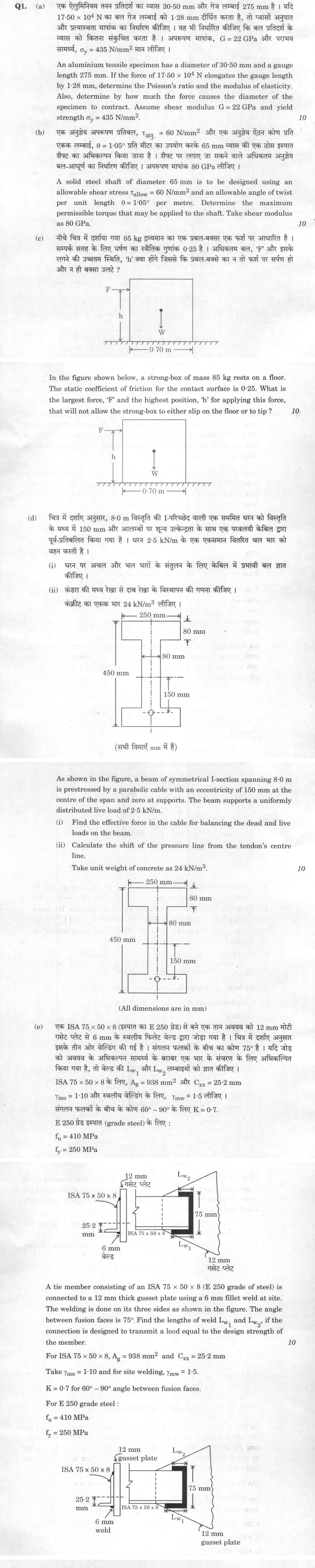
The figure this question refers to, in words
The question paper is a scan and the diagram did not survive as text. This is the figure as read from the original page — every component, value and label — so the question can be worked from the text below.
(c) A rectangular block (strong-box) rests on a horizontal floor. The width of the block is labeled as 0.70 m. A horizontal force 'F' is applied to the left vertical face of the block, directed to the right. The point of application of this force is at a height 'h' above the floor. The weight 'W' is shown acting downwards from the center of the block.
(d) A cross-sectional view of a symmetrical I-beam. The total height of the section is 450 mm. The top and bottom flanges are each 250 mm wide and 80 mm thick. The central web is 80 mm wide. A dashed vertical line indicates the axis of symmetry. A dashed horizontal line indicates the neutral axis. A small circle representing the tendon is located on the axis of symmetry, 150 mm above the bottom edge of the beam. A dimension line indicates the distance from the neutral axis to the tendon is 150 mm. All dimensions are in mm.
(e) A cross-sectional view of a structural connection. An angle section labeled 'ISA 75 x 50 x 8' is welded to a vertical plate labeled '12 mm gusset plate'. The angle section has a vertical leg of 75 mm height and a horizontal leg of 50 mm width, with a thickness of 8 mm. The gusset plate is 12 mm thick. The connection is made with a 6 mm fillet weld on three sides of the angle: the top horizontal leg, the bottom horizontal leg, and the vertical leg. The length of the weld on the bottom leg is labeled 'Lw1' and the length of the weld on the top leg is labeled 'Lw2'. A dimension line indicates the centroid of the angle section is located 25.2 mm from the back of the vertical leg. The welds are shown as thick black lines at the junction of the angle and the plate.
What "Calculate" is asking you to do
Apply the standard formula or schedule to data the question has already supplied — a table of readings, cost records, a balance sheet — and produce the number. The method is rarely in doubt; the marks sit in the named intermediate quantities, each of which has to appear as a labelled line.
Structure that answers it
Data as given → formula or standard treatment, named → substitution → each intermediate, labelled → result with units
Where marks are lost
Omitting an intermediate the marking scheme pays for separately, or rounding at an intermediate line so the final figure drifts. In commerce and accountancy, any figure in a statement that no numbered working note supports is treated as unearned.
How this answer will be evaluated
Approach
(a) calculate: given > formula > substitution > result with units > interpretation | (b) calculate: given > formula > substitution > result with units > interpretation | (c) calculate: given > formula > substitution > result with units > interpretation | (d(i)) calculate: given > formula > substitution > result with units > interpretation | (d(ii)) calculate: given > formula > substitution > result with units > interpretation | (e) calculate: given > formula > substitution > result with units > interpretation Full marks: All parts show complete derivation with units, checks, and clear sketches; all assumptions stated.
Key points expected
- Calculate axial and lateral strain from given data
- Use G = 22 GPa to find Poisson's ratio
- Compute modulus of elasticity E
- Calculate diameter contraction in mm
- Use allowable shear stress formula
- Apply angle of twist constraint
- Take minimum of both torque values
- State shear modulus G = 80 GPa
Evaluation rubric
Each sub-part is marked on its own, against the marks and word limit printed on the paper.
- (a) Determine Poisson's ratio, modulus of elasticity, and diameter contraction. 10 marks
calculate— given → formula → substitution → result with units → interpretation
Must cover
- Calculate axial and lateral strain from given data
- Use G = 22 GPa to find Poisson's ratio
- Compute modulus of elasticity E
- Calculate diameter contraction in mm
Loses marks
- Final value without derivation steps
- Unstated assumptions about material behavior
- Missing units in intermediate calculations
Earns more
- Check stress against yield strength
- State assumptions clearly
- Carry units through all steps
- Neat labelled sketch of specimen
Extra mark
- Reference to IS code for material properties
- Explicit check for elastic limit
- (b) Determine maximum permissible torque for the steel shaft. 10 marks
calculate— given → formula → substitution → result with units → interpretation
Must cover
- Use allowable shear stress formula
- Apply angle of twist constraint
- Take minimum of both torque values
- State shear modulus G = 80 GPa
Loses marks
- Only one constraint considered
- Final value without working
- Unstated assumptions about loading
Earns more
- Show both torque calculations explicitly
- Carry units through every step
- Check result against permissible limits
- Neat labelled sketch of shaft
Extra mark
- Reference to IS code for shaft design
- Explicit statement of governing criterion
- (c) Find maximum force F and highest position h for no slip or tip. 10 marks
calculate— given → formula → substitution → result with units → interpretation
Must cover
- Apply friction force limit for no slip
- Apply moment equilibrium for no tipping
- Solve for F and h simultaneously
- Use coefficient of friction 0.25
Loses marks
- Only one failure mode considered
- Final values without derivation
- Unstated assumptions about force application
Earns more
- Draw free body diagram clearly
- State assumptions about box rigidity
- Carry units through all steps
- Check both failure modes explicitly
Extra mark
- Reference to IS code for friction design
- Explicit statement of governing condition
- (d(i)) Find effective force in cable for balancing dead and live loads.
calculate— given → formula → substitution → result with units → interpretation
Must cover
- Calculate total load (dead + live)
- Use parabolic cable equilibrium
- Apply eccentricity of 150 mm
- Compute cable force in kN
Loses marks
- Missing dead load calculation
- Final value without derivation
- Unstated assumptions about cable profile
Earns more
- Show load calculation explicitly
- Carry units through all steps
- State assumptions about cable behavior
- Neat labelled sketch of beam and cable
Extra mark
- Reference to IS code for prestressed design
- Explicit check for cable stress limits
- (d(ii)) Calculate shift of pressure line from tendon's centre line.
calculate— given → formula → substitution → result with units → interpretation
Must cover
- Use pressure line formula
- Apply cable force from part (i)
- Compute shift in mm
- State eccentricity at centre
Loses marks
- Missing formula statement
- Final value without working
- Unstated assumptions about section properties
Earns more
- Show formula derivation briefly
- Carry units through all steps
- Check result against section properties
- Neat labelled sketch of pressure line
Extra mark
- Reference to IS code for pressure line
- Explicit check for section limits
- (e) Find lengths of weld Lw1 and Lw2 for the tie member connection. 10 marks
calculate— given → formula → substitution → result with units → interpretation
Must cover
- Calculate design strength of member
- Apply weld strength formula with K=0.7
- Use γmo=1.10 and γmw=1.5
- Solve for Lw1 and Lw2
Loses marks
- Missing member strength calculation
- Final values without derivation
- Unstated assumptions about weld geometry
Earns more
- Show member strength calculation
- Carry units through all steps
- State assumptions about weld quality
- Neat labelled sketch of connection
Extra mark
- Reference to IS code for weld design
- Explicit check for weld length limits
Model answer coming soon
Every evaluation on this site is marked against a verified model answer. This question's answer is still being written; evaluation opens the moment it lands.
More from Civil Engineering 2023 Paper I
- Q1 (a) An aluminium tensile specimen has a diameter of 30·50 mm and a gauge length 275 mm. I…
- Q2 (a) Draw the shearing force and bending moment diagrams for the beam loaded as shown in t…
- Q3 (a) Design a floor slab to cover a room with internal dimensions of 4·5 m × 6·0 m. The sl…
- Q4 (a) Determine the horizontal component of deflection of joint D of the truss loaded as sh…