Paper I — Q7
(a) A 3·0 m high sandy fill material was placed loosely at a relative density of 50%. Laboratory studies indicated that the…
A 3·0 m high sandy fill material was placed loosely at a relative density of 50%. Laboratory studies indicated that the maximum and minimum void ratios of the fill material are 0·90 and 0·52 respectively. Construction specifications required that the fill be compacted to a relative density of 80%. If Gs = 2·65, determine : Dry unit weight of the fill before and after compaction.
Final height of the fill after compaction. Take γw = 9·81 kN/m³. 15 marks
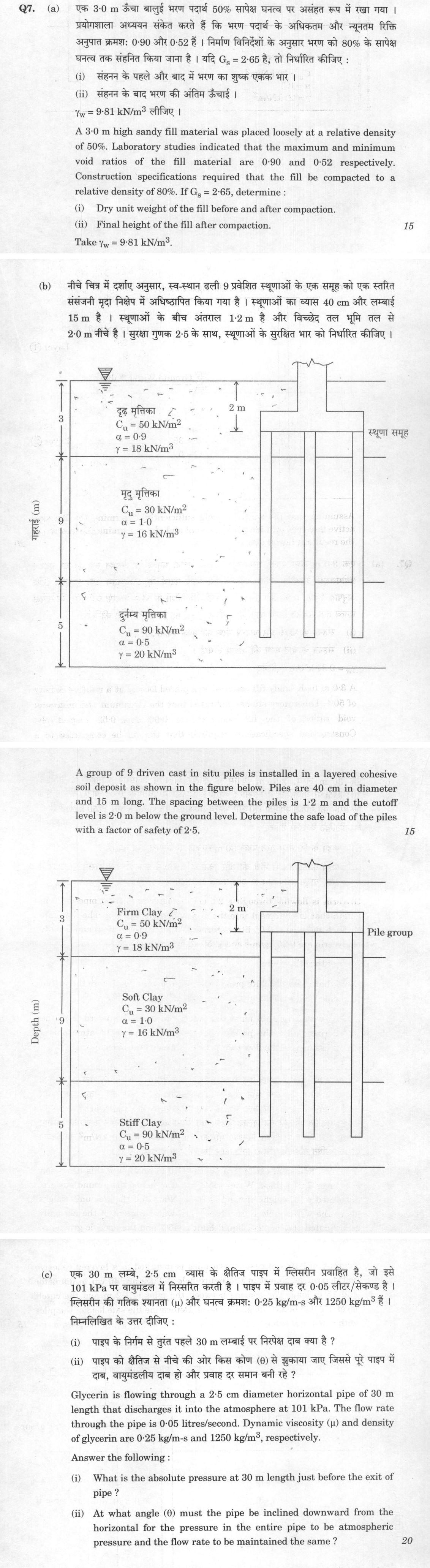
A group of 9 driven cast in situ piles is installed in a layered cohesive soil deposit as shown in the figure below. Piles are 40 cm in diameter and 15 m long. The spacing between the piles is 1·2 m and the cutoff level is 2·0 m below the ground level. Determine the safe load of the piles with a factor of safety of 2·5. 15 marks
Glycerin is flowing through a 2·5 cm diameter horizontal pipe of 30 m length that discharges it into the atmosphere at 101 kPa. The flow rate through the pipe is 0·05 litres/second. Dynamic viscosity (μ) and density of glycerin are 0·25 kg/m-s and 1250 kg/m³, respectively. Answer the following : What is the absolute pressure at 30 m length just before the exit of pipe ?
At what angle (θ) must the pipe be inclined downward from the horizontal for the pressure in the entire pipe to be atmospheric pressure and the flow rate to be maintained the same ? 20 marks
हिंदी में प्रश्न पढ़ें
एक 3·0 m ऊँचा बालुई भरण पदार्थ 50% सापेक्ष घनत्व पर असंहत रूप में रखा गया । प्रयोगशाला अध्ययन संकेत करते हैं कि भरण पदार्थ के अधिकतम और न्यूनतम रिक्त अनुपात क्रमशः: 0·90 और 0·52 हैं । निर्माण विनिर्देशों के अनुसार भरण को 80% के सापेक्ष घनत्व तक संहनित किया जाना है । यदि Gs = 2·65 है, तो निर्धारित कीजिए : संहनन के पहले और बाद में भरण का शुष्क एकक भार ।
संहनन के बाद भरण की अंतिम ऊँचाई । γw = 9·81 kN/m³ लीजिए । 15 marks
नीचे चित्र में दर्शाए अनुसार, स्व-स्थान ढली 9 प्रवेशित स्तंभों के एक समूह को एक स्तरित संसजनी मृदा निक्षेप में अधिष्ठापित किया गया है । स्तंभों का व्यास 40 cm और लम्बाई 15 m है । स्तंभों के बीच अंतराल 1·2 m है और विच्छेद तल भूमि तल से 2·0 m नीचे है । सुरक्षा गुणक 2·5 के साथ, स्तंभों के सुरक्षित भार को निर्धारित कीजिए ।
दृढ़ मृतिका Cᵤ = 50 kN/m² α = 0·9 γ = 18 kN/m³
मृदु मृतिका Cᵤ = 30 kN/m² α = 1·0 γ = 16 kN/m³
दृढ़ीय मृतिका Cᵤ = 90 kN/m² α = 0·5 γ = 20 kN/m³
स्तंभ समूह 15 marks
एक 30 m लम्बे, 2·5 cm व्यास के क्षैतिज पाइप में ग्लिसरिन प्रवाहित है, जो इसे 101 kPa पर वायुमण्डल में निर्सरित करती है । पाइप में प्रवाह दर 0·05 लीटर/सेकण्ड है । ग्लिसरिन की गतिक श्यानता (μ) और घनत्व क्रमशः: 0·25 kg/m-s और 1250 kg/m³ हैं । निम्नलिखित के उत्तर दीजिए : पाइप के निर्गम से तुरन्त पहले 30 m लम्बाई पर निरपेक्ष दाब क्या है ?
पाइप को क्षैतिज से नीचे की ओर किस कोण (θ) से झुकाया जाए जिससे पूरे पाइप में दाब, वायुमण्डलीय दाब हो और प्रवाह दर समान बनी रहे ? 20 marks
The figure this question refers to, in words
The question paper is a scan and the diagram did not survive as text. This is the figure as read from the original page — every component, value and label — so the question can be worked from the text below.
(b) A cross-sectional diagram of a shallow strip footing and soil layers:
- Ground surface is shown as a horizontal line with hatch marks below it.
- The footing is an inverted T-shaped strip footing with width at the base B = 2.8 m.
- Depth of foundation from the ground surface to the base of the footing is 2.5 m.
- Water table is indicated by an inverted triangle with horizontal lines at a depth of 6 m below the ground surface.
- Soil properties are given as: phi = 30 degrees, moist unit weight gamma = 18 kN/m^3, and cohesion C = 40 kN/m^2.
Model answer
Written by UPSC Answer Check against this question's marking rubric, to the expected length. UPSC does not publish answers for Mains — this is one way to score well, not an official key.
(a)
- The relative density of a granular soil is Dr = (emax − e)/(emax − emin). Given emax = 0.90 and emin = 0.52, so emax − emin = 0.38. This relation is valid for the same sand with fixed laboratory limits.
- For the loose placed fill, Dr = 0.50. Therefore e1 = emax − Dr(emax − emin) = 0.90 − 0.50(0.38) = 0.90 − 0.19 = 0.71.
- For the compacted fill, Dr = 0.80. Therefore e2 = 0.90 − 0.80(0.38) = 0.90 − 0.304 = 0.596.
- The dry unit weight is γd = Gs γw/(1 + e). This is the unit weight of the dry soil skeleton; Gs = 2.65 and γw = 9.81 kN/m³.
- Before compaction: γd1 = 2.65 × 9.81/(1 + 0.71) = 25.9965/1.71 = 15.2026 kN/m³, i.e. 15.20 kN/m³.
- After compaction: γd2 = 2.65 × 9.81/(1 + 0.596) = 25.9965/1.596 = 16.2885 kN/m³, i.e. 16.29 kN/m³.
- The mass of dry soil per unit plan area does not change during compaction. For a unit plan area, the initial total volume is Vt1 = H1 = 3.0 m³. The solid volume is Vs = Vt1/(1 + e1) = 3.0/1.71 = 1.7544 m³. After compaction, Vs is unchanged, so Vt2 = Vs(1 + e2) = 1.7544 × 1.596 = 2.80 m³. Since the plan area is 1 m², H2 = Vt2 = 2.80 m.
- Equivalently, H2 = H1(1 + e2)/(1 + e1) = 3.0 × 1.596/1.71. Since 1.596/1.71 = 14/15, H2 = 3.0 × 14/15 = 42/15 = 2.80 m.
- Check by dry unit weights: H2 = γd1 H1/γd2 = 15.2026 × 3.0/16.2885 = 2.80 m, agreeing with the void-ratio result. Final for (a): dry unit weight before = 15.20 kN/m³, after = 16.29 kN/m³; final height = 2.80 m.
[(b)] The figure printed on the original question paper for this part could not be recovered from the scan, so this part is not answered here.
(c) Given D = 2.5 cm = 0.025 m, L = 30 m, Q = 0.05 litres/s = 5 × 10⁻⁵ m³/s, μ = 0.25 kg/(m·s), ρ = 1250 kg/m³, and atmospheric pressure patm = 101 kPa.
- Pipe area: A = πD²/4 = π(0.025)²/4 = 4.9087 × 10⁻⁴ m².
- Mean velocity: V = Q/A = 5 × 10⁻⁵ / 4.9087 × 10⁻⁴ = 0.10186 m/s.
- Reynolds number: Re = ρVD/μ = 1250 × 0.10186 × 0.025/0.25 = 12.73. Because Re is far below 2000, the flow is laminar. For laminar flow in a circular pipe, use the Hagen–Poiseuille equation, Δp = 128 μ L Q/(πD⁴), equivalently Δp = 32 μ L V/D².
- The flow rate is very small, so the Reynolds number is low; glycerin's high viscosity keeps the flow laminar.
- Using the exact form: D⁴ = (0.025)⁴ = 3.90625 × 10⁻⁷ m⁴. The numerator is 128 × 0.25 × 30 × 5 × 10⁻⁵ = 0.048. Hence Δp = 0.048/[π × 3.90625 × 10⁻⁷] = 3.911 × 10⁴ Pa = 39.11 kPa.
- Unit weight of glycerin: γ = ρg = 1250 × 9.81 = 12262.5 N/m³.
- Friction head loss: hf = Δp/γ = 3.911 × 10⁴ / 12262.5 = 3.19 m. This head loss is the energy lost per unit weight of fluid over the 30 m length.
- Velocity head: V²/2g = (0.10186)²/(2 × 9.81) = 0.000529 m. It is small and equal at both ends of a constant-diameter pipe, so it cancels in the energy equation.
- Independent pressure-drop check: Δp = 32 μ L V/D² = 32 × 0.25 × 30 × 0.10186/(0.025)² = 3.911 × 10⁴ Pa, agreeing with the Hagen–Poiseuille value.
- The calculation assumes steady, incompressible, fully developed laminar flow in a uniform circular pipe, with no minor losses and no change in velocity head.
(i)
- The specified point is at the 30 m end, just before the free exit. For a pipe discharging freely into the atmosphere, the pressure at the exit section is atmospheric; hence the required absolute pressure is 101 kPa absolute.
- For completeness, the energy equation between inlet and exit gives p_inlet = p_exit + γhf = 101 kPa + 39.11 kPa = 140.1 kPa absolute. This is the inlet pressure, not the exit pressure asked for.
(ii)
- Require p = patm everywhere. Take upstream end 1 and downstream end 2. Since p1 = p2 and V1 = V2, the energy equation reduces to z1 − z2 = hf.
- For a downward inclination θ over length L, z1 − z2 = L sin θ. Hence sin θ = hf/L = 3.19/30 = 0.1063.
- The required elevation drop is 3.19 m over 30 m, a gentle slope; θ = arcsin(0.1063) = 6.10°. Final for (c): (i) 101 kPa absolute at the exit; (ii) θ = 6.1° downward.
What "Solve" is asking you to do
Choose the method, then carry it through to a final answer. Identifying what kind of problem this is and why that method applies is the first thing marked; a correct figure arrived at invisibly earns almost nothing.
Structure that answers it
Given data and what is required → method chosen, with the reason it applies → set-up (equation, circuit, free body, trial balance) → working, step by step → answer with units and any condition of validity
Where marks are lost
Doing the middle steps mentally and writing only the result. In mathematics papers, a further loss comes from giving a decimal where the exact value in surds or fractions was wanted, or from skipping the justification a part explicitly asks for.
How this answer will be evaluated
Approach
Framework: null. (a) calculate: given > formula > substitution > result with units > interpretation | (b) calculate: given > formula > substitution > result with units > interpretation | (c(i)) calculate: given > formula > substitution > result with units > interpretation | (c(ii)) calculate: given > formula > substitution > result with units > interpretation Full marks: All parts solved with correct formulas, units, and checks; clear presentation with sketches where relevant.
Key points expected
- Calculate void ratios for 50% and 80% relative density
- Compute dry unit weight using Gs and void ratio
- Apply volume conservation for final height
- State final values with units
- Calculate skin friction for each soil layer
- Calculate end bearing at pile tip
- Apply group efficiency for 3x3 arrangement
- Divide by factor of safety 2.5
Evaluation rubric
Each sub-part is marked on its own, against the marks and word limit printed on the paper.
- (a) Dry unit weights and final height of sandy fill after compaction. 15 marks
calculate— given → formula → substitution → result with units → interpretation
Must cover
- Calculate void ratios for 50% and 80% relative density
- Compute dry unit weight using Gs and void ratio
- Apply volume conservation for final height
- State final values with units
Loses marks
- Confusing void ratio with porosity
- Ignoring volume conservation for height
- Missing units in final answers
Earns more
- Show formula for relative density
- Show formula for dry unit weight
- Show height reduction calculation
- Check values against typical soil ranges
Extra mark
- Sketch of fill before/after compaction
- Reference to IS 2720 for compaction
- (b) Safe load of 9-pile group in layered cohesive soil. 15 marks
calculate— given → formula → substitution → result with units → interpretation
Must cover
- Calculate skin friction for each soil layer
- Calculate end bearing at pile tip
- Apply group efficiency for 3x3 arrangement
- Divide by factor of safety 2.5
Loses marks
- Ignoring soil layer boundaries
- Using wrong spacing for group efficiency
- Forgetting to apply factor of safety
Earns more
- Show layer-wise calculation table
- Show group efficiency formula
- Show pile group perimeter calculation
- Check against single pile capacity
Extra mark
- Sketch of pile group with dimensions
- Reference to IS 2911 for pile design
- (c(i)) Absolute pressure at 30 m length just before pipe exit.
calculate— given → formula → substitution → result with units → interpretation
Must cover
- Calculate flow velocity from flow rate
- Calculate Reynolds number to confirm laminar flow
- Apply Hagen-Poiseuille equation for pressure drop
- Add atmospheric pressure to get absolute pressure
Loses marks
- Assuming turbulent flow without checking
- Using wrong diameter in velocity calc
- Confusing gauge and absolute pressure
Earns more
- Show velocity calculation
- Show Reynolds number calculation
- Show pressure drop formula
- State assumption of laminar flow
Extra mark
- Sketch of pipe with pressure points
- Reference to fluid mechanics textbook
- (c(ii)) Downward inclination angle for atmospheric pressure throughout pipe.
calculate— given → formula → substitution → result with units → interpretation
Must cover
- Set pressure drop equal to hydrostatic head
- Solve for vertical drop over 30 m length
- Calculate angle using trigonometry
- State final angle in degrees
Loses marks
- Ignoring hydrostatic head contribution
- Using wrong trigonometric function
- Not converting to degrees
Earns more
- Show energy balance equation
- Show vertical drop calculation
- Show angle calculation
- Check if angle is physically reasonable
Extra mark
- Sketch of inclined pipe
- Reference to Bernoulli's principle
Practice this exact question
Write your answer and it is marked point by point against the model answer above — what you covered, what you missed, what you got wrong.
Evaluate my answer →More from Civil Engineering 2023 Paper I
- Q4 (a) Determine the horizontal component of deflection of joint D of the truss loaded as sh…
- Q5 The flow rate of water over a weir is 3 m³/s. A 1 : 10 scale model of the weir is tested…
- Q6 A flow of 9·0 m³/s occurs in a long rectangular channel of 3·0 m width with 1·5 m depth o…
- Q7 (a) A 3·0 m high sandy fill material was placed loosely at a relative density of 50%. Lab…
- Q8 (a) At a site, fine sand exists to a depth of 10 m and below this lies a soft clay layer…