Paper I — Q5
The flow rate of water over a weir is 3 m³/s. A 1 : 10 scale model of the weir is tested in a water channel. Answer the following…
The flow rate of water over a weir is 3 m³/s. A 1 : 10 scale model of the weir is tested in a water channel. Answer the following :
What flow rate should be used for the model ?
If a force of 15 N is experienced on the model, what force would be expected on the prototype ?
10
A rectangular wing on a small airplane has a 1·3 m chord and a 10 m span. When flying in air at 250 km/hour, the wing experiences a total aerodynamic force of 20 kN. If the lift to drag ratio is 3, what would be the lift coefficient of the wing ? Take density of air as 1·20 kg/m³.
10
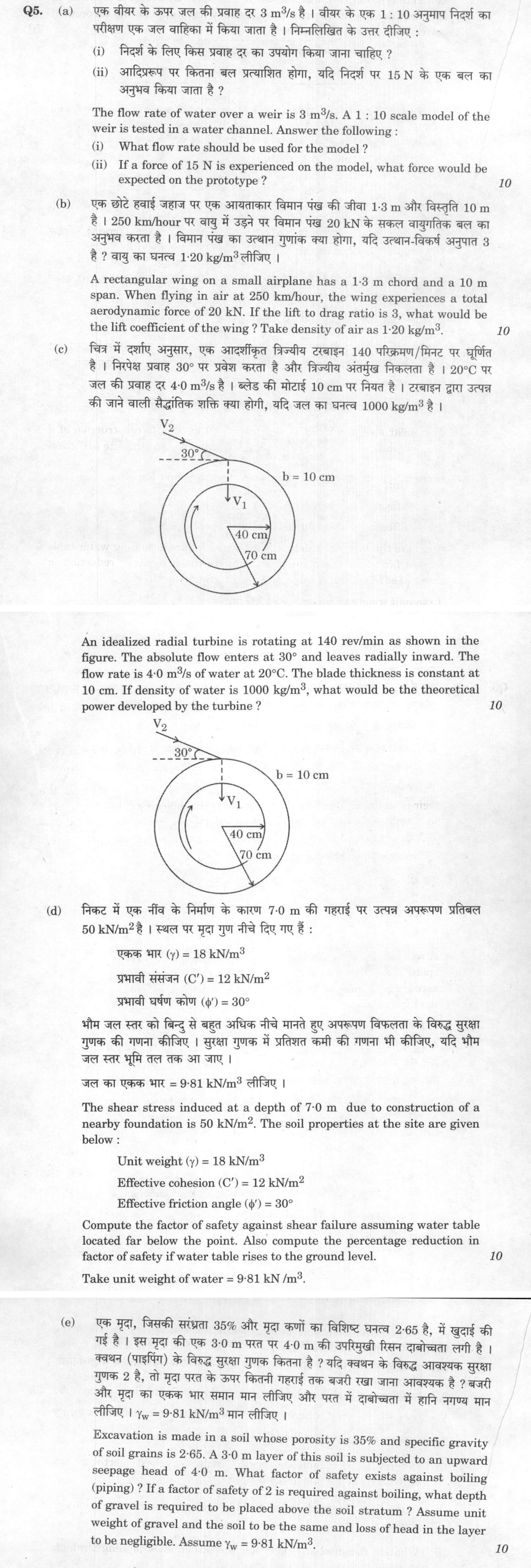
An idealized radial turbine is rotating at 140 rev/min as shown in the figure. The absolute flow enters at 30° and leaves radially inward. The flow rate is 4·0 m³/s of water at 20°C. The blade thickness is constant at 10 cm. If density of water is 1000 kg/m³, what would be the theoretical power developed by the turbine ?
10
The shear stress induced at a depth of 7·0 m due to construction of a nearby foundation is 50 kN/m². The soil properties at the site are given below :
Unit weight (γ) = 18 kN/m³
Effective cohesion (C') = 12 kN/m²
Effective friction angle (φ') = 30°
Compute the factor of safety against shear failure assuming water table located far below the point. Also compute the percentage reduction in factor of safety if water table rises to the ground level.
Take unit weight of water = 9·81 kN/m³.
10
Excavation is made in a soil whose porosity is 35% and specific gravity of soil grains is 2·65. A 3·0 m layer of this soil is subjected to an upward seepage head of 4·0 m. What factor of safety exists against boiling (piping) ? If a factor of safety of 2 is required against boiling, what depth of gravel is required to be placed above the soil stratum ? Assume unit weight of gravel and the soil to be the same and loss of head in the layer to be negligible. Assume γw = 9·81 kN/m³.
हिंदी में प्रश्न पढ़ें
एक बीयर के ऊपर जल की प्रवाह दर 3 m³/s है । बीयर के एक 1 : 10 अनुमाप निदर्श का परीक्षण एक जल वाहिका में किया जाता है । निम्नलिखित के उत्तर दीजिए :
निदर्श के लिए किस प्रवाह दर का उपयोग किया जाना चाहिए ?
आदिप्ररूप पर कितना बल प्रत्याशित होगा, यदि निदर्श पर 15 N के एक बल का अनुभव किया जाता है ?
10
एक छोटे हवाई जहाज पर एक आयताकार विमान पंख की जीवा 1·3 m और विस्तृति 10 m है । 250 km/hour पर वायु में उड़ने पर विमान पंख 20 kN के सकल वायुगतिक बल का अनुभव करता है । विमान पंख का उत्थान गुणांक क्या होगा, यदि उत्थान-विकर्ष अनुपात 3 है ? वायु का घनत्व 1·20 kg/m³ लीजिए ।
10
चित्र में दर्शाए अनुसार, एक आदर्शीकृत त्रिज्यीय टरबाइन 140 परिक्रमण/मिनट पर घूर्णित है । निरपेक्ष प्रवाह 30° पर प्रवेश करता है और त्रिज्यीय अंतर्मुख निकलता है । 20°C पर जल की प्रवाह दर 4·0 m³/s है । ब्लेड की मोटाई 10 cm पर नियत है । टरबाइन द्वारा उत्पन्न की जाने वाली सैद्धांतिक शक्ति क्या होगी, यदि जल का घनत्व 1000 kg/m³ है ।
10
निकट में एक नींव के निर्माण के कारण 7·0 m की गहराई पर उत्पन्न अपरूपण प्रतिबल 50 kN/m² है । स्थल पर मृदा गुण नीचे दिए गए हैं :
एकक भार (γ) = 18 kN/m³
प्रभावी संसजन (C') = 12 kN/m²
प्रभावी घर्षण कोण (φ') = 30°
भौम जल स्तर को बिंदु से बहुत अधिक नीचे मानते हुए अपरूपण विफलता के विरुद्ध सुरक्षा गुणक की गणना कीजिए । सुरक्षा गुणक में प्रतिशत कमी की गणना भी कीजिए, यदि भौम जल स्तर भूमि तल तक आ जाए ।
जल का एकक भार = 9·81 kN/m³ लीजिए ।
10
एक मृदा, जिसकी संरधता 35% और मृदा कणों का विशिष्ट घनत्व 2·65 है, में खुदाई की गई है । इस मृदा की एक 3·0 m परत पर 4·0 m की उपरिमुखी रिसन दाबोच्चता लगी है । क्वथन (पाइपिंग) के विरुद्ध सुरक्षा गुणक कितना है ? यदि क्वथन के विरुद्ध आवश्यक सुरक्षा गुणक 2 है, तो मृदा परत के ऊपर कितनी गहराई तक बजरी रखा जाना आवश्यक है ? बजरी और मृदा का एकक भार समान मान लीजिए और परत में दाबोच्चता में हानि नगण्य मान लीजिए । γw = 9·81 kN/m³ मान लीजिए ।
The figure this question refers to, in words
The question paper is a scan and the diagram did not survive as text. This is the figure as read from the original page — every component, value and label — so the question can be worked from the text below.
(c) A schematic of an idealized radial-flow turbine runner shown in front view as two concentric circles. The outer radius of the runner is marked as 70 cm, and the inner radius is marked as 40 cm. Between the inner and outer circles, a single curved runner blade is shown. A vertical dashed radial line passes through the center to the top of the outer circle. At the outer periphery (top), a horizontal dashed tangent line is drawn; the absolute inlet velocity vector V2 enters at an angle of 30 degrees to this tangent line, directed inwards and to the right. At the inner periphery, the absolute outlet velocity vector V1 is directed strictly radially inward along the vertical dashed line. The runner blade thickness/width is annotated to the right as 'b = 10 cm'.
(c) A schematic diagram of an idealized radial turbine runner showing two concentric circles: an inner circle with radius 40 cm and an outer circle with radius 70 cm. A curved arrow inside the inner circle indicates counter-clockwise rotation. At the top (12 o'clock position) of the outer circle, flow enters with an absolute velocity vector V2 directed downwards and to the right at an angle of 30 degrees below a horizontal dashed tangent line. A vertical dashed line connects the top of the outer circle radially inwards to the inner circle, where a downward-pointing arrow labelled V1 indicates that the flow leaves radially inward toward the center. The runner width is labelled as b = 10 cm near the outer circle.
Model answer
Written by UPSC Answer Check against this question's marking rubric, to the expected length. UPSC does not publish answers for Mains — this is one way to score well, not an official key.
(a)(i) For free-surface weir flow, use Froude similarity. Lr = Lm/Lp = 1/10. Velocity scale Vr = √Lr = 1/√10. Discharge scale Qr = Lr² Vr = Lr^(5/2) = (1/10)^(5/2). Qm = Qp Qr = 3/(100√10) = 0.00949 m³/s = 9.49 L/s. Qm ≈ 9.49 × 10⁻³ m³/s.
(a)(ii) Under the same Froude law, force scale Fr = ρr Lr³ = Lr³ = (1/10)³ = 1/1000. Thus Fp = Fm / (1/1000) = 15 × 1000 = 15000 N. Fp = 15 kN.
(b) V = 250 km/h = 250×1000/3600 = 625/9 m/s. Wing area S = chord × span = 1.3 × 10 = 13 m². Let L and D be lift and drag. L/D = 3, so D = L/3. Total force R = √(L²+D²) = L√10/3. Given R = 20 kN = 20000 N: L = 3R/√10 = 60000/√10 = 18973.7 N. Dynamic pressure-area product: qS = 0.5 ρ V² S = 0.5 × 1.20 × (625/9)² × 13 = 37615.7 N. C_L = L/(qS) = 18973.7/37615.7 = 0.5044. C_L ≈ 0.504.
(c) Euler turbine equation: P = ρQ(u2 Vt2 − u1 Vt1). N = 140 rev/min, so ω = 2πN/60 = 14π/3 rad/s. r2 = 0.70 m, r1 = 0.40 m, b = 0.10 m. u2 = ωr2 = (14π/3)×0.70 = 9.8π/3 = 10.2625 m/s. u1 = ωr1 = (14π/3)×0.40 = 5.6π/3 = 5.8644 m/s. Inlet area A2 = 2πr2b = 2π×0.70×0.10 = 0.14π m². Radial inlet velocity Vr2 = Q/A2 = 4/(0.14π) = 200/(7π) = 9.0946 m/s. Since absolute inlet makes 30° with tangent, Vt2 = Vr2 cot30° = (200/(7π))√3 = 15.752 m/s. Outlet is radially inward, so Vt1 = 0. P = 1000×4×[(9.8π/3)×(200√3/(7π))] = 4000×(280√3/3) W = 646632 W. P ≈ 646.6 kW.
(d) Mohr-Coulomb shear strength: τ_f = c' + σ'_v tanφ'. Depth z = 7.0 m, induced τ = 50 kN/m². Water table far below: σ'_v = γz = 18×7 = 126 kN/m². τ_f = 12 + 126 tan30° = 12 + 126/√3 = 84.746 kN/m². F1 = 84.746/50 = 1.695. Water table at ground: σ'_v = (γ − γw)z = (18 − 9.81)×7 = 57.33 kN/m². τ_f = 12 + 57.33 tan30° = 12 + 57.33/√3 = 45.099 kN/m². F2 = 45.099/50 = 0.902. Percentage reduction = (F1 − F2)/F1 × 100 = (1.695 − 0.902)/1.695 × 100 = 46.8%. F1 ≈ 1.70; F2 ≈ 0.90; reduction ≈ 46.8%.
(e) n = 35% = 0.35, G = 2.65. Void ratio e = n/(1−n) = 0.35/0.65 = 0.5385. Critical gradient i_c = (G−1)/(1+e) = (2.65−1)/(1+0.5385) = 1.0725. Actual gradient i = H/L = 4.0/3.0 = 1.3333. F = i_c/i = 1.0725/1.3333 = 0.8044. F ≈ 0.804 (unsafe).
For F = 2, use submerged weights since the seepage zone is saturated. γ' = i_c γw = 1.0725×9.81 = 10.521 kN/m³. Seepage uplift per unit area = γw H = 9.81×4 = 39.24 kN/m². Required resisting = 2×39.24 = 78.48 kN/m². Existing soil resisting = γ'L = 10.521×3 = 31.563 kN/m². Additional resisting needed = 78.48 − 31.563 = 46.917 kN/m². Let gravel depth be d. With same unit weight, γ'd = 46.917. d = 46.917/10.521 = 4.459 m. d ≈ 4.46 m.
What "Solve" is asking you to do
Choose the method, then carry it through to a final answer. Identifying what kind of problem this is and why that method applies is the first thing marked; a correct figure arrived at invisibly earns almost nothing.
Structure that answers it
Given data and what is required → method chosen, with the reason it applies → set-up (equation, circuit, free body, trial balance) → working, step by step → answer with units and any condition of validity
Where marks are lost
Doing the middle steps mentally and writing only the result. In mathematics papers, a further loss comes from giving a decimal where the exact value in surds or fractions was wanted, or from skipping the justification a part explicitly asks for.
How this answer will be evaluated
Approach
Framework: UPSC Civil Engineering Paper 1. (a(i)) calculate: given > formula > substitution > result with units > interpretation | (a(ii)) calculate: given > formula > substitution > result with units > interpretation | (b) calculate: given > formula > substitution > result with units > interpretation | (c) calculate: given > formula > substitution > result with units > interpretation | (d) calculate: given > formula > substitution > result with units > interpretation | (e) calculate: given > formula > substitution > result with units > interpretation Full marks: All parts show complete method with correct formulas, units, and final values with checks.
Key points expected
- State Froude similarity criterion for free surface flow
- Apply flow rate scale ratio Qm/Qp = (Lm/Lp)^2.5
- Substitute scale 1:10 and prototype flow 3 m³/s
- Provide final model flow rate with units
- State force scale ratio Fm/Fp = (Lm/Lp)^3
- Apply density ratio (same fluid, so 1)
- Substitute scale 1:10 and model force 15 N
- Provide final prototype force with units
Evaluation rubric
Each sub-part is marked on its own, against the marks and word limit printed on the paper.
- (a(i)) Determine the model flow rate using Froude scaling laws.
calculate— given → formula → substitution → result with units → interpretation
Must cover
- State Froude similarity criterion for free surface flow
- Apply flow rate scale ratio Qm/Qp = (Lm/Lp)^2.5
- Substitute scale 1:10 and prototype flow 3 m³/s
- Provide final model flow rate with units
Loses marks
- Using linear scale ratio instead of 2.5 power
- Omitting units in final answer
Earns more
- Explicitly state the exponent 2.5 derivation
- Show dimensional consistency check
Extra mark
- Mention Reynolds number check for validity
- (a(ii)) Determine the prototype force from the model force.
calculate— given → formula → substitution → result with units → interpretation
Must cover
- State force scale ratio Fm/Fp = (Lm/Lp)^3
- Apply density ratio (same fluid, so 1)
- Substitute scale 1:10 and model force 15 N
- Provide final prototype force with units
Loses marks
- Using 1:10 instead of 1:1000 for force ratio
- Forgetting to cube the scale factor
Earns more
- Show the derivation of force scaling from Froude law
- Verify dimensional consistency
Extra mark
- Mention applicability limits of Froude scaling
- (b) Determine the lift coefficient of the wing. 10 marks
calculate— given → formula → substitution → result with units → interpretation
Must cover
- Convert velocity 250 km/h to m/s
- Calculate wing area from chord and span
- Resolve total force into lift using L/D ratio
Loses marks
- Using total force instead of lift component
- Incorrect area calculation (chord × span)
Earns more
- Show all unit conversions explicitly
- State assumptions about flow conditions
Extra mark
- Mention typical CL range for comparison
- (c) Determine theoretical power developed by the turbine. 10 marks
calculate— given → formula → substitution → result with units → interpretation
Must cover
- Calculate blade velocity U from radius and rpm
- Determine whirl velocity Vw from inlet angle
- Apply Euler turbine equation P = ρQ(U1Vw1 - U2Vw2)
- Note Vw2 = 0 for radial discharge
Loses marks
- Ignoring radial discharge condition (Vw2 ≠ 0)
- Incorrect blade velocity calculation
Earns more
- Show velocity triangle construction
- Verify flow rate consistency with blade geometry
Extra mark
- Mention efficiency considerations
- (d) Compute factor of safety and percentage reduction. 10 marks
calculate— given → formula → substitution → result with units → interpretation
Must cover
- Calculate effective stress at 7m depth
- Apply Mohr-Coulomb failure criterion
- Compute FS with water table far below
- Compute FS with water table at ground level
Loses marks
- Using total stress instead of effective stress
- Incorrect pore pressure calculation
Earns more
- Show effective stress calculation clearly
- State the failure criterion formula explicitly
Extra mark
- Mention practical FS requirements
- (e) Determine FS against boiling and required gravel depth. 10 marks
calculate— given → formula → substitution → result with units → interpretation
Must cover
- Calculate soil permeability from porosity and G
- Determine critical hydraulic gradient
- Compute FS against boiling with given head
- Calculate required gravel depth for FS = 2
Loses marks
- Incorrect permeability calculation
- Confusing total and effective stress in gradient
Earns more
- Show permeability calculation steps
- State the boiling condition clearly
Extra mark
- Mention practical piping prevention measures
Practice this exact question
Write your answer and it is marked point by point against the model answer above — what you covered, what you missed, what you got wrong.
Evaluate my answer →More from Civil Engineering 2023 Paper I
- Q2 (a) Draw the shearing force and bending moment diagrams for the beam loaded as shown in t…
- Q3 (a) Design a floor slab to cover a room with internal dimensions of 4·5 m × 6·0 m. The sl…
- Q4 (a) Determine the horizontal component of deflection of joint D of the truss loaded as sh…
- Q5 The flow rate of water over a weir is 3 m³/s. A 1 : 10 scale model of the weir is tested…
- Q6 A flow of 9·0 m³/s occurs in a long rectangular channel of 3·0 m width with 1·5 m depth o…
- Q7 (a) A 3·0 m high sandy fill material was placed loosely at a relative density of 50%. Lab…
- Q8 (a) At a site, fine sand exists to a depth of 10 m and below this lies a soft clay layer…