Paper I — Q4
(a) Determine the horizontal component of deflection of joint D of the truss loaded as shown in the figure. The cross-sectional…
Determine the horizontal component of deflection of joint D of the truss loaded as shown in the figure. The cross-sectional area of each member is tabulated below. Take E = 200 kN/mm². Length of the members are indicated in the figure. Use Castigliano's theorems. 15 marks
Table : Area of cross-section
| S.No | Member | Area of cross-section |
|---|---|---|
| 1. | AB | 765 mm² |
| 2. | AD | 390 mm² |
| 3. | DB | 575 mm² |
| 4. | BC | 765 mm² |
| 5. | CD | 390 mm² |
Determine the collapse load in case of propped cantilever of span 'l' and subjected to uniformly distributed load 'P' per metre length as shown in the figure. Take the plastic moment capacity of beam as M_P. 15 marks
A circular water tank with flexible base is to be designed for a capacity of 450 kL. The depth of water is to be 4 m including a free board of 250 mm. Find the dimensions of the tank and design and detail the wall of the tank. Use M 20 concrete and Fe 250 steel. 20 marks
Given : Tensile stress in steel under direct tension for plain mild steel bars, σ_s = 115 MPa Permissible direct tensile stress in concrete (M 20), σ_ct = 1·2 MPa Unit weight of water, γ = 9800 N/m³
हिंदी में प्रश्न पढ़ें
चित्र में दर्शाए अनुसार भारित कैंची के जोड़ D के विषम के क्षैतिज घटक को निर्धारित कीजिए। प्रत्येक अवयव का अनुप्रस्थ-परिच्छेद क्षेत्रफल नीचे सारणीकृत किया गया है। E = 200 kN/mm² लीजिए। अवयवों की लंबाई चित्र में दर्शित है। कास्टिग्लियानो के प्रमेयों का उपयोग कीजिए। (15 अंक)
सारणी : अनुप्रस्थ-परिच्छेद का क्षेत्रफल
| क्रमांक | अवयव | अनुप्रस्थ-परिच्छेद का क्षेत्रफल |
|---|---|---|
| 1. | AB | 765 mm² |
| 2. | AD | 390 mm² |
| 3. | DB | 575 mm² |
| 4. | BC | 765 mm² |
| 5. | CD | 390 mm² |
चित्र में दर्शाए अनुसार, 'P' प्रति मीटर लंबाई के एकसमान वितरित भार से भारित 'l' विस्तृति के टेकदार प्रास के लिए निपात भार निर्धारित कीजिए । धरन की सुखदाय आरूण क्षमता को M_P लीजिए । (15 अंक)
450 kL क्षमता के लिए नम्य आधार वाली एक वृत्ताकार पानी की टंकी की अभिकल्पना की जानी है । 250 mm के मुक्तांतर सहित जल की गहराई 4 m होनी है । टंकी की विमाओं को ज्ञात कीजिए और टंकी की दीवार का अभिकल्पन एवं विस्तरण कीजिए । M 20 कंक्रीट और Fe 250 इस्पात का उपयोग कीजिए । (20 अंक)
प्रदत : सादा मृदु इस्पात छड़ों के लिए प्रत्यक्ष तनन में इस्पात में तनन प्रतिबल, σ_s = 115 MPa कंक्रीट (M 20) में अनुज्ञेय प्रत्यक्ष तनन प्रतिबल, σ_ct = 1·2 MPa जल का एकक भार, γ = 9800 N/m³
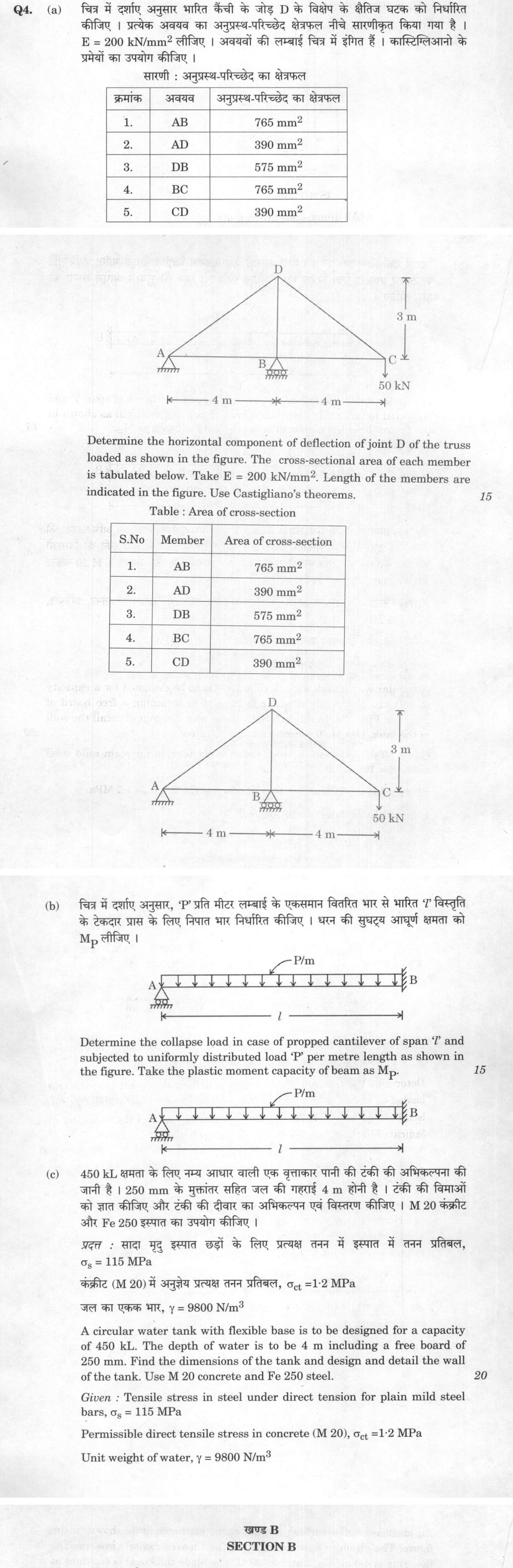
The figure this question refers to, in words
The question paper is a scan and the diagram did not survive as text. This is the figure as read from the original page — every component, value and label — so the question can be worked from the text below.
(a) A plane truss consists of joints A, B, C, and D. Joint A is a pinned support at the left end. Joint B is a roller support located 4 m to the right of A. Joint C is located 4 m to the right of B, so the horizontal distance from A to C is 8 m. Joint D is located directly above B at a vertical height of 3 m above the line AC. Members are AB, BC, AD, DB, and CD. A downward vertical load of 50 kN is applied at joint C. The cross-sectional areas are: AB = 765 mm^2, AD = 390 mm^2, DB = 575 mm^2, BC = 765 mm^2, CD = 390 mm^2. Take E = 200 kN/mm^2. Determine the horizontal component of deflection of joint D using Castigliano's theorem.
(b) A propped cantilever beam AB of span l. End A is a roller support (triangle on rollers) and end B is a fixed support (vertical hatched wall). The beam carries a uniformly distributed load P per metre length over its entire span, shown by downward arrows along the top of the beam with a label 'P/m'. The span between A and B is marked with a dimension line labelled 'l'.
Model answer
Written by UPSC Answer Check against this question's marking rubric, to the expected length. UPSC does not publish answers for Mains — this is one way to score well, not an official key.
(a) Using Castigliano’s theorem, introduce a fictitious horizontal load H at D to the right. Then U = Σ F_i² L_i/(2 A_i E) and Δ_Dx = Σ F_i(∂F_i/∂H) L_i/(A_i E) at H = 0.
For the actual load of 50 kN downward at C, the support reactions are B_y = 100 kN ↑ and A_y = 50 kN ↓. Taking tension positive, joint equilibrium gives:
- F_AB = -200/3 kN
- F_BC = -200/3 kN
- F_AD = 250/3 kN
- F_DB = -100 kN
- F_CD = 250/3 kN
For H = 1 kN at D to the right, the unit member forces are:
- u_AB = 0
- u_AD = 5/4
- u_DB = -3/4
- u_BC = 0
- u_CD = 0
Hence only AD and DB contribute: Δ_Dx = [(250/3)(5/4)(5000)]/(390×200) + [(-100)(-3/4)(3000)]/(575×200) mm
Δ_Dx = 3125/468 + 45/23 mm = 92935/10764 mm = 8.63 mm.
Final: Δ_Dx = 8.63 mm to the right.
(b) By the upper-bound/virtual-work theorem, the collapse mechanism forms plastic hinges at the fixed end B and at a section C, distance x from A. Let C deflect δ downward. Then θ_B = δ/(l - x) θ_C = δ/x + δ/(l - x)
Internal work = M_P(θ_B + θ_C) = M_P δ(l + x)/[x(l - x)]. External work = ∫ P δ(x) dx = P l δ/2.
Equating: P l δ/2 = M_P δ(l + x)/[x(l - x)] P = 2 M_P(l + x)/[l x(l - x)]
Minimising P with respect to x gives x² + 2lx - l² = 0, so x = (√2 - 1)l. Substituting: P_u = 2 M_P√2/[l²(3√2 - 4)] = (6 + 4√2)M_P/l².
Final: P_u = (6 + 4√2)M_P/l² ≈ 11.66 M_P/l².
(c) Effective water depth h = 4.0 - 0.25 = 3.75 m. Capacity = 450 kL = 450 m³. V = πD²h/4 ⇒ 450 = πD²(3.75)/4 ⇒ D = √(480/π) = 12.36 m. Provide inner diameter = 12.36 m, total depth = 4.0 m, freeboard = 0.25 m. With 200 mm wall, outer diameter ≈ 12.76 m.
Hoop tension at base: T = γhD/2 = 9800 × 3.75 × (12.36/2) = 227.13 × 10³ N/m = 227.13 kN/m.
Hoop steel required: A_st = T/σ_s = (227.13 × 10³)/115 = 1975 mm²/m.
Adopt wall thickness t = 200 mm. Provide two layers of 12 mm φ hoops @ 110 mm c/c on each face: A_st,provided = 2 × 1000 × (π × 12²/4)/110 = 2056 mm²/m > 1975 mm²/m.
Check steel stress: σ_s = 227.13 × 10³/2056 = 110.5 MPa < 115 MPa.
Check concrete tensile stress using transformed area. E_c = 5000√20 = 22361 N/mm², m = 200000/22361 ≈ 8.94. A_eq = 1000 × 200 + (8.94 - 1) × 2056 = 216.3 × 10³ mm²/m. σ_ct = 227.13 × 10³/(216.3 × 10³) = 1.05 MPa < 1.2 MPa. Hence safe.
Vertical reinforcement: minimum 0.3% of gross area = 0.003 × 1000 × 200 = 600 mm²/m. Provide 8 mm φ @ 160 mm c/c on each face: A_v = 2 × 1000 × (π × 8²/4)/160 = 628 mm²/m > 600 mm²/m.
Detailing: cover 45 mm on water face and 40 mm on outer face; hoop and vertical bars in two layers tied together; hoop bars anchored into base slab with development length; construction joints provided with water bar. Spacings 110 mm and 160 mm are within the limit of 300 mm.
Final: D = 12.36 m, total depth = 4.0 m, water depth = 3.75 m, wall thickness = 200 mm; hoop steel 12 mm φ @ 110 mm c/c each face; vertical steel 8 mm φ @ 160 mm c/c each face.
What "Solve" is asking you to do
Choose the method, then carry it through to a final answer. Identifying what kind of problem this is and why that method applies is the first thing marked; a correct figure arrived at invisibly earns almost nothing.
Structure that answers it
Given data and what is required → method chosen, with the reason it applies → set-up (equation, circuit, free body, trial balance) → working, step by step → answer with units and any condition of validity
Where marks are lost
Doing the middle steps mentally and writing only the result. In mathematics papers, a further loss comes from giving a decimal where the exact value in surds or fractions was wanted, or from skipping the justification a part explicitly asks for.
How this answer will be evaluated
Approach
(a) calculate: given > formula > substitution > result with units > interpretation | (b) calculate: given > formula > substitution > result with units > interpretation | (c) calculate: given > formula > substitution > result with units > interpretation Full marks: Complete method with all steps, units, and checks; neat sketches; code references
Key points expected
- Apply Castigliano's theorem for horizontal deflection
- Calculate member forces (N) and partial derivatives (∂N/∂P)
- Tabulate N, ∂N/∂P, L, A, and N(∂N/∂P)L/A for all members
- Sum terms and divide by E to get final deflection in mm
- Identify plastic hinge locations at A and B
- Apply virtual work or equilibrium method for collapse
- Relate plastic moment Mp to load P and span l
- Derive final expression for collapse load P
Evaluation rubric
Each sub-part is marked on its own, against the marks and word limit printed on the paper.
- (a) Horizontal deflection of joint D using Castigliano's theorem 15 marks
calculate— given → formula → substitution → result with units → interpretation
Must cover
- Apply Castigliano's theorem for horizontal deflection
- Calculate member forces (N) and partial derivatives (∂N/∂P)
- Tabulate N, ∂N/∂P, L, A, and N(∂N/∂P)L/A for all members
- Sum terms and divide by E to get final deflection in mm
Loses marks
- Missing ∂N/∂P column in the table
- Final value without showing summation of N(∂N/∂P)L/A
- Incorrect member lengths or areas from table
Earns more
- Correctly identifies zero-force members or symmetry
- States E = 200 kN/mm² explicitly in calculation
- Shows free body diagram or joint equilibrium steps
- Units carried through every calculation step
Extra mark
- Neat labelled truss sketch with member forces
- Verification using virtual work method
- (b) Collapse load P for propped cantilever under UDL 15 marks
calculate— given → formula → substitution → result with units → interpretation
Must cover
- Identify plastic hinge locations at A and B
- Apply virtual work or equilibrium method for collapse
- Relate plastic moment Mp to load P and span l
- Derive final expression for collapse load P
Loses marks
- Incorrect number of plastic hinges for mechanism
- Missing virtual work equation or equilibrium check
- Final answer without showing Mp relationship
Earns more
- Draws mechanism with hinge locations clearly marked
- Shows moment diagram at collapse state
- States degree of redundancy and required hinges
- Carries units consistently through derivation
Extra mark
- Comparison with elastic limit load
- Reference to IS 800 plastic design provisions
- (c) Dimensions and wall design for circular water tank 20 marks
calculate— given → formula → substitution → result with units → interpretation
Must cover
- Calculate tank radius from 450 kL capacity and 4 m depth
- Determine hoop tension at base using water pressure
- Calculate wall thickness from σ_ct = 1.2 MPa
- Design steel reinforcement using σ_s = 115 MPa
Loses marks
- Missing hoop tension calculation at critical section
- Wall thickness without showing stress calculation
- Reinforcement design without stating steel area formula
Earns more
- Shows free body diagram of tank wall section
- States M20 and Fe250 material properties explicitly
- Checks minimum reinforcement as per code
- Provides detailed bar arrangement sketch
Extra mark
- Reference to IS 4500 water tank design clauses
- Consideration of temperature and shrinkage steel
Practice this exact question
Write your answer and it is marked point by point against the model answer above — what you covered, what you missed, what you got wrong.
Evaluate my answer →More from Civil Engineering 2023 Paper I
- Q1 (a) An aluminium tensile specimen has a diameter of 30·50 mm and a gauge length 275 mm. I…
- Q2 (a) Draw the shearing force and bending moment diagrams for the beam loaded as shown in t…
- Q3 (a) Design a floor slab to cover a room with internal dimensions of 4·5 m × 6·0 m. The sl…
- Q4 (a) Determine the horizontal component of deflection of joint D of the truss loaded as sh…
- Q5 The flow rate of water over a weir is 3 m³/s. A 1 : 10 scale model of the weir is tested…
- Q6 A flow of 9·0 m³/s occurs in a long rectangular channel of 3·0 m width with 1·5 m depth o…
- Q7 (a) A 3·0 m high sandy fill material was placed loosely at a relative density of 50%. Lab…