Paper I — Q2
(a) Draw the shearing force and bending moment diagrams for the beam loaded as shown in the figure below. (8 marks) (b) During…
Draw the shearing force and bending moment diagrams for the beam loaded as shown in the figure below. 8 marks
During the design of a beam, an ISMB 550 @ 1·037 kN/m is selected for use as a simply supported beam of 7 m span carrying a reinforced concrete floor capable of providing lateral restraint to the top compression flange. The total uniformly distributed load is made up of 100 kN dead load and 150 kN imposed load. In addition to this load, the beam also carries a point load at its midspan which is made up of 50 kN dead load and 50 kN imposed load. Check the adequacy of the section for the following :
Shear strength
Bending strength
Deflection
Web buckling at support
Assume the section is plastic.
Given : Stiff bearing length = 100 mm f_y = 250 MPa, E = 2 × 10⁵ MPa γ_mo = 1·1 For plastic section β_b = 1·0 For simply supported beam, ψ = 1·2
| KL/r | 90 | 100 | 110 | 120 |
|---|---|---|---|---|
| f_cd (MPa) | 121 | 107 | 94·6 | 83·7 |
Properties of ISMB 550 : Elastic section modulus, Zₑ = 2359·8 × 10³ mm³ Plastic section modulus, Zₚ = 2711·98 × 10³ mm³ Moment of Inertia about major axis, I₂₂ = 64900 × 10⁴ mm⁴
(All dimensions are in mm) 20 marks
Using the unit load method, determine horizontal and vertical components of deflection at point A for the frame loaded as shown in the figure below. Support C is fixed and B is a rigid joint. Take E as constant and same for both the members. 15 marks
हिंदी में प्रश्न पढ़ें
नीचे चित्र में दर्शाए अनुसार भारित धरन के लिए अपरूपण बल और बंकन आघूर्ण आरेख बनाइए । (8 अंक)
धरन की अभिकल्पना के दौरान, एक ISMB 550 @ 1·037 kN/m को एक 7 m विस्तृति की शुद्धलंबित धरन की तरह उपयोग के लिए चुना गया जो शीर्ष संपीडन फ्लैंज को पार्श्वतः बाधित करने में सक्षम एक प्रबलित कंक्रीट फर्श को वहन करती है। सकल एकसमान वितरित भार 100 kN अचल भार और 150 kN अध्यारोपित भार से बना है। इस भार के अतिरिक्त, धरन अपनी विस्तृति के मध्य में एक बिंदु भार भी वहन करती है जो 50 kN के अचल भार और 50 kN के अध्यारोपित भार से बना है। निम्नलिखित के लिए परिछेद की पर्याप्तता की जांच कीजिए :
अपरूपण सामर्थ्य
बंकन सामर्थ्य
विस्थाप
आलंब पर वेब व्याकुंचन
परिछेद को सुखदाय मान लीजिए ।
प्रदत्त : दृढ़ धारण लंबाई = 100 mm f_y = 250 MPa, E = 2 × 10^5 MPa γ_mo = 1·1 सुखदाय परिछेद के लिए, β_b = 1·0 शुद्धलंबित धरन के लिए, ψ = 1·2
| KL/r | 90 | 100 | 110 | 120 |
|---|---|---|---|---|
| f_cd (MPa) | 121 | 107 | 94·6 | 83·7 |
ISMB 550 के गुण : प्रत्यास्थ परिच्छेद मापाक, Zₑ = 2359·8 × 10³ mm³ सुचद्रय परिच्छेद मापाक, Zₚ = 2711·98 × 10³ mm³ मुख्य अक्ष के परितः जड़त्व आघूर्ण, I₂₂ = 64900 × 10⁴ mm⁴
(सभी विमाएँ mm में हैं) (20 अंक)
एकांक भार विधि का उपयोग करके, नीचे चित्र में दर्शाए अनुसार भारित फ्रेम के लिए बिंदु A पर विसर्प के क्षैतिज और उद्वर्धर घटकों को निर्धारित कीजिए । आलम्ब C आबद्ध है और B दृढ़ जोड़ है । E को नियत और दोनों अवयवों के लिए समान लीजिए । (15 अंक)
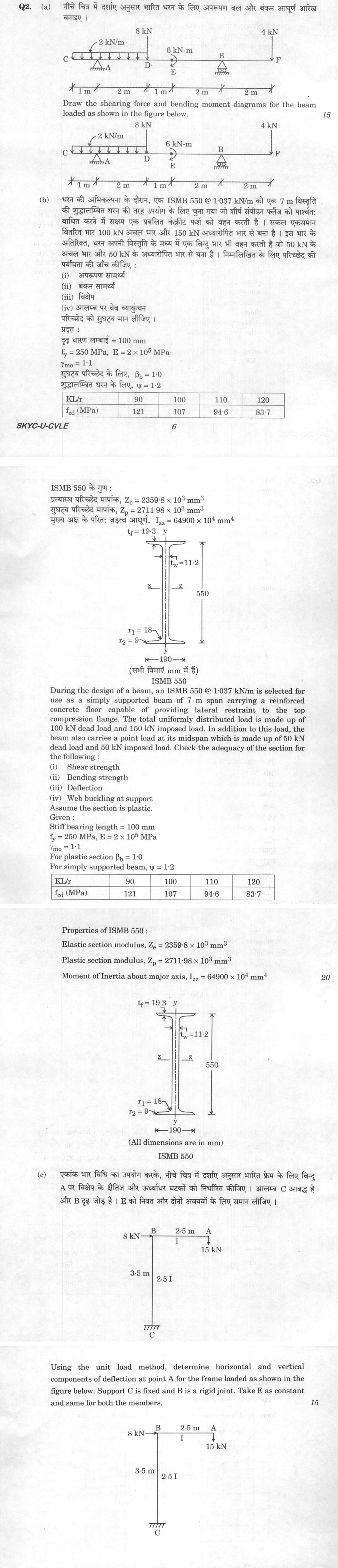
The figure this question refers to, in words
The question paper is a scan and the diagram did not survive as text. This is the figure as read from the original page — every component, value and label — so the question can be worked from the text below.
(a) A horizontal beam with points labeled C, A, D, E, B, and F from left to right. The beam is supported by a pin support at A and a roller support at B. The span is divided into segments with the following lengths: C to A is 1 m, A to D is 2 m, D to E is 1 m, E to B is 2 m, and B to F is 2 m. A uniformly distributed load of 2 kN/m acts downwards over the segment from C to D. A point load of 8 kN acts downwards at point D. A clockwise moment of 6 kN-m is applied at point E. A point load of 4 kN acts downwards at the free end F.
(b) Cross-section of an ISMB 550 steel beam. The total depth is 550 mm. The flange width is 190 mm. The flange thickness (tf) is 19.3 mm. The web thickness (tw) is 11.2 mm. The root radius (r1) is 18 mm. The toe radius (r2) is 9 mm. The vertical axis of symmetry is labeled y-y and the horizontal axis is labeled z-z. All dimensions are in mm.
(c) A frame structure consisting of two members, BC and BA, meeting at a rigid joint B. Member BC is vertical, extending 3.5 m downwards from B to a fixed support at C. The moment of inertia for member BC is labeled as 2.5 I. Member BA is horizontal, extending 2.5 m to the right from B to a free end at A. The moment of inertia for member BA is labeled as I. A horizontal point load of 8 kN acts to the right at joint B. A vertical point load of 15 kN acts downwards at point A.
What "Solve" is asking you to do
Choose the method, then carry it through to a final answer. Identifying what kind of problem this is and why that method applies is the first thing marked; a correct figure arrived at invisibly earns almost nothing.
Structure that answers it
Given data and what is required → method chosen, with the reason it applies → set-up (equation, circuit, free body, trial balance) → working, step by step → answer with units and any condition of validity
Where marks are lost
Doing the middle steps mentally and writing only the result. In mathematics papers, a further loss comes from giving a decimal where the exact value in surds or fractions was wanted, or from skipping the justification a part explicitly asks for.
How this answer will be evaluated
Approach
Framework: null. (a) describe: define > structure or process in order > labelled diagram > significance | (b) evaluate: criteria > evidence > balanced judgment | (c) calculate: given > formula > substitution > result with units > interpretation Full marks: All parts fully solved with correct calculations, clear diagrams, and proper checks against limits.
Key points expected
- Calculate support reactions at A and B
- Plot SFD with correct values at C, A, D, E, B, F
- Plot BMD with correct values at C, A, D, E, B, F
- Account for the 6 kN-m moment at E
- Calculate factored loads (1.5DL + 1.5IL)
- Check shear strength against Vd
- Check bending strength against Md
- Check deflection against L/350
Evaluation rubric
Each sub-part is marked on its own, against the marks and word limit printed on the paper.
- (a) Shearing force and bending moment diagrams for the given beam. 15 marks
describe— define → structure or process in order → labelled diagram → significance
Must cover
- Calculate support reactions at A and B
- Plot SFD with correct values at C, A, D, E, B, F
- Plot BMD with correct values at C, A, D, E, B, F
- Account for the 6 kN-m moment at E
Loses marks
- Incorrect reaction calculations
- Missing the 6 kN-m moment effect
- Diagrams without key values
Earns more
- Label all key points on diagrams
- Show calculation of reactions
- Indicate positive/negative regions
Extra mark
- Neat, to-scale diagrams
- (b) Check adequacy of ISMB 550 for shear, bending, deflection, and web buckling. 20 marks
evaluate— criteria → evidence → balanced judgment
Must cover
- Calculate factored loads (1.5DL + 1.5IL)
- Check shear strength against Vd
- Check bending strength against Md
- Check deflection against L/350
Loses marks
- Missing load factors
- No comparison with permissible limits
- Ignoring web buckling check
Earns more
- Check web buckling at support
- State IS 800:2007 clauses used
- Show all intermediate calculations
Extra mark
- Explicitly state section is adequate/inadequate
- (c) Horizontal and vertical deflection at point A using unit load method. 15 marks
calculate— given → formula → substitution → result with units → interpretation
Must cover
- Determine reactions at fixed support C
- Apply unit horizontal load at A
- Apply unit vertical load at A
- Integrate Mm/EI over both members
Loses marks
- Incorrect moment expressions
- Missing one component of deflection
- No integration steps shown
Earns more
- Show moment expressions for each member
- Correctly handle the rigid joint at B
- State assumptions about E and I
Extra mark
- Neat free body diagrams for unit loads
Model answer coming soon
Every evaluation on this site is marked against a verified model answer. This question's answer is still being written; evaluation opens the moment it lands.
More from Civil Engineering 2023 Paper I
- Q1 (a) An aluminium tensile specimen has a diameter of 30·50 mm and a gauge length 275 mm. I…
- Q2 (a) Draw the shearing force and bending moment diagrams for the beam loaded as shown in t…
- Q3 (a) Design a floor slab to cover a room with internal dimensions of 4·5 m × 6·0 m. The sl…
- Q4 (a) Determine the horizontal component of deflection of joint D of the truss loaded as sh…
- Q5 The flow rate of water over a weir is 3 m³/s. A 1 : 10 scale model of the weir is tested…