Paper I — Q6
A flow of 9·0 m³/s occurs in a long rectangular channel of 3·0 m width with 1·5 m depth of water flow. There is a smooth…
A flow of 9·0 m³/s occurs in a long rectangular channel of 3·0 m width with 1·5 m depth of water flow. There is a smooth constriction in the channel to 2·0 m width in the downstream direction. Answer the following :
What depths are to be expected in and just upstream of the constriction, if losses are neglected ?
Classify the gradually varied flow profile upstream of the constriction, with proper justification.
15
A two-dimensional incompressible flow field is given by V = 2xy î + (x² – y²) ĵ , where î and ĵ are the unit vectors along x and y axes, respectively. Answer the following :
Determine the magnitude and the angle the velocity vector makes with x-axis at x = 3 m and y = 1 m.
Is the flow physically possible ? If so, determine an expression for stream function.
What is the discharge between the streamlines passing through (1, 0) and (0, 1) ?
Is the flow irrotational ? Justify your answer with appropriate reasons.
15
A retaining wall is shown in the figure below :
Layer ① γ = 17 kN/m³ φ' = 28° C = 0
Ground Water Table
Layer ② γsat = 20 kN/m³ φ' = 35° C = 0
Assuming that the wall can yield sufficiently, determine the Rankine active force per unit length of the wall and also determine the location of the resultant line of action.
हिंदी में प्रश्न पढ़ें
3·0 m चौड़ी एक लंबी आयताकार वाहिका में 1·5 m की जल प्रवाह की गहराई पर 9·0 m³/s का एक प्रवाह होता है । वाहिका में, अनुप्रवाह की दिशा में 2·0 m की चौड़ाई तक का एक मसृण संकुचन है । निम्नलिखित के उत्तर दीजिए :
यदि हानियाँ नगण्य हैं, तो संकुचन में और संकुचन के ठीक प्रतिप्रवाह पर प्रत्याशित गहराइयाँ क्या हैं ?
संकुचन के प्रतिप्रवाह पर क्रमशः-परिवर्ती प्रवाह प्रोफाइल का वर्गीकरण उचित औचित्य देते हुए कीजिए ।
15
एक द्वि-विमीय असंपीड्य प्रवाह क्षेत्र V = 2xy î + (x² – y²) ĵ द्वारा दिया गया है, जहाँ î और ĵ क्रमशः x और y अक्षों के साथ एकक सदिश हैं । निम्नलिखित के उत्तर दीजिए :
x = 3 m और y = 1 m पर वेग सदिश का परिमाण और इसके द्वारा x-अक्ष के साथ बनाए जाने वाले कोण का निर्धारण कीजिए ।
क्या प्रवाह भौतिक रूप में संभव है ? यदि हाँ, तो धारा फलन का व्यंजक निर्धारित कीजिए ।
(1, 0) और (0, 1) से गुजरने वाली धारा रेखाओं के बीच निस्सरण क्या है ?
क्या प्रवाह अघूर्णी है ? उचित कारणों के साथ अपने उत्तर का औचित्य सिद्ध कीजिए ।
15
एक प्रतिधारक भित्ति नीचे चित्र में दर्शाई गई है :
z 3 m γ = 17 kN/m³ φ' = 28° C = 0 परत ① भौम जल स्तर 4 m γsat = 20 kN/m³ φ' = 35° C = 0 परत ②
यह मानते हुए कि भित्ति का प्रारंभ पयांस रूप से हो सकता है, रैंकिन का सक्रिय बल भित्ति की प्रति एकक लंबाई पर ज्ञात कीजिए और क्रिया की परिणामी रेखा की स्थिति भी ज्ञात कीजिए ।
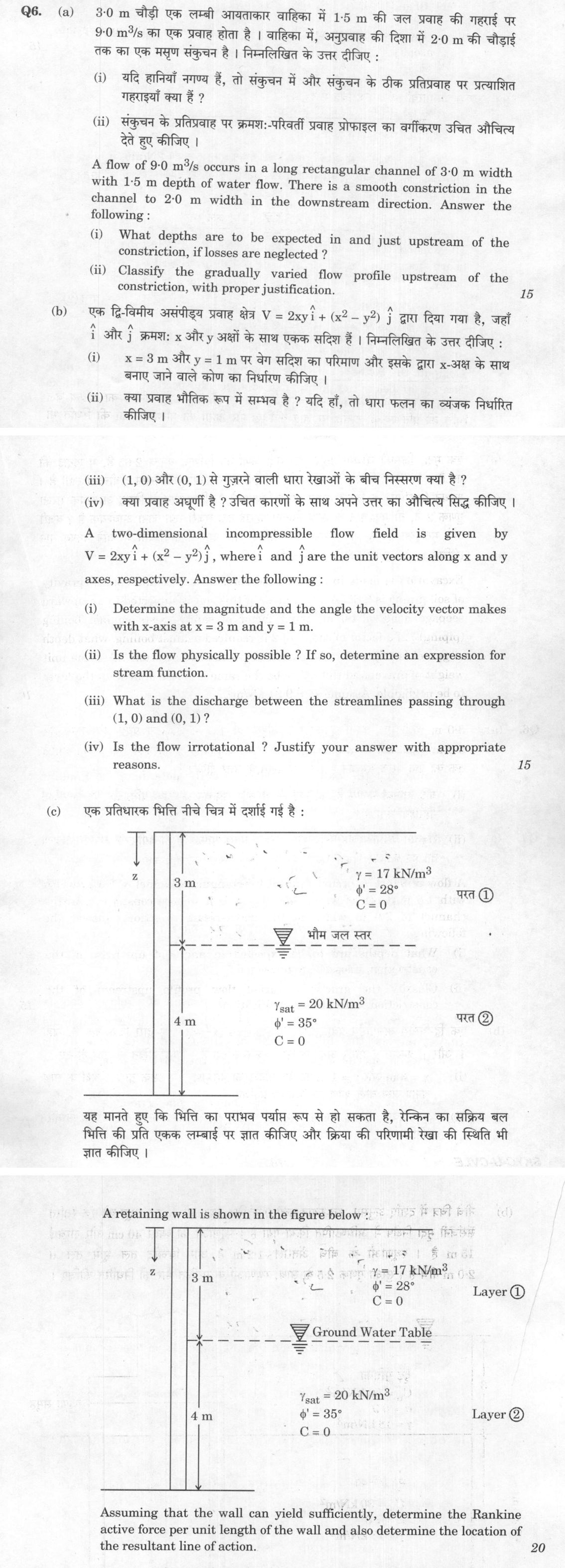
The figure this question refers to, in words
The question paper is a scan and the diagram did not survive as text. This is the figure as read from the original page — every component, value and label — so the question can be worked from the text below.
(c) A cross-section of a retaining wall with a vertical face. The wall retains two soil layers. The total height of the wall is 7 m, divided into two sections. The top section is 3 m high, and the bottom section is 4 m high. The ground water table is located at the interface between the two layers, 3 m below the top of the wall. Layer 1 (top layer, 0 to 3 m depth): Unit weight gamma = 17 kN/m3, friction angle phi' = 28 degrees, cohesion C = 0. Layer 2 (bottom layer, 3 m to 7 m depth): Saturated unit weight gamma_sat = 20 kN/m3, friction angle phi' = 35 degrees, cohesion C = 0. A vertical axis labeled 'z' is shown on the left side, pointing downwards.
A vertical cross-section of a retaining wall. The wall is a vertical line on the left. The backfill soil is divided into two horizontal layers. A vertical dimension line on the left indicates the depth 'z' from the top surface. The top layer, labeled 'Layer 1', has a thickness of 3 m. Its properties are listed as: gamma = 17 kN/m^3, phi' = 28 degrees, C = 0. A horizontal dashed line at the bottom of Layer 1 is labeled 'Ground Water Table' with a standard water level symbol. The bottom layer, labeled 'Layer 2', has a thickness of 4 m. Its properties are listed as: gamma_sat = 20 kN/m^3, phi' = 35 degrees, C = 0. The total height of the wall is 7 m.
Model answer
Written by UPSC Answer Check against this question's marking rubric, to the expected length. UPSC does not publish answers for Mains — this is one way to score well, not an official key.
(a) (i) Take g = 9.81 m/s², horizontal bed, no loss. In the 3 m reach, q₁ = 9/3 = 3 m²/s. At y = 1.5 m, V = 2 m/s, so E = y + V²/(2g) = 1.5 + 2²/(2×9.81) = 1.704 m. In the 2 m throat, q₂ = 9/2 = 4.5 m²/s. For a rectangular channel, critical depth y_c = ∛(q₂²/g) = ∛(4.5²/9.81) = 1.273 m, and minimum specific energy E_min = 1.5 y_c = 1.910 m. Since 1.704 m < 1.910 m, the throat is choked and the flow in it is critical. Depth in constriction = 1.27 m. Just upstream, the width is still 3 m and E = E_min. Solve y + (3/y)²/(2×9.81) = 1.910, i.e. y + 0.4587/y² = 1.910. The subcritical root is chosen because the approach flow is subcritical: y = 1.762 m. Depth just upstream = 1.76 m.
(a) (ii) In the 3 m reach, y_c = ∛(3²/9.81) = 0.972 m. The long-channel depth 1.5 m is the normal depth, y_n = 1.5 m, so y_n > y_c and the slope is mild. Just upstream of the constriction, y = 1.762 m > y_n > y_c. For gradually varied flow, dy/dx = (S0 - Sf)/(1 - Fr²). Here y > y_n gives Sf < S0, and y > y_c gives Fr < 1, so dy/dx > 0; depth rises downstream toward the constriction. Profile: M₁ (mild backwater) profile.
(b) (i) u = 2xy, v = x² - y². At x = 3 m, y = 1 m: u = 6 m/s, v = 8 m/s. Magnitude = √(6² + 8²) = 10 m/s. Angle with +x axis θ = tan⁻¹(v/u) = tan⁻¹(8/6) = tan⁻¹(4/3) = 53.13°. Velocity = 10 m/s at 53.13° to the x-axis.
(b) (ii) For 2-D incompressible flow, continuity requires ∂u/∂x + ∂v/∂y = 0. Here ∂u/∂x = 2y and ∂v/∂y = -2y, so the sum is 0; the flow is physically possible. Using u = ∂ψ/∂y and v = -∂ψ/∂x: ∂ψ/∂y = 2xy gives ψ = xy² + f(x). Then v = -(y² + f'(x)) = x² - y², so f'(x) = -x² and f(x) = -x³/3. ψ = xy² - x³/3 (constant arbitrary), units m²/s.
(b) (iii) Discharge per unit depth between two streamlines is |Δψ|. ψ(1, 0) = 1×0² - 1³/3 = -1/3 m²/s. ψ(0, 1) = 0×1² - 0³/3 = 0. Discharge = 1/3 m²/s per unit depth.
(b) (iv) The z-component of vorticity is ω_z = ∂v/∂x - ∂u/∂y = 2x - 2x = 0 everywhere. The flow is irrotational.
(c) Assume vertical wall, horizontal backfill, Rankine active state, c = 0, and γ_w = 9.81 kN/m³. Active soil pressure is p_a = Ka σ'_v, with Ka = tan²(45° - φ'/2); total horizontal pressure adds u. Layer 1: Ka₁ = tan²(31°) = 0.361. At z = 3 m, σ'_v = 17×3 = 51 kN/m², so p_a = 0.361×51 = 18.41 kN/m². F₁ = ½×3×18.41 = 27.62 kN/m, acting 2.00 m below top. Layer 2: Ka₂ = tan²(27.5°) = 0.271. At z = 3 m, p_a = 0.271×51 = 13.82 kN/m². Below GWT, γ' = 20 - 9.81 = 10.19 kN/m³. At z = 7 m, σ'_v = 51 + 10.19×4 = 91.76 kN/m², so p_a = 0.271×91.76 = 24.87 kN/m². Soil force F₂ = ½(13.82 + 24.87)×4 = 77.37 kN/m. Its arm from top is 3 + [4/3×(13.82 + 2×24.87)/(13.82 + 24.87)] = 5.19 m. Water: u = 0 at z = 3 m and u = 9.81×4 = 39.24 kN/m² at z = 7 m. F_w = ½×4×39.24 = 78.48 kN/m, acting 3 + 2/3×4 = 5.667 m below top. Total active force per unit length, F = 27.62 + 77.37 + 78.48 = 183.47 kN/m. For a 1 m length, M = 27.62×2.00 + 77.37×5.19 + 78.48×5.667 = 901.55 kN·m. Resultant arm = M/F = 901.55/183.47 = 4.91 m below top, i.e. 2.09 m above base. If only the Rankine soil active force is required, F_soil = 27.62 + 77.37 = 105.0 kN/m, with arm (27.62×2.00 + 77.37×5.19)/105.0 = 4.35 m below top. Total active force on wall = 183.5 kN/m at 4.91 m below top; Rankine soil active force alone = 105.0 kN/m at 4.35 m below top.
What "Solve" is asking you to do
Choose the method, then carry it through to a final answer. Identifying what kind of problem this is and why that method applies is the first thing marked; a correct figure arrived at invisibly earns almost nothing.
Structure that answers it
Given data and what is required → method chosen, with the reason it applies → set-up (equation, circuit, free body, trial balance) → working, step by step → answer with units and any condition of validity
Where marks are lost
Doing the middle steps mentally and writing only the result. In mathematics papers, a further loss comes from giving a decimal where the exact value in surds or fractions was wanted, or from skipping the justification a part explicitly asks for.
How this answer will be evaluated
Approach
(a(i)) calculate: given > formula > substitution > result with units > interpretation | (a(ii)) justify: claim > 3-4 reasons > evidence > conclusion | (b(i)) calculate: given > formula > substitution > result with units > interpretation | (b(ii)) justify: claim > 3-4 reasons > evidence > conclusion | (b(iii)) calculate: given > formula > substitution > result with units > interpretation | (b(iv)) justify: claim > 3-4 reasons > evidence > conclusion | (c) calculate: given > formula > substitution > result with units > interpretation Full marks: All calculations correct with clear steps, proper units, and justified conclusions.
Key points expected
- Apply continuity equation Q = A1V1 = A2V2
- Apply Bernoulli's equation (energy conservation)
- Solve for depth y1 and y2
- State assumption of negligible losses
- Determine Froude number (Fr) upstream
- Compare actual depth with critical depth
- Identify profile type (e.g., M1, S2)
- Justify based on slope and depth relation
Evaluation rubric
Each sub-part is marked on its own, against the marks and word limit printed on the paper.
- (a(i)) Depths in and upstream of the constriction.
calculate— given → formula → substitution → result with units → interpretation
Must cover
- Apply continuity equation Q = A1V1 = A2V2
- Apply Bernoulli's equation (energy conservation)
- Solve for depth y1 and y2
- State assumption of negligible losses
Loses marks
- Ignoring velocity head in energy equation
- Unit inconsistency in calculations
Earns more
- Correct calculation of specific energy
- Verification of flow regime (sub/supercritical)
Extra mark
- Sketch of water surface profile
- (a(ii)) Classification of the gradually varied flow profile.
justify— claim → 3-4 reasons → evidence → conclusion
Must cover
- Determine Froude number (Fr) upstream
- Compare actual depth with critical depth
- Identify profile type (e.g., M1, S2)
- Justify based on slope and depth relation
Loses marks
- Classifying without calculating Froude number
- Confusing slope types (M, S, H, C, A)
Earns more
- Sketch of the profile with labels
- Explanation of backwater effect
Extra mark
- Reference to standard GVF profile charts
- (b(i)) Magnitude and angle of velocity vector at (3,1).
calculate— given → formula → substitution → result with units → interpretation
Must cover
- Substitute x=3, y=1 into V components
- Calculate magnitude |V| = sqrt(u^2 + v^2)
- Calculate angle theta = arctan(v/u)
- State units (m/s, degrees)
Loses marks
- Arithmetic errors in substitution
- Confusing angle with x vs y axis
Earns more
- Correct vector notation
- Step-by-step substitution shown
Extra mark
- Vector diagram of velocity components
- (b(ii)) Physical possibility and stream function expression.
justify— claim → 3-4 reasons → evidence → conclusion
Must cover
- Check continuity equation (div V = 0)
- Integrate to find stream function psi
- Verify partial derivatives match u and v
- Conclude on physical possibility
Loses marks
- Skipping continuity check
- Incorrect integration of velocity components
Earns more
- Correct integration constants
- Verification step shown explicitly
Extra mark
- Sketch of streamlines
- (b(iii)) Discharge between streamlines through (1,0) and (0,1).
calculate— given → formula → substitution → result with units → interpretation
Must cover
- Evaluate psi at point (1,0)
- Evaluate psi at point (0,1)
- Calculate difference Q = psi2 - psi1
- State units (m^3/s)
Loses marks
- Sign error in subtraction
- Incorrect point coordinates used
Earns more
- Correct evaluation of stream function
- Clear labeling of points
Extra mark
- Sketch showing the two streamlines
- (b(iv)) Determination of whether flow is irrotational.
justify— claim → 3-4 reasons → evidence → conclusion
Must cover
- Calculate vorticity (curl V)
- Check if vorticity is zero
- State condition for irrotational flow
- Conclude based on calculation
Loses marks
- Confusing divergence with curl
- Incorrect partial differentiation
Earns more
- Correct calculation of partial derivatives
- Clear statement of vorticity components
Extra mark
- Reference to potential flow theory
- (c) Rankine active force and location of resultant.
calculate— given → formula → substitution → result with units → interpretation
Must cover
- Calculate active earth pressure coefficients (Ka)
- Determine pressure distribution for each layer
- Calculate total active force (area of pressure diagram)
- Determine location of resultant (centroid)
Loses marks
- Ignoring water pressure in saturated layer
- Incorrect calculation of Ka values
- Unit inconsistency in force calculation
Earns more
- Correct handling of water pressure
- Clear pressure diagram with values
- Separate calculation for each layer
Extra mark
- Free body diagram of the wall
- Check against passive resistance
Practice this exact question
Write your answer and it is marked point by point against the model answer above — what you covered, what you missed, what you got wrong.
Evaluate my answer →More from Civil Engineering 2023 Paper I
- Q3 (a) Design a floor slab to cover a room with internal dimensions of 4·5 m × 6·0 m. The sl…
- Q4 (a) Determine the horizontal component of deflection of joint D of the truss loaded as sh…
- Q5 The flow rate of water over a weir is 3 m³/s. A 1 : 10 scale model of the weir is tested…
- Q6 A flow of 9·0 m³/s occurs in a long rectangular channel of 3·0 m width with 1·5 m depth o…
- Q7 (a) A 3·0 m high sandy fill material was placed loosely at a relative density of 50%. Lab…
- Q8 (a) At a site, fine sand exists to a depth of 10 m and below this lies a soft clay layer…