Paper II — Q1
(a) Explain with a neat sketch the essential features of English bond in brick masonry construction. (10 marks) (b) State the…
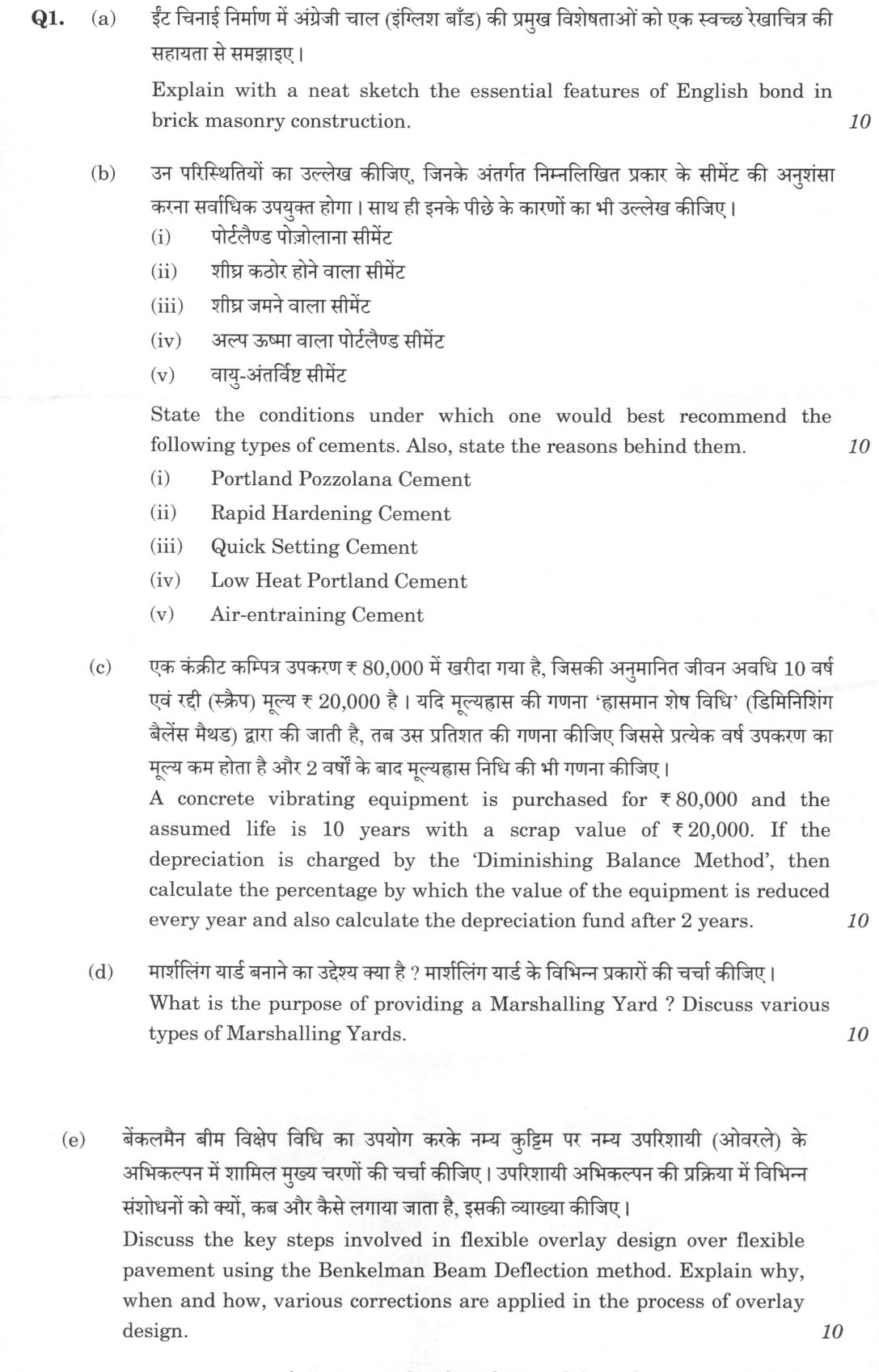
Explain with a neat sketch the essential features of English bond in brick masonry construction. 10 marks
State the conditions under which one would best recommend the following types of cements. Also, state the reasons behind them. Portland Pozzolana Cement
Rapid Hardening Cement
Quick Setting Cement
Low Heat Portland Cement
Air-entraining Cement 10 marks
A concrete vibrating equipment is purchased for ₹ 80,000 and the assumed life is 10 years with a scrap value of ₹ 20,000. If the depreciation is charged by the 'Diminishing Balance Method', then calculate the percentage by which the value of the equipment is reduced every year and also calculate the depreciation fund after 2 years. 10 marks
What is the purpose of providing a Marshalling Yard ? Discuss various types of Marshalling Yards. 10 marks
Discuss the key steps involved in flexible overlay design over flexible pavement using the Benkelman Beam Deflection method. Explain why, when and how, various corrections are applied in the process of overlay design. 10 marks
हिंदी में प्रश्न पढ़ें
ईंट चिनाई निर्माण में अंग्रेजी चाल (इंग्लिश बॉण्ड) की प्रमुख विशेषताओं को एक स्वच्छ रेखाचित्र की सहायता से समझाइए। (10 अंक)
उन परिस्थितियों का उल्लेख कीजिए, जिनके अंतर्गत निम्नलिखित प्रकार के सीमेंट की अनुशंसा करना सर्वाधिक उपयुक्त होगा। साथ ही इनके पीछे के कारणों का भी उल्लेख कीजिए। पोर्टलैण्ड पोज़ोलाना सीमेंट
शीघ्र कठोर होने वाला सीमेंट
शीघ्र जमने वाला सीमेंट
अल्प ऊष्मा वाला पोर्टलैण्ड सीमेंट
वायु-अंतर्विष्ट सीमेंट (10 अंक)
एक कंक्रीट कम्पित्र उपकरण ₹ 80,000 में खरीदा गया है, जिसकी अनुमानित जीवन अवधि 10 वर्ष एवं रद्दी (स्क्रैप) मूल्य ₹ 20,000 है। यदि मूल्यह्रास की गणना 'ह्रासमान शेष विधि' (डिमिनिशिंग बैलेंस मैथड) द्वारा की जाती है, तब उस प्रतिशत की गणना कीजिए जिससे प्रत्येक वर्ष उपकरण का मूल्य कम होता है और 2 वर्षों के बाद मूल्यह्रास निधि की भी गणना कीजिए। (10 अंक)
मार्शलिंग यार्ड बनाने का उद्देश्य क्या है ? मार्शलिंग यार्ड के विभिन्न प्रकारों की चर्चा कीजिए। (10 अंक)
बेंकलमैन बीम विश्लेषण विधि का उपयोग करके नम्य कुट्टिम पर नम्य उपरिशायी (ओवरले) के अभिकल्पन में शामिल मुख्य चरणों की चर्चा कीजिए। उपरिशायी अभिकल्पन की प्रक्रिया में विभिन्न संशोधनों को क्यों, कब और कैसे लगाया जाता है, इसकी व्याख्या कीजिए। (10 अंक)
Model answer
Drafted with AI by UPSC Answer Check against this question's marking rubric, to the expected length. UPSC does not publish answers for Mains — this is one way to score well, not an official key. How we build rubrics and answers.
(a) English bond in brick masonry (10 marks)
English bond is the strongest and most common bond for load-bearing brickwork. It is built of alternate courses of stretchers (bricks laid lengthwise along the face) and headers (bricks laid with their ends showing on the face).

Its essential features are:
- Alternate courses are stretcher courses and header courses, so the face shows stretchers in one course and headers in the next.
- The quoin (corner or stop-end) brick of a header course is a header, and a queen closer, a brick cut lengthwise into half its width, is placed next to it. The queen closer moves the following headers a quarter brick across, so each header lies centrally over the joint of the stretchers below.
- Each course laps the one below by a quarter brick, and the vertical joints of alternate courses are never in a line, so no continuous vertical joint runs through the wall.
- In a one-brick wall the stretcher course shows stretchers on both faces and the header course shows headers across the full thickness, which ties the two faces together.
- Bricks are laid frog up with 10 mm joints, and all vertical joints are filled with mortar.
(b) Choice of cement and reasons (10 marks)
(i) Portland Pozzolana Cement. It is the best choice for mass concrete, hydraulic and marine works, sewers and foundations in aggressive soil, and for plastering and masonry mortars. The pozzolana in it reacts with the free lime released by hydration, giving less lime to leach, lower permeability and heat, and better resistance to sulphates and chlorides. It gains strength more slowly early on, so it needs longer curing.
(ii) Rapid Hardening Cement. It is suited to work where early strength is needed: precast units, early removal of formwork, road repairs, and concreting in cold weather. It has more tricalcium silicate (C₃S) and a finer grind, so it achieves at 3 days the strength that ordinary cement reaches in 7 days. It develops more heat, so it is not for mass concrete.
(iii) Quick Setting Cement. It is used for concreting under water or in running water, for grouting, and for sealing leaks and water-bearing strata, where the concrete must set before it is washed out. The gypsum is reduced and aluminium sulphate or alkali is added, so that the initial set is about 5 minutes and the final set within 30 minutes. The concrete has to be mixed, placed and compacted quickly.
(iv) Low Heat Portland Cement. It is chosen for mass concrete such as dams, thick raft foundations and large piers. It has less C₃S and C₃A and more dicalcium silicate (C₂S), so heat is released slowly and the temperature rise and thermal cracking are limited, though early strength is low.
(v) Air-entraining Cement. It is used for concrete exposed to freezing and thawing and to de-icing salts, such as pavements, canal linings, and structures in cold regions. It contains an air-entraining agent that produces millions of tiny, well-spaced air bubbles (about 3–6% by volume), which give room for freezing water to expand, improve workability and reduce bleeding and segregation. Strength falls by about 5% for each 1% of air.
(c) Diminishing balance depreciation (10 marks)
In the diminishing balance (constant percentage) method the value falls by a fixed fraction r of the value at the start of each year. So the scrap value after n years is S = P(1 − r)ⁿ.
(c)(i) Annual rate. With P = ₹80,000, S = ₹20,000 and n = 10:
(1 − r)¹⁰ = 20,000/80,000 = 0.25
1 − r = 0.25^(1/10) = 0.8706
r = 0.1294, so the value falls by 12.94% each year.
(c)(ii) Depreciation fund after 2 years. Value after 2 years = 80,000 × 0.8706² = 80,000 × 0.7579 = ₹60,629. Check by years: depreciation in year 1 = 80,000 × 0.1294 = ₹10,356, and in year 2 = 69,644 × 0.1294 = ₹9,015.
Depreciation fund after 2 years = 80,000 − 60,629 = ₹19,371 (about ₹19,370).
(d) Marshalling yards (10 marks)
Purpose. A marshalling yard is a railway yard where incoming wagons are received, sorted by destination and made up into new trains. Its functions are to classify and reorder wagons, to detach and attach wagons and locomotives, to store wagons awaiting despatch, to inspect and repair wagons, and to hold a section of the network free from shunting so that through trains keep moving. It improves the use of wagons and the speed of goods movement.
Types. There are three types.
Flat (level) yard. The wagons are pushed by a shunting locomotive over level tracks, and each wagon or cut is moved to its siding in turn. It is simple and cheap to build, but slow and labour-intensive, with the locomotive busy on every movement. It suits small yards with little traffic.
Gravity yard. The yard is laid on a falling gradient in the direction of shunting, so the wagons roll down under gravity to the sorting sidings and are controlled by brakes or retarders. It needs less locomotive shunting than a flat yard, and it is suited to moderate traffic where a suitable natural or built gradient can be had.
Hump yard. A locomotive pushes the rake to the top of an artificial hump, where the wagons are uncoupled one by one. Each wagon then rolls down a steep gradient and along a series of switches into the correct sorting siding, with retarders controlling speed. The yard is the fastest and gives a high capacity and fewer locomotive movements, but has a high cost, and needs trained staff and signalling. It suits large yards with heavy traffic.
(e) Overlay design by the Benkelman Beam Deflection method (10 marks)
Key steps (IRC:81).
- Traffic. Estimate the design traffic in cumulative million standard axles (8.16 t) over the design life (at least 10 years for major roads), from N = 365A[(1 + r)ⁿ − 1]/r × F.
- Survey. Do a pavement condition survey (cracking, rutting) and divide the road into sections of uniform condition, at least about 1 km long each.
- Deflection tests. Load a rear axle to 8170 kg on dual tyres at 5.6 kg/cm² pressure. Take at least 10 points per section, not more than 50 m apart, along the outer wheel path, and place the beam tip between the dual wheels. Read the initial dial reading, the intermediate reading after the truck moves forward 2.7 m, and the final reading after 9 m.
- Corrections (below), then the characteristic deflection, D_c = mean + 2σ for national and state highways, or mean + σ for other roads.
- Overlay thickness. Read from the design chart of characteristic deflection against design traffic, the thickness in bituminous macadam (BM), and convert to other materials. The minimum overlay is 50 mm BM plus a wearing course.
Corrections, and why, when and how.
- Leg correction (why: the front legs of the beam sit in the deflection bowl and move, so the reading understates the true deflection). The apparent deflection is X_a = 2 × (initial − final reading). If the differences from the intermediate and final readings differ by more than 0.025 mm, the true deflection is X_t = X_a + 2.91Y, where Y is twice the difference between the final and intermediate readings. The reported rebound deflection is 2X_t.
- Temperature correction (why: a hot bituminous layer is softer, and deflects more). It applies when the bituminous layer is at least 40 mm thick. Correct to the standard 35 °C by 0.01 mm for each °C: add for a lower pavement temperature and subtract for a higher one.
- Seasonal correction (why: the subgrade is weakest after the monsoon, so tests in the dry season understate the deflection). Multiply the deflection corrected for temperature by a factor from IRC:81 charts, that depends on the type of subgrade soil (sandy or clayey, its plasticity), the annual rainfall, and the moisture content at the time of testing.
The corrected deflections for each section give the mean and standard deviation, then the characteristic deflection, and hence the overlay thickness. If a point differs from the mean by more than one third of the mean, extra points are tested 25 m either side.
How this answer will be evaluated
Evaluation rubric
Each sub-part is marked on its own, against the marks and word limit printed on the paper.
- (a) Explain with a neat sketch the essential features of English bond in brick masonry. 10 marks
Must cover
- Labelled sketch: elevation and plans of two successive courses of a one-brick wall
- Alternate courses of headers and stretchers
- Queen closer next to the quoin header of the header course
- Quarter-brick lap between courses, with no continuous vertical joints
Loses marks
- Sketching Flemish bond (headers and stretchers in the same course).
- Omitting the queen closer or placing it away from the quoin.
- Sketch with no labels or only one course.
Earns more
- Stretchers on both faces in the stretcher course and headers across the thickness in the header course.
- Dimensions or the 10 mm joint noted.
Extra mark
- Comment that English bond is the strongest bond for load-bearing walls
- (b) State the conditions best suited to each of the five cements (PPC, rapid hardening, quick setting, low heat, air-entraining) and the reason for each. 10 marks
Must cover
- PPC: hydraulic, marine and mass works or aggressive exposure; the pozzolana takes up free lime, giving lower heat, permeability and better sulphate resistance
- Rapid hardening: early strength (precast, early formwork removal, repair, cold weather); more C₃S and finer grinding
- Quick setting: underwater or running water, grouting; less gypsum and added aluminate, with set in about 5 and 30 minutes
- Low heat: mass concrete such as dams; less C₃S and C₃A, more C₂S, so slow heat release
- Air-entraining: freeze-thaw and de-icing exposure; tiny bubbles relieve freezing pressure
Loses marks
- Giving only uses and no reasons.
- Recommending rapid hardening cement for mass concrete.
- Confusing quick setting with rapid hardening.
Earns more
- Both the condition and the reason given for all five (2 marks each).
- Limitations such as slow strength gain of PPC or the loss of strength with air.
Extra mark
- Reference to the relevant IS specification for a cement
- (c) Using the declining balance method with P = ₹80,000, S = ₹20,000 and n = 10 years, find the annual rate of depreciation and the depreciation fund after 2 years. 10 marks
Must cover
- S = P(1 − r)ⁿ, so (1 − r)¹⁰ = 0.25
- r = 12.94% per year
- Book value after 2 years = 80,000 × 0.8706² ≈ ₹60,629
- Depreciation fund = ₹19,371
Loses marks
- Using a straight-line formula.
- Subtracting the fund from the wrong base or reporting the book value as the fund.
- Computing (1 − r) = 0.25/10.
Earns more
- Year-by-year check: ₹10,356 and ₹9,015.
- Units (₹ and %) given.
Extra mark
- Comparison with the straight-line rate of 7.5% of cost
- (d) State the purpose of a marshalling yard and discuss the types: flat, gravity and hump yards. 10 marks
Must cover
- Purpose: receive, sort and make up wagons into new trains by destination; other functions such as storage and inspection
- Flat yard: level tracks, shunting locomotive pushes wagons; simple, slow, suits small traffic
- Gravity yard: falling gradient, wagons roll by gravity under brake control; moderate traffic
- Hump yard: locomotive pushes rake to an artificial hump, wagons roll down to sorting sidings with retarders; fastest, for heavy traffic
Loses marks
- Describing a passenger yard or a locomotive shed.
- Giving the purpose without any function beyond storage.
- Swapping the descriptions of the gravity and hump yards.
Earns more
- Comparison of cost, capacity and locomotive use.
- Sketch of the layout of a hump yard.
Extra mark
- Mention of automation or retarders in modern yards
- (e) Discuss the steps of overlay design by the Benkelman Beam method (IRC:81) and explain why, when and how the corrections are applied. 10 marks
Must cover
- Steps: design traffic (msa), condition survey and section division, deflection test (8170 kg, 5.6 kg/cm², at most 50 m apart)
- Leg correction: X_a = 2(d₀ − d_f), X_t = X_a + 2.91Y, and the rebound deflection is twice X_t
- Temperature: 0.01 mm per °C about 35 °C for bituminous layers of 40 mm or more; seasonal: chart factor by soil, rainfall and moisture
- Characteristic deflection mean + 2σ (NH and SH) or mean + σ, and the overlay thickness from the chart against traffic
Loses marks
- Applying the temperature correction to thin surfacings.
- Using the mean deflection alone as the characteristic deflection.
- Listing the corrections with no reasons or method.
Earns more
- Reason for each correction stated.
- The rule for adding or subtracting for temperature and the extra test points at outliers.
Extra mark
- Conversion of BM thickness to DBM or WBM by equivalency
What "Explain" is asking you to do
Make the working of something clear — what sets it off, what follows from what, and what it produces. Explain is the Commission's mechanism word: it dominates the technical papers and the “explain why” stems, where the marks sit in the causal chain and not in the label.
Structure that answers it
State what it is → the initiating condition → the chain of cause, step by step → an instance where it plays out → what the chain produces
Where marks are lost
Describing what something looks like instead of why it works that way. Naming the stages without linking them reads as description too.
Practice this exact question
Write your answer and it is marked point by point against the model answer above — what you covered, what you missed, what you got wrong.
Evaluate my answer →More from Civil Engineering 2026 Paper II
- Q1 (a) Explain with a neat sketch the essential features of English bond in brick masonry co…
- Q2 (a) A vertical curve is formed when a descending gradient of 0·5% meets another descendin…
- Q3 (a) What do you understand by a Gantt or Bar chart with respect to construction project m…
- Q4 (a) What do you understand by the effective CBR value ? Discuss its significance. How is…