Paper II — Q4
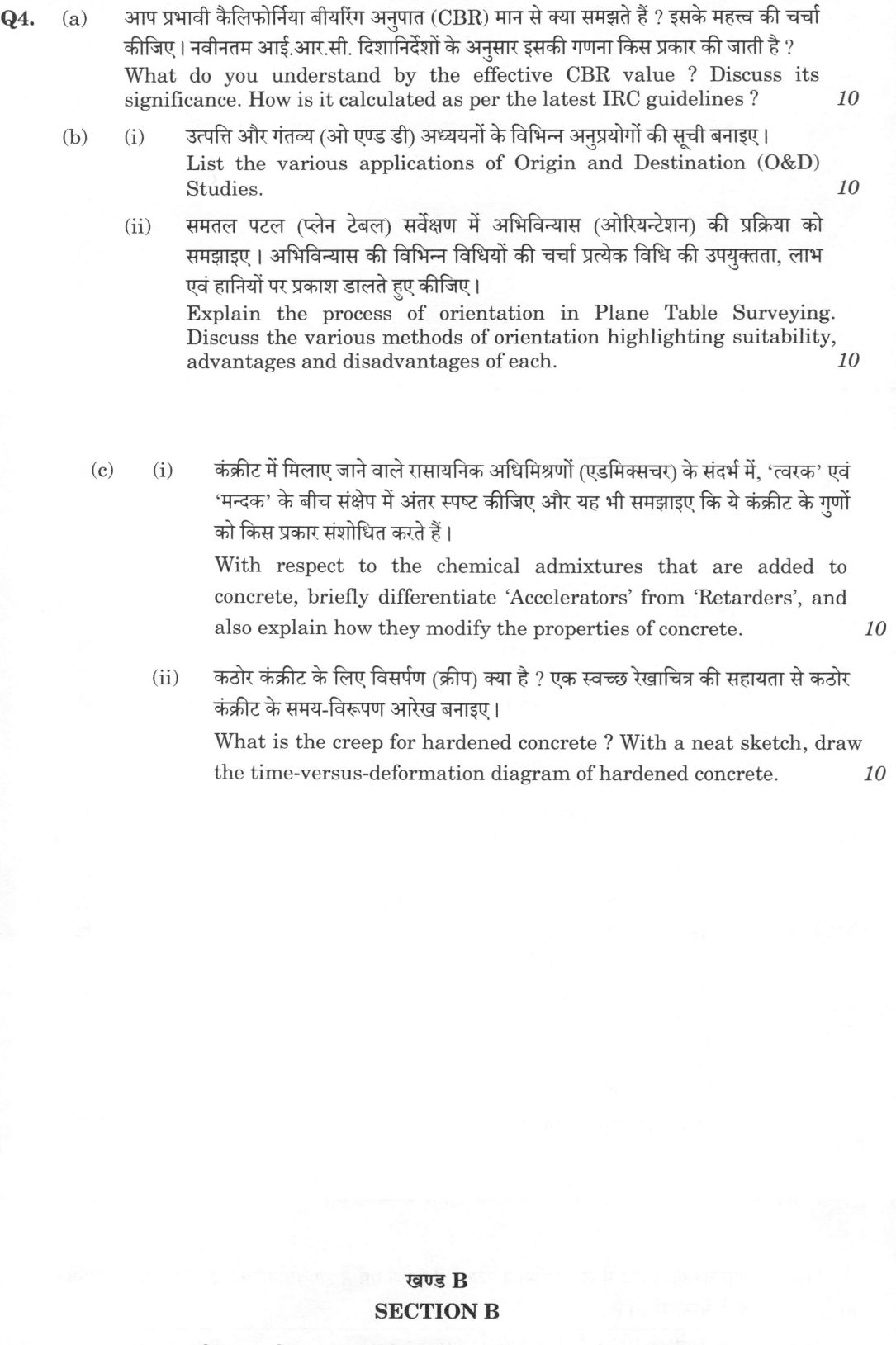
(a) What do you understand by the effective CBR value ? Discuss its significance. How is it calculated as per the latest IRC…
What do you understand by the effective CBR value ? Discuss its significance. How is it calculated as per the latest IRC guidelines ? 10 marks
List the various applications of Origin and Destination (O&D) Studies. 10 marks
Explain the process of orientation in Plane Table Surveying. Discuss the various methods of orientation highlighting suitability, advantages and disadvantages of each. 10 marks
With respect to the chemical admixtures that are added to concrete, briefly differentiate 'Accelerators' from 'Retarders', and also explain how they modify the properties of concrete. 10 marks
What is the creep for hardened concrete ? With a neat sketch, draw the time-versus-deformation diagram of hardened concrete. 10 marks
हिंदी में प्रश्न पढ़ें
आप प्रभावी कैलिफोर्निया बीयरिंग अनुपात (CBR) मान से क्या समझते हैं ? इसके महत्व की चर्चा कीजिए। नवीनतम आई.आर.सी. दिशानिर्देशों के अनुसार इसकी गणना किस प्रकार की जाती है ? (10 अंक)
उत्पत्ति और गंतव्य (ओ एण्ड डी) अध्ययनों के विभिन्न अनुप्रयोगों की सूची बनाइए। (10 अंक)
समतल पटल (प्लेन टेबल) सर्वेक्षण में अभिविन्यास (ओरियन्टेशन) की प्रक्रिया को समझाइए। अभिविन्यास की विभिन्न विधियों की चर्चा प्रत्येक विधि की उपयुक्तता, लाभ एवं हानियों पर प्रकाश डालते हुए कीजिए। (10 अंक)
कंक्रीट में मिलाए जाने वाले रासायनिक अधिमिश्रणों (एडमिक्सचर) के संदर्भ में, 'त्वरक' एवं 'मन्दक' के बीच संक्षेप में अंतर स्पष्ट कीजिए और यह भी समझाइए कि ये कंक्रीट के गुणों को किस प्रकार संशोधित करते हैं। (10 अंक)
कठोर कंक्रीट के लिए विसर्पण (क्रीप) क्या है ? एक स्वच्छ रेखाचित्र की सहायता से कठोर कंक्रीट के समय-विरूपण आरेख बनाइए। (10 अंक)
Model answer
Drafted with AI by UPSC Answer Check against this question's marking rubric, to the expected length. UPSC does not publish answers for Mains — this is one way to score well, not an official key. How we build rubrics and answers.
(a) Effective CBR of the subgrade (10 marks)
Meaning. The effective CBR is the single CBR value that represents a layered subgrade, that is, the CBR at which a uniform subgrade would give the same surface deflection as the actual layers. It is needed when the 500 mm subgrade has two layers of different strength, or when the subgrade differs significantly from the embankment or natural soil beneath it. IRC:37-2018 defines it through the effective resilient modulus of the subgrade.
Significance. The subgrade is the foundation of the pavement. Its strength controls the thickness of the granular and bituminous layers needed, and, in the mechanistic method, it sets the vertical compressive strain at the top of the subgrade that governs rutting. Using the CBR of the top layer alone over a weak embankment overestimates the support and gives an under-designed pavement, while using the weakest value alone wastes material.
Calculation as per IRC:37-2018.
- Design CBR of each layer. Determine the 4-day soaked CBR of the soil remoulded at the placement density (97% of the maximum dry density from the heavy compaction test) and moisture content, for the top 500 mm subgrade and for the embankment or natural soil below. Adopt the 90th percentile value for expressways, national and state highways, and for other roads the 80th percentile when the design traffic is below 20 msa and the 90th percentile otherwise.
- Convert each CBR to a resilient modulus. M_RS = 10.0 CBR (MPa) for CBR ≤ 5%, and M_RS = 17.6 (CBR)^0.64 for CBR > 5%.
- Two-layer analysis. Compute the maximum surface deflection δ for the two-layer system (500 mm subgrade over a semi-infinite embankment or soil layer) using IITPAVE, for a 40 kN wheel load with 0.56 MPa contact pressure (loaded radius a = 150.8 mm).
- Effective modulus. Take the modulus of a uniform half-space that gives the same deflection: M_RS(eff) = 2p a (1 − μ²)/δ, with μ = 0.35.
- Limits and use. The effective modulus is limited to a maximum of 100 MPa, and the corresponding effective CBR (from the equations above) is used in the design, and should exceed 5% for roads with more than 450 commercial vehicles per day.
(b)(i) Applications of origin and destination (O&D) studies (10 marks)
O&D data show where trips start and end, along with their purpose, mode and volume. They are collected by roadside or home interviews, post-card and licence-plate surveys, and now also by GPS, mobile-phone and ANPR data. Their applications are:
- Planning. Identifying desire lines and the main travel corridors, and finding the traffic generated and attracted by each zone. Forecasting future travel with growth-factor and gravity models. Deciding new links, bypasses and ring roads, and the phasing of road improvements.
- Design. Deciding the location and alignment of a bypass by the volume of through traffic. Choosing the type and geometry of intersections, flyovers and grade separations. Determining the number of lanes, and the capacity needed.
- Terminals and facilities. Locating bus stops and bus, truck and railway terminals, parking areas, toll plazas and airports. Planning public-transport routes and frequencies.
- Modelling. Building and calibrating the four-stage transport model (trip generation, distribution, mode split and assignment), and validating the assignment against observed flows.
- Traffic management. Planning one-way schemes, turn bans, diversions and parking restrictions. Coordinating signals, routing freight traffic away from congested areas, and assessing the effect of new policies or new facilities.
- Other. Estimating the share of through, local and internal traffic; studying the travel pattern of freight and passengers; and evaluating road-user costs and the economic viability of projects.
(b)(ii) Orientation in plane table surveying (10 marks)
Process. Orientation is the process of setting the plane table at a station so that all lines on the sheet are parallel to the corresponding lines on the ground. It is necessary because details plotted from different stations fit together on one sheet only if the table has the same orientation at every station. Without it, the plotted map is distorted.
Methods.
- By magnetic needle (trough compass). The trough compass is placed along the magnetic-meridian line drawn on the sheet at the first station, and the table is turned until the needle points to the ends of the trough. This is quick and simple, and is suited to small-scale surveys in areas free from local attraction. It is the least accurate, because the needle is affected by local attraction from iron and electrical lines, so it is not suitable for large-scale work.
- By backsighting. At a new station B, the alidade is placed along the plotted line ba, and the table is turned until the ranging rod at the previous station A is bisected, and then clamped. This is accurate and is the standard method for traversing, but it requires the line to be already plotted and the previous station to be visible. Any error in orientation at the earlier station is carried forward.
- By resection. The table is oriented at an unknown station using well-defined points already plotted on the sheet. It is suited to stations that are inaccessible or that have to be fixed from existing control points.
- Three-point problem. The station P is found by sighting three known points A, B and C. It is solved by the tracing-paper (Bessel) method, by Lehmann's trial-and-error rules using the triangle of error, or by the mechanical method. It is accurate if the points are well placed, but the solution fails if P lies on the circle through the three points (the danger circle), and it needs three visible, well-defined points.
- Two-point problem. Two known points A and B are used with an auxiliary station Q, from which rays to A and B are drawn with the table roughly oriented. The table is then set at P and oriented by backsighting Q, and back-rays are drawn from A and B, the intersection giving the position of P. This is used when only two points are visible, but it involves more work and trial and error, and is less accurate.
(c)(i) Accelerators and retarders (10 marks)
Difference. An accelerator is a chemical admixture that shortens the setting time and speeds up early hardening and strength gain. Examples are calcium chloride, calcium formate, triethanolamine and sodium silicate. A retarder is an admixture that slows down the setting and hydration. Examples are gypsum in excess, sugar, calcium lignosulphonate, tartaric acid and borax.
Effect on the properties of concrete.
- Accelerators. In fresh concrete, they shorten the initial and final setting time, and so the time available for placing. In hardened concrete, they raise the early strength, so that formwork can be struck sooner, but they may slightly reduce the later strength and increase shrinkage. Calcium chloride corrodes reinforcement, so it should not be used in reinforced or prestressed concrete. They are used in cold weather concreting, emergency repair, shotcrete, and where quick reuse of the formwork is needed.
- Retarders. In fresh concrete, they lengthen the setting time and keep the mix workable for longer, and they reduce the rate of heat release. In hardened concrete, they lower the early strength but usually improve the later strength. They are used in hot weather, in long hauls of ready-mixed concrete, in large pours, and in slip-form work, to avoid cold joints, and in grouting.
(c)(ii) Creep of hardened concrete (10 marks)
Definition. Creep is the gradual increase in strain of hardened concrete with time under a sustained constant stress, in addition to the instantaneous elastic strain on loading. It is mainly due to the movement of gel water and the viscous flow of the cement gel. The creep coefficient is φ = ε_c/ε_e, taken in IS 456 as about 2.2, 1.6 and 1.1 for loading at 7 days, 28 days and 1 year.
Diagram. The strain-time diagram is shown.

On loading at t₀ there is an instantaneous elastic strain ε_e. Under the sustained load, the strain then increases with time at a decreasing rate, giving the creep strain ε_c, which approaches a limiting value. On removal of the load at t₁, there is an instantaneous recovery, roughly equal to the elastic strain, followed by a slow creep recovery, which is only partial. A residual (permanent) strain remains. Creep increases with a higher stress, w/c ratio and cement paste content, and with earlier age at loading and lower humidity, and it is reduced by strong, stiff aggregate.
How this answer will be evaluated
Evaluation rubric
Each sub-part is marked on its own, against the marks and word limit printed on the paper.
- (a) Define the effective CBR of a subgrade, discuss its significance and explain how it is calculated as per the latest IRC guidelines. 10 marks
Must cover
- Definition: single CBR (or modulus) equivalent to the layered subgrade, giving the same surface deflection
- Significance: the subgrade strength governs pavement thickness and the subgrade strain criterion; a weak embankment below a good top layer is otherwise ignored
- Calculation: 4-day soaked CBR of each layer converted to M_RS = 10 CBR (≤ 5%) or 17.6 CBR^0.64 (> 5%)
- Two-layer (500 mm over semi-infinite) IITPAVE deflection for 40 kN and 0.56 MPa, then effective modulus, capped at 100 MPa, and back to effective CBR
Loses marks
- Defining the effective CBR as the mean of the CBR values of the layers.
- Using unsoaked CBR.
- Omitting the conversion to resilient modulus.
Earns more
- Design percentile (90th, or 80th for other roads under 20 msa) and compaction condition stated.
- Effective CBR above 5% for roads with more than 450 cvpd.
Extra mark
- Reference to IRC:37-2018 Section 6.4
- (b)(i) List the various applications of origin and destination (O&D) studies. 10 marks
Must cover
- Planning: desire lines, trip generation and attraction, forecasting, new links and bypasses
- Design: location of bypasses, intersection and flyover types, lanes and capacity
- Terminals and facilities: bus, truck and rail terminals, parking, toll plazas, public transport routes
- Modelling and traffic management: four-stage models, one-way schemes, diversions, signal coordination
Loses marks
- Describing the survey procedure at length rather than the applications.
- Confusing O&D studies with spot speed or volume studies.
- Applications without any link to the O&D data.
Earns more
- A one-line mention of the survey methods (roadside, home interview, post-card, licence plate, GPS).
- At least eight distinct applications given in an enumerated list.
Extra mark
- Economic evaluation of projects and road-user costs
- (b)(ii) Explain the process of orientation in plane table surveying and discuss the methods, with suitability, advantages and disadvantages of each. 10 marks
Must cover
- Orientation: table set so that the sheet lines are parallel to the ground lines; needed for consistent plotting from different stations
- Magnetic needle: quick, small scale, affected by local attraction
- Backsighting: accurate, standard for traversing, needs a plotted line and visibility, error propagates
- Resection: three-point (Bessel, Lehmann, mechanical; danger circle) and two-point problems
Loses marks
- Explaining orientation as levelling of the table.
- Describing only one method.
- Ignoring the two-point problem or the danger circle.
Earns more
- Suitability, advantages and disadvantages given for each method.
- Reference to the error triangle in the trial-and-error method.
Extra mark
- Choice of method by scale and the availability of control points
- (c)(i) Differentiate accelerators from retarders and explain how they modify the properties of concrete. 10 marks
Must cover
- Accelerators shorten the setting time and raise early strength (CaCl₂, calcium formate, triethanolamine)
- Retarders delay the setting time (gypsum, sugar, lignosulphonate, tartaric acid)
- Effects on fresh concrete (setting time, workability) and hardened concrete (early and later strength, shrinkage)
- Uses: cold weather, repair, shotcrete for accelerators; hot weather, long haul, large pours for retarders
Loses marks
- Interchanging the effects of the two admixtures.
- Recommending calcium chloride in prestressed concrete.
- Listing chemicals with no effect on the properties.
Earns more
- Chloride corrosion caution for accelerators.
- Retarders lowering the heat-release rate.
Extra mark
- Reference to IS 9103 for admixtures
- (c)(ii) Define creep of hardened concrete and draw the labelled time-deformation diagram. 10 marks
Must cover
- Definition: increase in strain with time under sustained constant stress, over and above the instantaneous elastic strain
- Diagram: elastic strain on loading, creep strain rising at a decreasing rate to a limit
- On unloading: instantaneous recovery and creep recovery, both labelled
- Residual permanent strain shown, and axes labelled with t₀ and t₁
Loses marks
- Confusing creep with shrinkage or relaxation.
- Diagram with no time axis or no recovery part.
- Showing complete recovery after unloading.
Earns more
- Factors affecting creep and the creep coefficient (IS 456 values 2.2, 1.6 and 1.1).
- Cause: gel water movement and viscous flow of the cement gel.
Extra mark
- Effect of creep on prestress loss and deflection
What "Discuss" is asking you to do
Lay the issue out from more than one side — how it arose, what is claimed for it, what is held against it, and where it now stands. UPSC attaches discuss to broad topics with several live dimensions, so coverage of the dimensions earns more than the strength of your opinion.
Structure that answers it
Set the issue up → the case as it is made → the case against → the dimension both sides leave out → where the balance now lies
Where marks are lost
Listing facts with no thread between them, or arguing one side throughout and calling it a discussion.
Practice this exact question
Write your answer and it is marked point by point against the model answer above — what you covered, what you missed, what you got wrong.
Evaluate my answer →More from Civil Engineering 2026 Paper II
- Q1 (a) Explain with a neat sketch the essential features of English bond in brick masonry co…
- Q2 (a) A vertical curve is formed when a descending gradient of 0·5% meets another descendin…
- Q3 (a) What do you understand by a Gantt or Bar chart with respect to construction project m…
- Q4 (a) What do you understand by the effective CBR value ? Discuss its significance. How is…
- Q5 (a) What is the difference between a flood hydrograph and a mass curve ? Using the follow…
- Q6 (a) The following information is available regarding the relationship between trap effici…
- Q7 (a) A sedimentation tank is treating 5 million litres of sewage per day containing 250 pp…