Paper II — Q7
(a) A sedimentation tank is treating 5 million litres of sewage per day containing 250 ppm of suspended solids. The tank removes…
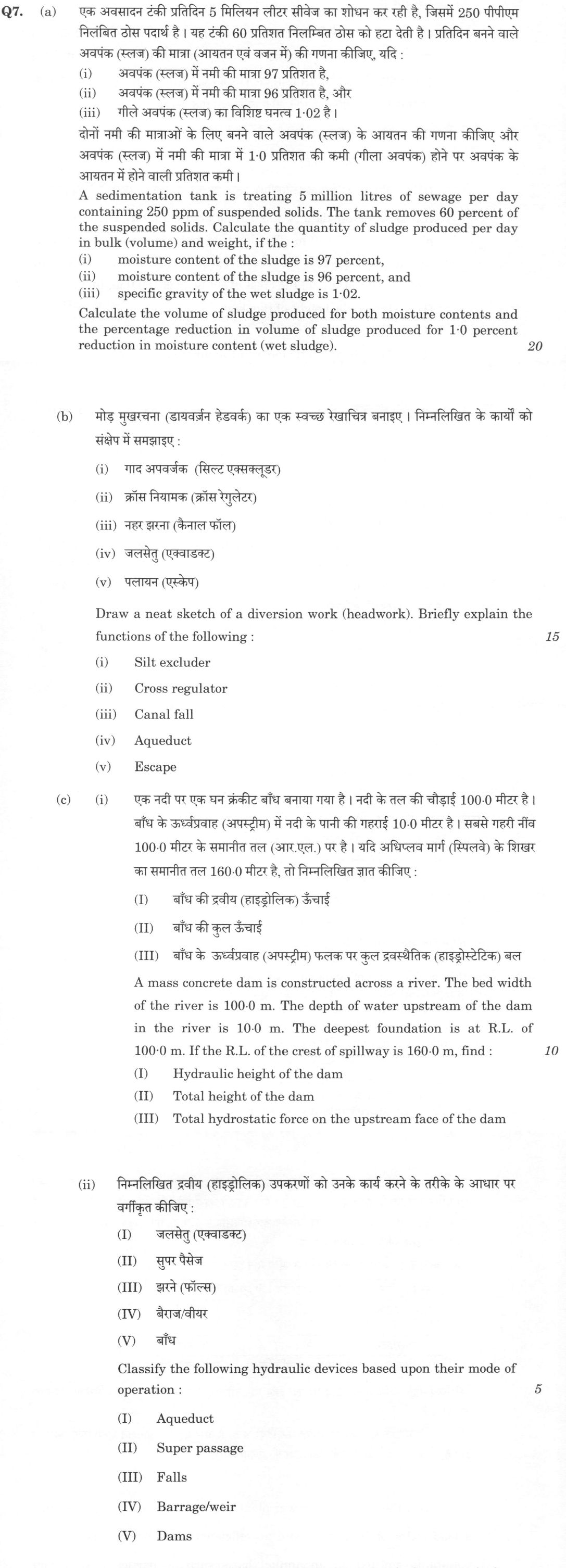
A sedimentation tank is treating 5 million litres of sewage per day containing 250 ppm of suspended solids. The tank removes 60 percent of the suspended solids. Calculate the quantity of sludge produced per day in bulk (volume) and weight, if the : moisture content of the sludge is 97 percent,
moisture content of the sludge is 96 percent, and
specific gravity of the wet sludge is 1·02. Calculate the volume of sludge produced for both moisture contents and the percentage reduction in volume of sludge produced for 1·0 percent reduction in moisture content (wet sludge). 20 marks
Draw a neat sketch of a diversion work (headwork). Briefly explain the functions of the following :
Silt excluder
Cross regulator
Canal fall
Aqueduct
Escape 15 marks
A mass concrete dam is constructed across a river. The bed width of the river is 100·0 m. The depth of water upstream of the dam in the river is 10·0 m. The deepest foundation is at R.L. of 100·0 m. If the R.L. of the crest of spillway is 160·0 m, find :
(I) Hydraulic height of the dam
(II) Total height of the dam
(III) Total hydrostatic force on the upstream face of the dam 10 marks
Classify the following hydraulic devices based upon their mode of operation : (I) Aqueduct (II) Super passage (III) Falls (IV) Barrage/weir (V) Dams 5 marks
हिंदी में प्रश्न पढ़ें
एक अवसादन टंकी प्रतिदिन 5 मिलियन लीटर सीवेज का शोधन कर रही है, जिसमें 250 पीपीएम निलंबित ठोस पदार्थ है । यह टंकी 60 प्रतिशत निलंबित ठोस को हटा देती है । प्रतिदिन बनने वाले अवपंक (स्लज) की मात्रा (आयतन एवं वजन में) की गणना कीजिए, यदि : अवपंक (स्लज) में नमी की मात्रा 97 प्रतिशत है,
अवपंक (स्लज) में नमी की मात्रा 96 प्रतिशत है, और
गीले अवपंक (स्लज) का विशिष्ट घनत्व 1·02 है । दोनों नमी की मात्राओं के लिए बनने वाले अवपंक (स्लज) के आयतन की गणना कीजिए और अवपंक (स्लज) में नमी की मात्रा में 1·0 प्रतिशत की कमी (गीला अवपंक) होने पर अवपंक के आयतन में होने वाली प्रतिशत कमी । (20 अंक)
मोड़ मुखरचना (डायवर्जन हैडवर्क) का एक स्वच्छ रेखाचित्र बनाइए । निम्नलिखित के कार्यों को संक्षेप में समझाइए :
गाद अपवर्जक (सिल्ट एक्सक्लूडर)
क्रॉस नियामक (क्रॉस रेगुलेटर)
नहर झरना (कैनाल फॉल)
जलसेतु (एक्वाडक्ट)
पलायन (एस्केप) (15 अंक)
एक नदी पर एक घन कंक्रीट बाँध बनाया गया है । नदी के तल की चौड़ाई 100·0 मीटर है । बाँध के ऊर्ध्वप्रवाह (अपस्ट्रीम) में नदी के पानी की गहराई 10·0 मीटर है । सबसे गहरी नींव 100·0 मीटर के समानीत तल (आर.एल.) पर है । यदि अधिप्लव मार्ग (स्पिलवे) के शिखर का समानीत तल 160·0 मीटर है, तो निम्नलिखित ज्ञात कीजिए :
(I) बाँध की द्रवीय (हाइड्रोलिक) ऊँचाई
(II) बाँध की कुल ऊँचाई
(III) बाँध के ऊर्ध्वप्रवाह (अपस्ट्रीम) फलक पर कुल द्रवस्थैतिक (हाइड्रोस्टेटिक) बल (10 अंक)
निम्नलिखित द्रवीय (हाइड्रोलिक) उपकरणों को उनके कार्य करने के तरीके के आधार पर वर्गीकृत कीजिए : (I) जलसेतु (एक्वाडक्ट) (II) सुपर पैसेज (III) झरने (फॉल्स) (IV) बैराज/वीयर (V) बाँध (5 अंक)
Model answer
Drafted with AI by UPSC Answer Check against this question's marking rubric, to the expected length. UPSC does not publish answers for Mains — this is one way to score well, not an official key. How we build rubrics and answers.
(a) Sludge from a sedimentation tank (20 marks)
Dry solids removed. The flow is 5 MLD = 5 × 10⁶ litres/day = 5000 m³/day, and 250 ppm = 250 mg/l = 0.25 kg/m³. The suspended solids entering are 5000 × 0.25 = 1250 kg/day, and the tank removes 60%:
dry solids = 0.60 × 1250 = 750 kg/day
Sludge at 97% moisture. The solids are 3% of the wet sludge by weight:
- weight of wet sludge = 750/0.03 = 25 000 kg/day = 25.0 t/day
- volume = weight/(specific gravity × 1000) = 25 000/(1.02 × 1000) = 24.51 m³/day
Sludge at 96% moisture. The solids are 4% of the wet sludge:
- weight of wet sludge = 750/0.04 = 18 750 kg/day = 18.75 t/day
- volume = 18 750/(1.02 × 1000) = 18.38 m³/day
Reduction caused by 1% less moisture.
Reduction in volume = (24.51 − 18.38)/24.51 = 6.13/24.51 = 25%
The same result follows from the ratio of the two weights, since the specific gravity is the same: (1/0.03 − 1/0.04)/(1/0.03) = 1 − 3/4 = 25%. A 1% drop in moisture cuts the volume of sludge to be handled by a quarter, which is why thickening and dewatering are worth doing.
(b) Diversion headwork: sketch and functions (15 marks)
A diversion headwork is a structure across a river that raises the water level and diverts a regulated supply into a canal. Its plan is shown, with the weir or barrage, the undersluices, the divide wall, the silt excluder, the canal head regulator, the fish ladder and the guide banks and marginal bunds.

Functions.
- (i) Silt excluder. It is a set of tunnels in the undersluice pocket in front of the head regulator, which carries the bottom layer of water, heavy with silt, through the undersluices to the river downstream. Only the clearer upper layer enters the canal. It acts before the silt gets into the canal, unlike a silt ejector, which removes it after it has entered.
- (ii) Cross regulator. It is a gated structure across the parent canal, just downstream of an offtake. It holds up the water level so that the required discharge enters the branch or distributary, regulates the flow in the parent canal, and can be closed for maintenance. It usually carries a road bridge as well.
- (iii) Canal fall. It is a drop in the canal bed where the ground slopes more steeply than the permitted canal gradient. It lets the water fall safely to the lower level and dissipates the excess energy, so that the bed and banks are not scoured, and the canal keeps its designed slope.
- (iv) Aqueduct. It is a cross-drainage work that carries the canal over a natural drainage or river in a trough, and the drainage flows below at a lower level, through the barrels.
- (v) Escape. It is a structure that lets surplus water from the canal out into a natural drain, and protects the canal from breaches when the inflow is too much, for example after heavy rain or when the downstream gates are closed. It also empties the canal for repairs.
(c)(i) Heights and hydrostatic force on a mass concrete dam (10 marks)
Definitions. The hydraulic height is the difference between the highest controlled water surface (here the spillway crest level) and the lowest point of the original river bed, which is the depth of water the dam holds back. The total (structural) height is the difference between the top of the dam and the lowest point of the foundation.
Assumptions. The reservoir is full to the spillway crest, RL 160.0 m, so the 10.0 m water depth in the river at the dam places the river bed at RL 160.0 − 10.0 = RL 150.0 m. The top of the dam is taken at the level of the spillway crest, RL 160.0 m, as no freeboard is given.
(I) Hydraulic height = 160.0 − 150.0 = 10.0 m.
(II) Total height = 160.0 − 100.0 = 60.0 m, so the foundation goes 50 m below the river bed.
(III) Total hydrostatic force on the upstream face. The face is loaded by the water only above the river bed, and the width of the river bed is 100 m:
F = ½ γ h² b = ½ × 9.81 × 10.0² × 100 = 49 050 kN ≈ 49.05 MN
It acts horizontally at h/3 = 3.33 m above the river bed.
(c)(ii) Classification of hydraulic structures (5 marks)
- Dams: storage works. They impound water in a reservoir, and regulate the supply over time, from the wet to the dry season.
- Weir and barrage: diversion (river) works. They raise the water level and divert a regulated supply into a canal, with little or no storage. A weir has a raised solid crest, and a barrage is mainly gated.
- Aqueduct and super passage: cross-drainage works. They carry a canal and a natural drainage across each other. An aqueduct carries the canal over the drainage, and a super passage carries the drainage over the canal.
- Falls: canal drop or energy-dissipation works. They lower the canal bed by a drop and dissipate the surplus energy, so that a gentle canal slope is kept on steep ground.
How this answer will be evaluated
Evaluation rubric
Each sub-part is marked on its own, against the marks and word limit printed on the paper.
- (a) For the 5 MLD sedimentation tank (250 ppm SS, 60% removal) find the daily sludge by weight and volume at 97% and 96% moisture (specific gravity 1.02) and the percentage reduction in volume for the 1% drop in moisture. 20 marks
Must cover
- Dry solids 5 × 10⁶ l × 250 mg/l × 0.60 = 750 kg/day
- At 97% moisture: 750/0.03 = 25 000 kg/day and volume 24.51 m³/day
- At 96% moisture: 750/0.04 = 18 750 kg/day and volume 18.38 m³/day
- Reduction in volume (24.51 − 18.38)/24.51 = 25%
Loses marks
- Taking the sludge as the whole 1250 kg/day of solids.
- Using 97% or 96% as the solids content.
- Dividing the weight by 1000 without the specific gravity.
Earns more
- Unit conversion of ppm to mg/l and MLD to m³.
- Volume from weight using the specific gravity 1.02.
Extra mark
- Statement that the ratio 3/4 gives 25% directly
- (b) Draw a neat sketch of a diversion headwork and explain the functions of the silt excluder, cross regulator, canal fall, aqueduct and escape. 15 marks
Must cover
- Labelled plan: weir or barrage, undersluices, divide wall, head regulator, silt excluder, fish ladder, guide banks and marginal bunds
- Silt excluder: tunnels in the undersluice pocket that pass bottom silt downstream (not a silt ejector)
- Cross regulator: gate across the parent canal below an offtake to head up water and control discharge; canal fall: drop and energy dissipation on steep ground
- Aqueduct: canal carried over a drainage; escape: releases surplus canal water to a natural drain
Loses marks
- Confusing the silt excluder with the silt ejector.
- Describing the aqueduct as carrying drainage over the canal.
- A sketch without the head regulator or undersluices.
Earns more
- Direction of flow and upstream and downstream marked.
- Reason for each function given.
Extra mark
- Difference between a weir and a barrage in the headwork
- (c)(i) Find the hydraulic height, the total height and the hydrostatic force on the upstream face of the mass concrete dam, stating the definitions. 10 marks
Must cover
- Definitions: hydraulic height is the highest controlled water level above the lowest original bed; total height is the top of dam above the lowest foundation
- Assumptions stated: reservoir at crest RL 160 with bed at RL 150, top of dam at crest
- Hydraulic height 10.0 m and total height 60.0 m
- F = ½γh²b = ½ × 9.81 × 10² × 100 = 49 050 kN, acting at h/3 above the bed
Loses marks
- Taking the hydraulic height as 60 m.
- Taking the pressure over the 60 m total height.
- Omitting the factor ½ or the width of 100 m.
Earns more
- Point of action of the force given.
- Consistent units in kN.
Extra mark
- Effect of freeboard on the total height
- (c)(ii) Classify the aqueduct, super passage, falls, barrage or weir and dams by their mode of operation. 5 marks
Must cover
- Dams: storage works
- Barrage or weir: diversion (river) works
- Aqueduct and super passage: cross-drainage works
- Falls: canal drop or energy-dissipation works, with the distinguishing feature of each class
Loses marks
- Classifying a fall as a cross-drainage work.
- Classifying a barrage as a storage work.
- Naming classes with no distinguishing feature.
Earns more
- Weir with a solid crest against the gated barrage.
- Aqueduct carries the canal over; super passage carries the drainage over.
Extra mark
- Mention of siphon aqueducts running under pressure
What "Calculate" is asking you to do
Apply the standard formula or schedule to data the question has already supplied — a table of readings, cost records, a balance sheet — and produce the number. The method is rarely in doubt; the marks sit in the named intermediate quantities, each of which has to appear as a labelled line.
Structure that answers it
Data as given → formula or standard treatment, named → substitution → each intermediate, labelled → result with units
Where marks are lost
Omitting an intermediate the marking scheme pays for separately, or rounding at an intermediate line so the final figure drifts. In commerce and accountancy, any figure in a statement that no numbered working note supports is treated as unearned.
Practice this exact question
Write your answer and it is marked point by point against the model answer above — what you covered, what you missed, what you got wrong.
Evaluate my answer →More from Civil Engineering 2026 Paper II
- Q4 (a) What do you understand by the effective CBR value ? Discuss its significance. How is…
- Q5 (a) What is the difference between a flood hydrograph and a mass curve ? Using the follow…
- Q6 (a) The following information is available regarding the relationship between trap effici…
- Q7 (a) A sedimentation tank is treating 5 million litres of sewage per day containing 250 pp…
- Q8 (a) (i) Explain Lacey's silt factor. If the value of this factor is 1.0, what does it ind…