Paper II — Q8
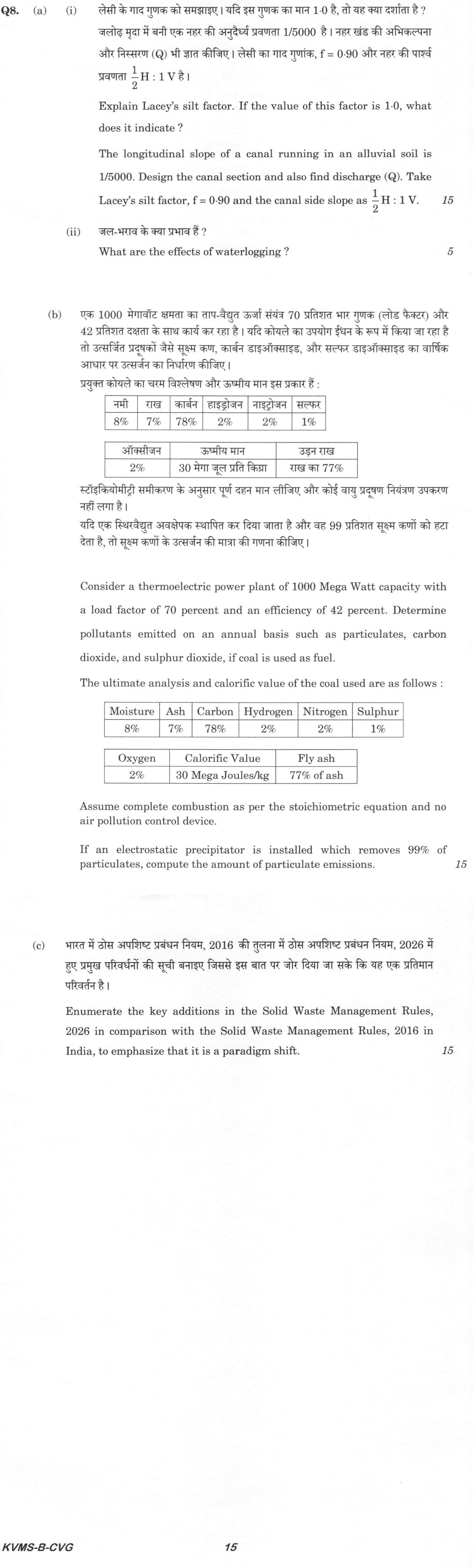
(a) (i) Explain Lacey's silt factor. If the value of this factor is 1.0, what does it indicate ? The longitudinal slope of a…
Explain Lacey's silt factor. If the value of this factor is 1.0, what does it indicate ? The longitudinal slope of a canal running in an alluvial soil is 1/5000. Design the canal section and also find discharge (Q). Take Lacey's silt factor, f = 0.90 and the canal side slope as 1/2 H : 1 V. 15 marks
What are the effects of waterlogging ? 5 marks
Consider a thermoelectric power plant of 1000 Mega Watt capacity with a load factor of 70 percent and an efficiency of 42 percent. Determine pollutants emitted on an annual basis such as particulates, carbon dioxide, and sulphur dioxide, if coal is used as fuel.
The ultimate analysis and calorific value of the coal used are as follows :
Moisture | Ash | Carbon | Hydrogen | Nitrogen | Sulphur 8% | 7% | 78% | 2% | 2% | 1%
Oxygen | Calorific Value | Fly ash 2% | 30 Mega Joules/kg | 77% of ash
Assume complete combustion as per the stoichiometric equation and no air pollution control device.
If an electrostatic precipitator is installed which removes 99% of particulates, compute the amount of particulate emissions. 15 marks
Enumerate the key additions in the Solid Waste Management Rules, 2026 in comparison with the Solid Waste Management Rules, 2016 in India, to emphasize that it is a paradigm shift. 15 marks
हिंदी में प्रश्न पढ़ें
लेसी के गाद गुणक को समझाइए। यदि इस गुणक का मान 1.0 है, तो यह क्या दर्शाता है ? जलोढ़ मृदा में बनी एक नहर की अनुदैर्ध्य प्रवणता 1/5000 है। नहर खंड की अभिकल्पना और निस्सरण (Q) भी ज्ञात कीजिए। लेसी का गाद गुणांक, f = 0.90 और नहर की पार्श्व प्रवणता 1/2 H : 1 V है। (15 अंक)
जल-भराव के क्या प्रभाव हैं ? (5 अंक)
एक 1000 मेगावॉट क्षमता का ताप-वैद्युत ऊर्जा संयंत्र 70 प्रतिशत भार गुणक (लोड फैक्टर) और 42 प्रतिशत दक्षता के साथ कार्य कर रहा है। यदि कोयले का उपयोग ईंधन के रूप में किया जा रहा है तो उत्सर्जित प्रदूषकों जैसे सूक्ष्म कण, कार्बन डाइऑक्साइड, और सल्फर डाइऑक्साइड का वार्षिक आधार पर उत्सर्जन का निर्धारण कीजिए।
प्रयुक्त कोयले का चरम विश्लेषण और ऊष्मीय मान इस प्रकार हैं :
नमी | राख | कार्बन | हाइड्रोजन | नाइट्रोजन | सल्फर 8% | 7% | 78% | 2% | 2% | 1%
ऑक्सीजन | ऊष्मीय मान | उड़न राख 2% | 30 मेगा जूल प्रति किग्रा | राख का 77%
स्टॉइकियोमीट्री समीकरण के अनुसार पूर्ण दहन मान लीजिए और कोई वायु प्रदूषण नियंत्रण उपकरण नहीं लगा है।
यदि एक स्थिरवैद्युत अवक्षेपक स्थापित कर दिया जाता है और वह 99 प्रतिशत सूक्ष्म कणों को हटा देता है, तो सूक्ष्म कणों के उत्सर्जन की मात्रा की गणना कीजिए। (15 अंक)
भारत में ठोस अपशिष्ट प्रबंधन नियम, 2016 की तुलना में ठोस अपशिष्ट प्रबंधन नियम, 2026 में हुए प्रमुख परिवर्धनों की सूची बनाइए जिससे इस बात पर ज़ोर दिया जा सके कि यह एक प्रतिमान परिवर्तन है। (15 अंक)
Model answer
Drafted with AI by UPSC Answer Check against this question's marking rubric, to the expected length. UPSC does not publish answers for Mains — this is one way to score well, not an official key. How we build rubrics and answers.
(a)(i) Lacey's silt factor and canal design (15 marks)
Silt factor. Lacey's silt factor is f = 1.76√d, where d is the mean particle size of the bed silt in mm. It measures how easily the bed material is scoured and carried: a larger f means coarser silt and a steeper, narrower, faster regime channel. f = 1.0 corresponds to standard (medium) silt of mean size d = (1/1.76)² ≈ 0.323 mm, the reference condition of Lacey's regime equations.
Design. The channel is in regime, so Lacey's equations apply, with S = 1/5000 = 0.0002 and f = 0.90:
S = f^(5/3)/(3340 Q^(1/6)), so Q^(1/6) = f^(5/3)/(3340 S) = 0.839/(3340 × 0.0002) = 0.839/0.668 = 1.256.
The discharge is therefore Q = 1.256⁶ = 3.92 m³/s. Then
- Velocity: V = (Q f²/140)^(1/6) = (3.92 × 0.81/140)^(1/6) = (0.02268)^(1/6) = 0.532 m/s.
- Area: A = Q/V = 3.92/0.532 = 7.37 m².
- Hydraulic radius: R = 5V²/(2f) = 5 × 0.2831/(1.8) = 0.787 m.
- Wetted perimeter: P = 4.75√Q = 4.75 × 1.980 = 9.41 m.
Bed width and depth. For side slopes ½H:1V the side length per unit depth is √(1 + 0.25) = 1.118, so
P = B + 2 × 1.118 D = B + 2.236 D and A = BD + 0.5 D².
Eliminating B = 9.41 − 2.236 D gives 1.736 D² − 9.41 D + 7.37 = 0, so D = 0.95 m (the other root, 4.5 m, is rejected because it makes B negative). Then B = 9.41 − 2.236 × 0.95 = 7.28 m. Check: A = 7.28 × 0.95 + 0.5 × 0.95² = 7.37 m², and A/P = 0.783 m, in close agreement with the Lacey R of 0.787 m.
The canal has Q = 3.92 m³/s, V = 0.53 m/s, bed width 7.3 m, depth 0.95 m, A = 7.37 m², P = 9.41 m and R = 0.79 m. Here Q is fixed by S and f through Lacey's slope equation.
(a)(ii) Effects of waterlogging (5 marks)
Waterlogging is the rise of the water table into the root zone. It drives out soil air, so roots lack oxygen, nitrification stops and crop yield falls. Capillary rise and evaporation leave salts on the surface, making the soil saline or alkaline and sometimes barren. Tillage and sowing are delayed, and the yield of crops like wheat and cotton drops sharply. Stagnant water breeds mosquitoes and spreads malaria, and it damages foundations, roads and canal linings.
(b) Emissions from a 1000 MW coal-fired plant (15 marks)
Assumptions. The percentages are on an as-received basis (8 + 7 + 78 + 2 + 2 + 1 + 2 = 100%); all carbon burns to CO₂ and all sulphur to SO₂; a year has 8760 h.
Coal consumption. Average output = 1000 × 0.70 = 700 MW, so the annual electrical energy is 700 × 8760 = 6.132 × 10⁶ MWh = 6.132 × 10⁶ × 3600 = 2.207 × 10¹⁰ MJ. The heat input is this divided by the efficiency, 2.207 × 10¹⁰/0.42 = 5.256 × 10¹⁰ MJ. Coal burnt = 5.256 × 10¹⁰/30 = 1.752 × 10⁹ kg = 1.75 × 10⁶ t/yr (about 55.6 kg/s).
Particulates, no control. Ash = 0.07 × 1.752 × 10⁹ = 1.226 × 10⁸ kg. Fly ash is 77% of this: 0.77 × 1.226 × 10⁸ = 9.44 × 10⁷ kg = 94 400 t/yr (about 9.4 × 10⁴ t/yr).
CO₂. Carbon burnt = 0.78 × 1.752 × 10⁹ = 1.367 × 10⁹ kg. C + O₂ → CO₂, so each kg of C gives 44/12 kg of CO₂: 1.367 × 10⁹ × 44/12 = 5.01 × 10⁹ kg = 5.0 Mt/yr.
SO₂. Sulphur = 0.01 × 1.752 × 10⁹ = 1.752 × 10⁷ kg. S + O₂ → SO₂, so each kg of S gives 64/32 = 2 kg of SO₂: 3.50 × 10⁷ kg = 35 000 t/yr.
Particulates with a 99% ESP. Emission = (1 − 0.99) × 94 400 = 944 t/yr, about 0.94 × 10³ t/yr. The ESP removes 93 500 t/yr of fly ash, which must be handled as a by-product (bricks, cement, road fill).
(c) SWM Rules, 2026: key additions and the paradigm shift (15 marks)
The Solid Waste Management Rules, 2026 were notified on 28 January 2026 and came into force on 1 April 2026, superseding the SWM Rules, 2016. The 2016 rules asked citizens to segregate waste into three streams, made local bodies the main actors, and left much of the burden on municipalities.
Key additions.
- Four-stream source segregation: wet, dry, sanitary and special care waste, against three streams in 2016.
- Polluter-pays compensation: environmental compensation on violators, levied by State and Union Territory pollution control boards or committees under CPCB guidelines.
- Bulk waste generators: buildings of 20,000 m² or more floor area, or 40,000 litres a day water use, or 100 kg a day of waste, about 30% of all waste, come under an extended bulk waste generator responsibility: on-site wet-waste processing or a responsibility certificate.
- Central online portal: registration, authorisation, returns and audits of the whole waste cycle are on one portal.
- Materials recovery facilities and carbon credits: MRFs are recognised as sorting and deposit points, and local bodies are encouraged to earn carbon credits.
- Landfill discipline: only non-recyclable, non-energy-recoverable and inert waste may go to landfill, with higher fees for unsegregated waste and annual audits by State boards.
- Legacy dumpsites: time-bound mapping, biomining and bioremediation with quarterly reporting.
- Waste-to-resource targets: RDF use in cement and similar industries rising from 5% to 15% over six years, and bio-methanation for wet waste.
- Special areas: provisions for hills and islands, including tourist user fees.
Paradigm shift. The 2016 framework was about collection and disposal by local bodies, with weak enforcement. The 2026 rules move to a circular economy: responsibility shifts to the generator, enforcement rests on financial liability and digital tracking, and landfill becomes the last resort, not the default.
How this answer will be evaluated
Evaluation rubric
Each sub-part is marked on its own, against the marks and word limit printed on the paper.
- (a)(i) Explain Lacey's silt factor and what f = 1.0 signifies, then design the canal (bed width, depth, velocity, area, wetted perimeter, hydraulic radius) and find the discharge for S = 1/5000, f = 0.90 and side slopes ½H:1V. 15 marks
Must cover
- f = 1.76√d (d in mm); f = 1.0 is standard medium silt, d ≈ 0.323 mm
- Lacey's equations: V = (Qf²/140)^(1/6), R = 5V²/2f, P = 4.75√Q, S = f^(5/3)/(3340Q^(1/6))
- Q ≈ 3.9 m³/s, V ≈ 0.53 m/s, A ≈ 7.37 m², P ≈ 9.4 m, R ≈ 0.79 m
- Trapezoid solved with P = B + 2.236D and A = BD + 0.5D²: D ≈ 0.95 m, B ≈ 7.3 m
Loses marks
- Using Kennedy's or Manning's formula in place of Lacey's equations.
- Taking the side slope as 1H:2V instead of ½H:1V.
- Arithmetic slips in the sixth-root steps that carry through the design.
Earns more
- Stating that Q follows from S and f when it is not given.
- Rejecting the second root of the quadratic and checking A/P against Lacey's R.
Extra mark
- Remark that a regime channel needs a stable, non-scouring, non-silting section and that Lacey's theory suits alluvial channels
- (a)(ii) About 75 words on the effects of waterlogging: soil aeration and crop yield, salinity/alkalinity, and agricultural, health and structural consequences. 5 marks
Must cover
- Rise of water table into the root zone, poor aeration and reduced crop yield
- Salinity and alkalinity from capillary rise and evaporation
- Ancillary effects: delayed tillage and sowing, mosquito breeding and disease
- Damage to foundations, roads and canal linings
Loses marks
- Descriptions of remedies without covering effects.
- Well over the 75-word limit.
Earns more
- Brief cause-and-effect link between each effect and the waterlogged condition.
Extra mark
- Mention of remedies such as lining, drainage and conjunctive use
- (b) Compute for a 1000 MW coal plant at 70% load factor and 42% efficiency (coal: moisture 8%, ash 7%, C 78%, H 2%, N 2%, S 1%, O 2%, CV 30 MJ/kg; fly ash 77% of ash) the annual coal, particulates, CO₂ and SO₂ with no control, and the particulates with a 99% ESP. 15 marks
Must cover
- Average output 700 MW; energy 6.132 × 10⁶ MWh/yr; heat input at 42% efficiency
- Coal ≈ 1.75 × 10⁶ t/yr (about 55.6 kg/s)
- Fly ash ≈ 9.4 × 10⁴ t/yr with no control; ≈ 944 t/yr with a 99% ESP
- CO₂ ≈ 5.0 Mt/yr using 44/12 of the carbon mass; SO₂ ≈ 35 000 t/yr using 64/32 of the sulphur mass
Loses marks
- Using 1000 MW instead of 700 MW as the average output.
- Ignoring the 42% efficiency or the ash fraction of 77%.
- Using 44/12 for sulphur or 64/32 for carbon.
Earns more
- Stating assumptions: as-received basis, complete combustion, 8760 h/yr.
- Correct unit conversion 1 MWh = 3600 MJ.
Extra mark
- Noting the fate of the 93 500 t/yr of collected ash and its reuse
- (c) Enumerate the key additions of the Solid Waste Management Rules, 2026 over the 2016 Rules and show that they mark a paradigm shift. 15 marks
Must cover
- Notified 28 January 2026, in force 1 April 2026, superseding the 2016 Rules
- Four-stream source segregation (wet, dry, sanitary, special care) against three in 2016
- Polluter-pays environmental compensation and extended bulk waste generator responsibility (20 000 m², 40 000 l/day or 100 kg/day)
- Central online portal, landfill restriction and audits, legacy dumpsite biomining, RDF targets of 5% to 15%
- Paradigm shift: from local-body collection and disposal to generator responsibility, circular economy and enforcement by liability and digital tracking
Loses marks
- Attributing the 2016 provisions to the 2026 Rules, or the reverse.
- A list of provisions with no argument on why it is a paradigm shift.
- Wrong dates or thresholds.
Earns more
- Contrast with the 2016 baseline (three streams, local bodies as the main actors, weak enforcement).
Extra mark
- Special provisions for hills and islands and carbon credits for MRFs
What "Explain" is asking you to do
Make the working of something clear — what sets it off, what follows from what, and what it produces. Explain is the Commission's mechanism word: it dominates the technical papers and the “explain why” stems, where the marks sit in the causal chain and not in the label.
Structure that answers it
State what it is → the initiating condition → the chain of cause, step by step → an instance where it plays out → what the chain produces
Where marks are lost
Describing what something looks like instead of why it works that way. Naming the stages without linking them reads as description too.
Practice this exact question
Write your answer and it is marked point by point against the model answer above — what you covered, what you missed, what you got wrong.
Evaluate my answer →More from Civil Engineering 2026 Paper II
- Q5 (a) What is the difference between a flood hydrograph and a mass curve ? Using the follow…
- Q6 (a) The following information is available regarding the relationship between trap effici…
- Q7 (a) A sedimentation tank is treating 5 million litres of sewage per day containing 250 pp…
- Q8 (a) (i) Explain Lacey's silt factor. If the value of this factor is 1.0, what does it ind…