Paper II — Q6
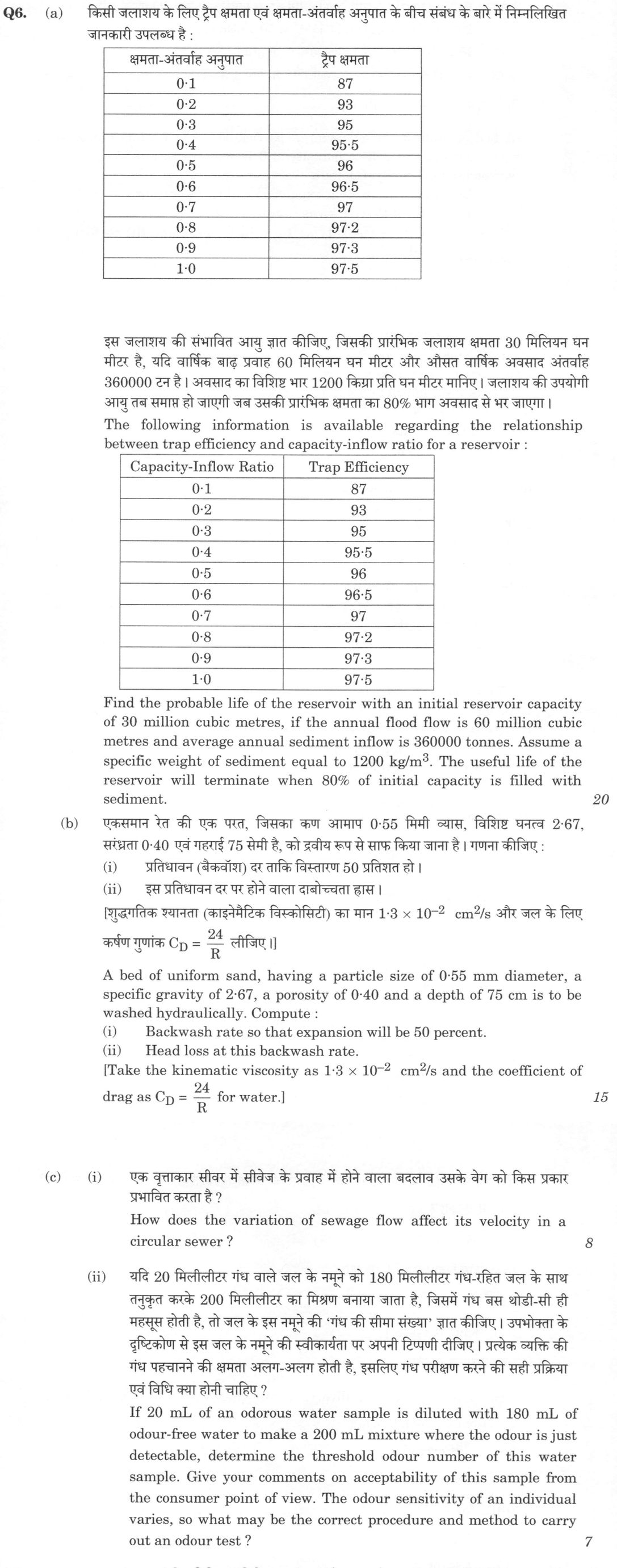
(a) The following information is available regarding the relationship between trap efficiency and capacity-inflow ratio for a…
The following information is available regarding the relationship between trap efficiency and capacity-inflow ratio for a reservoir :
| Capacity-Inflow Ratio | Trap Efficiency |
|---|---|
| 0·1 | 87 |
| 0·2 | 93 |
| 0·3 | 95 |
| 0·4 | 95·5 |
| 0·5 | 96 |
| 0·6 | 96·5 |
| 0·7 | 97 |
| 0·8 | 97·2 |
| 0·9 | 97·3 |
| 1·0 | 97·5 |
Find the probable life of the reservoir with an initial reservoir capacity of 30 million cubic metres, if the annual flood flow is 60 million cubic metres and average annual sediment inflow is 360000 tonnes. Assume a specific weight of sediment equal to 1200 kg/m³. The useful life of the reservoir will terminate when 80% of initial capacity is filled with sediment. 20 marks
A bed of uniform sand, having a particle size of 0·55 mm diameter, a specific gravity of 2·67, a porosity of 0·40 and a depth of 75 cm is to be washed hydraulically. Compute : Backwash rate so that expansion will be 50 percent.
Head loss at this backwash rate. [Take the kinematic viscosity as 1·3 × 10⁻² cm²/s and the coefficient of drag as C_D = 24/R for water.] 15 marks
How does the variation of sewage flow affect its velocity in a circular sewer ? 8 marks
If 20 mL of an odorous water sample is diluted with 180 mL of odour-free water to make a 200 mL mixture where the odour is just detectable, determine the threshold odour number of this water sample. Give your comments on acceptability of this sample from the consumer point of view. The odour sensitivity of an individual varies, so what may be the correct procedure and method to carry out an odour test ? 7 marks
हिंदी में प्रश्न पढ़ें
इस जलाशय की संभावित आयु ज्ञात कीजिए, जिसकी प्रारंभिक जलाशय क्षमता 30 मिलियन घन मीटर है, यदि वार्षिक बाढ़ प्रवाह 60 मिलियन घन मीटर और औसत वार्षिक अवसाद अंतर्वाह 360000 टन है। अवसाद का विशिष्ट भार 1200 किग्रा प्रति घन मीटर मानिए। जलाशय की उपयोगी आयु तब समाप्त हो जाएगी जब उसकी प्रारंभिक क्षमता का 80% भाग अवसाद से भर जाएगा। (20 अंक)
एकसमान रेत की एक परत, जिसका कण आमाप 0·55 मिमी व्यास, विशिष्ट घनत्व 2·67, संरंध्रता 0·40 एवं गहराई 75 सेमी है, को द्रवीय रूप से साफ किया जाना है। गणना कीजिए : प्रतिधावन (बैकवॉश) दर ताकि विस्तारण 50 प्रतिशत हो ।
इस प्रतिधावन दर पर होने वाला दाबोच्चता ह्रास । [शुद्धगतिक श्यानता (काइनेमेटिक विस्कोसिटी) का मान 1·3 × 10⁻² cm²/s और जल के लिए कर्षण गुणांक C_D = 24/R लीजिए ।] (15 अंक)
एक वृत्ताकार सीवर में सीवेज के प्रवाह में होने वाला बदलाव उसके वेग को किस प्रकार प्रभावित करता है ? (8 अंक)
यदि 20 मिलीलीटर गंध वाले जल के नमूने को 180 मिलीलीटर गंध-रहित जल के साथ तनुकृत करके 200 मिलीलीटर का मिश्रण बनाया जाता है, जिसमें गंध बस थोड़ी-सी ही महसूस होती है, तो जल के इस नमूने की 'गंध की सीमा संख्या' ज्ञात कीजिए । उपभोक्ता के दृष्टिकोण से इस जल के नमूने की स्वीकार्यता पर अपनी टिप्पणी दीजिए । प्रत्येक व्यक्ति की गंध पहचानने की क्षमता अलग-अलग होती है, इसलिए गंध परीक्षण करने की सही प्रक्रिया एवं विधि क्या होनी चाहिए ? (7 अंक)
Model answer
Drafted with AI by UPSC Answer Check against this question's marking rubric, to the expected length. UPSC does not publish answers for Mains — this is one way to score well, not an official key. How we build rubrics and answers.
(a) Useful life of the reservoir by the incremental method (20 marks)
Data. Initial capacity C₀ = 30 Mm³ and annual inflow I = 60 Mm³, so the initial capacity-inflow ratio is 30/60 = 0.5. The sediment inflow is 360 000 t/year at 1200 kg/m³, so the annual volume of sediment brought in is
360 000 × 1000/1200 = 300 000 m³/year = 0.30 Mm³/year.
The useful life ends when 80% of the initial capacity is silted, that is when 0.8 × 30 = 24 Mm³ of storage is lost and the capacity is reduced to 6 Mm³ (capacity-inflow ratio 0.1).
Method. The trap efficiency falls as the capacity shrinks, so the life is worked out in steps, each covering a fall of 6 Mm³ in capacity, which is 0.1 in the capacity-inflow ratio. In each step the mean trap efficiency is taken from the table, the annual deposit is 0.30 × (mean trap efficiency), and the time is (volume lost)/(annual deposit).
- Step 1, capacity 30 to 24 Mm³ (ratio 0.5 to 0.4): mean trap efficiency = (96 + 95.5)/2 = 95.75%. Deposit = 0.30 × 0.9575 = 0.2873 Mm³/year. Time = 6/0.2873 = 20.9 years.
- Step 2, capacity 24 to 18 Mm³ (ratio 0.4 to 0.3): mean = (95.5 + 95)/2 = 95.25%. Deposit = 0.2858 Mm³/year. Time = 6/0.2858 = 21.0 years.
- Step 3, capacity 18 to 12 Mm³ (ratio 0.3 to 0.2): mean = (95 + 93)/2 = 94%. Deposit = 0.2820 Mm³/year. Time = 6/0.2820 = 21.3 years.
- Step 4, capacity 12 to 6 Mm³ (ratio 0.2 to 0.1): mean = (93 + 87)/2 = 90%. Deposit = 0.2700 Mm³/year. Time = 6/0.2700 = 22.2 years.
Probable useful life = 20.9 + 21.0 + 21.3 + 22.2 ≈ 85 years.
As a check, if the initial trap efficiency of 96% held throughout, the life would be 24/(0.30 × 0.96) = 83 years. The real life is longer because the efficiency falls, so less sediment is trapped as the reservoir fills.
(b) Backwash rate and head loss of a sand filter (15 marks)
Data. d = 0.55 mm = 0.055 cm, G = 2.67, ν = 1.3 × 10⁻² cm²/s, depth L = 75 cm, porosity ε = 0.40, expansion 50%.
(b)(i) Backwash rate
Settling velocity of a grain. With C_D = 24/R (Stokes' law), the settling velocity is
v_s = g(G − 1)d²/(18ν) = 981 × 1.67 × 0.055²/(18 × 0.013) = 21.2 cm/s
The grain Reynolds number is R = v_s d/ν = 21.2 × 0.055/0.013 ≈ 90, much larger than 1, so Stokes' law is only an approximation here, and it overestimates v_s. It is used because the problem prescribes C_D = 24/R.
Porosity of the expanded bed. The volume of sand is constant, so (1 − ε_e)L_e = (1 − ε)L. With L_e = 1.5L, 1 − ε_e = 0.60/1.5 = 0.40, so ε_e = 0.60.
Backwash velocity. The velocity that fluidises the bed to this porosity, from the Fair and Hatch relation v_b = v_s ε_e^4.5, is
v_b = 21.2 × 0.60^4.5 = 21.2 × 0.1005 = 2.13 cm/s
Backwash rate ≈ 2.1 cm/s = 0.0213 m/s, that is about 77 m/h (1.28 m³/m²/min).
(b)(ii) Head loss through the expanded bed
In a fluidised bed the head loss equals the submerged weight of the sand per unit area, and is unchanged by the expansion:
h_L = (1 − ε)(G − 1)L = (1 − 0.40)(2.67 − 1)(0.75) = 0.60 × 1.67 × 0.75 = 0.75 m
The same result comes from the expanded bed: (1 − 0.60)(1.67)(1.125) = 0.75 m.
(c)(i) Velocity in a circular sewer as the flow varies (8 marks)
In Manning's equation v = (1/n)R^(2/3)S^(1/2), with n and the slope S fixed, the velocity depends only on the hydraulic mean depth R = A/P. As the depth of flow d in a circular sewer of diameter D changes, so does R, and so the velocity and the discharge change.

- At full depth and at half depth, R = D/4, so the velocity is the same, V_full.
- Between half depth and about 0.81D, R rises above D/4 (largest R at 0.81D), so the velocity is greater than the full-pipe value, with a maximum of about 1.14 V_full at d = 0.81D. The discharge is maximum, about 1.07 Q_full, at d = 0.95D.
- Below half depth, R falls, and so does the velocity. It is about 0.70 V_full at d = 0.25D and about 0.40 V_full at d = 0.1D.
Design consequences. Sewage flow varies through the day, from a minimum at night to a peak in the morning and evening. The sewer must give a self-cleansing velocity at low flow, so that solids do not settle, commonly about 0.6–0.8 m/s at the design peak flow and not much below 0.45 m/s at minimum flow. It must also keep the velocity at the maximum flow below the non-scouring limit that the pipe material can withstand (about 2.4–3 m/s), so that the pipe is not eroded. The gradient is chosen to satisfy both conditions.
(c)(ii) Threshold odour number (7 marks)
The threshold odour number (TON) is (A + B)/A, where A is the volume of the sample and B is the volume of odour-free water: TON = (20 + 180)/20 = 10.
A drinking water should have TON of about 3 or less; 10 is objectionable to consumers, and needs treatment (aeration, activated carbon, chlorination). Individual sensitivity to odour varies, so the test is done by a panel of at least five, preferably ten, persons in an odour-free room, using dilutions in odour-free water, with blanks, in increasing concentration. The threshold is the geometric mean of the individual thresholds.
How this answer will be evaluated
Evaluation rubric
Each sub-part is marked on its own, against the marks and word limit printed on the paper.
- (a) Find the probable useful life of the 30 Mm³ reservoir (inflow 60 Mm³/year, sediment 360 000 t/year at 1200 kg/m³) up to 80% siltation using the trap-efficiency table in steps. 20 marks
Must cover
- Sediment volume 360 000 × 1000/1200 = 0.30 Mm³/year; initial capacity-inflow ratio 0.5
- Life ends at 24 Mm³ lost, capacity 6 Mm³ (ratio 0.1)
- Steps of 6 Mm³ using mean trap efficiency 95.75%, 95.25%, 94% and 90% from the table
- Times 20.9, 21.0, 21.3 and 22.2 years, total about 85 years
Loses marks
- Using the mass of sediment without dividing by the density.
- Using one trap efficiency for the whole life.
- Stopping at 100% siltation or at 20% siltation.
Earns more
- Trap efficiency falling with capacity explained.
- Check with a constant 96% efficiency (about 83 years).
Extra mark
- Comment on the use of Brune's curve in place of the table
- (b) For the 75 cm sand bed (d = 0.55 mm, G = 2.67, ε = 0.40, 50% expansion, C_D = 24/R) find the backwash rate and the head loss. 15 marks
Must cover
- Stokes settling velocity v_s = g(G − 1)d²/18ν = 21.2 cm/s
- Expanded-bed porosity 0.60 from (1 − ε_e)L_e = (1 − ε)L
- Backwash velocity v_b = v_s ε_e^4.5 ≈ 2.13 cm/s (about 77 m/h)
- Head loss (1 − ε)(G − 1)L = 0.75 m
Loses marks
- Using the unexpanded porosity in the backwash velocity.
- Using ν in m²/s with d in cm.
- Expecting the head loss to change with the expansion.
Earns more
- Units handled consistently (cm and s).
- Comment that R ≈ 90, so Stokes' law is an approximation.
Extra mark
- Check of the head loss from the expanded depth (0.75 m)
- (c)(i) Explain how the velocity in a circular sewer changes with the depth of flow, through the hydraulic mean depth in Manning's equation, and the design consequences. 8 marks
Must cover
- Manning v = (1/n)R^(2/3)S^(1/2); velocity depends on R = A/P at fixed n and S
- Same velocity at full and half depth (R = D/4); maximum v ≈ 1.14 V at 0.81D and maximum Q ≈ 1.07 Q at 0.95D
- Velocity falls below half depth (about 0.7 V at 0.25D)
- Design: self-cleansing velocity at minimum flow and non-scouring velocity at maximum flow
Loses marks
- Stating that the velocity is proportional to the depth.
- Ignoring the maximum velocity at 0.81D.
- Design consequences with no reference to minimum flow.
Earns more
- A sketch or values of the hydraulic elements.
- Typical limits stated for velocities.
Extra mark
- Effect of a variable roughness n with depth
- (c)(ii) Compute the threshold odour number for 20 mL of sample made up to 200 mL, comment on the acceptability of the water and state the correct procedure for an odour test. 7 marks
Must cover
- TON = (A + B)/A = 200/20 = 10
- Comment: not acceptable for drinking (limit about 3), needs treatment
- Procedure: panel of at least five persons, odour-free room and dilution water, blanks, increasing concentrations, geometric mean of the thresholds
Loses marks
- Using the diluted volume A/(A + B).
- Testing with a single person.
- Calling TON = 10 acceptable.
Earns more
- Treatment options such as aeration or activated carbon.
- Individual sensitivity as the reason for a panel.
Extra mark
- Test temperature (40 °C hot odour test)
What "Solve" is asking you to do
Choose the method, then carry it through to a final answer. Identifying what kind of problem this is and why that method applies is the first thing marked; a correct figure arrived at invisibly earns almost nothing.
Structure that answers it
Given data and what is required → method chosen, with the reason it applies → set-up (equation, circuit, free body, trial balance) → working, step by step → answer with units and any condition of validity
Where marks are lost
Doing the middle steps mentally and writing only the result. In mathematics papers, a further loss comes from giving a decimal where the exact value in surds or fractions was wanted, or from skipping the justification a part explicitly asks for.
Practice this exact question
Write your answer and it is marked point by point against the model answer above — what you covered, what you missed, what you got wrong.
Evaluate my answer →More from Civil Engineering 2026 Paper II
- Q3 (a) What do you understand by a Gantt or Bar chart with respect to construction project m…
- Q4 (a) What do you understand by the effective CBR value ? Discuss its significance. How is…
- Q5 (a) What is the difference between a flood hydrograph and a mass curve ? Using the follow…
- Q6 (a) The following information is available regarding the relationship between trap effici…
- Q7 (a) A sedimentation tank is treating 5 million litres of sewage per day containing 250 pp…
- Q8 (a) (i) Explain Lacey's silt factor. If the value of this factor is 1.0, what does it ind…