Paper II — Q2
(a) A vertical curve is formed when a descending gradient of 0·5% meets another descending gradient of 3·0%. Find the length of…
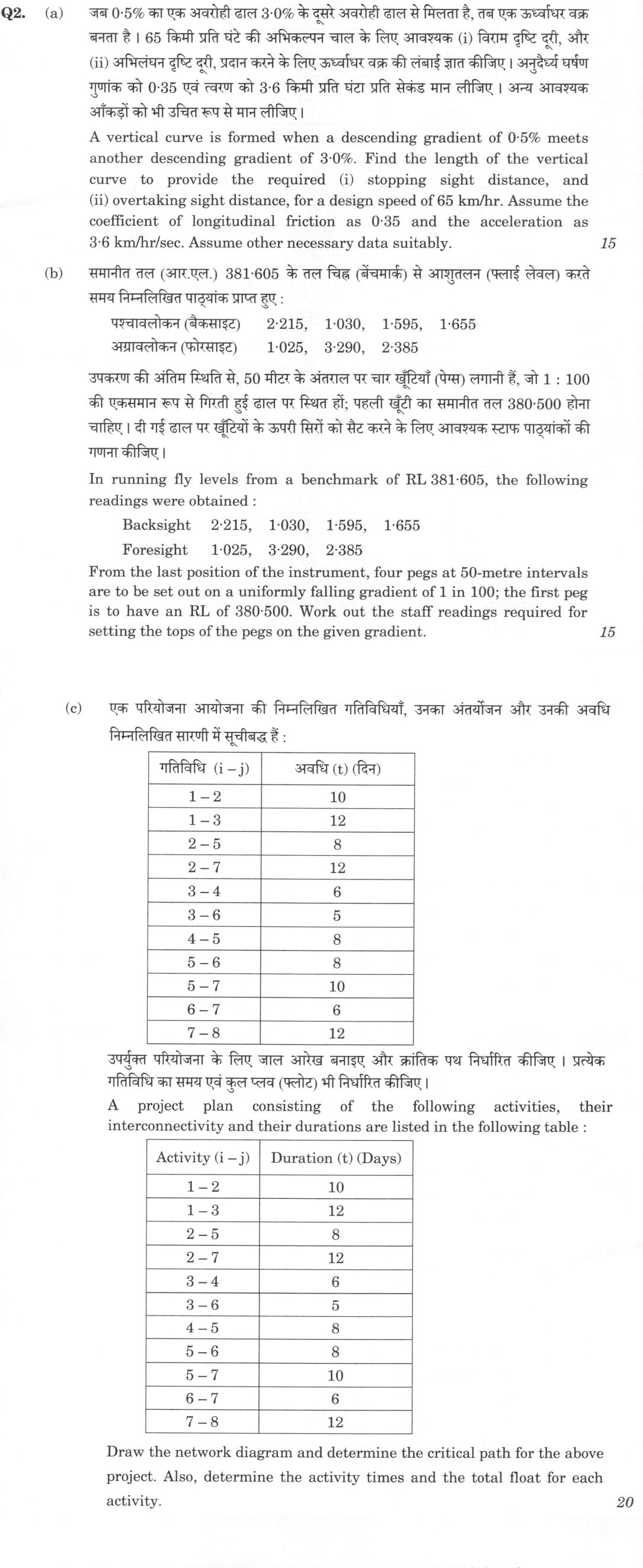
A vertical curve is formed when a descending gradient of 0·5% meets another descending gradient of 3·0%. Find the length of the vertical curve to provide the required (i) stopping sight distance, and (ii) overtaking sight distance, for a design speed of 65 km/hr. Assume the coefficient of longitudinal friction as 0·35 and the acceleration as 3·6 km/hr/sec. Assume other necessary data suitably. 15 marks
In running fly levels from a benchmark of RL 381·605, the following readings were obtained : Backsight 2·215, 1·030, 1·595, 1·655 Foresight 1·025, 3·290, 2·385 From the last position of the instrument, four pegs at 50-metre intervals are to be set out on a uniformly falling gradient of 1 in 100; the first peg is to have an RL of 380·500. Work out the staff readings required for setting the tops of the pegs on the given gradient. 15 marks
A project plan consisting of the following activities, their interconnectivity and their durations are listed in the following table :
| Activity (i – j) | Duration (t) (Days) |
|---|---|
| 1 – 2 | 10 |
| 1 – 3 | 12 |
| 2 – 5 | 8 |
| 2 – 7 | 12 |
| 3 – 4 | 6 |
| 3 – 6 | 5 |
| 4 – 5 | 8 |
| 5 – 6 | 8 |
| 5 – 7 | 10 |
| 6 – 7 | 6 |
| 7 – 8 | 12 |
Draw the network diagram and determine the critical path for the above project. Also, determine the activity times and the total float for each activity. 20 marks
हिंदी में प्रश्न पढ़ें
जब 0·5% का एक अवरोही ढाल 3·0% के दूसरे अवरोही ढाल से मिलता है, तब एक ऊर्ध्वाधर वक्र बनता है। 65 किमी प्रति घंटे की अभिकल्पन चाल के लिए आवश्यक (i) विराम दृष्टि दूरी, और (ii) अभिलंघन दृष्टि दूरी, प्रदान करने के लिए ऊर्ध्वाधर वक्र की लंबाई ज्ञात कीजिए। अनुदैर्घ्य घर्षण गुणांक को 0·35 एवं त्वरण को 3·6 किमी प्रति घंटा प्रति सेकंड मान लीजिए। अन्य आवश्यक आँकड़ों को भी उचित रूप से मान लीजिए। (15 अंक)
समानीत तल (आर.एल.) 381·605 के तल चिह्न (बेंचमार्क) से आशुतलन (फ्लाई लेवल) करते समय निम्नलिखित पाठ्यांक प्राप्त हुए : पश्चावलोकन (बैकसाइट) 2·215, 1·030, 1·595, 1·655 अग्रावलोकन (फोरसाइट) 1·025, 3·290, 2·385 उपकरण की अंतिम स्थिति से, 50 मीटर के अंतराल पर चार खूँटियाँ (पेग्स) लगानी हैं, जो 1 : 100 की एकसमान रूप से गिरती हुई ढाल पर स्थित हैं; पहली खूँटी का समानीत तल 380·500 होना चाहिए। दी गई ढाल पर खूँटियों के ऊपरी सिरों को सेट करने के लिए आवश्यक स्टाफ पाठ्यांकों की गणना कीजिए। (15 अंक)
एक परियोजना आयोजना की निम्नलिखित गतिविधियाँ, उनका अंतर्योजन और उनकी अवधि निम्नलिखित सारणी में सूचीबद्ध हैं :
| गतिविधि (i – j) | अवधि (t) (दिन) |
|---|---|
| 1 – 2 | 10 |
| 1 – 3 | 12 |
| 2 – 5 | 8 |
| 2 – 7 | 12 |
| 3 – 4 | 6 |
| 3 – 6 | 5 |
| 4 – 5 | 8 |
| 5 – 6 | 8 |
| 5 – 7 | 10 |
| 6 – 7 | 6 |
| 7 – 8 | 12 |
उपर्युक्त परियोजना के लिए जाल आरेख बनाइए और क्रांतिक पथ निर्धारित कीजिए । प्रत्येक गतिविधि का समय एवं कुल प्लव (फ्लोट) भी निर्धारित कीजिए । (20 अंक)
Model answer
Drafted with AI by UPSC Answer Check against this question's marking rubric, to the expected length. UPSC does not publish answers for Mains — this is one way to score well, not an official key. How we build rubrics and answers.
(a) Summit curve length for stopping and overtaking sight distance (15 marks)
A falling grade of 0.5% meeting a steeper falling grade of 3.0% makes a summit (convex) curve. The deviation angle is N = |g₁ − g₂| = |−0.005 − (−0.030)| = 0.025.
Assumed data. Design speed V = 65 km/h; f = 0.35; reaction time t = 2.5 s for stopping and 2.0 s for overtaking; eye height H = 1.2 m; object height h = 0.15 m for stopping and 1.2 m for overtaking (as in IRC); acceleration a = 3.6 km/h/s = 1 m/s²; the overtaken vehicle travels at V_b = V − 16 = 49 km/h = 13.61 m/s.
(a)(i) Stopping sight distance
SSD = 0.278Vt + V²/(254f) = 0.278 × 65 × 2.5 + 65²/(254 × 0.35) = 45.2 + 47.5 = 92.7 m, on level ground as is usual for design.
Length of curve. Test the case L > S: L = NS²/(√(2H) + √(2h))² = 0.025 × 92.7²/4.40 = 48.9 m, which is less than S, so the assumption fails. Use L < S:
L = 2S − (√(2H) + √(2h))²/N = 2 × 92.7 − 4.40/0.025 = 185.4 − 175.9 = 9.5 m
The length for stopping alone is therefore very small because the deviation angle is only 2.5%. A minimum practical curve length (about 30–40 m for 65 km/h) should be provided.
(a)(ii) Overtaking sight distance
Speeds: v = 65/3.6 = 18.06 m/s and v_b = 13.61 m/s.
- Reaction distance d₁ = v_b t = 13.61 × 2 = 27.2 m.
- Spacing s = 0.7v_b + 6 = 15.53 m, and the overtaking time T = √(4s/a) = √(4 × 15.53/1) = 7.88 s. Then d₂ = v_bT + 2s = 13.61 × 7.88 + 2 × 15.53 = 138.3 m.
- Distance covered by the opposing vehicle d₃ = vT = 18.06 × 7.88 = 142.3 m.
OSD = d₁ + d₂ + d₃ = 27.2 + 138.3 + 142.3 ≈ 308 m
Length of curve. With H = h = 1.2 m: (√2.4 + √2.4)² = 9.6. Test L > S: L = 0.025 × 308²/9.6 = 247 m, less than S = 308 m, so this case is invalid. Use L < S:
L = 2S − 9.6/N = 2 × 308 − 9.6/0.025 = 616 − 384 = 232 m
Result. Provide L ≈ 9.5 m (in practice the minimum length) for stopping sight distance, and L ≈ 232 m if overtaking sight distance is to be provided over the crest.
(b) Fly levelling and setting out pegs on a gradient (15 marks)
Reduction (height of instrument method). The four backsights and three foresights are taken alternately from the benchmark of RL 381.605 m.
- Set-up 1: HI = 381.605 + 2.215 = 383.820; RL of the first change point = 383.820 − 1.025 = 382.795.
- Set-up 2: HI = 382.795 + 1.030 = 383.825; RL = 383.825 − 3.290 = 380.535.
- Set-up 3: HI = 380.535 + 1.595 = 382.130; RL = 382.130 − 2.385 = 379.745.
- Set-up 4 (last): HI = 379.745 + 1.655 = 381.400 m.
Check. Σ backsights (first three) − Σ foresights = (2.215 + 1.030 + 1.595) − (1.025 + 3.290 + 2.385) = 4.840 − 6.700 = −1.860, and 379.745 − 381.605 = −1.860. It agrees.
Peg levels. The gradient is 1 in 100 falling, so the fall in 50 m is 0.500 m. The RLs of the four pegs are 380.500, 380.000, 379.500 and 379.000 m.
Staff readings (staff reading = HI − required RL, with HI = 381.400 m):
- Peg 1: 381.400 − 380.500 = 0.900 m
- Peg 2: 381.400 − 380.000 = 1.400 m
- Peg 3: 381.400 − 379.500 = 1.900 m
- Peg 4: 381.400 − 379.000 = 2.400 m
The staff reading increases by 0.500 m from peg to peg because the pegs fall away from the line of collimation.
(c) Network, forward and backward passes, critical path and floats (20 marks)
Network. The activity-on-arrow network for events 1 to 8 is shown, with the earliest and latest event times at each node.

Forward pass (earliest event time E, taking the largest at merging events):
- E₁ = 0; E₂ = 10; E₃ = 12; E₄ = 12 + 6 = 18
- E₅ = max(10 + 8, 18 + 8) = 26
- E₆ = max(12 + 5, 26 + 8) = 34
- E₇ = max(10 + 12, 26 + 10, 34 + 6) = 40
- E₈ = 40 + 12 = 52
Backward pass (latest event time L, taking the smallest):
- L₈ = 52; L₇ = 52 − 12 = 40; L₆ = 40 − 6 = 34
- L₅ = min(34 − 8, 40 − 10) = 26
- L₄ = 26 − 8 = 18; L₃ = min(18 − 6, 34 − 5) = 12
- L₂ = min(26 − 8, 40 − 12) = 18; L₁ = min(18 − 10, 12 − 12) = 0
Critical path. The critical events have E = L (1, 3, 4, 5, 6, 7 and 8) and the critical activities have zero total float. The critical path is 1-3-4-5-6-7-8 with duration 12 + 6 + 8 + 8 + 6 + 12 = 52 days.
Activity times and total float (EST = E_i, EFT = EST + t, LFT = L_j, LST = LFT − t, total float = LFT − EFT):
- 1-2 (10 d): EST 0, EFT 10, LST 8, LFT 18, float 8
- 1-3 (12 d): EST 0, EFT 12, LST 0, LFT 12, float 0, critical
- 2-5 (8 d): EST 10, EFT 18, LST 18, LFT 26, float 8
- 2-7 (12 d): EST 10, EFT 22, LST 28, LFT 40, float 18
- 3-4 (6 d): EST 12, EFT 18, LST 12, LFT 18, float 0, critical
- 3-6 (5 d): EST 12, EFT 17, LST 29, LFT 34, float 17
- 4-5 (8 d): EST 18, EFT 26, LST 18, LFT 26, float 0, critical
- 5-6 (8 d): EST 26, EFT 34, LST 26, LFT 34, float 0, critical
- 5-7 (10 d): EST 26, EFT 36, LST 30, LFT 40, float 4
- 6-7 (6 d): EST 34, EFT 40, LST 34, LFT 40, float 0, critical
- 7-8 (12 d): EST 40, EFT 52, LST 40, LFT 52, float 0, critical
How this answer will be evaluated
Evaluation rubric
Each sub-part is marked on its own, against the marks and word limit printed on the paper.
- (a) Find the length of the summit curve (falling grades 0.5% and 3.0%) for stopping and for overtaking sight distance at 65 km/h with f = 0.35 and a = 3.6 km/h/s, stating the assumed data. 15 marks
Must cover
- N = 0.025 and a summit curve; assumed t = 2.5 s (SSD), 2.0 s (OSD), H = 1.2 m, h = 0.15 m (SSD) and 1.2 m (OSD)
- SSD = 0.278Vt + V²/254f = 92.7 m
- OSD = d₁ + d₂ + d₃ ≈ 308 m, with v_b = V − 16, s = 0.7v_b + 6 and T = √(4s/a)
- Curve lengths by testing L > S then L < S: about 9.5 m for SSD (minimum practical length used) and 232 m for OSD
Loses marks
- Using a valley-curve formula.
- Using the L > S formula without checking L against S.
- Omitting the 2s term in d₂ or the assumed speed of the overtaken vehicle.
Earns more
- Explicit check of which case (L > S or L < S) applies.
- All the assumed data listed.
Extra mark
- Comment that the gradient effect on SSD (about 97 m on 3% down-grade) is not included
- (b) Reduce the fly levels from RL 381.605 to get the height of instrument at the last set-up, then find the staff readings for four pegs at 50 m on a 1 in 100 falling gradient from RL 380.500. 15 marks
Must cover
- HI by set-up: 383.820, 383.825, 382.130 and 381.400; change-point RLs 382.795, 380.535 and 379.745
- Arithmetic check ΣBS − ΣFS = −1.860 matching the RL difference
- Peg RLs 380.500, 380.000, 379.500 and 379.000
- Staff readings 0.900, 1.400, 1.900 and 2.400 m from HI 381.400
Loses marks
- Using the first HI for the pegs.
- Treating the gradient as rising.
- Staff reading taken as RL − HI.
Earns more
- Level-book layout used.
- Correct pairing of the four backsights with three foresights.
Extra mark
- Explanation of why the staff reading rises by 0.500 m per peg
- (c) Draw the activity-on-arrow network for events 1 to 8, do the forward and backward passes, identify the critical path and duration, and tabulate EST, EFT, LST, LFT and total float. 20 marks
Must cover
- Correct network with the 11 activities and their durations
- Forward pass E: 0, 10, 12, 18, 26, 34, 40, 52 and backward pass L: 0, 18, 12, 18, 26, 34, 40, 52
- Critical path 1-3-4-5-6-7-8, project duration 52 days
- Activity table with total floats: 1-2: 8, 2-5: 8, 2-7: 18, 3-6: 17, 5-7: 4, and zero on the critical activities
Loses marks
- Taking the sum of all durations as the project duration.
- Missing the 4-5 activity as critical.
- Floats computed from the wrong node times.
Earns more
- Max at merge events in the forward pass and min at burst events in the backward pass.
- Critical activities marked.
Extra mark
- Free float or independent float of the non-critical activities
What "Design" is asking you to do
Produce a specification that meets the given brief and demonstrate that it does. In civil and electrical papers the design is incomplete until it is expressed in buildable numbers — diameter, spacing, section, component value — and checked back against every limit stated.
Structure that answers it
Requirements and permissible values listed → code clause or design basis adopted → proportioning calculations → the specification in final dimensions → check against each requirement → sketch
Where marks are lost
Stopping at a required area or a required value without converting it into the bar size, spacing or component actually provided. The provided-against-required comparison and the serviceability or stability check are separately marked and routinely left out.
Practice this exact question
Write your answer and it is marked point by point against the model answer above — what you covered, what you missed, what you got wrong.
Evaluate my answer →More from Civil Engineering 2026 Paper II
- Q1 (a) Explain with a neat sketch the essential features of English bond in brick masonry co…
- Q2 (a) A vertical curve is formed when a descending gradient of 0·5% meets another descendin…
- Q3 (a) What do you understand by a Gantt or Bar chart with respect to construction project m…
- Q4 (a) What do you understand by the effective CBR value ? Discuss its significance. How is…
- Q5 (a) What is the difference between a flood hydrograph and a mass curve ? Using the follow…