Paper I — Q1
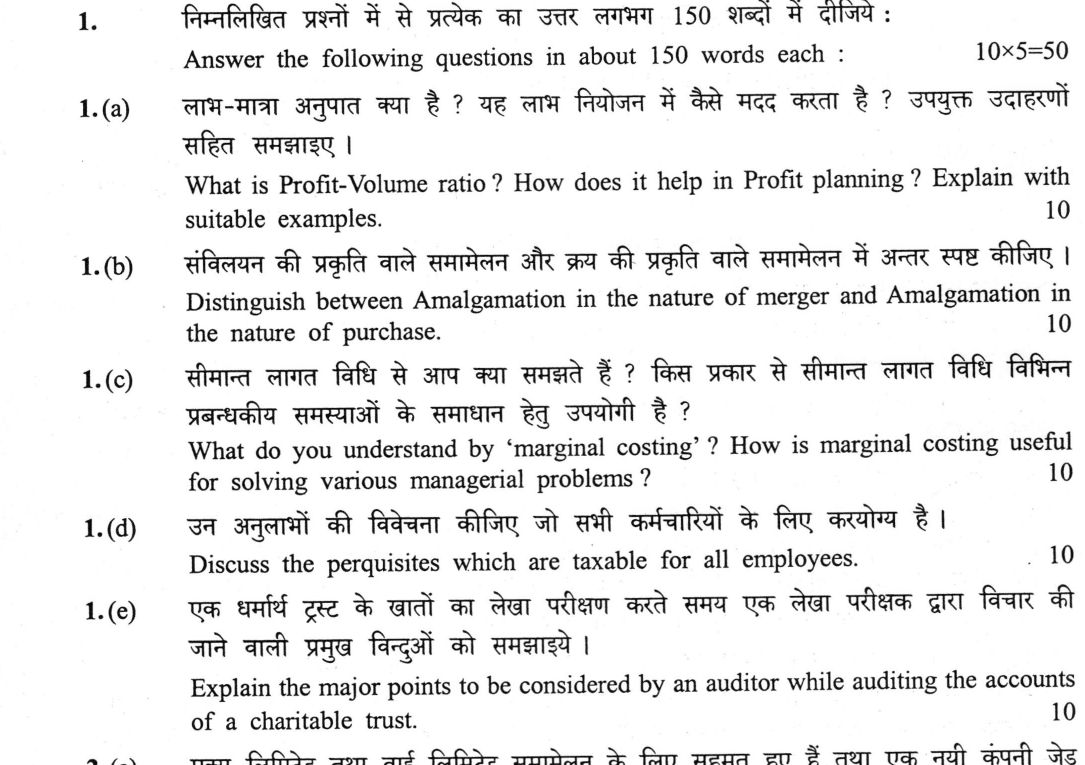
(a) What is Profit-Volume ratio ? How does it help in Profit planning ? Explain with suitable examples. (10 marks) (b)…
Answer the following questions in about 150 words each :
What is Profit-Volume ratio ? How does it help in Profit planning ? Explain with suitable examples. 10 marks
Distinguish between Amalgamation in the nature of merger and Amalgamation in the nature of purchase. 10 marks
What do you understand by 'marginal costing' ? How is marginal costing useful for solving various managerial problems ? 10 marks
Discuss the perquisites which are taxable for all employees. 10 marks
Explain the major points to be considered by an auditor while auditing the accounts of a charitable trust. 10 marks
हिंदी में प्रश्न पढ़ें
निम्नलिखित प्रश्नों में से प्रत्येक का उत्तर लगभग 150 शब्दों में दीजिये :
लाभ-मात्रा अनुपात क्या है ? यह लाभ नियोजन में कैसे मदद करता है ? उपयुक्त उदाहरणों सहित समझाइए । (10 अंक)
संविलयन की प्रकृति वाले समामेलन और क्रय की प्रकृति वाले समामेलन में अन्तर स्पष्ट कीजिए । (10 अंक)
सीमान्त लागत विधि से आप क्या समझते हैं ? किस प्रकार से सीमान्त लागत विधि विभिन्न प्रबन्धकीय समस्याओं के समाधान हेतु उपयोगी है ? (10 अंक)
उन अनुलाभों की विवेचना कीजिए जो सभी कर्मचारियों के लिए करयोग्य है । (10 अंक)
एक धर्मार्थ ट्रस्ट के खातों का लेखा परीक्षण करते समय एक लेखा परीक्षक द्वारा विचार की जाने वाली प्रमुख विन्दुओं को समझाइये । (10 अंक)
Model answer
Drafted with AI by UPSC Answer Check against this question's marking rubric, to the 150-word length. UPSC does not publish answers for Mains — this is one way to score well, not an official key. How we build rubrics and answers.
(a) What is Profit-Volume ratio ? How does it help in Profit planning ? Explain with suitable examples.
The Profit-Volume (P/V) or contribution-to-sales ratio expresses contribution as a percentage of sales: P/V ratio = (Contribution ÷ Sales) × 100, where Contribution = Sales − Variable cost. Because it shows how much of every rupee of sales is left to cover fixed cost and profit, it is the key tool of Cost-Volume-Profit (CVP) analysis in profit planning:
- Break-even sales = Fixed cost ÷ P/V ratio
- Margin of safety = Profit ÷ P/V ratio
- Sales for a target profit = (Fixed cost + Desired profit) ÷ P/V ratio
- Product ranking: where no factor is scarce, products with a higher P/V ratio are pushed.
The ratio is independent of fixed cost; it improves only by raising price, cutting variable cost or shifting the mix towards high-contribution products.
Example: Sales ₹2,00,000, variable cost ₹1,20,000, fixed cost ₹40,000. P/V ratio = 80,000/2,00,000 = 40%; break-even sales = 40,000/0.40 = ₹1,00,000; profit is ₹40,000, so margin of safety = 40,000/0.40 = ₹1,00,000. To earn a profit of ₹60,000, required sales = (40,000 + 60,000)/0.40 = ₹2,50,000.
(b) Distinguish between Amalgamation in the nature of merger and Amalgamation in the nature of purchase.
Under AS 14, an amalgamation is in the nature of merger only if all five conditions of para 3(e) are met: (i) all assets and liabilities of the transferor become those of the transferee; (ii) holders of at least 90% of the face value of the transferor's equity shares become equity shareholders of the transferee; (iii) they are paid wholly in equity shares, except cash for fractional shares; (iv) the transferor's business is intended to be carried on; and (v) book values are not adjusted except to align accounting policies. It is accounted for by the pooling of interests method: assets, liabilities and reserves are recorded at book values, reserves keep their identity, and the difference between consideration and share capital taken over is adjusted in reserves.
If any condition fails, it is in the nature of purchase, accounted for by the purchase method: assets and liabilities at book or fair values, only statutory reserves carried forward against an Amalgamation Adjustment Reserve, and any excess or shortfall of consideration over net assets taken as goodwill (amortised over up to five years) or capital reserve. Ind AS 103 instead prescribes the acquisition method (pooling under Appendix C for common-control combinations).
(c) What do you understand by 'marginal costing' ? How is marginal costing useful for solving various managerial problems ?
Marginal costing is a technique of cost analysis in which only variable costs are charged to products (marginal cost = aggregate variable cost) and fixed costs are written off as period costs. Profit = Contribution (Sales − Variable cost) − Fixed cost. It suits short-run decisions because it avoids arbitrary apportionment of fixed overheads and the distortion of profit that stock changes cause under absorption costing.
Its use in managerial problems:
- Special or export order: accept if the price exceeds variable cost, spare capacity exists and regular sales are not disturbed.
- Make or buy: buy if the purchase price is below the variable (plus avoidable fixed) cost of making.
- Product mix: rank products by contribution per unit of the key (limiting) factor.
- Shut-down: close a unit or product if its contribution does not cover its avoidable fixed costs.
- Pricing in a recession and profit planning through the P/V ratio and break-even point; sell-or-process-further decisions through incremental contribution.
Limitations: splitting semi-variable costs is often artificial, long-run recovery of fixed cost is ignored, and inventory valued at variable cost does not comply with AS 2/Ind AS 2 for financial reporting.
(d) Discuss the perquisites which are taxable for all employees.
Under section 17 of the Income-tax Act, 2025 (section 17(2) of the 1961 Act), with valuation under Rule 15 of the Income-tax Rules, 2026, some perquisites are taxable for every employee and others only for "specified employees".
Taxable for all employees:
- Rent-free or concessional accommodation (old s. 17(2)(i)/(ii)).
- Any obligation of the employee met by the employer, e.g., children's school fees paid directly (old (iv)).
- Life insurance premium or annuity paid by the employer (old (v)).
- ESOPs/sweat equity shares: fair market value on the exercise date less the amount paid (old (vi)).
- Employer's contribution to recognised PF, NPS and superannuation fund above ₹7,50,000 a year, and accretion on the excess (old (vii)/(viia)).
- Other prescribed fringe benefits (old (viii)): interest-free or concessional loans, holiday travel, meals above ₹200 per meal, gifts or vouchers above ₹15,000 a year, credit-card and club bills, and use or transfer of movable assets.
Taxable only for specified employees (a director, a holder of 20% or more voting power, or an employee whose salary, excluding non-monetary perquisites, exceeds the prescribed limit, now ₹4,00,000): the employer's motor car, domestic servants, free utilities, and free education in the employer's institution (old (iii)).
(e) Explain the major points to be considered by an auditor while auditing the accounts of a charitable trust.
The auditor should first study the trust deed (objects, trustees' powers, investment clauses), the governing law (Indian Trusts Act, 1882 or a State Public Trusts Act, e.g., Maharashtra's, with its report to the Charity Commissioner) and trustees' minutes. Then:
- Receipts: vouch donations with counterfoils and the donation register, hundi collections counted jointly, grants with sanction letters; separate corpus and earmarked funds from revenue receipts.
- Expenditure: check that it is authorised and applied to the declared objects with a correct capital/revenue split; verify title to, and registers of, trust property and investments.
- Income-tax (Income-tax Act, 2025, sections 332–355; old sections 11–13): valid registration (s. 332; old 12A/12AB); application of at least 85% of income, with 15% deemed accumulation (s. 343); investment only in the modes in Schedule XVI (s. 350; old 11(5)); anonymous donations above the limit taxed at 30% (s. 337; old 115BBC); no benefit to trustees or related persons (old s. 13(3)); books of account and audit report in the prescribed form (ss. 347–348).
- FCRA, 2010: registration, the designated FCRA account at SBI New Delhi, the 20% cap on administrative expenses, and Form FC-4.
- TDS and GST compliance where applicable.
How this answer will be evaluated
Evaluation rubric
Each sub-part is marked on its own, against the marks and word limit printed on the paper.
- (a) Three linked demands: define the Profit-Volume (P/V) ratio with its formula, explain HOW it is used in profit planning (break-even point, margin of safety, required sales for a target profit, product ranking), and illustrate with a worked numerical example. A purely theoretical answer with no figures cannot score full marks because 'explain with suitable examples' is explicit. 10 marks · 150 words
Must cover
- P/V ratio = Contribution / Sales x 100
- Contribution = Sales - Variable cost
- BEP (in value) = Fixed cost / P/V ratio
- Margin of Safety = Profit / P/V ratio
- Sales for desired profit = (Fixed cost + Desired profit) / P/V ratio
- P/V ratio is independent of fixed cost
- Cost-Volume-Profit (CVP) analysis / marginal costing framework
Loses marks
- Writing the formula as Profit/Sales instead of Contribution/Sales
- Giving only theory and skipping the numerical example that the question explicitly asks for
- Claiming that a reduction in fixed cost raises the P/V ratio (it lowers the BEP but leaves the ratio unchanged)
- Confusing Margin of Safety (Profit / P/V ratio) with BEP (Fixed cost / P/V ratio)
- Computing BEP in units by dividing fixed cost by the P/V ratio - the P/V ratio gives BEP in sales value, units need contribution per unit
Earns more
- Notes that the P/V ratio is improved only by raising selling price, cutting variable cost or shifting the mix towards high-contribution products - not by cutting fixed cost - and is used to rank products
- States at least two limitations/assumptions (linearity of costs, constant price and mix, relevant range only)
- (b) A point-by-point distinction, under AS 14 'Accounting for Amalgamations' (and its Ind AS 103 counterpart), between an amalgamation in the nature of merger and one in the nature of purchase. The answer must give the five conditions of AS 14 para 3(e) that define a merger and then contrast the accounting method and its consequences. 10 marks · 150 words
Must cover
- AS 14 Accounting for Amalgamations, para 3(e) and para 3(f)
- Pooling of Interests Method
- Purchase Method
- 90% of the face value of equity shares test
- Consideration discharged wholly in equity shares (except cash for fractional shares)
- Amalgamation Adjustment Reserve (separate line item under Reserves and Surplus)
- Goodwill amortised over a period not exceeding five years; alternatively Capital Reserve
- Ind AS 103 Business Combinations - acquisition method; Appendix C for common-control combinations
Loses marks
- Confusing the AS 14 categories with the legal distinction between amalgamation, absorption and external reconstruction
- Stating the 90% test as 90% of shareholders or of voting power instead of 90% of the face value of equity shares
- Saying consideration may be partly in cash in a merger (only cash for fractional shares is allowed)
- Claiming reserves of the transferor are never carried forward in a purchase - statutory reserves must be carried with an Amalgamation Adjustment Reserve
- Omitting the goodwill amortisation rule or the treatment of the difference against reserves in pooling of interests
Earns more
- Reserves: in a merger the identity of all reserves (general reserve, capital reserve, statutory reserves, credit balance of P&L) is preserved; in a purchase only statutory reserves are carried, with a corresponding debit to an Amalgamation Adjustment Reserve shown as a separate line item under Reserves and Surplus, both being reversed when the identity of the statutory reserve need no longer be maintained
- Difference between consideration and share capital/net assets taken over: adjusted in reserves in a merger; recognised as goodwill (amortised, normally over not more than five years) or capital reserve in a purchase
- (c) Two parts: define marginal costing (marginal cost, contribution, the variable-costing treatment of fixed overhead) and then demonstrate its usefulness for specific managerial decisions. The second part carries the greater weight, so the answer must name concrete decision situations and the decision rule applied in each. 10 marks · 150 words
Must cover
- Marginal cost = aggregate variable cost; fixed cost treated as period cost
- Contribution = Sales - Variable cost
- Profit = Contribution - Fixed cost
- Key factor / limiting factor; contribution per unit of key factor
- P/V ratio and break-even point
- Make or buy; special/export order; optimum product mix; shut-down decision; sell or process further
- Differential/incremental costing
- AS 2 / Ind AS 2 Inventories require absorption costing for reporting
Loses marks
- Treating marginal costing as a method of cost ascertainment (like job or process costing) rather than a technique of cost analysis for decisions
- Equating marginal cost with average cost, or with the economist's marginal cost of exactly one unit, without noting the accountant's variable-cost interpretation
- Listing decisions as bare headings ('pricing', 'make or buy') without stating the contribution-based rule used in each
- Recommending maximisation of contribution per unit instead of contribution per unit of the limiting factor when capacity is constrained
- Omitting limitations, especially the AS 2/Ind AS 2 non-compliance of variable-cost inventory valuation
Earns more
- Explains why it is superior for short-run decisions - avoids arbitrary apportionment of fixed overhead and the effect of stock changes on reported profit that arises under absorption costing
- States at least two limitations: the fixed/variable dichotomy is often artificial (semi-variable costs), it ignores long-run cost recovery, and inventory valued at variable cost only does not comply with AS 2 / Ind AS 2 for financial reporting
- (d) Identify and discuss the perquisites under section 17 of the Income-tax Act, 2025 (section 17(2) of the Income-tax Act, 1961) that are taxable in the hands of EVERY employee, which necessarily requires distinguishing them from those taxable only for 'specified employees' (old section 17(2)(iii)). The answer must name the statutory categories and the valuation rules. 10 marks · 150 words
Must cover
- Section 17 of the Income-tax Act, 2025 (section 17(2) of the 1961 Act)
- Rent-free / concessional accommodation (old s. 17(2)(i), (ii))
- Obligation of the employee met by the employer (old s. 17(2)(iv))
- Life insurance premium / annuity paid by the employer (old s. 17(2)(v))
- Specified security or sweat equity shares (ESOP), FMV on date of exercise less amount paid (old s. 17(2)(vi))
- Employer contribution to RPF/NPS/superannuation above Rs 7,50,000 and the annual accretion on it (old s. 17(2)(vii), (viia))
- Other prescribed fringe benefits (old s. 17(2)(viii))
- Specified employee: director, 20% or more voting power, or salary (excluding non-monetary perquisites) above Rs 4,00,000 (Rs 50,000 before FY 2025-26) (old s. 17(2)(iii))
- Valuation under Rule 15 of the Income-tax Rules, 2026 (Rule 3 of the 1962 Rules)
Loses marks
- Listing motor car, free education in the employer's institution, or the services of a sweeper/gardener/watchman as taxable for all employees - these are taxable only for specified employees
- Failing to define 'specified employee', which is the very concept that makes the 'taxable for all' category meaningful
- Quoting no section or rule references, so the examiner cannot see statutory grounding
- Stating the specified-employee salary threshold as including non-monetary perquisites
- Listing tax-free perquisites (telephone/mobile for official use, employer's contribution to RPF within limits, medical facility in the employer's own hospital, refreshments during working hours) as taxable
Earns more
- Employer's aggregate contribution to recognised PF, NPS and approved superannuation fund exceeding Rs 7,50,000 in a year, and the annual accretion on that excess
- Fringe benefits taxable for all: concessional/interest-free loans, travelling/touring/holiday, free meals above Rs 200 per meal (Rs 50 under the old Rules), gifts/vouchers above Rs 15,000 a year (Rs 5,000 under the old Rules), credit card and club expenditure, use and transfer of movable assets
- Correctly excludes/contrasts the perquisites taxable only for specified employees - motor car, gas/electricity/water, free education in the employer's institution, and sweeper/gardener/watchman/personal attendant - and defines 'specified employee' (director; 20% or more voting power; salary excluding non-monetary perquisites above Rs 4,00,000)
- (e) Set out the major matters an auditor must attend to when auditing a charitable trust - the legal and constitutional documents, the special audit procedures for a not-for-profit entity's receipts and application of income, and the income-tax and FCRA compliance checks that govern the trust's exemption. A generic company-audit checklist will not do. 10 marks · 150 words
Must cover
- Trust deed / memorandum and objects clause
- Indian Trusts Act, 1882; State Public Trusts Act; Societies Registration Act, 1860; section 8 of the Companies Act, 2013
- Part B of Chapter XVII (sections 332-355) of the Income-tax Act, 2025 (old sections 11, 12, 12A/12AB, 13); registration under section 332
- 85% application of income; 15% deemed accumulation (section 343; old section 11(1)); further accumulation for specified purposes (old section 11(2))
- Specified modes of investment - Schedule XVI (section 350; old section 11(5))
- Anonymous donations taxed at 30% (section 337; old section 115BBC)
- Books of account and audit report in the prescribed form (sections 347-348; old Rules 17AA/17B, Form 10B/10BB)
- Foreign Contribution (Regulation) Act, 2010 and Form FC-4
- Donation register, counterfoil receipts, hundi collections
Loses marks
- Reproducing a general company-audit programme (CARO, section 143(3) reporting, dividend, share capital) that does not apply to a trust
- Omitting the income-tax exemption conditions altogether - these are the heart of a charitable-trust audit
- Confusing the 85% application requirement with an 85% expenditure-on-administration limit, or quoting the accumulation limit as 25% (the old law) instead of 15%
- Ignoring FCRA compliance where the trust receives foreign contributions
- Not distinguishing corpus/earmarked funds from revenue receipts, which distorts both the income and expenditure account and the 85% computation
Earns more
- Verification that expenditure is authorised by the trust deed/board resolution and is applied to the declared charitable objects, with proper capital/revenue classification and a register of trust property
- Reporting obligations: audit report in the prescribed form (Form 10B/10BB under the 1961 Rules), books of account, statements of donations supporting donors' deductions, and the report to the Charity Commissioner where the State Public Trusts Act so requires
- Other compliance: Foreign Contribution (Regulation) Act, 2010 - registration or prior permission, the designated FCRA account at SBI New Delhi, Form FC-4 annual return and the 20% cap on administrative expenses; TDS and GST where applicable; related-party/interested-person transactions
What "Explain" is asking you to do
Make the working of something clear — what sets it off, what follows from what, and what it produces. Explain is the Commission's mechanism word: it dominates the technical papers and the “explain why” stems, where the marks sit in the causal chain and not in the label.
Structure that answers it
State what it is → the initiating condition → the chain of cause, step by step → an instance where it plays out → what the chain produces
Where marks are lost
Describing what something looks like instead of why it works that way. Naming the stages without linking them reads as description too.
Practice this exact question
Write your answer and it is marked point by point against the model answer above — what you covered, what you missed, what you got wrong.
Evaluate my answer →More from Commerce & Accountancy 2026 Paper I
- Q1 Answer the following questions in about 150 words each : (a) What is Profit-Volume ratio…
- Q2 (a) X ltd. and Y ltd. agreed to amalgamate and form a new company Z ltd. which will take…
- Q3 (a) Mr. A of Agra submits the following particulars of his let out residential house : (A…
- Q4 (a) The financial position of a firm as on 31st March 2024 and 2025 was as follows : Part…