Paper I — Q3
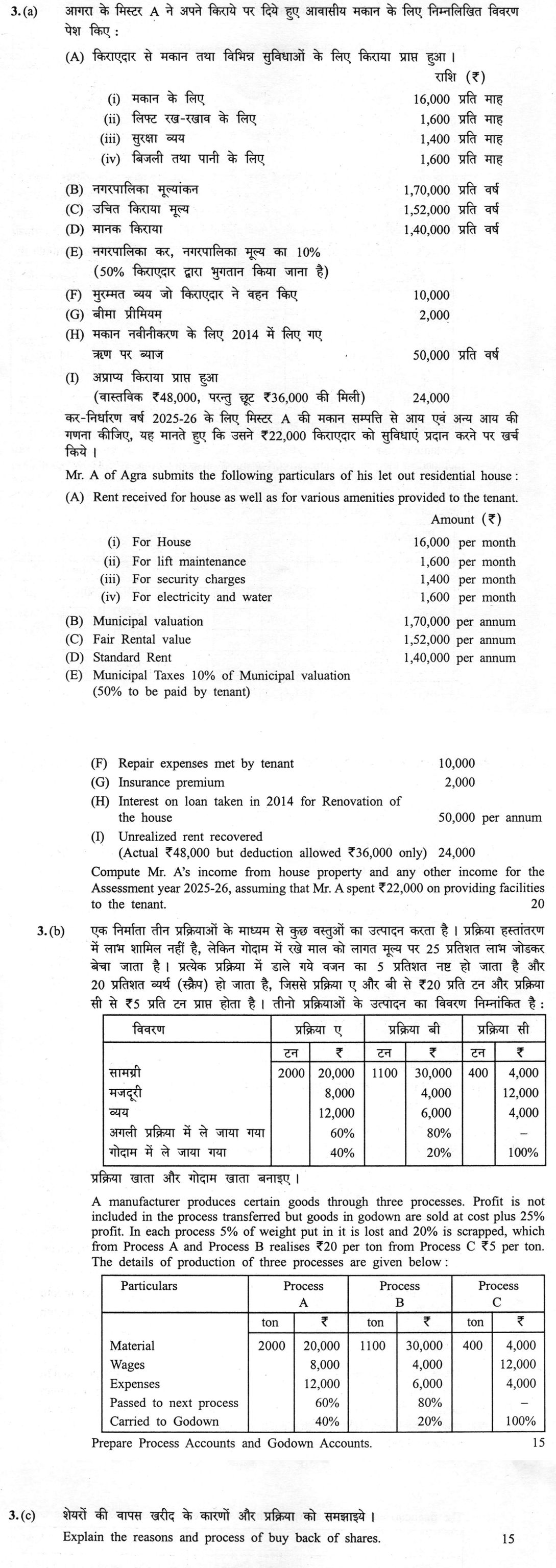
(a) Mr. A of Agra submits the following particulars of his let out residential house : (A) Rent received for house as well as…
Mr. A of Agra submits the following particulars of his let out residential house :
(A) Rent received for house as well as for various amenities provided to the tenant. Amount (₹) For House 16,000 per month
For lift maintenance 1,600 per month
For security charges 1,400 per month
For electricity and water 1,600 per month
(B) Municipal valuation 1,70,000 per annum (C) Fair Rental value 1,52,000 per annum (D) Standard Rent 1,40,000 per annum (E) Municipal Taxes 10% of Municipal valuation (50% to be paid by tenant) (F) Repair expenses met by tenant 10,000 (G) Insurance premium 2,000 (H) Interest on loan taken in 2014 for Renovation of the house 50,000 per annum (I) Unrealized rent recovered (Actual ₹48,000 but deduction allowed ₹36,000 only) 24,000 Compute Mr. A's income from house property and any other income for the Assessment year 2025-26, assuming that Mr. A spent ₹22,000 on providing facilities to the tenant. 20 marks
A manufacturer produces certain goods through three processes. Profit is not included in the process transferred but goods in godown are sold at cost plus 25% profit. In each process 5% of weight put in it is lost and 20% is scrapped, which from Process A and Process B realises ₹20 per ton from Process C ₹5 per ton. The details of production of three processes are given below :
Particulars | Process A | Process B | Process C ton | ₹ | ton | ₹ | ton | ₹ Material | 2000 | 20,000 | 1100 | 30,000 | 400 | 4,000 Wages | | 8,000 | | 4,000 | | 12,000 Expenses | | 12,000 | | 6,000 | | 4,000 Passed to next process | | 60% | | 80% | | – Carried to Godown | | 40% | | 20% | | 100%
Prepare Process Accounts and Godown Accounts. 15 marks
Explain the reasons and process of buy back of shares. 15 marks
हिंदी में प्रश्न पढ़ें
आगरा के मिस्टर A ने अपने किराये पर दिये हुए आवासीय मकान के लिए निम्नलिखित विवरण पेश किए :
(A) किराएदार से मकान तथा विभिन्न सुविधाओं के लिए किराया प्राप्त हुआ । राशि (₹) मकान के लिए 16,000 प्रति माह
लिफ्ट रख-रखाव के लिए 1,600 प्रति माह
सुरक्षा व्यय 1,400 प्रति माह
बिजली तथा पानी के लिए 1,600 प्रति माह
(B) नगरपालिका मूल्यांकन 1,70,000 प्रति वर्ष (C) उचित किराया मूल्य 1,52,000 प्रति वर्ष (D) मानक किराया 1,40,000 प्रति वर्ष (E) नगरपालिका कर, नगरपालिका मूल्य का 10% (50% किराएदार द्वारा भुगतान किया जाना है) (F) किरायेदार द्वारा वहन किया गया मरम्मत व्यय 10,000 (G) बीमा प्रीमियम 2,000 (H) मकान के नवीनीकरण के लिए 2014 में लिए गए ऋण पर ब्याज 50,000 प्रति वर्ष (I) वसूल किया गया अप्राप्त किराया (वास्तविक ₹48,000 परन्तु कटौती केवल ₹36,000 की अनुमन्य) 24,000 श्री ए की मकान संपत्ति से आय तथा कोई अन्य आय निर्धारण वर्ष 2025-26 के लिए परिकलित कीजिए, यह मानते हुए कि श्री ए ने किरायेदार को सुविधाएँ उपलब्ध कराने पर ₹22,000 व्यय किए । (20 अंक)
एक निर्माता तीन प्रक्रियाओं के माध्यम से कुछ वस्तुओं का उत्पादन करता है । प्रक्रिया हस्तांतरण में लाभ शामिल नहीं है, लेकिन गोदाम में रखे माल को लागत मूल्य पर 25 प्रतिशत लाभ जोड़कर बेचा जाता है । प्रत्येक प्रक्रिया में डाले गए वजन का 5 प्रतिशत नष्ट हो जाता है और 20 प्रतिशत व्यर्थ (स्क्रैप) हो जाता है, जिससे प्रक्रिया ए और बी से ₹20 प्रति टन और प्रक्रिया सी से ₹5 प्रति टन प्राप्त होता है । तीनों प्रक्रियाओं के उत्पादन का विवरण निम्नांकित है :
विवरण | प्रक्रिया ए | प्रक्रिया बी | प्रक्रिया सी टन | ₹ | टन | ₹ | टन | ₹ सामग्री | 2000 | 20,000 | 1100 | 30,000 | 400 | 4,000 मजदूरी | | 8,000 | | 4,000 | | 12,000 व्यय | | 12,000 | | 6,000 | | 4,000 अगली प्रक्रिया में ले जाया गया | | 60% | | 80% | | – गोदाम में ले जाया गया | | 40% | | 20% | | 100%
प्रक्रिया खाता और गोदाम खाता बनाइए । (15 अंक)
शेयरों की वापस खरीद के कारणों और प्रक्रिया को समझाइए । (15 अंक)
Model answer
Drafted with AI by UPSC Answer Check against this question's marking rubric, to the expected length. UPSC does not publish answers for Mains — this is one way to score well, not an official key. How we build rubrics and answers.
(a) Income from house property and other income of Mr. A, AY 2025-26
The computation follows sections 22 to 25A of the Income-tax Act, 1961, which governs AY 2025-26 (the same rules now sit in sections 20 to 23 of the Income-tax Act, 2025). Rent for the house (₹16,000 a month) is separately stated from the charges for amenities, so only the house rent enters annual value; the amenity charges are taxed under "Income from other sources".
Income from house property
| Particulars | ₹ |
|---|---|
| Municipal value | 1,70,000 |
| Fair rent | 1,52,000 |
| Expected rent: higher of the two, limited to standard rent | 1,40,000 |
| Actual rent (16,000 × 12) | 1,92,000 |
| Gross annual value (higher of expected rent and actual rent) | 1,92,000 |
| Less: municipal tax borne by the owner (50% of 10% of 1,70,000) | 8,500 |
| Net annual value | 1,83,500 |
| Less: standard deduction u/s 24(a), 30% | 55,050 |
| Less: interest on renovation loan u/s 24(b) (no ceiling for a let-out house) | 50,000 |
| Income from the let-out house | 78,450 |
| Add: unrealised rent recovered u/s 25A (24,000 less 30%) | 16,800 |
| Income from house property | 95,250 |
Notes: only the owner's share of municipal tax is deductible, assumed paid during the year. Repairs borne by the tenant and the insurance premium get no separate deduction; the 30% standard deduction covers them. Under the present section 25A, unrealised rent recovered is taxed in the year of receipt after a 30% deduction, irrespective of the amount allowed earlier.
Income from other sources
Amenity charges (1,600 + 1,400 + 1,600) × 12 = ₹55,200, less expenditure on providing the facilities ₹22,000 (section 57(iii)) = ₹33,200.
Total of the two heads = 95,250 + 33,200 = ₹1,28,450.
(b) Process accounts and Godown account
Loss (5%) and scrap (20%) are computed on the total weight put into each process; normal loss carries no value and scrap is credited at its realisable value. The net cost is divided between the next process and the godown in the given ratio, without profit.
Process A Account
| Particulars | Tons | ₹ | Particulars | Tons | ₹ |
|---|---|---|---|---|---|
| To Material | 2,000 | 20,000 | By Normal loss (5%) | 100 | – |
| To Wages | 8,000 | By Scrap (20% at ₹20) | 400 | 8,000 | |
| To Expenses | 12,000 | By Process B (60%) | 900 | 19,200 | |
| By Godown (40%) | 600 | 12,800 | |||
| Total | 2,000 | 40,000 | Total | 2,000 | 40,000 |
Cost per ton of output = 32,000 ÷ 1,500 = ₹21.33.
Process B Account
| Particulars | Tons | ₹ | Particulars | Tons | ₹ |
|---|---|---|---|---|---|
| To Process A | 900 | 19,200 | By Normal loss (5%) | 100 | – |
| To Material | 1,100 | 30,000 | By Scrap (20% at ₹20) | 400 | 8,000 |
| To Wages | 4,000 | By Process C (80%) | 1,200 | 40,960 | |
| To Expenses | 6,000 | By Godown (20%) | 300 | 10,240 | |
| Total | 2,000 | 59,200 | Total | 2,000 | 59,200 |
Cost per ton of output = 51,200 ÷ 1,500 = ₹34.13.
Process C Account
| Particulars | Tons | ₹ | Particulars | Tons | ₹ |
|---|---|---|---|---|---|
| To Process B | 1,200 | 40,960 | By Normal loss (5%) | 80 | – |
| To Material | 400 | 4,000 | By Scrap (20% at ₹5) | 320 | 1,600 |
| To Wages | 12,000 | By Godown (100%) | 1,200 | 59,360 | |
| To Expenses | 4,000 | ||||
| Total | 1,600 | 60,960 | Total | 1,600 | 60,960 |
Cost per ton of output = 59,360 ÷ 1,200 = ₹49.47.
Godown Account (assuming all goods in the godown are sold)
| Particulars | Tons | ₹ | Particulars | Tons | ₹ |
|---|---|---|---|---|---|
| To Process A | 600 | 12,800 | By Sales (cost + 25%) | 2,100 | 1,03,000 |
| To Process B | 300 | 10,240 | |||
| To Process C | 1,200 | 59,360 | |||
| To Profit (25% of 82,400) | 20,600 | ||||
| Total | 2,100 | 1,03,000 | Total | 2,100 | 1,03,000 |
(c) Explain the reasons and process of buy back of shares.
Reasons:
- Returning surplus cash that the company cannot deploy profitably.
- Raising earnings per share and return on equity by reducing the number of shares.
- Signalling that management considers the shares undervalued, and supporting the price in a weak market.
- Moving the capital structure towards a target debt-equity ratio.
- Consolidating promoter holding and deterring hostile takeovers.
- Giving shareholders an exit, especially in unlisted companies.
Process (sections 68 to 70 of the Companies Act, 2013; Rule 17 of the Companies (Share Capital and Debentures) Rules, 2014; SEBI (Buy-Back of Securities) Regulations, 2018 for listed companies):
- Authority: the articles must permit it; a board resolution suffices up to 10% of paid-up equity capital and free reserves, a special resolution up to 25%.
- Limits: total buy-back not above 25% of paid-up capital and free reserves (including securities premium); equity bought back in a year not above 25% of paid-up equity capital; post-buy-back debt not more than twice capital and free reserves; only fully paid shares; no fresh offer within one year of the previous one.
- Sources: free reserves, securities premium, or proceeds of an issue of a different kind of shares or securities.
- Documents: letter of offer (SH-8), declaration of solvency (SH-9) and register (SH-10); for listed companies a public announcement, an escrow account and, in tender offers, a 15% reservation for small shareholders.
- Methods: tender offer, open-market purchase through book-building or the stock exchange (the exchange route, discontinued from 1 April 2025, was approved for reintroduction by SEBI in June 2026), odd-lot purchase, or purchase from employees under ESOP or sweat equity.
- Completion: within one year of the resolution; shares extinguished and physically destroyed within seven days; return in SH-11 within 30 days; nominal value transferred to Capital Redemption Reserve when bought out of free reserves or premium (section 69); no fresh issue of the same kind for six months, except bonus or conversion.
- Prohibitions (section 70): no buy-back through a subsidiary or investment company, or while a default on deposits, debentures, preference shares, dividend or term loans subsists.
- Tax: from 1 April 2026 buy-back proceeds are taxed as capital gains in shareholders' hands under the Income-tax Act, 2025, with an additional tax on promoters.
How this answer will be evaluated
Evaluation rubric
Each sub-part is marked on its own, against the marks and word limit printed on the paper.
- (a) Compute Mr A's income from house property for Assessment Year 2025-26 for a let-out residential house, AND his 'any other income', from a composite rent situation. The candidate must split composite rent between the building and the amenities, compute Gross Annual Value with the standard-rent cap, deduct only the owner's share of municipal taxes, apply the section 24 deductions, bring the recovered unrealised rent to tax under section 25A, and tax the net amenity charges under 'Income from Other Sources'. 20 marks
Must cover
- Expected Rent Rs 1,40,000 (standard rent cap)
- Gross Annual Value Rs 1,92,000
- Municipal taxes deductible Rs 8,500 (owner's 50% of Rs 17,000)
- Net Annual Value Rs 1,83,500
- Section 24(a) standard deduction 30% = Rs 55,050
- Section 24(b) interest Rs 50,000
- Section 25A - unrealised rent recovered Rs 24,000 less 30% = Rs 16,800
- Income from house property Rs 95,250
- Income from other sources Rs 33,200 (Rs 55,200 - Rs 22,000)
- Sections 22, 23(1), 24 and 25A of the Income-tax Act, 1961 (sections 20-23 of the Income-tax Act, 2025); composite rent
Loses marks
- Adding the lift, security, electricity and water charges of Rs 55,200 to the rent and taking GAV as Rs 2,47,200 - service charges are not rent of the property
- Deducting the whole municipal tax of Rs 17,000 instead of only the owner's Rs 8,500, or deducting municipal tax on an accrual basis when section 23 allows it only when actually paid by the owner
- Capping the interest deduction at Rs 2,00,000 or Rs 30,000 - those limits apply only to self-occupied property; a let-out house gets the whole Rs 50,000
- Claiming a separate deduction for the insurance premium of Rs 2,000 or for the tenant's repairs of Rs 10,000 on top of the 30% standard deduction
- Taking the Expected Rent as Rs 1,70,000 by ignoring the standard rent cap, or taking GAV as Rs 1,40,000 by ignoring that actual rent exceeds expected rent
Earns more
- Unrealised rent recovered of Rs 24,000 charged under section 25A with the 30% statutory deduction = Rs 16,800; total income from house property = Rs 95,250
- Other income: amenity/service charges Rs 55,200 less expenditure of Rs 22,000 incurred on providing the facilities = Rs 33,200 chargeable under 'Income from other sources'; tenant's repairs Rs 10,000 and insurance premium Rs 2,000 correctly ignored as they are subsumed in the 30% standard deduction
- (b) Prepare the three Process Accounts (A, B and C) and the Godown Account for a manufacturer whose output passes through three processes with a 5% weight loss and a 20% scrap in each process, where scrap from A and B realises Rs 20 per ton and from C Rs 5 per ton, part of each process output goes to the godown and the balance to the next process, transfers carry no profit, and godown stock is sold at cost plus 25%. 15 marks
Must cover
- Process A: net cost Rs 32,000 for 1,500 tons; Rs 21.33 per ton
- Process B: net cost Rs 51,200 for 1,500 tons; Rs 34.13 per ton
- Process C: net cost Rs 59,360 for 1,200 tons; Rs 49.47 per ton
- Scrap credits: Rs 8,000 in A, Rs 8,000 in B, Rs 1,600 in C
- Total godown cost Rs 82,400 for 2,100 tons
- Godown sales Rs 1,03,000 at cost plus 25%
- Godown profit Rs 20,600
- Normal loss carries no cost; scrap credited at realisable value
Loses marks
- Computing the 5% loss and 20% scrap only on the material added in Process B and C instead of on the total weight put in (transfer-in plus added material), which throws out every subsequent figure
- Crediting the normal loss with a value, or crediting the scrap of Process C at Rs 20 instead of Rs 5 per ton
- Apportioning only the material cost, not the whole net process cost, between the next process and the godown
- Adding a profit loading to inter-process transfers, although the question states that profit is not included in process transfers
- Computing the godown selling price as Rs 82,400 / 0.75 (i.e. treating 25% as a margin on sales) instead of 82,400 x 1.25, cost plus 25%
Earns more
- Correct principle applied throughout: loss and scrap percentages are computed on the total weight put into the process (transfer-in plus material added), scrap is credited at its realisable value and normal loss at nil, and the net process cost is apportioned to the next process and to the godown in the given percentages because transfers carry no profit
- (c) Two demands of equal weight: the REASONS why a company buys back its own shares (financial, signalling, capital-structure and strategic motives) and the PROCESS of buy-back, which must be answered with the statutory machinery of sections 68, 69 and 70 of the Companies Act, 2013, Rule 17 of the Companies (Share Capital and Debentures) Rules, 2014, and the SEBI (Buy-Back of Securities) Regulations, 2018 for listed companies. 15 marks
Must cover
- Sections 68, 69 and 70 of the Companies Act, 2013
- Rule 17 of the Companies (Share Capital and Debentures) Rules, 2014
- SEBI (Buy-Back of Securities) Regulations, 2018
- Sources: free reserves, securities premium account, proceeds of a fresh issue
- 25% ceiling on paid-up capital and free reserves; 25% of paid-up equity capital in a financial year; 10% board-resolution route
- Post-buy-back debt-equity ratio not exceeding 2:1
- Declaration of solvency in Form SH-9; letter of offer Form SH-8; return of buy-back Form SH-11; certificate Form SH-15
- Capital Redemption Reserve under section 69
- Extinguishment and physical destruction within seven days; one-year cooling-off period
- Tender offer, open market/book-building, odd-lot and ESOP routes
- Earnings per share and return on equity; signalling undervaluation
Loses marks
- Writing only the reasons and treating the 'process' as a vague sequence of board meetings without any section, rule or form number
- Stating the ceiling as 25% of paid-up capital alone, or omitting that in any financial year not more than 25% of the paid-up EQUITY capital may be bought back
- Omitting the post-buy-back 2:1 debt limit and the declaration of solvency, which are the creditor-protection core of section 68
- Confusing buy-back under section 68 with reduction of capital under section 66 (which needs Tribunal confirmation) or with redemption of preference shares under section 55
- Asserting without qualification that buy-back is more tax-efficient than dividend - buy-back proceeds were taxed as deemed dividend from 1 October 2024, and from 1 April 2026 are taxed as capital gains in the shareholder's hands with an additional tax on promoters
Earns more
- Section 69 - transfer of an amount equal to the nominal value of the shares bought back to the Capital Redemption Reserve where the buy-back is out of free reserves or the securities premium account; and section 70 prohibitions - no buy-back through a subsidiary or investment company, or while a default in repayment of deposits, debentures, preference shares or term loans subsists, or while sections 92, 123, 127 and 129 are not complied with
- Methods of buy-back and the SEBI framework: tender offer on a proportionate basis, open-market purchase through book-building or the stock exchange (the exchange route was discontinued from 1 April 2025 and approved for reintroduction by SEBI in June 2026), odd-lot buy-back, and purchase from employees under ESOP or sweat equity; SEBI (Buy-Back of Securities) Regulations, 2018 requiring a public announcement, an escrow account and a 15% reservation for small shareholders in tender offers
What "Solve" is asking you to do
Choose the method, then carry it through to a final answer. Identifying what kind of problem this is and why that method applies is the first thing marked; a correct figure arrived at invisibly earns almost nothing.
Structure that answers it
Given data and what is required → method chosen, with the reason it applies → set-up (equation, circuit, free body, trial balance) → working, step by step → answer with units and any condition of validity
Where marks are lost
Doing the middle steps mentally and writing only the result. In mathematics papers, a further loss comes from giving a decimal where the exact value in surds or fractions was wanted, or from skipping the justification a part explicitly asks for.
Practice this exact question
Write your answer and it is marked point by point against the model answer above — what you covered, what you missed, what you got wrong.
Evaluate my answer →More from Commerce & Accountancy 2026 Paper I
- Q1 Answer the following questions in about 150 words each : (a) What is Profit-Volume ratio…
- Q2 (a) X ltd. and Y ltd. agreed to amalgamate and form a new company Z ltd. which will take…
- Q3 (a) Mr. A of Agra submits the following particulars of his let out residential house : (A…
- Q4 (a) The financial position of a firm as on 31st March 2024 and 2025 was as follows : Part…
- Q5 Answer each of the following questions in about 150 words : (a) Explain the CAPM approach…
- Q6 (a) Discuss the monetary policy of the Reserve Bank of India over the years. Explain the…