Paper I — Q5
(a) Explain the CAPM approach for computing the cost of equity. Discuss the merits and demerits of the approach. (10 marks) (b)…
Answer each of the following questions in about 150 words :
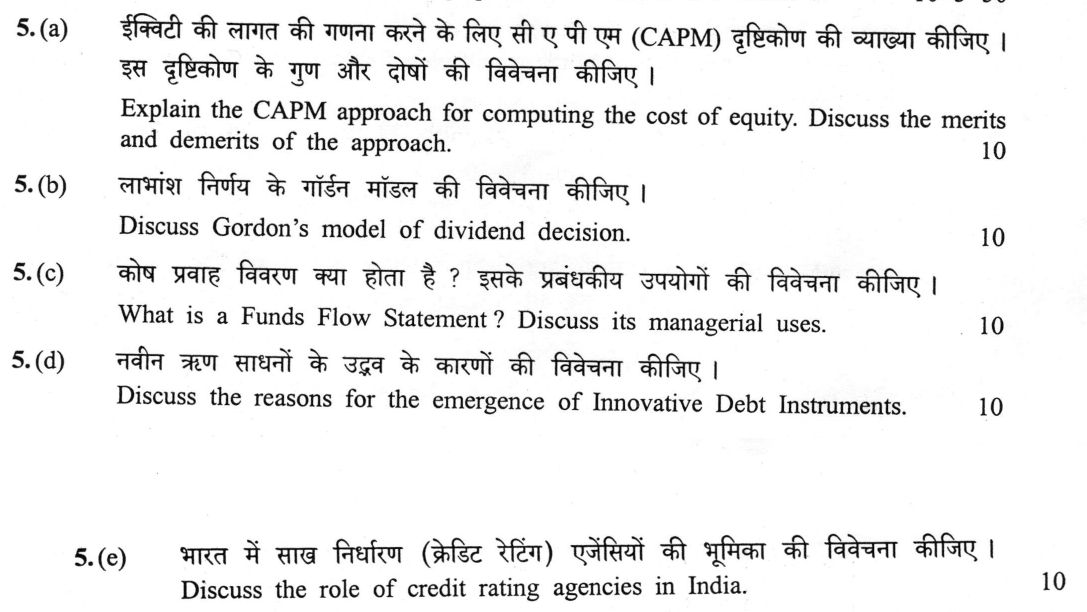
Explain the CAPM approach for computing the cost of equity. Discuss the merits and demerits of the approach. 10 marks
Discuss Gordon's model of dividend decision. 10 marks
What is a Funds Flow Statement ? Discuss its managerial uses. 10 marks
Discuss the reasons for the emergence of Innovative Debt Instruments. 10 marks
Discuss the role of credit rating agencies in India. 10 marks
हिंदी में प्रश्न पढ़ें
निम्नलिखित प्रश्नों में से प्रत्येक का उत्तर लगभग 150 शब्दों में दीजिये :
इक्विटी की लागत की गणना करने के लिए सी ए पी एम (CAPM) दृष्टिकोण की व्याख्या कीजिए । इस दृष्टिकोण के गुण और दोषों की विवेचना कीजिए । (10 अंक)
लाभांश निर्णय के गॉर्डन मॉडल की विवेचना कीजिए । (10 अंक)
कोष प्रवाह विवरण क्या होता है ? इसके प्रबंधकीय उपयोगों की विवेचना कीजिए । (10 अंक)
नवीन ऋण साधनों के उद्भव के कारणों की विवेचना कीजिए । (10 अंक)
भारत में साख निर्धारण (क्रेडिट रेटिंग) एजेंसियों की भूमिका की विवेचना कीजिए । (10 अंक)
Model answer
Drafted with AI by UPSC Answer Check against this question's marking rubric, to the 150-word length. UPSC does not publish answers for Mains — this is one way to score well, not an official key. How we build rubrics and answers.
(a) Explain the CAPM approach for computing the cost of equity. Discuss the merits and demerits of the approach.
The Capital Asset Pricing Model (CAPM) of Sharpe, Lintner and Mossin, built on Markowitz's portfolio theory, estimates the cost of equity as the return investors require for bearing systematic risk:
Ke = Rf + β(Rm − Rf)
Here Rf is the risk-free rate (e.g., the government securities yield), Rm the expected market return, (Rm − Rf) the market risk premium, and β = Cov(Rj, Rm)/Var(Rm), the sensitivity of the share's return to the market; Ke lies on the security market line. Example: Rf 7%, β 1.2, Rm 13% gives Ke = 7 + 1.2 × 6 = 14.2%.
Merits: it prices only systematic (non-diversifiable) risk, which a diversified investor actually bears; it works for firms that pay no dividends, where the dividend growth model fails; and its inputs come from observable market data.
Demerits: the true market portfolio cannot be observed (Roll's critique); historical betas are unstable and depend on the period and index chosen; the risk-free rate and market premium are contestable; multi-factor evidence (Fama-French three-factor, Carhart four-factor) shows that beta alone does not explain returns; and unlisted firms need a proxy beta, ungeared and regeared.
(b) Discuss Gordon's model of dividend decision.
Myron Gordon's dividend capitalisation model is a theory of dividend relevance: the payout ratio affects share value. Assumptions: an all-equity firm financed only by retained earnings; constant return on investment (r), cost of equity (Ke) and retention ratio (b); perpetual life; no taxes; and Ke > br.
Price: P = E(1 − b)/(Ke − br), i.e. P = D1/(Ke − g), where growth g = br.
- Growth firm (r > Ke): value rises with retention, so the lowest payout is optimal.
- Normal firm (r = Ke): payout does not affect value.
- Declining firm (r < Ke): value rises with payout, so a 100% payout is optimal.
Gordon's "bird-in-the-hand" argument adds that risk-averse investors discount distant dividends at a rising rate, so a higher current dividend lowers Ke and raises the price even when r = Ke.
Criticism: excluding external finance and holding r and Ke constant is unrealistic; the model breaks down as br approaches Ke; taxes and flotation costs are ignored; and Modigliani and Miller call the bird-in-the-hand argument a fallacy, since dividend policy does not change business risk. Walter's model, the other relevance theory, reaches similar conclusions.
(c) What is a Funds Flow Statement ? Discuss its managerial uses.
A funds flow statement explains the change in working capital (current assets less current liabilities) between two balance sheet dates by showing where funds came from and how they were used. It has three parts: a schedule of changes in working capital; funds from operations (profit plus non-fund charges such as depreciation, goodwill written off and loss on sale of fixed assets, less non-operating gains); and a statement of sources (funds from operations, issue of shares or debentures, long-term loans, sale of fixed assets) and applications (purchase of fixed assets, redemptions, loan repayment, tax and dividend paid). Funds flow only when a transaction touches one current and one non-current account.
Managerial uses:
- Explains why working capital rose or fell despite profits or losses.
- Tests whether fixed assets are financed by long-term funds or by squeezing working capital.
- Judges the capacity to pay dividends and repay debt from internal funds.
- Serves as the base of a projected funds statement for capital budgeting and financing plans.
- Helps lenders appraise the firm's financial policy.
Unlike the cash flow statement required by section 2(40) of the Companies Act, 2013 and AS 3/Ind AS 7, it is not statutory.
(d) Discuss the reasons for the emergence of Innovative Debt Instruments.
Innovative debt instruments emerged in India from the 1990s because of forces on both sides of the market:
- Issuer needs: cheaper, longer or better-timed finance produced deep discount and zero coupon bonds (IDBI's deep discount bond, 1992), secured premium notes (TISCO, 1992) and convertible debentures that defer equity dilution.
- Investor needs: protection against interest-rate and inflation risk led to floating rate and inflation-indexed bonds; call and put options and warrants add flexibility.
- Deregulation: abolition of the Controller of Capital Issues and free pricing under SEBI (1992), and RBI's interest-rate deregulation, allowed market-priced instruments.
- Risk unbundling: securitisation, backed by the SARFAESI Act, 2002, created pass-through certificates and asset- and mortgage-backed securities.
- Bank capital rules: Basel III norms gave rise to perpetual Additional Tier 1 and Tier 2 bonds.
- Globalisation and ESG: FCCBs, masala bonds and green bonds tap foreign and sustainability-focused investors.
- Tax incentives: capital gains bonds (old section 54EC) and tax-free infrastructure bonds.
- Market development: the R.H. Patil (2005) and H.R. Khan (2016) committees, credit rating and dematerialisation deepened the corporate bond market.
(e) Discuss the role of credit rating agencies in India.
A credit rating is an agency's opinion on an issuer's ability and willingness to service a specific debt instrument on time; it is neither a recommendation to buy or sell nor a guarantee. India's agencies are CRISIL (1987, the first), ICRA (1991), CARE (1993), India Ratings and Research, Brickwork, Acuité and Infomerics, registered under the SEBI (Credit Rating Agencies) Regulations, 1999.
Role:
- Investors: an independent, comparable measure of default risk on the AAA-to-D scale, reducing information asymmetry.
- Issuers: a good rating widens market access and lowers borrowing cost.
- Regulation: ratings are mandatory for public and listed debt issues, commercial paper and NBFC deposits, and bank-loan ratings set risk weights under Basel norms.
- Markets: ratings and their surveillance support the corporate bond market and the investment mandates of pension and insurance funds.
Criticism: the issuer-pays model creates conflicts of interest and rating shopping, and downgrades lagged in the IL&FS (2018) and DHFL defaults. SEBI has responded with "Issuer Not Cooperating" tagging, probability-of-default benchmarks, standardised default studies and disclosure of rating histories.
How this answer will be evaluated
Evaluation rubric
Each sub-part is marked on its own, against the marks and word limit printed on the paper.
- (a) Explain the Capital Asset Pricing Model as a method of estimating the cost of equity - the equation, the meaning of each input and how beta is obtained - and then evaluate the approach by discussing its merits and its demerits. Both halves must be present. 10 marks · 150 words
Must cover
- Ke = Rf + beta (Rm - Rf)
- Beta = Cov(Rj, Rm) / Var(Rm); characteristic line
- Systematic (non-diversifiable) versus unsystematic (diversifiable) risk
- Security Market Line; market risk premium
- Sharpe, Lintner and Mossin as the model's authors; Markowitz portfolio theory as its base
- Roll's critique - unobservability of the true market portfolio
- Fama-French three-factor model; Carhart four-factor model
- Applicability to non-dividend-paying firms where the dividend growth model fails
Loses marks
- Writing the equation as Ke = Rf + beta x Rm, i.e. omitting the subtraction of Rf from the market return
- Defining beta as total risk or standard deviation rather than as the covariance-based measure of systematic risk
- Giving only the model and no evaluation, although the question explicitly asks for merits and demerits
- Confusing the Security Market Line (return against beta) with the Capital Market Line (return against standard deviation of efficient portfolios)
- Asserting that CAPM cannot be used for unlisted firms without mentioning the standard proxy-beta and ungearing/regearing remedy
Earns more
- A worked illustration with figures, e.g. Rf = 7%, beta = 1.2, Rm = 13% gives Ke = 7 + 1.2(13 - 7) = 14.2%
- (b) Discuss Myron Gordon's dividend capitalisation model as a theory of dividend RELEVANCE: state its assumptions, give the valuation formula, derive the optimum payout for growth, normal and declining firms, explain the bird-in-the-hand argument that underlies it, and criticise it. 10 marks · 150 words
Must cover
- P = E(1 - b) / (Ke - br); P = D1 / (Ke - g)
- g = br, the growth rate as retention ratio times return on investment
- Condition Ke > br
- Growth firm r > Ke: zero payout optimal; Normal firm r = Ke: payout irrelevant; Declining firm r < Ke: 100% payout optimal
- Bird-in-the-hand argument; risk aversion and increasing uncertainty of distant dividends
- Myron Gordon; dividend relevance; contrast with Modigliani and Miller's irrelevance hypothesis
- Relation to Walter's model as the other relevance theory
Loses marks
- Writing the denominator as (Ke - r) instead of (Ke - br), which is the single most common error in this model
- Reversing the payout conclusions - recommending 100% payout for a growth firm and zero for a declining firm
- Ignoring the condition Ke > br, so the answer cannot explain why the model breaks down for a high-growth firm
- Confusing Gordon's model with Walter's - Walter uses P = [D + (r/Ke)(E - D)]/Ke and assumes all earnings are either distributed or reinvested without growth compounding
- Presenting the model as a theory of dividend irrelevance, which is Modigliani and Miller's position, not Gordon's
Earns more
- The bird-in-the-hand / uncertainty argument: investors are risk-averse and discount distant dividends more heavily, so a rupee of current dividend is worth more than a rupee of retained earnings and a higher payout lowers Ke and raises the price
- Criticism: no external financing is unrealistic; r and Ke do not stay constant; the model breaks down as br approaches Ke; taxes, flotation and transaction costs are ignored; and Modigliani and Miller's counter that the bird-in-the-hand argument is a fallacy because dividend policy does not alter business risk
- (c) Define the funds flow statement - specifying what 'funds' means (working capital) and the three documents that make it up - and then discuss its uses to management. The second half carries at least half the marks, so specific managerial uses must be named, not merely asserted. 10 marks · 150 words
Must cover
- Funds = net working capital (current assets less current liabilities)
- Schedule of Changes in Working Capital
- Funds From Operations; add back depreciation, goodwill written off, loss on sale of fixed assets, transfer to reserve
- Statement of Sources and Applications of Funds
- Sources: funds from operations, issue of shares/debentures, long-term loans, sale of fixed assets
- Applications: purchase of fixed assets, redemption of debentures/preference shares, repayment of loans, dividend and tax paid
- Flow arises only between a current and a non-current account
- AS 3 / Ind AS 7 and section 2(40) of the Companies Act, 2013 require a Cash Flow Statement, not a funds flow statement
Loses marks
- Defining 'funds' as cash and thereby describing a cash flow statement instead of a funds flow statement
- Omitting the Schedule of Changes in Working Capital, which is what makes the statement a funds flow statement at all
- Treating depreciation as a source of funds in itself rather than as a non-fund charge added back to arrive at funds from operations
- Listing uses in one-word form ('planning', 'control') without saying what managerial question each answers
- Claiming that the funds flow statement is a statutory requirement under the Companies Act, 2013 - the statute requires a cash flow statement
Earns more
- The flow principle stated: a flow of funds arises only where one current and one non-current account are involved; purely current-to-current or non-current-to-non-current transactions cause no flow
- (d) Discuss the REASONS for the emergence of innovative debt instruments. The directive is causal, so the answer must explain the issuer-side, investor-side, regulatory and market forces that produced financial innovation in debt, illustrating each reason with the specific instrument it gave rise to. A bare catalogue of instruments without reasons does not answer the question. 10 marks · 150 words
Must cover
- Deep discount bonds (IDBI, 1992); zero coupon bonds
- Secured Premium Notes (TISCO, 1992)
- Floating rate notes/bonds; inflation-indexed bonds
- Fully, partly and optionally convertible debentures; debentures with detachable warrants
- Callable and puttable bonds
- Abolition of the Controller of Capital Issues, 1992; free pricing under SEBI; interest rate deregulation by the RBI
- Securitisation - mortgage-backed and asset-backed securities, pass-through certificates; SARFAESI Act, 2002
- Basel norms; perpetual Additional Tier 1 bonds and Tier 2 subordinated debt
- Masala bonds; foreign currency convertible bonds; external commercial borrowings; green bonds
- R.H. Patil Committee (2005) and H.R. Khan Committee (2016) on the corporate bond market
- Section 54EC capital gains bonds; tax-free infrastructure bonds
- Credit rating agencies and dematerialisation as enablers
Loses marks
- Listing instruments and describing their features without giving the reason each was invented, which is what the question asks
- Attributing the whole development to 'globalisation' without the domestic drivers - interest-rate deregulation, the abolition of the Controller of Capital Issues, the tax code and the corporate bond market gap
- Confusing innovative debt instruments with derivatives (futures, options, swaps), which are risk-transfer contracts rather than debt securities, without noting the distinction
- Giving no Indian example or date, so the answer could describe any country
- Ignoring the regulatory-capital driver behind perpetual Additional Tier 1 bonds and the securitisation driver behind pass-through certificates
Earns more
- Structural and regulatory drivers: the deliberate effort to build a corporate bond market and finance long-gestation infrastructure (Narasimham Committee, R.H. Patil Committee 2005, H.R. Khan Committee 2016); risk unbundling through securitisation - mortgage- and asset-backed securities, pass-through certificates, credit-linked notes - supported by the SARFAESI Act, 2002; Basel capital norms driving perpetual Additional Tier 1 and Tier 2 subordinated bonds; and globalisation and ESG demand producing FCCBs, masala bonds and green bonds
- (e) Discuss the role of credit rating agencies in India - what a credit rating is and is not, the functions rating agencies perform for investors, issuers, intermediaries and regulators, the mandatory rating requirements in Indian law, the principal agencies operating here and the regulatory framework, and a balanced critique of their performance. 10 marks · 150 words
Must cover
- A rating is an opinion on a specific instrument, not a recommendation to buy or sell and not a guarantee
- CRISIL (1987), ICRA (1991), CARE (1993), India Ratings and Research, Brickwork Ratings, Acuite Ratings, Infomerics
- SEBI (Credit Rating Agencies) Regulations, 1999
- Rating symbols AAA to D; investment grade versus speculative grade; outlook and rating watch
- Mandatory rating of public/listed debt issues, commercial paper, certificates of deposit and NBFC public deposits
- Bank loan ratings and Basel standardised approach risk weights
- Issuer-pays conflict of interest; rating shopping
- IL&FS default of 2018; DHFL; Amtek Auto
- Issuer Not Cooperating (INC) tagging; probability of default benchmarks
Loses marks
- Describing a rating as a recommendation to invest or as a certificate of the issuer's financial health rather than an opinion on a specific instrument's credit risk
- Naming no Indian agency or getting the founding facts wrong - CRISIL, set up in 1987, was the first
- Omitting the regulatory mandates (SEBI for public debt issues, RBI for commercial paper and bank loan ratings), which are the source of the agencies' importance in India
- Presenting an entirely uncritical account with no mention of the issuer-pays conflict or the IL&FS episode
- Confusing credit rating with equity research, IPO grading or credit scoring of individuals by credit information companies such as CIBIL
Earns more
- Names at least three Indian agencies and the governing regulation: CRISIL (1987, the first), ICRA (1991), CARE (1993), India Ratings and Research, Brickwork, Acuite and Infomerics, all registered under the SEBI (Credit Rating Agencies) Regulations, 1999
- Balanced critique: the issuer-pays conflict of interest and rating shopping; lagged downgrades, illustrated by IL&FS (2018), DHFL and Amtek Auto; pro-cyclicality; investor over-reliance; and SEBI's reform response - rating rationales, probability-of-default benchmarks, standardised default tracking, 'Issuer Not Cooperating' tagging and disclosure of rating history
What "Discuss" is asking you to do
Lay the issue out from more than one side — how it arose, what is claimed for it, what is held against it, and where it now stands. UPSC attaches discuss to broad topics with several live dimensions, so coverage of the dimensions earns more than the strength of your opinion.
Structure that answers it
Set the issue up → the case as it is made → the case against → the dimension both sides leave out → where the balance now lies
Where marks are lost
Listing facts with no thread between them, or arguing one side throughout and calling it a discussion.
Practice this exact question
Write your answer and it is marked point by point against the model answer above — what you covered, what you missed, what you got wrong.
Evaluate my answer →More from Commerce & Accountancy 2026 Paper I
- Q2 (a) X ltd. and Y ltd. agreed to amalgamate and form a new company Z ltd. which will take…
- Q3 (a) Mr. A of Agra submits the following particulars of his let out residential house : (A…
- Q4 (a) The financial position of a firm as on 31st March 2024 and 2025 was as follows : Part…
- Q5 Answer each of the following questions in about 150 words : (a) Explain the CAPM approach…
- Q6 (a) Discuss the monetary policy of the Reserve Bank of India over the years. Explain the…
- Q7 (a) Using the following information, complete the Balance Sheet given below : Total Debt…
- Q8 (a) “Investing in securities through mutual funds is a better choice than direct investme…