Paper I — Q7
(a) Using the following information, complete the Balance Sheet given below : Total Debt to Net worth – 0·5 : 1 Turnover of total…
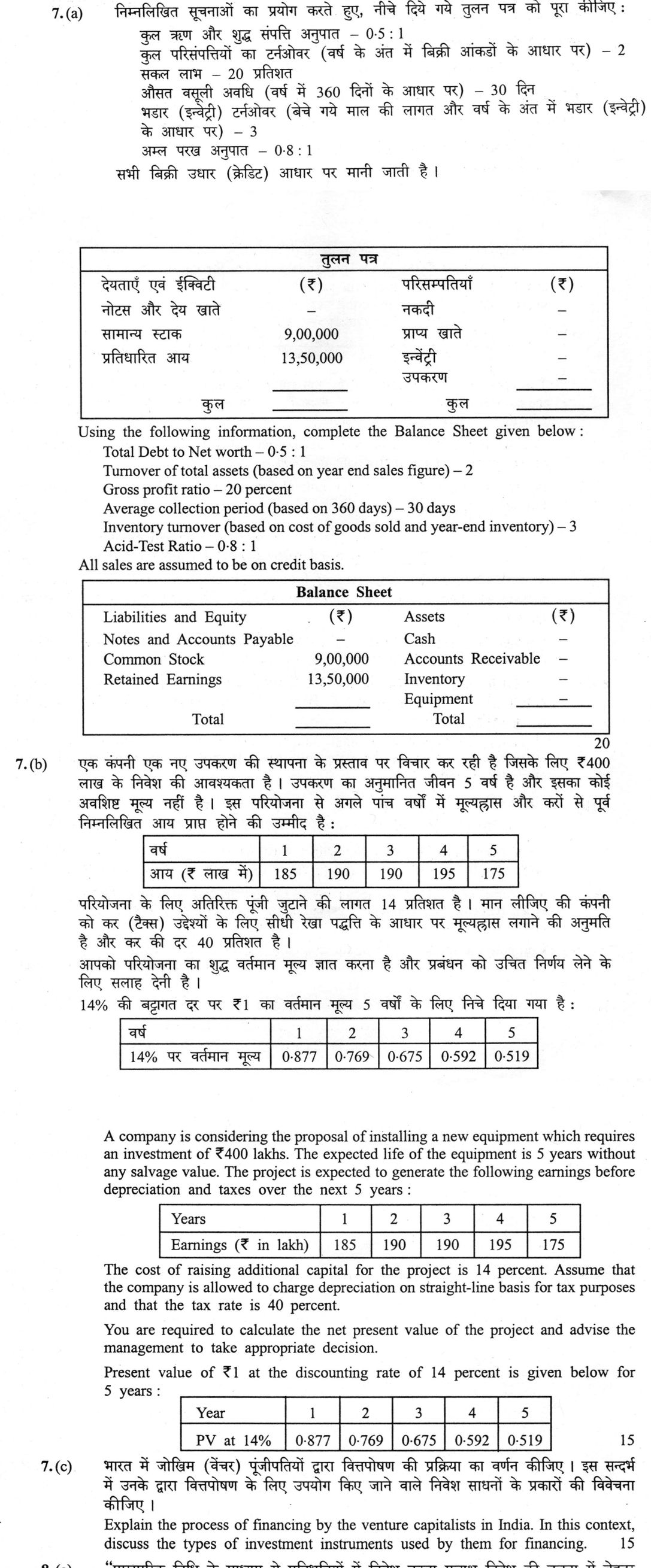
Using the following information, complete the Balance Sheet given below : Total Debt to Net worth – 0·5 : 1 Turnover of total assets (based on year end sales figure) – 2 Gross profit ratio – 20 percent Average collection period (based on 360 days) – 30 days Inventory turnover (based on cost of goods sold and year-end inventory) – 3 Acid-Test Ratio – 0·8 : 1 All sales are assumed to be on credit basis. Balance Sheet Liabilities and Equity (₹) Assets (₹) Notes and Accounts Payable – Cash – Common Stock 9,00,000 Accounts Receivable – Retained Earnings 13,50,000 Inventory – Equipment – Total ______ Total ______ 20 marks
A company is considering the proposal of installing a new equipment which requires an investment of ₹400 lakhs. The expected life of the equipment is 5 years without any salvage value. The project is expected to generate the following earnings before depreciation and taxes over the next 5 years : Years | 1 | 2 | 3 | 4 | 5 Earnings (₹ in lakh) | 185 | 190 | 190 | 195 | 175 The cost of raising additional capital for the project is 14 percent. Assume that the company is allowed to charge depreciation on straight-line basis for tax purposes and that the tax rate is 40 percent. You are required to calculate the net present value of the project and advise the management to take appropriate decision. Present value of ₹1 at the discounting rate of 14 percent is given below for 5 years : Year | 1 | 2 | 3 | 4 | 5 PV at 14% | 0·877 | 0·769 | 0·675 | 0·592 | 0·519 15 marks
Explain the process of financing by the venture capitalists in India. In this context, discuss the types of investment instruments used by them for financing. 15 marks
हिंदी में प्रश्न पढ़ें
निम्नलिखित सूचनाओं का प्रयोग करते हुए, नीचे दिये गये तुलन पत्र को पूरा कीजिए : कुल ऋण और शुद्ध संपत्ति अनुपात – 0·5 : 1 कुल परिसंपत्तियों का टर्नओवर (वर्ष के अंत में बिक्री आंकडों के आधार पर) – 2 सकल लाभ – 20 प्रतिशत औसत वसूली अवधि (वर्ष में 360 दिनों के आधार पर) – 30 दिन भडार (इन्वेंट्री) टर्नओवर (बेचे गये माल की लागत और वर्ष के अंत में भडार (इन्वेंट्री) के आधार पर) – 3 अम्ल परख अनुपात – 0·8 : 1 सभी बिक्री उधार (क्रेडिट) आधार पर मानी जाती है । तुलन पत्र देयताएँ एवं ईक्विटी (₹) परिसम्पतियाँ (₹) नोटस और देय खाते – नकदी – सामान्य स्टाक 9,00,000 प्राप्य खाते – प्रतिधारित आय 13,50,000 इन्वेंट्री – उपकरण – कुल ______ कुल ______ (20 अंक)
एक कंपनी एक नए उपकरण की स्थापना के प्रस्ताव पर विचार कर रही है जिसके लिए ₹400 लाख के निवेश की आवश्यकता है । उपकरण का अनुमानित जीवन 5 वर्ष है और इसका कोई अवशिष्ट मूल्य नहीं है । इस परियोजना से अगले पांच वर्षों में मूल्यह्रास और करों से पूर्व निम्नलिखित आय प्राप्त होने की उम्मीद है :
वर्ष 1 2 3 4 5 आय (₹ लाख में) 185 190 190 195 175
परियोजना के लिए अतिरिक्त पूंजी जुटाने की लागत 14 प्रतिशत है । मान लीजिए की कंपनी को कर (टैक्स) उद्देश्यों के लिए सीधी रेखा पद्धति के आधार पर मूल्यह्रास लगाने की अनुमति है और कर की दर 40 प्रतिशत है ।
आपको परियोजना का शुद्ध वर्तमान मूल्य ज्ञात करना है और प्रबंधन को उचित निर्णय लेने के लिए सलाह देनी है ।
14% की बट्टागत दर पर ₹1 का वर्तमान मूल्य 5 वर्षों के लिए निचे दिया गया है :
वर्ष 1 2 3 4 5 14% पर वर्तमान मूल्य 0·877 0·769 0·675 0·592 0·519 (15 अंक)
भारत में जोखिम (वेंचर) पूँजीपतियों द्वारा वित्तपोषण की प्रक्रिया का वर्णन कीजिए । इस सन्दर्भ में उनके द्वारा वित्तपोषण के लिए उपयोग किए जाने वाले निवेश साधनों के प्रकारों की विवेचना कीजिए । (15 अंक)
Model answer
Drafted with AI by UPSC Answer Check against this question's marking rubric, to the expected length. UPSC does not publish answers for Mains — this is one way to score well, not an official key. How we build rubrics and answers.
(a) Balance sheet from ratios (20 marks)
Net worth = Common stock + Retained earnings = ₹9,00,000 + ₹13,50,000 = ₹22,50,000.
- Total debt = 0.5 × net worth = ₹11,25,000. Here the only liability is Notes and Accounts Payable, so it is ₹11,25,000, all current.
- Total liabilities and equity = ₹11,25,000 + ₹22,50,000 = ₹33,75,000, so Total assets = ₹33,75,000.
- Sales = total asset turnover 2 × ₹33,75,000 = ₹67,50,000 (all on credit).
- Cost of goods sold = 80% × ₹67,50,000 = ₹54,00,000 (gross profit 20% = ₹13,50,000).
- Accounts receivable = sales × 30/360 = ₹67,50,000 ÷ 12 = ₹5,62,500.
- Inventory = cost of goods sold ÷ 3 = ₹18,00,000.
- Acid-test ratio: (Cash + Accounts receivable) ÷ current liabilities = 0.8, so Cash + Accounts receivable = 0.8 × ₹11,25,000 = ₹9,00,000, and Cash = ₹9,00,000 - ₹5,62,500 = ₹3,37,500.
- Equipment = total assets - cash - receivables - inventory = ₹33,75,000 - ₹3,37,500 - ₹5,62,500 - ₹18,00,000 = ₹6,75,000.
Balance sheet:
Liabilities and Equity: Notes and Accounts Payable ₹11,25,000; Common Stock ₹9,00,000; Retained Earnings ₹13,50,000; Total ₹33,75,000.
Assets: Cash ₹3,37,500; Accounts Receivable ₹5,62,500; Inventory ₹18,00,000; Equipment ₹6,75,000; Total ₹33,75,000.
Check: the current ratio is (3,37,500 + 5,62,500 + 18,00,000) ÷ 11,25,000 = 2.4, and the two totals agree.
(b) Net present value (15 marks)
Depreciation by straight line, with no salvage = ₹400 lakh ÷ 5 = ₹80 lakh a year. Cash inflow after tax = (EBDT - depreciation) × (1 - 0.40) + depreciation. All figures are in ₹ lakh.
Year 1: EBDT 185; profit before tax 105; tax 42; profit after tax 63; cash flow after tax 143. Year 2: EBDT 190; profit before tax 110; tax 44; profit after tax 66; cash flow after tax 146. Year 3: EBDT 190; profit before tax 110; tax 44; profit after tax 66; cash flow after tax 146. Year 4: EBDT 195; profit before tax 115; tax 46; profit after tax 69; cash flow after tax 149. Year 5: EBDT 175; profit before tax 95; tax 38; profit after tax 57; cash flow after tax 137.
Present values at 14%:
- Year 1: 143 × 0.877 = 125.41
- Year 2: 146 × 0.769 = 112.27
- Year 3: 146 × 0.675 = 98.55
- Year 4: 149 × 0.592 = 88.21
- Year 5: 137 × 0.519 = 71.10 Total present value of inflows = ₹495.55 lakh.
NPV = ₹495.55 lakh - ₹400 lakh = ₹95.55 lakh.
Advice: the NPV is positive, so the project earns more than the 14% cost of capital and adds about ₹95.55 lakh to shareholder wealth. Management should accept it, subject to the reliability of the cash-flow estimates and to a sensitivity check.
(c) Venture capital financing in India (15 marks)
Process (8). Venture capital is long-term risk capital, provided mainly as equity to unlisted, high-growth start-ups and small firms with promising technology or a business model. In India venture capital funds are registered as Category I Alternative Investment Funds under the SEBI (AIF) Regulations, 2012, with money raised from institutional and high-net-worth investors and invested by a fund manager. The steps are:
- Deal origination: proposals come through business plans, networks, incubators and referrals.
- Screening: quick filters on the entrepreneur, technology, market size and fit with the fund's stage and sector.
- Due diligence: detailed appraisal of the team, product, market, financials and legal position.
- Deal structuring: valuation, choice of instrument, stake, board seat, protective covenants, anti-dilution and exit terms in a term sheet and shareholders' agreement.
- Post-investment support: tranches of funding against milestones, board participation, strategic guidance, hiring and follow-on funding.
- Exit: the fund realises its return through an IPO, a trade sale, a buyback by promoters, or a secondary sale to another investor, generally within 4 to 7 years. The stage of financing varies: seed, start-up or early stage, expansion or growth, bridge and pre-IPO.
Instruments (7):
- Equity shares: the ownership stake, giving the highest return and risk.
- Convertible preference shares (CCPS): a preferential dividend and liquidation right, converting into equity at set terms; the most common instrument.
- Convertible debentures or notes: debt that converts into equity on a trigger, such as a later funding round or a valuation milestone.
- Warrants and options: the right to buy shares later at a fixed price, which helps in structuring incentives.
- Conditionally convertible and mezzanine instruments, and quasi-equity, which combine debt and equity features.
- Venture debt: loans to firms at a later stage, with low dilution, often carrying warrants. The choice depends on the stage, risk and control sought by the investor and the needs of the firm.
How this answer will be evaluated
Evaluation rubric
Each sub-part is marked on its own, against the marks and word limit printed on the paper.
- (a) (a) Complete the balance sheet from the six given ratios (20). 20 marks
Must cover
- Net worth 22,50,000; debt 11,25,000; total assets 33,75,000
- Sales 67,50,000; COGS 54,00,000; receivables 5,62,500; inventory 18,00,000
- Cash 3,37,500 from acid-test 0.8 on current liabilities of 11,25,000
- Equipment 6,75,000 and a tallied balance sheet
Loses marks
- Using average or opening balances instead of year-end figures.
- Treating only part of the debt as current.
- Balance sheet that does not tally.
Earns more
- Step-by-step derivation shown in order.
- Cross-check such as the current ratio of 2.4.
Extra mark
- Comment on liquidity and leverage
- (b) (b) Calculate the NPV of the Rs 400 lakh equipment project and advise management (15). 15 marks
Must cover
- Depreciation 80 lakh a year; tax 40%
- CFAT: 143, 146, 146, 149, 137 lakh
- PV at 14% totalling about 495.55 lakh
- NPV about 95.55 lakh; accept the project on a positive NPV
Loses marks
- Computing tax on EBDT without deducting depreciation.
- Forgetting to add depreciation back.
- No recommendation.
Earns more
- Formula CFAT = (EBDT - depreciation)(1 - t) + depreciation.
- Year-wise table with every step.
Extra mark
- Sensitivity or IRR comment
- (c) (c) Process of venture capital financing in India (8) and types of instruments used (7) (15). 15 marks
Must cover
- Process: origination, screening, due diligence, structuring, post-investment support, exit
- Regulatory setting: Category I AIF under SEBI (AIF) Regulations 2012
- Instruments: equity, CCPS, convertible debentures or notes, warrants, venture debt, mezzanine
- Exit routes: IPO, trade sale, buyback, secondary sale
Loses marks
- Confusing venture capital with bank finance.
- Listing instruments only, without how they work.
- Missing the exit stage.
Earns more
- Stages of financing (seed to pre-IPO).
- Why each instrument is used.
Extra mark
- Startup ecosystem support such as fund of funds
What "Solve" is asking you to do
Choose the method, then carry it through to a final answer. Identifying what kind of problem this is and why that method applies is the first thing marked; a correct figure arrived at invisibly earns almost nothing.
Structure that answers it
Given data and what is required → method chosen, with the reason it applies → set-up (equation, circuit, free body, trial balance) → working, step by step → answer with units and any condition of validity
Where marks are lost
Doing the middle steps mentally and writing only the result. In mathematics papers, a further loss comes from giving a decimal where the exact value in surds or fractions was wanted, or from skipping the justification a part explicitly asks for.
Practice this exact question
Write your answer and it is marked point by point against the model answer above — what you covered, what you missed, what you got wrong.
Evaluate my answer →More from Commerce & Accountancy 2026 Paper I
- Q4 (a) The financial position of a firm as on 31st March 2024 and 2025 was as follows : Part…
- Q5 Answer each of the following questions in about 150 words : (a) Explain the CAPM approach…
- Q6 (a) Discuss the monetary policy of the Reserve Bank of India over the years. Explain the…
- Q7 (a) Using the following information, complete the Balance Sheet given below : Total Debt…
- Q8 (a) “Investing in securities through mutual funds is a better choice than direct investme…