Paper I — Q8
(a) “Investing in securities through mutual funds is a better choice than direct investment” — explain the statement. Also…
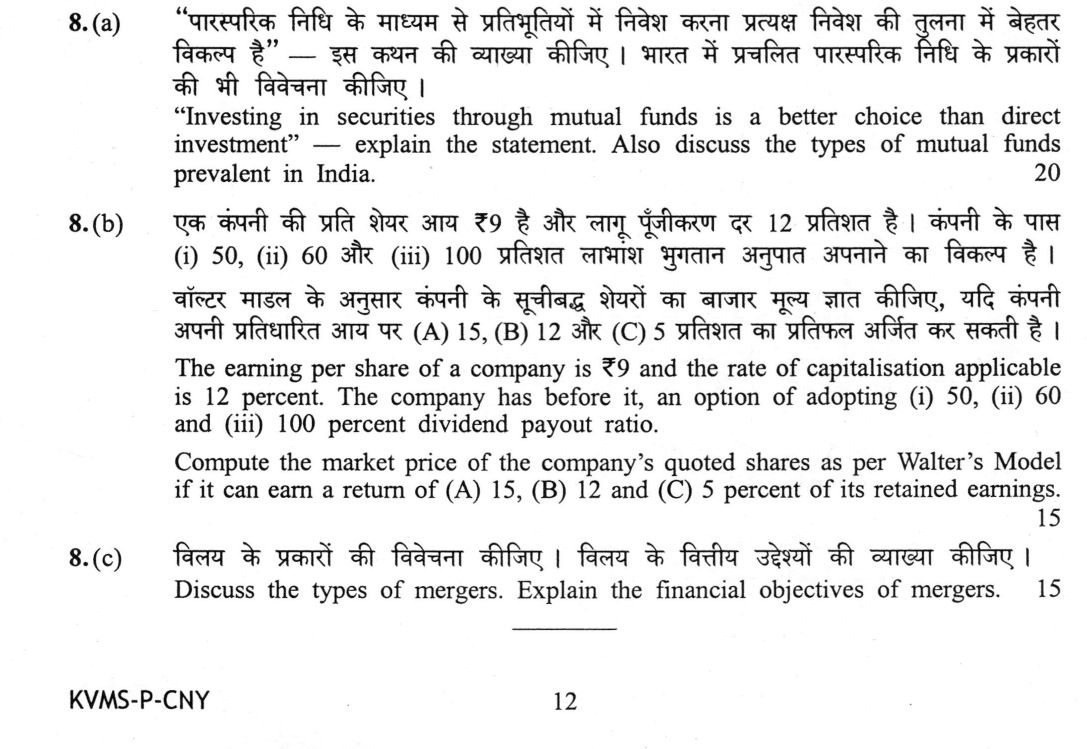
“Investing in securities through mutual funds is a better choice than direct investment” — explain the statement. Also discuss the types of mutual funds prevalent in India. 20 marks
The earning per share of a company is ₹9 and the rate of capitalisation applicable is 12 percent. The company has before it, an option of adopting (i) 50, (ii) 60 and (iii) 100 percent dividend payout ratio. Compute the market price of the company’s quoted shares as per Walter’s Model if it can earn a return of (A) 15, (B) 12 and (C) 5 percent of its retained earnings. 15 marks
Discuss the types of mergers. Explain the financial objectives of mergers. 15 marks
हिंदी में प्रश्न पढ़ें
“पारस्परिक निधि के माध्यम से प्रतिभूतियों में निवेश करना प्रत्यक्ष निवेश की तुलना में बेहतर विकल्प है” — इस कथन की व्याख्या कीजिए । भारत में प्रचलित पारस्परिक निधि के प्रकारों की भी विवेचना कीजिए । (20 अंक)
एक कंपनी की प्रति शेयर आय ₹9 है और लागू पूँजीकरण दर 12 प्रतिशत है । कंपनी के पास (i) 50, (ii) 60 और (iii) 100 प्रतिशत लाभांश भुगतान अनुपात अपनाने का विकल्प है । वॉल्टर माडल के अनुसार कंपनी के सूचीबद्ध शेयरों का बाजार मूल्य ज्ञात कीजिए, यदि कंपनी अपनी प्रतिधारित आय पर (A) 15, (B) 12 और (C) 5 प्रतिशत का प्रतिफल अर्जित कर सकती है । (15 अंक)
विलय के प्रकारों की विवेचना कीजिए । विलय के वित्तीय उद्देश्यों की व्याख्या कीजिए । (15 अंक)
Model answer
Drafted with AI by UPSC Answer Check against this question's marking rubric, to the expected length. UPSC does not publish answers for Mains — this is one way to score well, not an official key. How we build rubrics and answers.
(a) Mutual funds and their types (20 marks)
Mutual funds versus direct investment. A mutual fund pools money from many investors and invests it in securities under stated objectives, through units whose price is the Net Asset Value (NAV). The claim that it is a better choice than direct investment is largely justified for the ordinary investor, because:
- Professional management: experts with research backing select and monitor securities.
- Diversification: a small sum buys a share in a broad portfolio, which reduces unsystematic risk.
- Affordability: small amounts, including Systematic Investment Plans from a few hundred rupees a month, and fractional units.
- Liquidity: open-ended units can be redeemed at NAV on any business day.
- Transparency and regulation: SEBI (Mutual Funds) Regulations, 1996, daily NAV, periodic portfolio disclosure, an independent trustee and custodian.
- Lower transaction and monitoring cost through scale, and convenience of record-keeping and reinvestment.
- Access to markets and instruments (debt, gold, international) that are hard for individuals to reach. It is not free of drawbacks: expense ratios and exit loads, no control over the portfolio, market risk with no guaranteed returns, fund-manager risk, and poor choice leading to overlapping schemes. A knowledgeable investor may still prefer direct holdings, but for most investors mutual funds are the better vehicle.
Types of mutual funds in India:
- By structure: open-ended (continuous entry and exit at NAV), closed-ended (fixed maturity, units traded on exchanges) and interval funds.
- By investment objective, under SEBI's categorisation: equity schemes (large-cap, mid-cap, small-cap, multi-cap, flexi-cap, sectoral or thematic, dividend yield, value, focused and ELSS, the tax-saving fund with a three-year lock-in); debt schemes (overnight, liquid, ultra-short, short, medium, long duration, gilt, corporate bond, credit risk); hybrid schemes (aggressive, conservative, balanced advantage, arbitrage, multi-asset); and solution-oriented schemes (retirement and children's funds).
- Others: index funds and exchange-traded funds (passive, tracking an index or gold), and fund of funds (investing in other funds).
- By plan and option: direct and regular plans, and growth or income distribution options.
- Specialised Investment Funds (SIFs), introduced in 2025 with a higher minimum ticket, provide more flexible strategies for sophisticated investors.
(b) Walter's model (15 marks)
Walter's formula: P = [D + (r/k)(E - D)] ÷ k, where P is the market price per share, D the dividend per share, E the earnings per share (₹9), r the return on retained earnings and k the capitalisation rate (12%).
Payout ratio 50% (D = ₹4.50, retained = ₹4.50):
- (A) r = 15%: P = [4.50 + (0.15/0.12)(4.50)] ÷ 0.12 = (4.50 + 5.625) ÷ 0.12 = ₹84.38
- (B) r = 12%: P = [4.50 + 1 × 4.50] ÷ 0.12 = ₹75.00
- (C) r = 5%: P = [4.50 + (0.05/0.12)(4.50)] ÷ 0.12 = (4.50 + 1.875) ÷ 0.12 = ₹53.13
Payout ratio 60% (D = ₹5.40, retained = ₹3.60):
- (A) r = 15%: P = [5.40 + 1.25 × 3.60] ÷ 0.12 = (5.40 + 4.50) ÷ 0.12 = ₹82.50
- (B) r = 12%: P = [5.40 + 3.60] ÷ 0.12 = ₹75.00
- (C) r = 5%: P = [5.40 + 0.41667 × 3.60] ÷ 0.12 = (5.40 + 1.50) ÷ 0.12 = ₹57.50
Payout ratio 100% (D = ₹9, retained = 0), for every value of r: P = 9 ÷ 0.12 = ₹75.00.
Conclusion: for a growth firm (r > k, case A) the price is highest at the lowest payout, so the optimum payout is 0% (₹84.38 at 50%, ₹82.50 at 60%, and only ₹75 at 100%); for a normal firm (r = k, case B) the price stays at ₹75 whatever the payout, so dividend policy is irrelevant; for a declining firm (r < k, case C) the price rises with the payout, from ₹53.13 at 50% to ₹57.50 at 60% and ₹75 at 100%, so the optimum payout is 100%.
(c) Mergers (15 marks)
Types of mergers (8). A merger is a combination in which one company absorbs another, or two companies combine to form a new one; in India it is done as an amalgamation under sections 230 to 232 of the Companies Act, 2013, with approval of the National Company Law Tribunal (a fast-track route exists for small companies and holding-subsidiary mergers), and it is subject to Competition Commission review above thresholds.
- Horizontal: between firms in the same line of business at the same stage, which gives scale and market share but may raise competition concerns (for example two banks or two telecom firms).
- Vertical: between firms at successive stages of the supply chain; backward (towards suppliers) or forward (towards distribution), ensuring supply or market access.
- Conglomerate: between firms in unrelated businesses, for diversification; sub-types are product-extension, market-extension and pure conglomerate.
- Congeneric or concentric: firms in related activities that share technology or customers but do not compete directly.
- By legal form: absorption (one firm survives) and consolidation (a new firm is formed), and a reverse merger, in which a healthy firm is merged into a weaker, often listed, firm.
Financial objectives (7):
- Synergy: the combined value exceeds the sum of the parts, through cost savings and revenue enhancement.
- Economies of scale and scope, lowering unit cost.
- Financial synergy: greater debt capacity, lower cost of capital and better access to funds.
- Higher earnings per share and market price, when a firm with a higher P/E acquires one with a lower P/E.
- Tax benefits from carry-forward of accumulated losses and unabsorbed depreciation of the merged firm, subject to the conditions in the income-tax law.
- Diversification of business risk and stability of earnings.
- Acquiring undervalued assets or capacity, cheaper than building it, and growth and market power. Each objective must be weighed against the price paid and integration risk, since a merger creates value only if the synergy exceeds the premium.
How this answer will be evaluated
Evaluation rubric
Each sub-part is marked on its own, against the marks and word limit printed on the paper.
- (a) (a) Explain the statement that mutual funds are better than direct investment in securities, and discuss the types of mutual funds in India (20). 20 marks
Must cover
- Advantages: professional management, diversification, liquidity, affordability and SIP, transparency and SEBI regulation
- Limitations: expense ratio, exit load, market risk, no control
- Types by structure: open-ended, closed-ended, interval
- Types by objective: equity, debt, hybrid, solution-oriented, index or ETF, fund of funds, ELSS
Loses marks
- One-sided answer with no drawbacks.
- Types listed without description.
- Confusing NAV with market price.
Earns more
- Balanced verdict for the ordinary investor.
- SEBI categorisation and direct versus regular plans.
Extra mark
- Specialised Investment Funds and NAV explanation
- (b) (b) Walter's model: market price for payout 50, 60 and 100% with r of 15, 12 and 5% (15). 15 marks
Must cover
- Formula P = [D + (r/k)(E - D)]/k with E = 9 and k = 12%
- At 50%: 84.38, 75.00, 53.13
- At 60%: 82.50, 75.00, 57.50; at 100%: 75.00 in all cases
- Conclusion: growth firm optimum payout 0%, normal firm indifferent, declining firm 100%
Loses marks
- Using D as retained earnings or swapping D and E - D.
- Only some of the nine values.
- No interpretation.
Earns more
- All nine values correct with working.
- Interpretation of r versus k.
Extra mark
- Assumptions and limits of Walter's model
- (c) (c) Types of mergers (8) and the financial objectives of mergers (7) (15). 15 marks
Must cover
- Types: horizontal, vertical (forward and backward), conglomerate, congeneric, with an example
- Legal forms: absorption, consolidation, reverse merger; Companies Act 2013 ss. 230-232 and NCLT
- Objectives: synergy, economies of scale, financial synergy, EPS growth, tax benefits, diversification
- Value creation only if synergy exceeds premium
Loses marks
- Confusing merger with takeover.
- Objectives that are not financial.
- Type names with no distinction between them.
Earns more
- Competition Commission review.
- Examples from India.
Extra mark
- Difference between merger and acquisition
What "Discuss" is asking you to do
Lay the issue out from more than one side — how it arose, what is claimed for it, what is held against it, and where it now stands. UPSC attaches discuss to broad topics with several live dimensions, so coverage of the dimensions earns more than the strength of your opinion.
Structure that answers it
Set the issue up → the case as it is made → the case against → the dimension both sides leave out → where the balance now lies
Where marks are lost
Listing facts with no thread between them, or arguing one side throughout and calling it a discussion.
Practice this exact question
Write your answer and it is marked point by point against the model answer above — what you covered, what you missed, what you got wrong.
Evaluate my answer →More from Commerce & Accountancy 2026 Paper I
- Q5 Answer each of the following questions in about 150 words : (a) Explain the CAPM approach…
- Q6 (a) Discuss the monetary policy of the Reserve Bank of India over the years. Explain the…
- Q7 (a) Using the following information, complete the Balance Sheet given below : Total Debt…
- Q8 (a) “Investing in securities through mutual funds is a better choice than direct investme…