Paper I — Q6
(a) Discuss the monetary policy of the Reserve Bank of India over the years. Explain the tools of monetary policy available with…
Discuss the monetary policy of the Reserve Bank of India over the years. Explain the tools of monetary policy available with the Reserve Bank of India. 20 marks
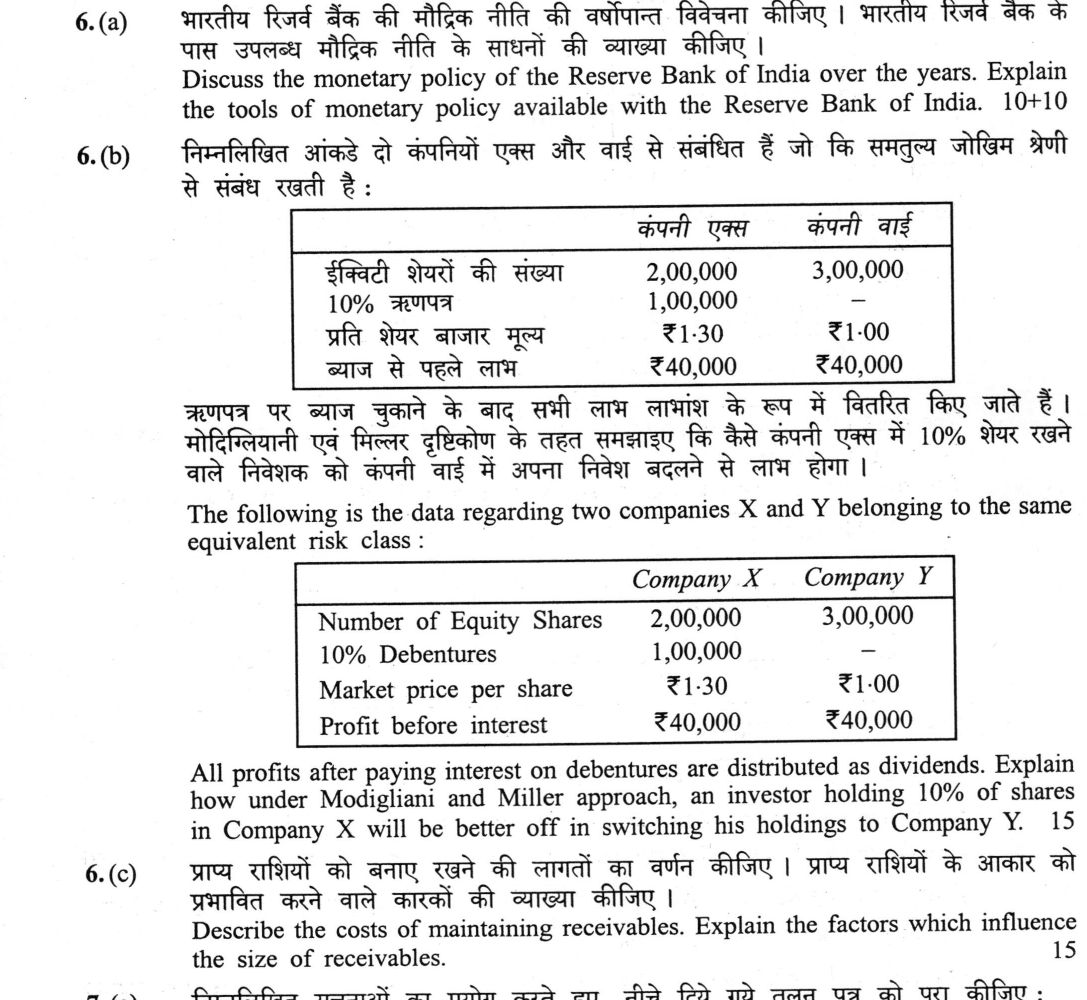
The following is the data regarding two companies X and Y belonging to the same equivalent risk class :
Company X Company Y Number of Equity Shares 2,00,000 3,00,000 10% Debentures 1,00,000 – Market price per share ₹1·30 ₹1·00 Profit before interest ₹40,000 ₹40,000
All profits after paying interest on debentures are distributed as dividends. Explain how under Modigliani and Miller approach, an investor holding 10% of shares in Company X will be better off in switching his holdings to Company Y. 15 marks
Describe the costs of maintaining receivables. Explain the factors which influence the size of receivables. 15 marks
हिंदी में प्रश्न पढ़ें
भारतीय रिजर्व बैंक की मौद्रिक नीति की वर्षोपान्त विवेचना कीजिए । भारतीय रिजर्व बैंक के पास उपलब्ध मौद्रिक नीति के साधनों की व्याख्या कीजिए । (20 अंक)
निम्नलिखित आंकड़े दो कंपनियों एक्स और वाई से संबंधित हैं जो कि समतुल्य जोखिम श्रेणी से संबंध रखती है :
कंपनी एक्स कंपनी वाई इक्विटी शेयरों की संख्या 2,00,000 3,00,000 10% ऋणपत्र 1,00,000 – प्रति शेयर बाजार मूल्य ₹1·30 ₹1·00 ब्याज से पहले लाभ ₹40,000 ₹40,000
ऋणपत्र पर ब्याज चुकाने के बाद सभी लाभ लाभांश के रूप में वितरित किए जाते हैं । मोदिग्लियानी एवं मिल्लर दृष्टिकोण के तहत समझाइए कि कैसे कंपनी एक्स में 10% शेयर रखने वाले निवेशक को कंपनी वाई में अपना निवेश बदलने से लाभ होगा । (15 अंक)
प्राप्य राशियों को बनाए रखने की लागतों का वर्णन कीजिए । प्राप्य राशियों के आकार को प्रभावित करने वाले कारकों की व्याख्या कीजिए । (15 अंक)
Model answer
Drafted with AI by UPSC Answer Check against this question's marking rubric, to the expected length. UPSC does not publish answers for Mains — this is one way to score well, not an official key. How we build rubrics and answers.
(a) Monetary policy of the RBI and its tools (10 + 10 = 20 marks)
Evolution (10). Monetary policy is the RBI's use of money supply, credit and interest rates to attain price stability, growth and financial stability (RBI Act, 1934).
- Till 1991, policy was administered: high CRR and SLR pre-empted bank resources for the government, interest rates were regulated, and credit was allocated through selective controls and priority sectors. Following the Chakravarty Committee (1985), monetary targeting with a feedback from broad money (M3) was adopted, and fiscal deficits were monetised through ad hoc Treasury bills.
- After 1991 the Narasimham Committee (1991, 1998) pushed liberalisation: CRR and SLR were cut, interest rates were freed, ad hoc Treasury bills were phased out (1994 agreement with the government, effective 1997), and indirect, market-based instruments took over.
- From 1998, under Governor Bimal Jalan, a multiple-indicators approach replaced monetary targeting. The Liquidity Adjustment Facility (repo and reverse repo) began in 2000, and open market operations, the market stabilisation scheme (2004) and the Marginal Standing Facility (2011) were added.
- The Urjit Patel Committee (2014) recommended a nominal anchor. The RBI Act was amended in 2016 to adopt flexible inflation targeting, with the Government setting a CPI target of 4% with a tolerance band of ±2%, and a six-member Monetary Policy Committee (three from the RBI, three external) deciding the repo rate by majority. In 2022 the Standing Deposit Facility became the floor of the corridor (SDF at repo minus 0.25%, MSF at repo plus 0.25%).
- Since then the RBI has responded to shocks: liquidity and rate cuts during COVID-19 (repo to 4%), tightening in 2022-23 (to 6.5%), and easing during 2025, with the repo rate reduced from 6.5% to 5.25% and a cut in CRR to 3%.
Tools (10). Quantitative (general) tools regulate the volume of money and credit; qualitative (selective) tools regulate its direction.
- Repo rate: the rate at which the RBI lends against government securities under the LAF, the main policy rate; reverse repo and SDF absorb surplus liquidity; MSF is emergency overnight borrowing by banks.
- Cash Reserve Ratio: the share of net demand and time liabilities kept with the RBI (without interest); SLR is the share kept in liquid assets (government securities, cash and gold), currently 18%.
- Open market operations: outright sale or purchase of government securities to absorb or inject durable liquidity; variable rate repo and reverse repo auctions manage short-term liquidity; the market stabilisation scheme sterilises capital inflows.
- Bank rate: the long-term lending rate, now aligned to the MSF rate.
- Selective tools: margin requirements on loans against securities, regulation of consumer credit, credit rationing, moral suasion, and directives on sectoral exposure and risk weights.
- Forex intervention also moves the money supply. Transmission works through the repo rate to lending rates, which since 2019 are linked to external benchmarks such as the repo rate.
(b) Modigliani-Miller arbitrage (15 marks)
Modigliani and Miller hold that, in a perfect market, two firms in the same risk class with the same operating income must have the same total value, and that any difference is removed by arbitrage, as investors sell the overvalued firm's shares and buy the undervalued one's.
Value of firms:
- Company X: equity = 2,00,000 × ₹1.30 = ₹2,60,000; debt = ₹1,00,000; V_X = ₹3,60,000.
- Company Y: equity = 3,00,000 × ₹1.00 = ₹3,00,000; no debt; V_Y = ₹3,00,000. Both earn the same ₹40,000 before interest, yet V_X > V_Y by ₹60,000, so the levered firm X is overvalued and Y is undervalued.
Investor's present position (10% of X's shares):
- Shares held: 20,000, with market value ₹26,000.
- Income: (₹40,000 - ₹10,000 interest) = ₹30,000 distributed; 10% = ₹3,000.
Arbitrage steps:
- Sell the 20,000 shares of X for ₹26,000.
- Borrow personally ₹10,000 (10% of X's debt, at 10%, the same rate as the debentures), reproducing the leverage of X in proportion to his stake. Total funds = ₹36,000.
- Buy shares of Y: ₹36,000 ÷ ₹1 = 36,000 shares, that is 12% of Y.
Income after switching:
- Share of Y's profit = 12% × ₹40,000 = ₹4,800.
- Less: interest on personal loan = 10% × ₹10,000 = ₹1,000.
- Net income = ₹3,800.
The investor's income rises from ₹3,000 to ₹3,800, a gain of ₹800, with the same financial risk. As investors sell X and buy Y, the price of X falls and that of Y rises until V_X = V_Y, when arbitrage stops, which shows that the value of a firm is independent of its capital structure.
(c) Receivables (15 marks)
Costs of maintaining receivables (7). Granting credit ties up funds and creates the following costs:
- Capital or carrying cost: the return forgone on funds locked in receivables, being the cost of financing them, whether the firm's cost of capital or the interest on borrowings.
- Administrative cost: credit investigation and information, record-keeping, billing, and staff and system costs.
- Collection cost: reminders, follow-ups, legal and agency charges for recovering dues.
- Delinquency cost: the cost of delay beyond the due date, including extra interest and the cost of blocked funds.
- Default cost: bad debts and losses when customers do not pay at all. Against these costs stand the benefit of higher sales and profit; the firm should extend credit until the marginal benefit equals the marginal cost.
Factors affecting the size of receivables (8):
- Level of sales, and the proportion made on credit: more credit sales mean larger receivables.
- Credit policy: the credit standards (how strict), the credit period, cash discount terms, and the collection policy, whether tight or liberal.
- Terms of sale and credit period: a longer period or generous discount terms raise receivables.
- Industry practice and competition: a firm must match competitors' credit terms.
- Nature and seasonality of the business and the product, such as perishability, durability and price.
- Economic conditions, such as recession or credit squeeze, which slow collections.
- Cost of capital and the firm's own liquidity, which limit how much credit can be financed.
- Customer base: their financial strength and payment habits.
How this answer will be evaluated
Evaluation rubric
Each sub-part is marked on its own, against the marks and word limit printed on the paper.
- (a) (a) RBI monetary policy over the years (10) and the tools of monetary policy (10) (20). 20 marks
Must cover
- Evolution: administered regime and monetary targeting to multiple indicators, LAF, and flexible inflation targeting with MPC (2016, 4% ± 2%)
- Quantitative tools: repo, reverse repo, SDF, MSF, CRR, SLR, OMO, bank rate, MSS
- Qualitative tools: margins, moral suasion, credit rationing, selective controls
- Recent developments: SDF corridor 2022, COVID response, 2025 easing and CRR cut
Loses marks
- Listing tools with no explanation of how they work.
- Omitting the inflation-targeting framework.
- Stating wrong SLR, repo or corridor values.
Earns more
- Committees (Chakravarty, Narasimham, Urjit Patel).
- Transmission of policy rate to lending rates.
Extra mark
- External benchmark lending rates since 2019
- (b) (b) Modigliani-Miller arbitrage: show that a 10% holder of X gains by switching to Y (15). 15 marks
Must cover
- V_X = 2,60,000 + 1,00,000 = 3,60,000 and V_Y = 3,00,000, so X is overvalued
- Current income: 10% of (40,000 - 10,000) = 3,000 on shares worth 26,000
- Sell 20,000 X shares, borrow 10,000, buy 36,000 Y shares (12%)
- New income 4,800 - 1,000 = 3,800; gain of 800 and the arbitrage conclusion V_X = V_Y
Loses marks
- Ignoring interest on the personal loan.
- Incorrect valuation of X or Y.
- No conclusion about equilibrium.
Earns more
- Statement of the MM proposition and assumptions.
- Explaining why personal leverage replaces corporate leverage.
Extra mark
- Alternative unlevered switch: 26,000 in Y gives about 3,467
- (c) (c) Costs of maintaining receivables (7) and factors influencing the size of receivables (8) (15). 15 marks
Must cover
- Costs: carrying or capital, administrative, collection, delinquency, default
- Trade-off of cost against the benefit of additional sales
- Factors: sales level, credit policy (standards, period, discount, collection), competition, industry practice
- Other factors: seasonality, economic conditions, cost of capital and liquidity, customers
Loses marks
- Confusing costs with benefits.
- Only one of the two parts answered.
- Listing factors with no reasoning.
Earns more
- Explanation of each cost with an illustration.
- Marginal cost and benefit principle.
Extra mark
- Formula for average receivables or ageing analysis
What "Discuss" is asking you to do
Lay the issue out from more than one side — how it arose, what is claimed for it, what is held against it, and where it now stands. UPSC attaches discuss to broad topics with several live dimensions, so coverage of the dimensions earns more than the strength of your opinion.
Structure that answers it
Set the issue up → the case as it is made → the case against → the dimension both sides leave out → where the balance now lies
Where marks are lost
Listing facts with no thread between them, or arguing one side throughout and calling it a discussion.
Practice this exact question
Write your answer and it is marked point by point against the model answer above — what you covered, what you missed, what you got wrong.
Evaluate my answer →More from Commerce & Accountancy 2026 Paper I
- Q3 (a) Mr. A of Agra submits the following particulars of his let out residential house : (A…
- Q4 (a) The financial position of a firm as on 31st March 2024 and 2025 was as follows : Part…
- Q5 Answer each of the following questions in about 150 words : (a) Explain the CAPM approach…
- Q6 (a) Discuss the monetary policy of the Reserve Bank of India over the years. Explain the…
- Q7 (a) Using the following information, complete the Balance Sheet given below : Total Debt…
- Q8 (a) “Investing in securities through mutual funds is a better choice than direct investme…