Paper I — Q2
(a) X ltd. and Y ltd. agreed to amalgamate and form a new company Z ltd. which will take over all the assets and liabilities of…
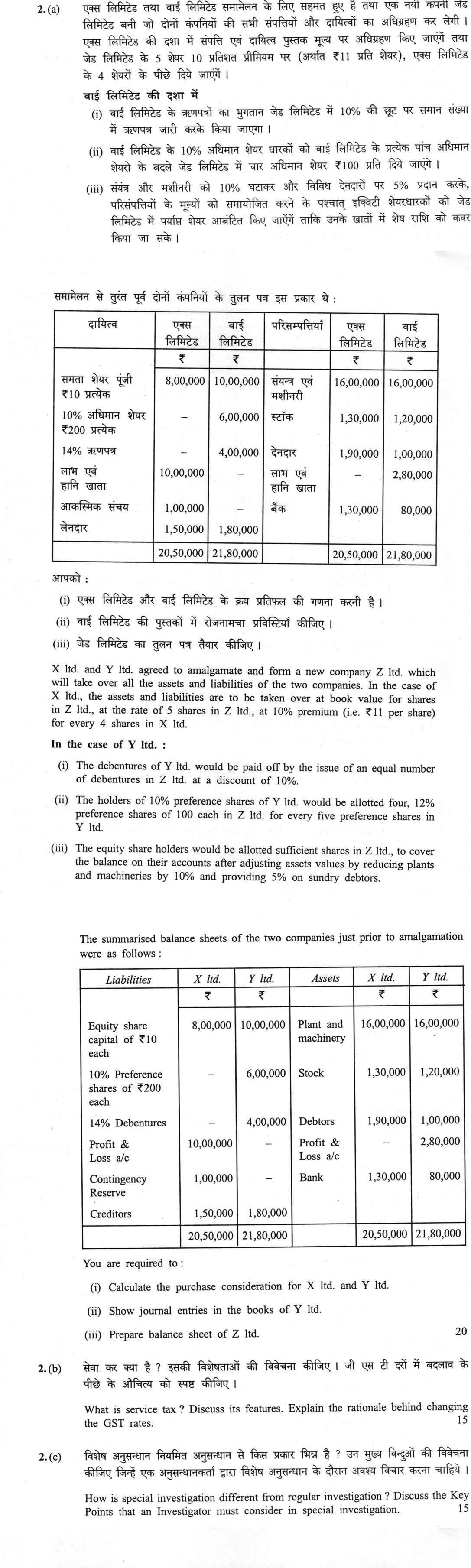
X ltd. and Y ltd. agreed to amalgamate and form a new company Z ltd. which will take over all the assets and liabilities of the two companies. In the case of X ltd., the assets and liabilities are to be taken over at book value for shares in Z ltd., at the rate of 5 shares in Z ltd., at 10% premium (i.e. ₹11 per share) for every 4 shares in X ltd. In the case of Y ltd. : The debentures of Y ltd. would be paid off by the issue of an equal number of debentures in Z ltd. at a discount of 10%.
The holders of 10% preference shares of Y ltd. would be allotted four, 12% preference shares of 100 each in Z ltd. for every five preference shares in Y ltd.
The equity share holders would be allotted sufficient shares in Z ltd., to cover the balance on their accounts after adjusting assets values by reducing plants and machineries by 10% and providing 5% on sundry debtors. The summarised balance sheets of the two companies just prior to amalgamation were as follows : Liabilities | X ltd. (₹) | Y ltd. (₹) | Assets | X ltd. (₹) | Y ltd. (₹) Equity share capital of ₹10 each | 8,00,000 | 10,00,000 | Plant and machinery | 16,00,000 | 16,00,000 10% Preference shares of ₹200 each | – | 6,00,000 | Stock | 1,30,000 | 1,20,000 14% Debentures | – | 4,00,000 | Debtors | 1,90,000 | 1,00,000 Profit & Loss a/c | 10,00,000 | – | Profit & Loss a/c | – | 2,80,000 Contingency Reserve | 1,00,000 | – | Bank | 1,30,000 | 80,000 Creditors | 1,50,000 | 1,80,000 | | |
| 20,50,000 | 21,80,000 | 20,50,000 | 21,80,000 |
|---|
You are required to :
Calculate the purchase consideration for X ltd. and Y ltd.
Show journal entries in the books of Y ltd.
Prepare balance sheet of Z ltd. 20 marks
What is service tax ? Discuss its features. Explain the rationale behind changing the GST rates. 15 marks
How is special investigation different from regular investigation ? Discuss the Key Points that an Investigator must consider in special investigation. 15 marks
हिंदी में प्रश्न पढ़ें
एक्स लिमिटेड तथा वाई लिमिटेड समामेलन के लिए सहमत हुए हैं तथा एक नयी कंपनी जेड लिमिटेड बनी जो दोनों कंपनियों की सभी संपत्तियों और दायित्वों का अधिग्रहण कर लेगी । एक्स लिमिटेड की दशा में संपत्ति एवं दायित्व पुस्तक मूल्य पर अधिग्रहण किए जाएंगें तथा जेड लिमिटेड के 5 शेयर 10 प्रतिशत प्रीमियम पर (अर्थात ₹11 प्रति शेयर), एक्स लिमिटेड के 4 शेयरों के पीछे दिये जाएंगें । वाई लिमिटेड की दशा में वाई लिमिटेड के ऋणपत्रों का भुगतान जेड लिमिटेड में 10% की छूट पर समान संख्या में ऋणपत्र जारी करके किया जाएगा ।
वाई लिमिटेड के 10% अधिमान शेयर धारकों को वाई लिमिटेड के प्रत्येक पांच अधिमान शेयरो के बदले जेड लिमिटेड में चार 12% अधिमान शेयर ₹100 प्रति दिये जाएंगे ।
संयंत्र और मशीनरी को 10% घटाकर और विविध देनदारों पर 5% प्रदान करके, परिसंपत्तियों के मूल्यों को समायोजित करने के पश्चात् इक्विटी शेयरधारकों को जेड लिमिटेड में पर्याप्त शेयर आबंटित किए जाएंगें ताकि उनके खातों में शेष राशि को कवर किया जा सके । समामेलन से तुरंत पूर्व दोनों कंपनियों के तुलन पत्र इस प्रकार थे : दायित्व | एक्स लिमिटेड (₹) | वाई लिमिटेड (₹) | परिसम्पत्तियाँ | एक्स लिमिटेड (₹) | वाई लिमिटेड (₹) समता शेयर पूंजी ₹10 प्रत्येक | 8,00,000 | 10,00,000 | संयन्त्र एवं मशीनरी | 16,00,000 | 16,00,000 10% अधिमान शेयर ₹200 प्रत्येक | – | 6,00,000 | स्टॉक | 1,30,000 | 1,20,000 14% ऋणपत्र | – | 4,00,000 | देनदार | 1,90,000 | 1,00,000 लाभ एवं हानि खाता | 10,00,000 | – | लाभ एवं हानि खाता | – | 2,80,000 आकस्मिक संचय | 1,00,000 | – | बैंक | 1,30,000 | 80,000 लेनदार | 1,50,000 | 1,80,000 | | |
| 20,50,000 | 21,80,000 | 20,50,000 | 21,80,000 |
|---|
आपको :
एक्स लिमिटेड और वाई लिमिटेड के क्रय प्रतिफल की गणना करनी है ।
वाई लिमिटेड की पुस्तकों में रोजनामचा प्रविस्टियाँ कीजिए ।
जेड लिमिटेड का तुलन पत्र तैयार कीजिए । (20 अंक)
सेवा कर क्या है ? इसकी विशेषताओं की विवेचना कीजिए । जी एस टी दरों में बदलाव के पीछे के औचित्य को स्पष्ट कीजिए । (15 अंक)
विशेष अनुसन्धान नियमित अनुसन्धान से किस प्रकार भिन्न है ? उन मुख्य विन्दुओं की विवेचना कीजिए जिन्हें एक अनुसन्धानकर्ता द्वारा विशेष अनुसन्धान के दौरान अवश्य विचार करना चाहिये । (15 अंक)
Model answer
Drafted with AI by UPSC Answer Check against this question's marking rubric, to the expected length. UPSC does not publish answers for Mains — this is one way to score well, not an official key. How we build rubrics and answers.
(a) Amalgamation of X Ltd. and Y Ltd. into Z Ltd.
(i) Purchase consideration
X Ltd.: 80,000 equity shares × 5/4 = 1,00,000 shares of Z Ltd. at ₹11 = ₹11,00,000 (share capital ₹10,00,000 + securities premium ₹1,00,000). Net assets taken over at book value = ₹20,50,000 − creditors ₹1,50,000 = ₹19,00,000. The excess of ₹8,00,000 appears in Z Ltd. as capital reserve (purchase method). If X's amalgamation is treated as a merger under AS 14 (all para 3(e) conditions are met), the same ₹8,00,000 appears as X's reserves carried forward: P&L ₹10,00,000 + contingency reserve ₹1,00,000 − ₹3,00,000 excess of consideration over X's share capital.
Y Ltd. (revalued): plant ₹16,00,000 − 10% = ₹14,40,000; stock ₹1,20,000; debtors ₹1,00,000 − 5% = ₹95,000; bank ₹80,000; total ₹17,35,000. Less creditors ₹1,80,000 and debentures ₹3,60,000 (4,000 debentures of ₹100 replaced by an equal number issued at ₹90) = net assets ₹11,95,000.
- Preference: 6,00,000/200 = 3,000 shares × 4/5 = 2,400 12% preference shares of ₹100 = ₹2,40,000
- Equity: ₹11,95,000 − ₹2,40,000 = ₹9,55,000 = 95,500 equity shares of ₹10
Purchase consideration of Y Ltd. = ₹11,95,000. (If the debentures are taken at ₹4,00,000 with no discount, it is ₹11,55,000 and equity gets 91,500 shares.)
(ii) Journal entries in the books of Y Ltd.
| No. | Particulars | Dr (₹) | Cr (₹) |
|---|---|---|---|
| 1 | Realisation A/c Dr. To Plant & Machinery 16,00,000; To Stock 1,20,000; To Debtors 1,00,000; To Bank 80,000 (assets transferred) | 19,00,000 | 19,00,000 |
| 2 | Creditors A/c Dr. 1,80,000; 14% Debentures A/c Dr. 4,00,000; To Realisation A/c (liabilities taken over) | 5,80,000 | 5,80,000 |
| 3 | Z Ltd. A/c Dr. To Realisation A/c (purchase consideration) | 11,95,000 | 11,95,000 |
| 4 | 10% Preference Share Capital A/c Dr. To Preference Shareholders A/c | 6,00,000 | 6,00,000 |
| 5 | Preference Shareholders A/c Dr. To Realisation A/c (sacrifice by preference shareholders) | 3,60,000 | 3,60,000 |
| 6 | Equity Share Capital A/c Dr. To Equity Shareholders A/c | 10,00,000 | 10,00,000 |
| 7 | Equity Shareholders A/c Dr. To Profit & Loss A/c (debit balance written off) | 2,80,000 | 2,80,000 |
| 8 | Realisation A/c Dr. To Equity Shareholders A/c (profit on realisation) | 2,35,000 | 2,35,000 |
| 9 | Preference Shares in Z Ltd. A/c Dr. 2,40,000; Equity Shares in Z Ltd. A/c Dr. 9,55,000; To Z Ltd. A/c | 11,95,000 | 11,95,000 |
| 10 | Preference Shareholders A/c Dr. 2,40,000; Equity Shareholders A/c Dr. 9,55,000; To Preference Shares in Z Ltd. 2,40,000; To Equity Shares in Z Ltd. 9,55,000 | 11,95,000 | 11,95,000 |
Realisation account closes: debits 19,00,000 + 2,35,000 = credits 5,80,000 + 11,95,000 + 3,60,000 = ₹21,35,000. Equity shareholders: 10,00,000 − 2,80,000 + 2,35,000 = ₹9,55,000.
(iii) Balance Sheet of Z Ltd. (after amalgamation)
| Particulars | ₹ |
|---|---|
| Equity and Liabilities | |
| Share capital: 1,95,500 equity shares of ₹10 (1,00,000 to X + 95,500 to Y) | 19,55,000 |
| Share capital: 2,400 12% preference shares of ₹100 | 2,40,000 |
| Reserves and surplus: securities premium | 1,00,000 |
| Reserves and surplus: capital reserve | 8,00,000 |
| Long-term borrowings: debentures (4,000 of ₹100) | 4,00,000 |
| Trade payables (1,50,000 + 1,80,000) | 3,30,000 |
| Total | 38,25,000 |
| Assets | |
| Property, plant and equipment: plant and machinery (16,00,000 + 14,40,000) | 30,40,000 |
| Other non-current assets: unamortised discount on issue of debentures | 40,000 |
| Inventories (1,30,000 + 1,20,000) | 2,50,000 |
| Trade receivables (2,90,000 − provision 5,000) | 2,85,000 |
| Cash and bank (1,30,000 + 80,000) | 2,10,000 |
| Total | 38,25,000 |
The discount of ₹40,000 may instead be written off against securities premium under section 52 of the Companies Act, 2013; the total then becomes ₹37,85,000.
(b) What is service tax ? Discuss its features. Explain the rationale behind changing the GST rates.
Service tax was a Union tax on the provision of services, levied under Chapter V of the Finance Act, 1994 on the recommendation of the Raja Chelliah Tax Reforms Committee. It began in 1994 at 5% on three services (telephone, non-life insurance and stockbroking).
Features:
- Union levy under the residuary Entry 97 of the Union List, administered by CBEC.
- Selective taxation of listed services until 30 June 2012; from 1 July 2012 a negative-list regime taxed all services (section 65B definition) except those in the negative list (section 66D) and the Mega Exemption Notification.
- Rules on taxable event and location: Point of Taxation Rules, 2011 and Place of Provision of Services Rules, 2012.
- Reverse charge for notified services; CENVAT credit of inputs, capital goods and input services.
- Final rate 15% (14% + 0.5% Swachh Bharat Cess + 0.5% Krishi Kalyan Cess).
- Subsumed in GST from 1 July 2017 under the 101st Constitutional Amendment (Article 246A; GST Council under Article 279A).
Rationale for changing GST rates:
- The 2017 slabs (5, 12, 18, 28% plus compensation cess) were set for revenue neutrality; with a stable base, the GST Council has simplified them.
- Inverted duty structures, with inputs taxed above outputs, block input tax credit and force refunds.
- Fewer slabs cut classification disputes and MSME compliance costs.
- Equity: low or nil rates on food and essentials, a high demerit rate on sin and luxury goods.
- Demand stimulus by reducing rates on mass-consumption goods.
Accordingly, the 56th GST Council meeting (September 2025) moved, from 22 September 2025, to two main slabs of 5% and 18% with a 40% demerit rate for goods such as pan masala, tobacco products and luxury cars.
(c) How is special investigation different from regular investigation ? Discuss the Key Points that an Investigator must consider in special investigation.
A regular investigation is a routine, periodic review of a general nature, often internal, with wide scope, test checking, persuasive evidence and a report to management. A special investigation is a one-off examination for a specific purpose, such as suspected fraud, acquisition of a business, admission of a partner, a lending proposal or an insurance claim, or one ordered by the Central Government under sections 210, 212 (SFIO), 213 or 216 of the Companies Act, 2013. It needs complete checking of the suspect area and conclusive, corroborated evidence, applies no materiality threshold, gives no "true and fair" opinion, and its report may be used in court or by a regulator.
Key points for the investigator:
- Terms of reference: obtain a written scope letter stating the objective, period and limits.
- Independence: accept only if free of conflict of interest; do not rely on the fact that the accounts were audited.
- Understanding: study the business, its ownership, accounting system and internal controls, and design a purpose-specific programme.
- Evidence: insist on unrestricted access and record any restriction; obtain documents, third-party confirmations and written representations.
- Fraud indicators: teeming and lading, defalcation of cash or goods, fictitious vendors, related-party dealings, unusual journal entries and window dressing, applying SA 240 fraud-risk thinking.
- Confidentiality and legal care: protect evidence and avoid defamatory language.
- Report: self-contained, separating facts, assumptions, limitations and opinion.
How this answer will be evaluated
Evaluation rubric
Each sub-part is marked on its own, against the marks and word limit printed on the paper.
- (a) A three-part amalgamation problem: (i) compute the purchase consideration payable to X Ltd and to Y Ltd on the stated share-exchange, debenture and preference-share terms after the specified revaluation of Y's plant and debtors; (ii) pass the journal entries in the books of Y Ltd, the transferor (Realisation Account route); and (iii) draw up the opening balance sheet of the new company Z Ltd. All three parts must be attempted. 20 marks
Must cover
- Purchase consideration X Ltd = Rs 11,00,000 (1,00,000 equity shares of Rs 10 at Rs 11)
- Purchase consideration Y Ltd = Rs 11,95,000 (2,400 preference shares of Rs 100 = Rs 2,40,000 + 95,500 equity shares of Rs 10 = Rs 9,55,000)
- Revalued net assets of Y Ltd available to equity shareholders = Rs 9,55,000
- Plant and machinery of Y written down to Rs 14,40,000; provision of Rs 5,000 on debtors
- Profit & Loss A/c debit balance of Rs 2,80,000 not taken over
- Discount on issue of debentures Rs 40,000
- Balance Sheet of Z Ltd total = Rs 38,25,000
- Securities premium Rs 1,00,000; capital reserve/reserves Rs 8,00,000 on X Ltd's takeover
- AS 14 Accounting for Amalgamations; Schedule III of the Companies Act, 2013
- Realisation Account in the transferor's books
Loses marks
- Taking the debit balance of Y Ltd's Profit & Loss Account (Rs 2,80,000) as an asset acquired by Z Ltd instead of writing it off against the equity shareholders' account
- Computing X Ltd's consideration as 80,000 x 5/4 x Rs 10 = Rs 10,00,000 and forgetting the Rs 1 per share premium, or applying the 5:4 ratio the wrong way round (giving 64,000 shares)
- Taking Y Ltd's preference shares as 6,000 shares of Rs 100 instead of 3,000 shares of Rs 200, which doubles the preference consideration
- Including the payment to debenture holders in the purchase consideration, contrary to AS 14, or ignoring the 10% discount altogether
- Failing to record the difference of Rs 8,00,000 between X Ltd's net assets (Rs 19,00,000) and its consideration (Rs 11,00,000), so the balance sheet of Z Ltd does not tally
Earns more
- Balance Sheet of Z Ltd balancing at Rs 38,25,000 - equity share capital Rs 19,55,000 (1,95,500 shares of Rs 10), 12% preference share capital Rs 2,40,000, securities premium Rs 1,00,000, capital reserve/reserves Rs 8,00,000 arising on the takeover of X Ltd, debentures Rs 4,00,000, trade payables Rs 3,30,000; assets - plant and machinery Rs 30,40,000, stock Rs 2,50,000, trade receivables Rs 2,85,000, bank Rs 2,10,000, discount on issue of debentures Rs 40,000
- (b) Three demands: define service tax as it existed in India, discuss its features, and then explain the rationale behind changes in GST rates. The answer must connect the two - service tax (Chapter V of the Finance Act, 1994) was subsumed into GST on 1 July 2017 - and must then argue the economic and administrative reasons for rate rationalisation under GST. 15 marks
Must cover
- Chapter V of the Finance Act, 1994; sections 65, 65B, 66B, 66D
- Dr Raja Chelliah Tax Reforms Committee; introduced 1994 at 5% on three services
- Negative list regime from 1 July 2012; Mega Exemption Notification
- Place of Provision of Services Rules, 2012; Point of Taxation Rules, 2011; reverse charge; CENVAT credit
- Final rate 15% (14% + 0.5% Swachh Bharat Cess + 0.5% Krishi Kalyan Cess)
- Constitution (One Hundred and First Amendment) Act, 2016; Article 246A; Article 279A GST Council
- CGST Act, 2017; SGST Acts; IGST Act, 2017; subsumed with effect from 1 July 2017
- Revenue-neutral rate; inverted duty structure; input tax credit accumulation
- Demerit/sin rate on tobacco, pan masala and luxury cars
- 56th GST Council meeting, September 2025 - two principal slabs of 5% and 18% with a 40% demerit rate
Loses marks
- Writing about service tax in the present tense as a tax still in force - it ceased on 30 June 2017
- Quoting the final service tax rate as 14% or 12.36% without the Swachh Bharat and Krishi Kalyan Cesses that took it to 15%
- Describing service tax as a State levy - it was a Union levy, under the residuary Entry 97 of the Union List
- Answering the third part only as a list of current GST slabs instead of explaining WHY rates are changed (revenue neutrality, inverted duty structure, litigation, equity, demand)
- Confusing the GST Council's recommendatory role under Article 279A with a binding power, or attributing rate-setting to the Union Finance Ministry alone
Earns more
- Equity and welfare rationale: nil or lowest slab for food, essential medicines and mass-consumption goods to reduce the regressivity of a consumption tax, against a high demerit rate on sin and luxury goods (tobacco, pan masala, aerated drinks, luxury cars) for revenue and public-health reasons
- Growth, simplicity and federal-process dimension: stimulating demand, easing MSME compliance, converging on the international norm of one or two main rates as urged by the Fifteenth Finance Commission and the Economic Survey; rates recommended by the GST Council under Article 279A, with the September 2025 (56th) Council meeting moving to principally two slabs of 5% and 18% plus a 40% demerit rate; constraints of revenue loss, transition and anti-profiteering
- (c) Two demands: first distinguish special investigation from regular (routine/general) investigation on grounds such as purpose, scope, periodicity, depth of evidence and reporting; second, discuss the key points an investigator must consider before and during a special investigation - terms of reference, independence, nature of evidence, extent of checking, legal implications and the form of the report. 15 marks
Must cover
- Terms of reference / scope letter / engagement letter
- Statutory investigation under sections 210, 212 (Serious Fraud Investigation Office), 213 and 216 of the Companies Act, 2013
- Non-statutory investigation: acquisition of a business, admission of a partner, lending proposal, insurance claim, suspected fraud
- Conclusive versus persuasive evidence; no materiality concept and no 'true and fair view' opinion
- Extent of checking - complete checking rather than test checking in the suspect area
- Independence and conflict of interest
- Teeming and lading; defalcation of cash and goods; window dressing
- Self-contained report separating facts, assumptions, limitations and opinion
- SA 240 fraud-risk thinking; confidentiality
Loses marks
- Answering the difference between audit and investigation instead of between special and regular investigation
- Failing to name any statutory basis, so the answer reads as generic advice rather than as commerce/auditing
- Saying the investigator may rely on the statutory audit report - investigation must be independent of it
- Omitting the terms of reference, which is the single most important preliminary step and is explicitly a 'key point'
- Treating test checking and sampling as adequate in a fraud investigation, where complete checking of the suspect area is required
Earns more
- Distinction on nature of evidence and reporting: persuasive evidence and an internal management report in routine work versus conclusive, independently corroborated evidence and a formal self-contained report - possibly for use in court or before a regulator - in a special investigation; the absence of any 'true and fair' opinion or materiality threshold in investigation generally
- Key point: establish independence and absence of conflict of interest, understand the business, its ownership, accounting system and internal controls, and design a purpose-specific programme rather than relying on the fact that the accounts have been audited
- Key point: evidence-gathering and reporting discipline - insist on unrestricted access and record any restriction; obtain documentary and third-party corroboration and written representations; watch for teeming and lading, fictitious vendors, related-party dealings, unusual journal entries and window dressing; preserve confidentiality; avoid defamatory language; and state assumptions, limitations, facts and opinion separately in the report
What "Calculate" is asking you to do
Apply the standard formula or schedule to data the question has already supplied — a table of readings, cost records, a balance sheet — and produce the number. The method is rarely in doubt; the marks sit in the named intermediate quantities, each of which has to appear as a labelled line.
Structure that answers it
Data as given → formula or standard treatment, named → substitution → each intermediate, labelled → result with units
Where marks are lost
Omitting an intermediate the marking scheme pays for separately, or rounding at an intermediate line so the final figure drifts. In commerce and accountancy, any figure in a statement that no numbered working note supports is treated as unearned.
Practice this exact question
Write your answer and it is marked point by point against the model answer above — what you covered, what you missed, what you got wrong.
Evaluate my answer →More from Commerce & Accountancy 2026 Paper I
- Q1 Answer the following questions in about 150 words each : (a) What is Profit-Volume ratio…
- Q2 (a) X ltd. and Y ltd. agreed to amalgamate and form a new company Z ltd. which will take…
- Q3 (a) Mr. A of Agra submits the following particulars of his let out residential house : (A…
- Q4 (a) The financial position of a firm as on 31st March 2024 and 2025 was as follows : Part…
- Q5 Answer each of the following questions in about 150 words : (a) Explain the CAPM approach…