Paper II — Q1
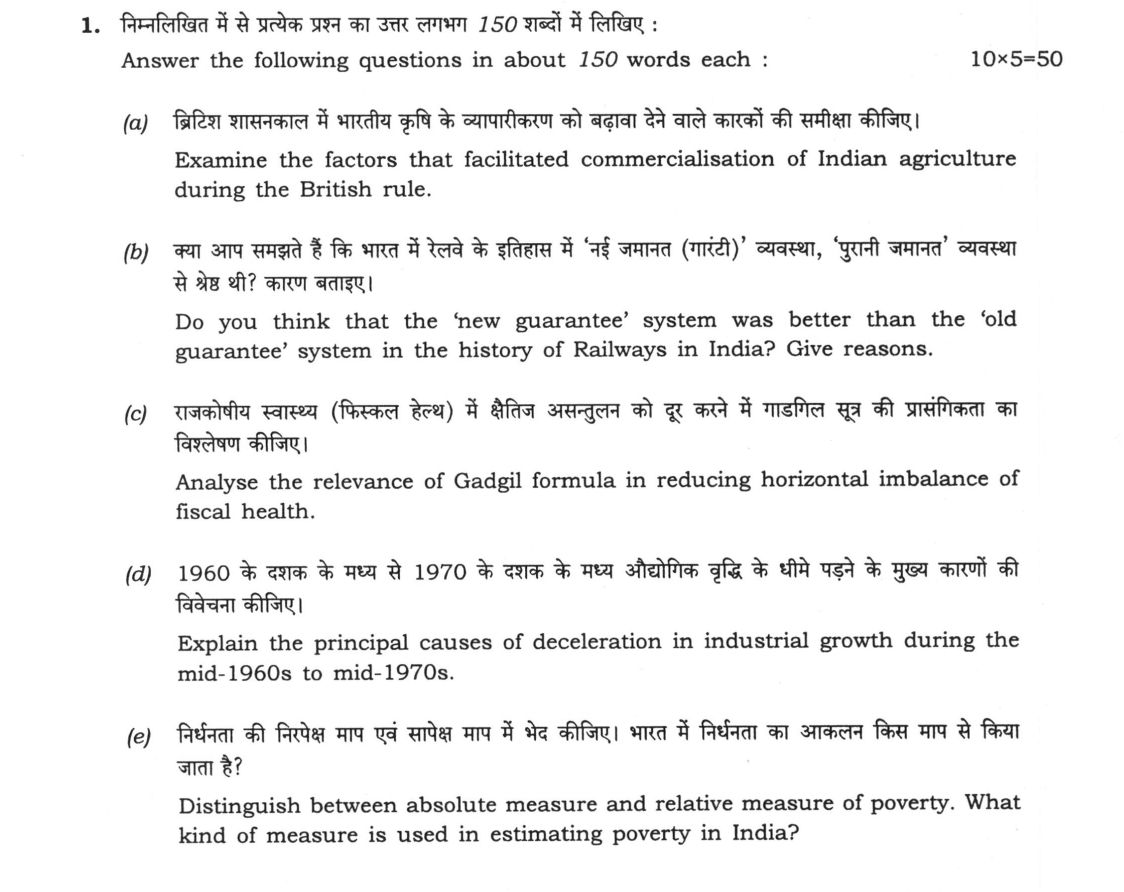
Answer the following questions in about 150 words each: (a) Examine the factors that facilitated commercialisation of Indian…
Answer the following questions in about 150 words each:
Examine the factors that facilitated commercialisation of Indian agriculture during the British rule. 10 marks
Do you think that the 'new guarantee' system was better than the 'old guarantee' system in the history of Railways in India? Give reasons. 10 marks
Analyse the relevance of Gadgil formula in reducing horizontal imbalance of fiscal health. 10 marks
Explain the principal causes of deceleration in industrial growth during the mid-1960s to mid-1970s. 10 marks
Distinguish between absolute measure and relative measure of poverty. What kind of measure is used in estimating poverty in India? 10 marks
हिंदी में प्रश्न पढ़ें
निम्नलिखित में से प्रत्येक प्रश्न का उत्तर लगभग 150 शब्दों में लिखिए :
ब्रिटिश शासनकाल में भारतीय कृषि के व्यापारीकरण को बढ़ावा देने वाले कारकों की समीक्षा कीजिए। (10 अंक)
क्या आप समझते हैं कि भारत में रेलवे के इतिहास में 'नई जमानत (गारंटी)' व्यवस्था, 'पुरानी जमानत' व्यवस्था से श्रेष्ठ थी? कारण बताइए। (10 अंक)
राजकोषीय स्वास्थ्य (फिस्कल हेल्थ) में क्षैतिज असंतुलन को दूर करने में गाडगिल सूत्र की प्रासंगिकता का विश्लेषण कीजिए। (10 अंक)
1960 के दशक के मध्य से 1970 के दशक के मध्य औद्योगिक वृद्धि के धीमे पड़ने के मुख्य कारणों की विवेचना कीजिए। (10 अंक)
निर्धनता की निरपेक्ष माप एवं सापेक्ष माप में भेद कीजिए। भारत में निर्धनता का आकलन किस माप से किया जाता है? (10 अंक)
Model answer
Written by UPSC Answer Check against this question's marking rubric, to the 150-word length. UPSC does not publish answers for Mains — this is one way to score well, not an official key.
Commercialisation of agriculture. British commercialisation was produced by fiscal and market institutions that converted Indian agriculture from subsistence to export-oriented cash-crop production. Permanent Settlement in Bengal fixed land revenue and created a proprietary class that had incentive to raise cash crops for market sale. Ryotwari and other revenue systems pressed direct cultivators to sell produce to meet fixed demands, increasing dependence on moneylenders. Colonial demand for opium, indigo and cotton, together with export orientation, drew land and credit away from food crops. Railways and ports lowered transport costs and integrated Indian markets with world markets, while moneylender penetration deepened debt and price volatility. The result was a market-dependent agrarian economy. The finding is that commercialisation was facilitated by colonial revenue settlement, cash-crop demand, transport revolution and market integration, but it made agriculture vulnerable to world prices and rural indebtedness.
Railway guarantee systems. The old guarantee system was less satisfactory because the government guaranteed a 5 per cent return to private companies, while they retained ownership and could earn more; the state bore the shortfall, creating a large drain of wealth. The 1869–79 state-construction phase showed that state ownership from inception was possible, but the 1879 New Guarantee did not adopt that model. Under the New Guarantee, private companies still constructed and owned lines until the government exercised its purchase option, but the guaranteed return was reduced and the state gained a later right to buy the lines. This policy shift reduced private profit drain and strengthened state control. It was therefore better than the old guarantee, because it limited colonial-era private earnings and gave the government greater leverage. Yet it remained a compromise: it did not create state ownership from the start and still depended on private capital. Nationalist drain-of-wealth critique remained valid, though it was a step toward public control.
Gadgil formula. The 1969 Gadgil formula was relevant to reducing horizontal imbalance because it provided a transparent rule for central grants to states with different fiscal capacities. Its components—population, tax effort and fiscal discipline—recognised that population size affected service needs, while own-revenue effort and fiscal discipline rewarded states that mobilised resources and controlled expenditure. By using population as a major factor, it transferred resources to states with large populations and weak per-capita revenue; by linking grants to tax effort and fiscal discipline, it encouraged fiscal responsibility. Special-category treatment for weaker states further reduced horizontal imbalance by compensating geographic and structural disadvantages. The formula became a predecessor to later Finance Commission criteria, showing that grants could be formula-based rather than ad hoc. Its limitation was that it did not fully address backwardness: population weight could favour large states, and tax-effort criteria could penalise states with narrow tax bases. Thus it improved equalisation but remained incomplete.
Industrial deceleration. Industrial growth decelerated from the mid-1960s to mid-1970s because external shocks interacted with structural and policy weaknesses. The Third Plan was disrupted by the 1965 war and successive droughts, which raised defence expenditure, cut agricultural output and worsened the balance of payments. The resulting foreign-exchange crisis forced import restrictions, devaluation and tighter credit, reducing capital goods availability. The Fourth Plan inherited these constraints, so growth remained low through the early 1970s. The savings-investment gap widened because low household savings and weak public investment limited domestic capital formation. Reduced public investment adversely affected private investment, a reversal of crowding-in, because infrastructure and public-sector projects had previously anchored private expansion. The licence-permit raj intensified, raising compliance costs and discouraging new capacity. Public-sector inefficiency, technological stagnation and slow diffusion of modern techniques further lowered productivity. Thus the deceleration was not merely cyclical; it reflected fiscal stress, policy rigidity and weak industrial modernisation.
Poverty measures. Absolute poverty measures a person against a fixed minimum standard of living, usually a consumption or income basket needed for basic needs; it does not change when overall society becomes richer. Relative poverty, by contrast, defines poverty in relation to the income distribution, often using a share of median income or inequality indicators such as the Gini coefficient, so the poverty line rises as average income rises. India has used an absolute measure for official poverty estimation. The Tendulkar Committee moved away from calorie or nutritional anchoring and used consumption expenditure to set poverty lines at 2004–05 prices. The Planning Commission later updated these lines to 2011–12 prices, giving ₹27.2 per day in rural areas and ₹33.3 in urban areas. The Rangarajan Committee also used an absolute, consumption-based approach, though with higher estimates. India’s approach is therefore absolute rather than relative, with multidimensional indices such as the MPI used as complementary measures of deprivation.
What "Examine" is asking you to do
Test the proposition the question puts to you and return a finding on how far it holds. Examine stems carry a claim, or ask whether something has happened, and expect evidence weighed both ways before the extent is stated — often with remedial measures attached.
Structure that answers it
Restate the claim as the question frames it → evidence that supports it → evidence that undercuts it → the conditions under which it holds → verdict on how far it stands
Where marks are lost
Stopping at description. An examination has to reach a finding, and “examine with justification” means the extent must be stated, not implied.
How this answer will be evaluated
Approach
Framework: UPSC General Studies Paper II (Economic & Social Development). (a) examine: intro > how/why with reasoning > evidence > conclusion | (b) comment: context > arguments both sides > judgment > close | (c) analyse: intro > causes > effects > stakeholders/linkages > way forward | (d) explain: definition/context > points in order > small example > short close | (e) compare: paired headings or table > key differences > significance > conclusion Full marks: Precise definitions, clear reasoning, specific examples, and a strong conclusion.
Key points expected
- Mention land revenue systems (Zamindari/Ryotwari) as a driver
- Link railway expansion to export-oriented cash crop production
- Explain the collapse of traditional cottage industries
- Discuss the role of colonial trade policies (e.g., free trade)
- Define 'Old Guarantee' (state bears all risk)
- Define 'New Guarantee' (state guarantees interest, company bears risk)
- Explain the shift in fiscal burden from the state to private capital
- Provide a clear judgment on which was 'better' with justification
Evaluation rubric
Each sub-part is marked on its own, against the marks and word limit printed on the paper.
- (a) Identify and reason through the structural and policy factors driving the shift to cash crops. 10 marks · 150 words
examine— intro → how/why with reasoning → evidence → conclusion
Must cover
- Mention land revenue systems (Zamindari/Ryotwari) as a driver
- Link railway expansion to export-oriented cash crop production
- Explain the collapse of traditional cottage industries
- Discuss the role of colonial trade policies (e.g., free trade)
Loses marks
- Treating commercialization as a purely positive modernization
- Ignoring the role of the state in enforcing the shift
Earns more
- Reference to specific cash crops (indigo, cotton, jute)
- Mention the impact on food security/famines
- Reference to the 'drain of wealth' concept
Extra mark
- Cite a specific historian (e.g., R.C. Dutt or Dadabhai Naoroji)
- (b) Compare the financial risk structures of the two systems and provide a reasoned judgment. 10 marks · 150 words
comment— context → arguments both sides → judgment → close
Must cover
- Define 'Old Guarantee' (state bears all risk)
- Define 'New Guarantee' (state guarantees interest, company bears risk)
- Explain the shift in fiscal burden from the state to private capital
- Provide a clear judgment on which was 'better' with justification
Loses marks
- Failing to distinguish who bears the operational risk in each
- Providing a neutral answer without a clear judgment
Earns more
- Mention the 1853 Railway Act as the starting point
- Reference to the 1899 shift to New Guarantee
- Discussion of the 'guaranteed interest' rate (typically 5%)
Extra mark
- Mention the specific financial crisis that prompted the shift
- (c) Explain how the formula's components address the gap between states' fiscal capacity and needs. 10 marks · 150 words
analyse— intro → causes → effects → stakeholders/linkages → way forward
Must cover
- Define 'horizontal imbalance' in fiscal health
- Identify the key components of the formula (population, area, forest cover, etc.)
- Explain how the formula redistributes resources to weaker states
- Link the formula to the reduction of regional disparities
Loses marks
- Confusing horizontal imbalance with vertical imbalance
- Failing to explain the mechanism of redistribution
Earns more
- Mention the 13th Finance Commission as the originator
- Reference to the 'population' and 'area' weights
- Mention the 'effort' or 'tax effort' component
Extra mark
- Cite a specific state that benefited significantly from the formula
- (d) List and explain the key economic and political factors that slowed industrial growth in this period. 10 marks · 150 words
explain— definition/context → points in order → small example → short close
Must cover
- Mention the 1965-66 and 1972-73 balance of payments crises
- Explain the impact of the 1965 and 1971 wars on the economy
- Discuss the 'License Raj' and its stifling effect on industry
- Mention the impact of the 1973 nationalization of banks
Loses marks
- Focusing only on external factors (wars) and ignoring internal policy
- Failing to link the causes to the specific time period
Earns more
- Reference to the 'Hindu Rate of Growth' (approx 3.5%)
- Mention the impact of the 1974 general elections
- Discussion of the 'stop-go' policies
Extra mark
- Cite a specific industrial sector that was hit hardest
- (e) Define both measures, highlight their key differences, and identify the one used in India. 10 marks · 150 words
compare— paired headings or table → key differences → significance → conclusion
Must cover
- Define 'absolute measure' (fixed poverty line)
- Define 'relative measure' (percentage of median income)
- Highlight the key difference (fixed vs. variable threshold)
- State that India uses the absolute measure (Tendulkar/ Rangarajan committees)
Loses marks
- Failing to clearly distinguish the two measures
- Incorrectly stating that India uses a relative measure
Earns more
- Mention the 'calorie requirement' basis of the Indian measure
- Reference to the 'poverty line' as a fixed monetary value
- Mention the 'relative' measure's use in developed countries
Extra mark
- Cite the specific calorie norm (2400 urban, 2700 rural)
Practice this exact question
Write your answer and it is marked point by point against the model answer above — what you covered, what you missed, what you got wrong.
Evaluate my answer →More from Economics 2021 Paper II
- Q1 Answer the following questions in about 150 words each: (a) Examine the factors that faci…
- Q2 (a) Compare the main features of development of jute and cotton textile industry in India…
- Q3 (a) Do you think that effective land reforms are necessary but not sufficient conditions…
- Q4 (a) Do you think that India experienced a major break in GDP growth and its sectoral comp…