Paper II — Q5
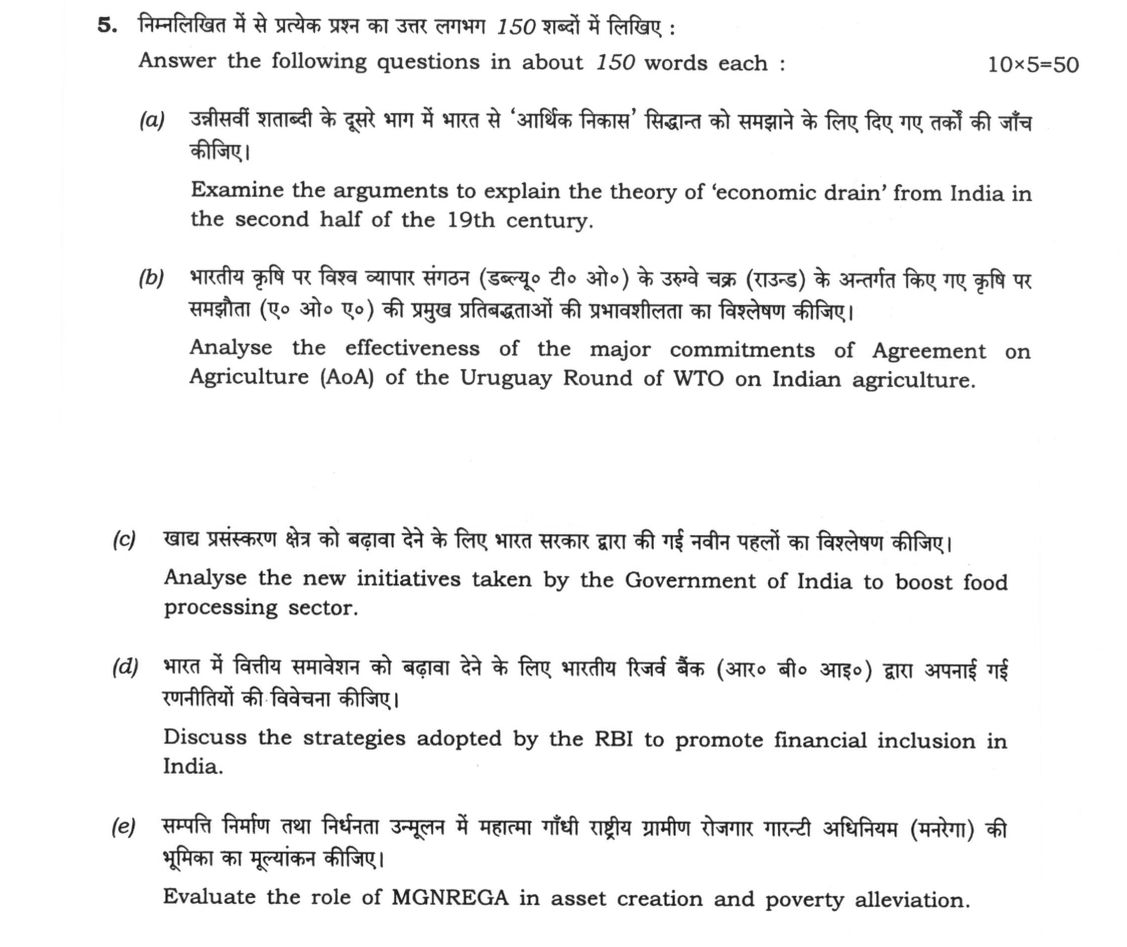
Answer the following questions in about 150 words each: (a) Examine the arguments to explain the theory of 'economic drain' from…
Answer the following questions in about 150 words each:
Examine the arguments to explain the theory of 'economic drain' from India in the second half of the 19th century. 10 marks
Analyse the effectiveness of the major commitments of Agreement on Agriculture (AoA) of the Uruguay Round of WTO on Indian agriculture. 10 marks
Analyse the new initiatives taken by the Government of India to boost food processing sector. 10 marks
Discuss the strategies adopted by the RBI to promote financial inclusion in India. 10 marks
Evaluate the role of MGNREGA in asset creation and poverty alleviation. 10 marks
हिंदी में प्रश्न पढ़ें
निम्नलिखित में से प्रत्येक प्रश्न का उत्तर लगभग 150 शब्दों में लिखिए :
उन्नीसवीं शताब्दी के दूसरे भाग में भारत से 'आर्थिक निकास' सिद्धांत को समझाने के लिए दिए गए तर्कों की जांच कीजिए। (10 अंक)
भारतीय कृषि पर विश्व व्यापार संगठन (डब्ल्यू. टी. ओ.) के उरुग्वे चक्र (राउंड) के अंतर्गत किए गए कृषि पर समझौता (ए. ओ. ए.) की प्रमुख प्रतिबद्धताओं की प्रभावशीलता का विश्लेषण कीजिए। (10 अंक)
खाद्य प्रसंस्करण क्षेत्र को बढ़ावा देने के लिए भारत सरकार द्वारा की गई नवीन पहलों का विस्तृत विवरण कीजिए। (10 अंक)
भारत में वित्तीय समावेशन को बढ़ावा देने के लिए भारतीय रिजर्व बैंक (आर० बी० आई०) द्वारा अपनाई गई रणनीतियों की विवेचना कीजिए। (10 अंक)
संपत्ति निर्माण तथा निर्धनता उन्मूलन में महात्मा गांधी राष्ट्रीय ग्रामीण रोजगार गारंटी अधिनियम (मनरेगा) की भूमिका का मूल्यांकन कीजिए। (10 अंक)
Model answer
Written by UPSC Answer Check against this question's marking rubric, to the 150-word length. UPSC does not publish answers for Mains — this is one way to score well, not an official key.
(a) Economic drain. Naoroji’s drain theory, advanced in 1867 and later in Poverty and Un-British Rule in India (1901), argued that colonial India generated a surplus that was transferred to Britain without equivalent return. Home Charges—interest on railway and public debt, pensions and salaries of British officials, military expenditure, and remittances—were paid from Indian revenues, while trade policies protected British manufactures and exposed Indian textiles. The argument linked this unilateral transfer to deindustrialisation, low wages, and stagnation, making it a powerful nationalist critique of fiscal extraction. Its strength is in exposing how railways and public works served imperial revenue and strategic control. Its weakness is that it under-weights internal factors, such as land relations, technology, and Indian capital formation, and treats drain as the sole cause of poverty. It remains a foundational explanation of colonial fiscal transfer and trade policy, though not a complete growth model for India.
(b) AoA effectiveness. The AoA’s three pillars—market access, domestic support and export subsidies—had mixed effects on Indian agriculture. Market access required tariffication and bound tariffs, allowing India to keep high tariffs while opening sectors through tariff-rate quotas; this limited import competition but constrained Indian exports. Domestic support rules introduced Amber Box reduction commitments, while India’s de minimis entitlement of 10 per cent of crop value gave limited space for support exempt from reduction commitments. India’s food security operations, MSP and public distribution, often exceeded these limits, creating disputes, though the Public Stockholding waiver provided relief. Export subsidies were not prohibited in the Uruguay Round; they were subject to reduction commitments, with elimination agreed later at Nairobi. For Indian farm exports, this reduced some subsidy competition but did not remove quality, logistics and market-access constraints. Effectiveness is therefore partial: rules reduced distortions but left structural vulnerabilities for small farmers and food security.
(c) Food processing initiatives. India’s newer initiatives target post-harvest losses, value addition and farmer income. PMFME formalises micro food-processing enterprises through cluster development, credit, branding and marketing, helping small processors scale up. The PLI scheme for food products encourages investment, technology, quality standards and export-oriented production, especially in dairy, fruits, vegetables, spices and processed foods. Pradhan Mantri Kisan SAMPADA Yojana integrates infrastructure, processing units, cold chains and market linkages, while Mega Food Parks create agri-based industrial clusters with backward and forward linkages. Operation Greens, expanded from TOP to all fruits and vegetables, aims to stabilise prices through buffer stock, processing, exports and market infrastructure. These measures can reduce waste, create rural employment and raise farm realisations. Their effectiveness depends on timely implementation, cold-chain reliability, credit access, quality certification and demand-side linkages. They are most useful where linked to FPOs, contract farming and export markets and institutional buyers for small farmers.
(d) RBI financial inclusion. The RBI has promoted financial inclusion by making banking cheaper, wider and more digital. PMJDY expanded zero-balance account penetration, with RuPay cards, overdraft facilities, insurance and pension linkages, bringing unbanked households into formal systems. The SHG-Bank Linkage Programme channels credit and savings to women’s self-help groups, improving access for poor rural households. The Business Correspondent model extends bank services through local agents, while UPI and AePS reduce the cost of payments and cash access in remote areas. Payments Banks expanded payment and deposit access but cannot lend; Small Finance Banks, by contrast, deepen rural credit. Financial literacy initiatives through banks, BCs and digital platforms aim to convert account ownership into usage. The strategy has broadened access, but effectiveness depends on digital literacy, last-mile connectivity, credit discipline and meaningful use of accounts. It has laid the foundation for a more inclusive financial system with sustained usage and credit.
(e) MGNREGA evaluation. MGNREGA’s role is best seen as a dual instrument of asset creation and poverty alleviation. By guaranteeing 100 days of unskilled rural work, it provides a wage floor, reduces distress migration and supports household consumption, especially during lean and monsoon seasons. Asset creation has been significant in water conservation, farm ponds, irrigation, rural roads and watershed works, particularly where convergence with agriculture and irrigation departments improves planning, materials and maintenance. The 60:40 wage-material ratio ensures that a major share of outlays goes to wages, while local materials reduce costs. Women’s share of person-days has exceeded 50 per cent in recent years, reflecting gender inclusion. Yet delayed payments, fund-flow gaps, asset quality and weak convergence limit impact. Overall, MGNREGA is an effective safety net and asset creator, but its poverty-alleviation role will improve only with timely payments, better convergence and durable asset maintenance and institutional follow-up by states.
What "Examine" is asking you to do
Test the proposition the question puts to you and return a finding on how far it holds. Examine stems carry a claim, or ask whether something has happened, and expect evidence weighed both ways before the extent is stated — often with remedial measures attached.
Structure that answers it
Restate the claim as the question frames it → evidence that supports it → evidence that undercuts it → the conditions under which it holds → verdict on how far it stands
Where marks are lost
Stopping at description. An examination has to reach a finding, and “examine with justification” means the extent must be stated, not implied.
How this answer will be evaluated
Approach
Framework: UPSC Economics Paper II (150 words). (a) examine: intro > how/why with reasoning > evidence > conclusion | (b) analyse: intro > causes > effects > stakeholders/linkages > way forward | (c) analyse: intro > causes > effects > stakeholders/linkages > way forward | (d) discuss: intro > 3-4 dimensions > example > balanced close | (e) evaluate: criteria > evidence > balanced judgment Full marks: Precise definitions, specific schemes/names, clear link to Indian context, balanced judgment.
Key points expected
- Define 'drain' as unilateral transfer of surplus
- Identify Home Charges (pensions, debt, military)
- Explain mechanism of trade deficit/sterling demand
- Mention impact on domestic capital formation
- Define AoA pillars (Market Access, Domestic Support, Export)
- Explain 'Amber Box' vs 'Green Box' constraints
- Discuss impact on MSP and procurement costs
- Mention 'Special Safeguard Mechanism' (SSM) or 'Peace Clause'
Evaluation rubric
Each sub-part is marked on its own, against the marks and word limit printed on the paper.
- (a) Intro > how/why with reasoning > evidence > conclusion 10 marks · 150 words
examine— intro → how/why with reasoning → evidence → conclusion
Must cover
- Define 'drain' as unilateral transfer of surplus
- Identify Home Charges (pensions, debt, military)
- Explain mechanism of trade deficit/sterling demand
- Mention impact on domestic capital formation
Loses marks
- Confusing 'drain' with general trade deficit
- Ignoring the 'unilateral' nature of the transfer
- Failing to link drain to lack of industrialization
Earns more
- Reference to Dadabhai Naoroji
- Distinction between 'drain' and 'trade'
- Mention of 'Sterling Demand' mechanism
- Reference to 'Polarization' of economy
Extra mark
- Specific figure of Home Charges (e.g., £10-12 million)
- Reference to Dadabhai Naoroji's 'Poverty and Un-British Rule'
- (b) Intro > causes > effects > stakeholders/linkages > way forward 10 marks · 150 words
analyse— intro → causes → effects → stakeholders/linkages → way forward
Must cover
- Define AoA pillars (Market Access, Domestic Support, Export)
- Explain 'Amber Box' vs 'Green Box' constraints
- Discuss impact on MSP and procurement costs
- Mention 'Special Safeguard Mechanism' (SSM) or 'Peace Clause'
Loses marks
- Treating AoA as a general trade agreement
- Ignoring the 'Domestic Support' classification
- Failing to link AoA to Indian MSP policy
Earns more
- Reference to 'Trade-related Agricultural Subsidies' (TRAINS)
- Mention of 'Blue Box' for decoupled payments
- Link to 'Food Security' vs 'Trade Liberalization' conflict
- Reference to 'NAMA' (Non-Agricultural Market Access) context
Extra mark
- Reference to 'MacSharry' or 'GATT' history
- Specific mention of 'De Minimis' limits (5% for developing)
- (c) Intro > causes > effects > stakeholders/linkages > way forward 10 marks · 150 words
analyse— intro → causes → effects → stakeholders/linkages → way forward
Must cover
- Identify 'PM Kisan SAMPADA Yojana' (PMKSY)
- Mention 'Food Processing Zones' (FPZ) and 'Hubs'
- Discuss 'Cold Chain' and 'Packaging' infrastructure
- Link to 'Doubling Farmer Income' goal
Loses marks
- Listing generic schemes without specific names
- Ignoring the 'Processing' aspect (focusing only on farming)
- Failing to mention infrastructure (cold chain, hubs)
Earns more
- Reference to 'FSSAI' (Food Safety and Standards Authority)
- Mention of 'Agri-Processing' and 'Value Addition'
- Link to 'Make in India' or 'Atmanirbhar Bharat'
- Reference to 'Mega Food Parks' (MFPs)
Extra mark
- Specific budget allocation for PMKSY (e.g., ₹10,000 Cr)
- Reference to 'National Food Processing Mission' (NFPM)
- (d) Intro > 3-4 dimensions > example > balanced close 10 marks · 150 words
discuss— intro → 3-4 dimensions → example → balanced close
Must cover
- Define 'Financial Inclusion' (access, usage, quality)
- Mention 'Jan Dhan Yojana' (JDBY) and 'Aadhaar'
- Discuss 'UPI' (Unified Payments Interface) and 'Digital India'
- Reference to 'Banks' Last Mile' or 'Business Correspondents'
Loses marks
- Confusing 'Financial Inclusion' with 'Financial Literacy'
- Ignoring the 'Digital' aspect (UPI, Aadhaar)
- Failing to mention 'Jan Dhan Yojana' or 'Aadhaar'
Earns more
- Mention of 'Pradhan Mantri Jan Dhan Yojana' (PMJDY)
- Reference to 'Digital Lending' and 'Credit Bureaus'
- Link to 'Financial Literacy' and 'Awareness'
- Mention of 'RBI's 'Financial Inclusion' framework'
Extra mark
- Specific figure of 'Jan Dhan' accounts (e.g., 50 Cr+)
- Reference to 'UPI' transaction volume (e.g., 100 Cr+)
- (e) Criteria > evidence > balanced judgment 10 marks · 150 words
evaluate— criteria → evidence → balanced judgment
Must cover
- Define 'Asset Creation' (irrigation, roads, water bodies)
- Mention '100 days' guarantee and 'Wage' component
- Discuss 'Poverty Alleviation' via direct cash transfer
- Reference to 'Gram Panchayat' and 'Works Committee'
Loses marks
- Treating MGNREGA as a general 'Welfare' scheme
- Ignoring the 'Asset Creation' aspect (focusing only on wages)
- Failing to mention '100 days' guarantee or 'Gram Panchayat'
Earns more
- Reference to 'MGNREGA' (Mahatma Gandhi National Rural Employment Guarantee Act)
- Mention of 'Social Audit' and 'Transparency'
- Link to 'Rural Infrastructure' and 'Agriculture'
- Reference to 'Wage' as 'Minimum Wage' or 'Market Wage'
Extra mark
- Specific figure of 'MGNREGA' expenditure (e.g., ₹1 Lakh Cr)
- Reference to 'MGNREGA' 'Asset Creation' report (e.g., 10 Lakh km roads)
Practice this exact question
Write your answer and it is marked point by point against the model answer above — what you covered, what you missed, what you got wrong.
Evaluate my answer →More from Economics 2021 Paper II
- Q2 (a) Compare the main features of development of jute and cotton textile industry in India…
- Q3 (a) Do you think that effective land reforms are necessary but not sufficient conditions…
- Q4 (a) Do you think that India experienced a major break in GDP growth and its sectoral comp…
- Q5 Answer the following questions in about 150 words each: (a) Examine the arguments to expl…
- Q6 (a) What are the major components of public expenditure on agriculture in India? Would yo…
- Q7 (a) Analyse the sectoral inflows of FDI in India during the post-liberalisation period. (…
- Q8 (a) Define capital account convertibility. Examine Tarapore Committee (I and II) recommen…