Paper II — Q2
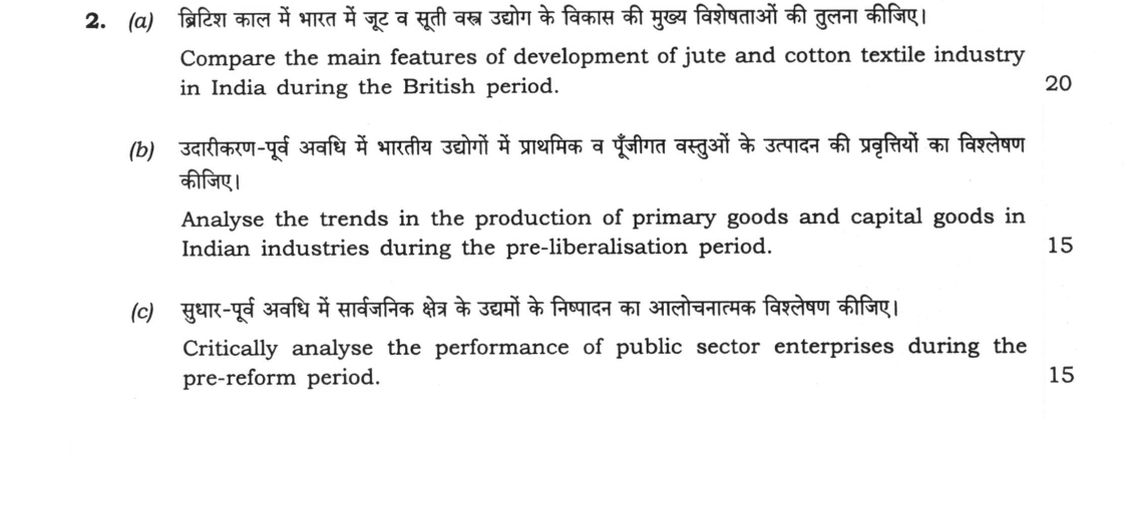
(a) Compare the main features of development of jute and cotton textile industry in India during the British period. (20…
Compare the main features of development of jute and cotton textile industry in India during the British period. 20 marks
Analyse the trends in the production of primary goods and capital goods in Indian industries during the pre-liberalisation period. 15 marks
Critically analyse the performance of public sector enterprises during the pre-reform period. 15 marks
हिंदी में प्रश्न पढ़ें
ब्रिटिश काल में भारत में जूट व सूती वस्त्र उद्योग के विकास की मुख्य विशेषताओं की तुलना कीजिए। (20 अंक)
उदारीकरण-पूर्व अवधि में भारतीय उद्योगों में प्राथमिक व पूंजीगत वस्तुओं के उत्पादन की प्रवृत्तियों का विश्लेषण कीजिए। (15 अंक)
सुधार-पूर्व अवधि में सार्वजनिक क्षेत्र के उद्यमों के निष्पादन का आलोचनात्मक विश्लेषण कीजिए। (15 अंक)
Model answer
Written by UPSC Answer Check against this question's marking rubric, to the expected length. UPSC does not publish answers for Mains — this is one way to score well, not an official key.
Jute and cotton under colonialism Colonial industrialisation was uneven, shaped by raw materials, ports, capital and labour. Jute mills clustered in Bengal, especially Calcutta and Hooghly, because raw jute was local, river transport cheap, and Calcutta port served export markets. Cotton mills concentrated in Bombay and Ahmedabad, close to Deccan and Gujarat raw cotton and merchant capital. Jute was export-oriented, making hessian and sacking for Britain and world markets; cotton textiles served a large domestic market. Raw-material dependence differed: jute relied on indigenous fibre, while cotton mills increasingly imported American cotton for finer yarns. Ownership contrasted sharply: jute was dominated by British capital and management, while cotton was largely Indian-owned, with Bombay and Ahmedabad merchants controlling mills. Jute mill labour conditions were generally harsher, with long hours, low wages, child labour and seasonal unemployment; cotton mills also had poor conditions, but Indian ownership produced different wage and discipline patterns. Both displaced handloom weavers and handspinners, but cotton mills hit the Deccan handloom economy harder, while jute mills coexisted with a smaller handloom sector and drew on Bengal’s surplus labour. Technology adoption also differed: jute mills were newer, more capital-intensive and geared to export standards, whereas many cotton units were older, smaller and more flexible to domestic demand.
Primary and capital goods before liberalisation In the Indian industrial classification, primary or basic goods include coal, iron ore, steel, cement, electricity and fertilisers, not consumer textiles. The early plans gave priority to basic goods to create industrial capacity. Coal and iron-ore production rose, steel capacity expanded through SAIL units at Bhilai, Rourkela and Bokaro, and cement and electricity output grew, though bottlenecks appeared. Fertiliser production improved but remained erratic. Capital goods were relatively neglected under the first phase of import substitution until the Second Plan, after which public-sector investment expanded machine tools, tractors, engineering and heavy equipment. However, after 1965 growth decelerated, and the 1970s saw stagnation in capital-goods output due to droughts, oil shocks, licence controls and weak capacity utilisation. Agriculture-linked primary inputs such as fertilisers and agricultural machinery showed uneven or stagnant growth, while mining and metal industries continued to expand. Structurally, consumer goods’ share in manufacturing fell from about 62 per cent in 1951; by 1990–91 basic goods were about 32 per cent and capital goods 12–13 per cent, a combined 45 per cent. This reflected a deliberate shift to basic and capital goods, but gains were uneven and constrained by public-sector inefficiency.
Public sector performance before reform Public sector enterprises were central to pre-reform industrial policy. They expanded in steel, power, fertilisers, oil, heavy engineering and transport, generated employment, supplied strategic goods and helped develop backward regions. In some cases, such as SAIL, BHEL and IOCL, they built large-scale capacity and met social objectives. Yet performance was mixed. Capacity utilisation was often low because of input shortages, poor planning and overcapacity. Technological upgradation lagged, with outdated machinery and limited R&D. Employment generation was high, but overstaffing and rigid labour practices reduced productivity. Political interference in appointments, pricing and procurement was common, and pricing distortions—often below-cost or administered prices—discouraged efficiency. The result was a growing number of sick units before 1991, many dependent on soft budgets and government support. Thus the public sector met developmental objectives but created inefficiencies that made liberalisation and corporate reform necessary.
Conclusion The colonial legacy of export-oriented jute and Indian-owned cotton shaped post-independence policy: the state promoted import substitution, public-sector heavy industry and planned basic goods. Pre-reform India thus built a basic and capital-goods base, but with structural rigidities. The verdict is that public-sector-led industrialisation expanded capacity and employment, but inefficiencies and 1970s stagnation justified 1991 reforms.
What "Compare" is asking you to do
Set the items against each other on named dimensions. In UPSC practice compare already carries both halves — likeness and difference — and where the stem names the dimensions, as in region, nature and climatic impact, those are the headings the examiner expects to see.
Structure that answers it
Dimensions named → both items on dimension 1 → dimension 2 → dimension 3 → where they converge and where they part
Where marks are lost
Two self-contained descriptive blocks with the comparison left for the reader to make. Marks here sit on the dimensions, so an answer that names none of them gives the examiner nothing to award.
How this answer will be evaluated
Approach
Framework: UPSC Economics Paper II (Industrial Development). (a) compare: paired headings or table > key differences > significance > conclusion | (b) analyse: intro > causes > effects > stakeholders/linkages > way forward | (c) critically evaluate: positives > negatives/limits > conditions/safeguards > conclusion Full marks: Comprehensive, data-driven, and critically analytical with clear structure.
Key points expected
- Geographical concentration (Bengal vs Bombay/Maharashtra)
- Raw material supply and transport costs
- Capital structure (foreign vs Indian)
- Technological level and scale of production
- Definition of primary vs capital goods
- Trend of primary goods (consumer durables/agri-based)
- Trend of capital goods (heavy industry/infrastructure)
- Role of Five Year Plans in this shift
Evaluation rubric
Each sub-part is marked on its own, against the marks and word limit printed on the paper.
- (a) Paired comparison of jute and cotton textile development features during the British period. 20 marks
compare— paired headings or table → key differences → significance → conclusion
Must cover
- Geographical concentration (Bengal vs Bombay/Maharashtra)
- Raw material supply and transport costs
- Capital structure (foreign vs Indian)
- Technological level and scale of production
Loses marks
- Descriptive history without comparative structure
- Ignoring the 'British period' constraint
Earns more
- Role of colonial trade policy (tariffs)
- Labor conditions and wage differentials
- Export markets (Russia vs domestic)
Extra mark
- Specific data on mill numbers or output
- Reference to specific colonial acts (e.g., Jute Act)
- (b) Trend analysis of primary vs capital goods production in pre-liberalisation India. 15 marks
analyse— intro → causes → effects → stakeholders/linkages → way forward
Must cover
- Definition of primary vs capital goods
- Trend of primary goods (consumer durables/agri-based)
- Trend of capital goods (heavy industry/infrastructure)
- Role of Five Year Plans in this shift
Loses marks
- Confusing 'primary goods' with 'primary sector'
- Ignoring the 'pre-liberalisation' timeframe
Earns more
- Impact of import substitution policy
- Sectoral growth rates (e.g., steel, cement)
- Bottlenecks in capital goods production
Extra mark
- Specific data from Economic Surveys
- Reference to specific Five Year Plan targets
- (c) Critical assessment of public sector enterprise performance pre-reform. 15 marks
critically evaluate— positives → negatives/limits → conditions/safeguards → conclusion
Must cover
- Definition of public sector enterprises (PSUs)
- Positive performance indicators (employment, infrastructure)
- Negative performance indicators (efficiency, profitability)
- Structural issues (bureaucracy, political interference)
Loses marks
- One-sided view (only positive or only negative)
- Ignoring the 'pre-reform' constraint
Earns more
- Reference to 'Navratnas' or 'Miniratnas' (if applicable to period)
- Comparison with private sector efficiency
- Role in regional development
Extra mark
- Reference to specific PSU failures (e.g., BHEL, SAIL)
- Reference to Dabhol Power Plant or similar
Practice this exact question
Write your answer and it is marked point by point against the model answer above — what you covered, what you missed, what you got wrong.
Evaluate my answer →More from Economics 2021 Paper II
- Q1 Answer the following questions in about 150 words each: (a) Examine the factors that faci…
- Q2 (a) Compare the main features of development of jute and cotton textile industry in India…
- Q3 (a) Do you think that effective land reforms are necessary but not sufficient conditions…
- Q4 (a) Do you think that India experienced a major break in GDP growth and its sectoral comp…
- Q5 Answer the following questions in about 150 words each: (a) Examine the arguments to expl…