Paper II — Q3
(a) Do you think that effective land reforms are necessary but not sufficient conditions for raising agricultural productivity in…
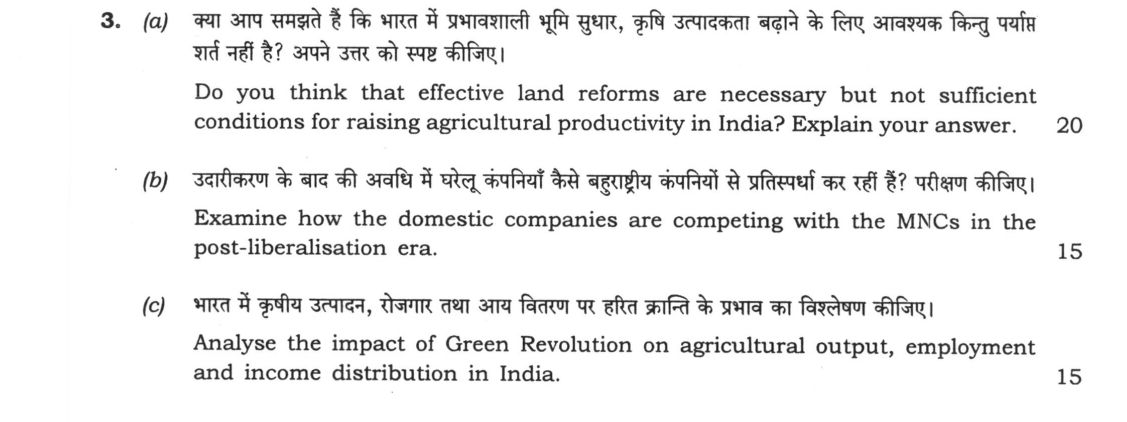
Do you think that effective land reforms are necessary but not sufficient conditions for raising agricultural productivity in India? Explain your answer. 20 marks
Examine how the domestic companies are competing with the MNCs in the post-liberalisation era. 15 marks
Analyse the impact of Green Revolution on agricultural output, employment and income distribution in India. 15 marks
हिंदी में प्रश्न पढ़ें
क्या आप समझते हैं कि भारत में प्रभावशाली भूमि सुधार, कृषि उत्पादकता बढ़ाने के लिए आवश्यक किन्तु पर्याप्त शर्त नहीं हैं? अपने उत्तर को स्पष्ट कीजिए। (20 अंक)
उदारीकरण के बाद की अवधि में घरेलू कंपनियां कैसे बहुराष्ट्रीय कंपनियों से प्रतिस्पर्धा कर रही हैं? परीक्षण कीजिए। (15 अंक)
भारत में कृषीय उत्पादन, रोजगार तथा आय वितरण पर हरित क्रांति के प्रभाव का विश्लेषण कीजिए। (15 अंक)
Model answer
Written by UPSC Answer Check against this question's marking rubric, to the expected length. UPSC does not publish answers for Mains — this is one way to score well, not an official key.
Effective land reforms are necessary but not sufficient for raising agricultural productivity in India; the same institutional-technology-market logic also explains domestic firm competition and the Green Revolution’s mixed outcomes.
Land reforms: necessary but not sufficient Effective land reforms are necessary because they remove exploitative intermediaries, secure tenure and create incentives to invest. Zamindari abolition, tenancy regulation, land-ceiling acts and consolidation can reduce rent extraction, make tenants willing to improve soil, and make land usable as collateral. However, these reforms are not sufficient. A farmer with secure tenure but no irrigation, HYV seeds, credit, extension services, power or market infrastructure cannot raise productivity. The causal chain is clear: tenure security encourages investment, but output rises only when water, seed, credit and extension convert that investment into yield. Empirically, Kerala and West Bengal show partial success in tenancy and redistribution, yet their agricultural transformation remained constrained by irrigation, credit and market infrastructure. Punjab, by contrast, achieved high productivity mainly through canal and tube-well irrigation, HYV seeds and input markets, not through major redistribution. Bihar illustrates the failure of legislation alone: despite ceiling and tenancy laws, weak implementation, political resistance and incomplete records left productivity low. Thus land reform is a precondition, not a complete solution.
Domestic firms and MNCs after liberalisation After 1991, domestic companies have competed with MNCs by using cost leadership, frugal engineering and deep local market knowledge. Tata Nano and Mitticool show how low-cost design can serve large mass markets; jugaad innovation allows firms to adapt products to Indian conditions. Domestic firms also exploit distribution networks, cost arbitrage and sector-specific strengths: Sun Pharma and Cipla compete globally in pharmaceuticals, while TCS and Infosys compete in IT services by combining scale and process innovation. Their strategy is not merely price competition. They use strategic alliances and acquisitions, reversing the earlier MNC-led Suzuki-Maruti pattern in many sectors, as in Tata-Jaguar, to access technology while retaining brand, distribution and local adaptation. Some firms have acquired distressed or underperforming foreign assets, and regulatory arbitrage helps them use local adaptation and market protection while navigating global standards. Yet challenges remain in capital-intensive sectors such as semiconductors, aerospace and high-end equipment, where MNCs still dominate through patents and global supply chains. Domestic competitiveness therefore depends on innovation ecosystems, skilled labour, credit and standards, not only protection.
Green Revolution: output, employment and distribution The Green Revolution raised output by introducing HYV seeds, irrigation, fertilisers and mechanisation. Foodgrain production rose from about 50 million tonnes in the 1950s to 234 million tonnes in 2008-09, 244 million tonnes in 2010-11, and crossed 250 million tonnes in 2011-12. This made India largely self-sufficient and supported buffer stocks and the PDS. But gains were regionally concentrated in Punjab, Haryana and western UP, where water and market infrastructure were better. The technology was capital-biased: tractors and harvesters displaced some agricultural labour, employment stagnated relative to output, and smallholders often shifted to casual wage work. Income distribution worsened, as rising rural Gini coefficients show, because large and medium farmers with access to credit, water and extension captured more gains, while small and marginal farmers lagged. Regional divergence created a “Bharat vs India” pattern, and farmer suicides in non-GR regions such as parts of Maharashtra, Andhra Pradesh and Karnataka reflected distress where technology and credit were uneven.
The lesson is that inclusive transformation requires a triad: land reform, technology and institutional support. Agriculture needs the Second Green Revolution in eastern India, with climate-resilient seeds, water efficiency and sustainable practices. Industry needs domestic innovation ecosystems to compete with MNCs. Only then will productivity and competitiveness become broad-based.
What "Explain" is asking you to do
Make the working of something clear — what sets it off, what follows from what, and what it produces. Explain is the Commission's mechanism word: it dominates the technical papers and the “explain why” stems, where the marks sit in the causal chain and not in the label.
Structure that answers it
State what it is → the initiating condition → the chain of cause, step by step → an instance where it plays out → what the chain produces
Where marks are lost
Describing what something looks like instead of why it works that way. Naming the stages without linking them reads as description too.
How this answer will be evaluated
Approach
Framework: UPSC Economics Paper II. (a) explain: definition/context > points in order > small example > short close | (b) examine: intro > how/why with reasoning > evidence > conclusion | (c) analyse: intro > causes > effects > stakeholders/linkages > way forward Full marks: Precise definitions, specific policy names, balanced analysis, and clear distinction between necessary/sufficient conditions.
Key points expected
- Define 'necessary' vs 'sufficient' in this context
- Explain why reform is necessary (incentives, fragmentation)
- Explain why it is not sufficient (credit, irrigation, tech)
- Cite specific Indian land reform acts or policies
- Contextualize with 1991 LPG reforms
- Identify specific competitive strategies (branding, R&D, scale)
- Provide examples of successful domestic firms (e.g., Tata, Infosys)
- Discuss the role of FDI policy changes
Evaluation rubric
Each sub-part is marked on its own, against the marks and word limit printed on the paper.
- (a) Argument that land reform is a necessary but not sufficient condition for productivity. 20 marks
explain— definition/context → points in order → small example → short close
Must cover
- Define 'necessary' vs 'sufficient' in this context
- Explain why reform is necessary (incentives, fragmentation)
- Explain why it is not sufficient (credit, irrigation, tech)
- Cite specific Indian land reform acts or policies
Loses marks
- Treating land reform as the sole solution
- Ignoring the 'sufficient' part of the prompt
- Vague generalities without specific policy names
Earns more
- Reference to Bhoodan-Gramdan movement
- Mention of 10th/11th Five Year Plan focus
- Data on landholding size distribution (Agricultural Census)
Extra mark
- Reference to Swaminathan Commission
- Specific state examples (e.g., West Bengal vs Bihar)
- (b) Analysis of domestic firms' strategies to compete with MNCs post-1991. 15 marks
examine— intro → how/why with reasoning → evidence → conclusion
Must cover
- Contextualize with 1991 LPG reforms
- Identify specific competitive strategies (branding, R&D, scale)
- Provide examples of successful domestic firms (e.g., Tata, Infosys)
- Discuss the role of FDI policy changes
Loses marks
- Focusing only on MNCs' dominance
- Ignoring the 'post-liberalisation' timeframe
- Lack of specific corporate examples
Earns more
- Mention of 'Make in India' or PLI schemes
- Reference to specific sectors (IT, Pharma, Auto)
- Discussion of 'China+1' strategy benefits
Extra mark
- Citing specific FDI inflow data
- Reference to CII or FICCI reports
- (c) Impact of Green Revolution on output, employment, and income distribution. 15 marks
analyse— intro → causes → effects → stakeholders/linkages → way forward
Must cover
- Define Green Revolution (HYV seeds, irrigation, fertilizer)
- Analyze impact on agricultural output (growth rates)
- Analyze impact on employment (labor displacement vs creation)
- Analyze impact on income distribution (regional/rural inequality)
Loses marks
- Ignoring the 'income distribution' aspect
- Treating Green Revolution as uniformly positive
- Failing to link output to employment changes
Earns more
- Mention of 'food bowl' states (Punjab, Haryana)
- Reference to environmental costs (water table drop)
- Discussion of 'second green revolution' (drought resistant)
Extra mark
- Citing specific yield data (e.g., wheat production growth)
- Reference to Swaminathan's role
Practice this exact question
Write your answer and it is marked point by point against the model answer above — what you covered, what you missed, what you got wrong.
Evaluate my answer →More from Economics 2021 Paper II
- Q1 Answer the following questions in about 150 words each: (a) Examine the factors that faci…
- Q2 (a) Compare the main features of development of jute and cotton textile industry in India…
- Q3 (a) Do you think that effective land reforms are necessary but not sufficient conditions…
- Q4 (a) Do you think that India experienced a major break in GDP growth and its sectoral comp…
- Q5 Answer the following questions in about 150 words each: (a) Examine the arguments to expl…
- Q6 (a) What are the major components of public expenditure on agriculture in India? Would yo…