Paper II — Q7
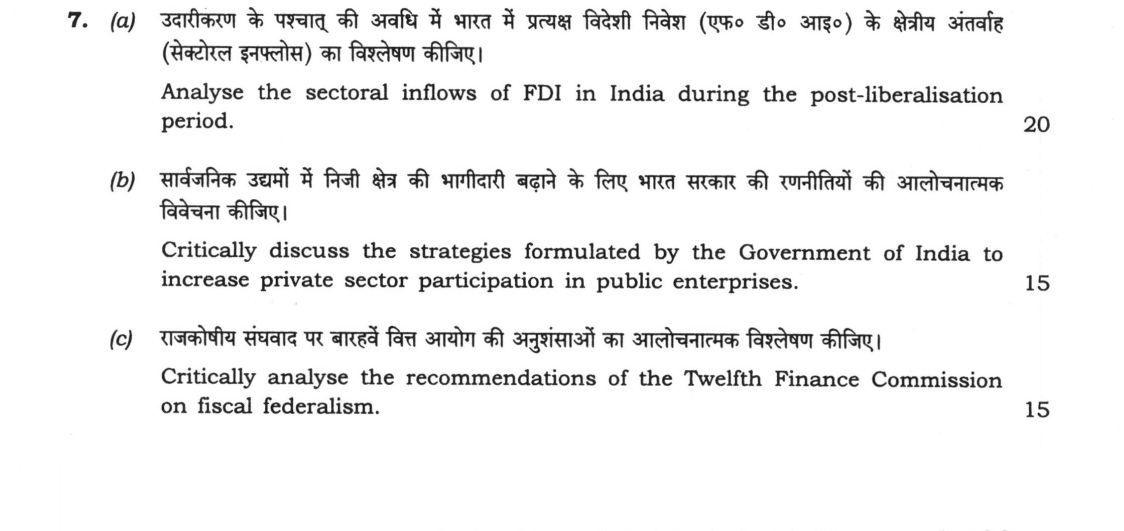
(a) Analyse the sectoral inflows of FDI in India during the post-liberalisation period. (20 marks) (b) Critically discuss the…
Analyse the sectoral inflows of FDI in India during the post-liberalisation period. 20 marks
Critically discuss the strategies formulated by the Government of India to increase private sector participation in public enterprises. 15 marks
Critically analyse the recommendations of the Twelfth Finance Commission on fiscal federalism. 15 marks
हिंदी में प्रश्न पढ़ें
उदारीकरण के पश्चात् की अवधि में भारत में प्रत्यक्ष विदेशी निवेश (एफ० डी० आई०) के क्षेत्रीय अंतर्वह (सेक्टोरल इन्फ्लोस) का विस्तरण कीजिए। (20 अंक)
सार्वजनिक उद्यमों में निजी क्षेत्र की भागीदारी बढ़ाने के लिए भारत सरकार की रणनीतियों की आलोचनात्मक विवेचना कीजिए। (15 अंक)
राजकोषीय संघवाद पर बारहवें वित्त आयोग की अनुसंशाओं का आलोचनात्मक विस्तरण कीजिए। (15 अंक)
Model answer
Written by UPSC Answer Check against this question's marking rubric, to the expected length. UPSC does not publish answers for Mains — this is one way to score well, not an official key.
Post-1991 reforms tied external capital, public-sector retrenchment and fiscal restructuring. The three issues show how India recalibrated the state-market relationship: FDI entered services, PSUs were opened to private capital, and states were given conditional fiscal space.
Sectoral FDI After 1991, FDI policy moved from case-by-case government approval to automatic route for many sectors, first up to 51 per cent and later 74 and 100 per cent, while sensitive sectors remained on the government route. Early inflows were concentrated in manufacturing, trading and telecom; by the 2000s services—IT/ITeS, telecom, financial services and business services—became a major recipient in annual flows. The shift was not a simple cumulative majority: DIPP equity data show services around 17-20 per cent of cumulative inflows, while manufacturing’s share fell to about one-quarter in later years. Computer software/hardware was often the largest single sub-sector when the composite services category was excluded. Greenfield investment supported new capacity in manufacturing, telecom and IT parks, while brownfield inflows rose through acquisitions and joint ventures. Agriculture’s share remained small and declined because of land, food-policy and regulatory constraints. Source-country data show heavy routing through Mauritius and Singapore, reflecting tax treaties and treaty shopping, which made sectoral analysis sensitive to conduit effects. The services bias reflected globalisation of IT, telecom liberalisation, financial-sector opening and India’s skilled-services advantage; the automatic route lowered uncertainty and encouraged brownfield M&A, while the government route in sensitive sectors slowed inflows. Thus, sectoral FDI was shaped by policy access, global value chains and source-country routing.
Private participation in PSUs The government used disinvestment and PPPs. Minority stake sales (1991-2000) raised revenue but left control with the state; strategic sales (1999-2004) transferred management control, as in VSNL to Bharti, Maruti to Suzuki and BALCO to Vedanta, while ONGC Videsh sales showed limits of strategic exit. CPSE restructuring, through mergers, closures and the National Investment Fund created from sale proceeds, aimed to make PSUs viable. PPP frameworks, especially Viability Gap Funding and IIFCL, targeted infrastructure where private capital needed long-term finance and risk-sharing. Critically, these strategies were uneven: valuation controversies, political opposition, employee resistance and incomplete privatisation—residual government stakes, regulatory capture and weak exit—reduced efficiency gains. Minority stakes improved governance but did not change ownership; strategic sales attracted global buyers but faced political and union resistance; PPPs mobilised private capital for roads, power and urban infrastructure but VGF and IIFCL could not fully address land acquisition, clearances and tariff risk.
Twelfth Finance Commission The 12th Finance Commission strengthened fiscal federalism by recommending a larger devolution of central tax proceeds to states and a debt-relief scheme for 2005-10. It linked relief to FRBM enactment, revenue-deficit elimination and lower interest rates on central loans, reducing interest burdens and disciplining borrowing. Under Article 275, it continued non-plan revenue deficit grants while adding purpose-specific grants, including local-body grants for Panchayati Raj and municipal institutions, with conditions for capacity building. These were precursors to later GST compensation arrangements. The approach improved fiscal discipline and state capacity, but conditionalities constrained state autonomy, and local-body grants remained limited by weak institutions and implementation. The 42 per cent devolution gave states a predictable share of central taxes, while debt relief addressed vertical imbalance.
Conclusion The post-liberalisation pattern is coherent: FDI favoured services, private participation focused on infrastructure, and fiscal federalism tried to make states fiscally sustainable. The interactions matter: services-led FDI strengthened urban infrastructure demand, PSU reforms sought to fill infrastructure gaps, and fiscal federalism aimed to give states capacity to deliver services and invest. A way forward is to broaden FDI into manufacturing and agriculture, complete PSU reforms with transparent valuations, and balance fiscal conditionalities with state and local autonomy.
What "Analyse" is asking you to do
Break the subject into its working parts and show how they act on each other. The marks are in the interconnections — which factor drives which, and what the resulting structure explains — not in the inventory of factors.
Structure that answers it
Define the whole → separate it into its parts → show which part drives which → what that interaction produces → what the structure implies
Where marks are lost
A flat list of causes with no account of which drives which. An answer of neatly separated headings, each self-contained, scores as description.
How this answer will be evaluated
Approach
Framework: UPSC Economics Paper II (Indian Economy). (a) analyse: intro > causes > effects > stakeholders/linkages > way forward | (b) discuss: intro > 3-4 dimensions > example > balanced close | (c) analyse: intro > causes > effects > stakeholders/linkages > way forward Full marks: Precise data, clear policy linkages, balanced critical analysis, and correct terminology.
Key points expected
- Identify top 3-4 sectors (e.g., Telecom, IT, Banking, Auto)
- Distinguish between FDI and FPI inflows
- Link sectoral shifts to specific policy changes (e.g., 1991, 2000, 2015)
- Mention specific policy instruments (e.g., Automatic Route, FDI Policy)
- Define the strategy (e.g., Disinvestment, Strategic Sales, IPOs)
- Identify specific mechanisms (e.g., NSE/BSE listing, 51% rule)
- Provide a balanced view (efficiency vs. social welfare)
- Mention the role of the Disinvestment Commission
Evaluation rubric
Each sub-part is marked on its own, against the marks and word limit printed on the paper.
- (a) Sectoral breakdown of FDI inflows in India post-1991 with trend analysis. 20 marks
analyse— intro → causes → effects → stakeholders/linkages → way forward
Must cover
- Identify top 3-4 sectors (e.g., Telecom, IT, Banking, Auto)
- Distinguish between FDI and FPI inflows
- Link sectoral shifts to specific policy changes (e.g., 1991, 2000, 2015)
- Mention specific policy instruments (e.g., Automatic Route, FDI Policy)
Loses marks
- Confusing FDI with FPI or general foreign investment
- Listing sectors without explaining the 'why' (policy drivers)
- Ignoring the pre-1991 context for comparison
Earns more
- Cite specific RBI or DPIIT data points
- Discuss the 'Make in India' impact on manufacturing FDI
- Reference the 2015 FDI policy changes in retail
Extra mark
- Mention specific FDI inflow figures for a recent year
- Reference the 'Ease of Doing Business' ranking
- (b) Evaluation of government strategies to increase private participation in PSUs. 15 marks
discuss— intro → 3-4 dimensions → example → balanced close
Must cover
- Define the strategy (e.g., Disinvestment, Strategic Sales, IPOs)
- Identify specific mechanisms (e.g., NSE/BSE listing, 51% rule)
- Provide a balanced view (efficiency vs. social welfare)
- Mention the role of the Disinvestment Commission
Loses marks
- Treating 'privatization' and 'disinvestment' as identical without nuance
- Ignoring the social cost of privatization (unemployment)
- Failing to distinguish between minority and majority stake sales
Earns more
- Reference the 'Golden Share' concept
- Discuss the 'Exit Policy' of the government
- Mention specific successful/failed privatization examples
Extra mark
- Cite the 'National Investment and Infrastructure Fund' (NIIF)
- Reference the 'Public Enterprises (Amendment) Bill'
- (c) Analysis of the 12th Finance Commission's recommendations on fiscal federalism. 15 marks
analyse— intro → causes → effects → stakeholders/linkages → way forward
Must cover
- Identify the core recommendation (e.g., 42% devolution)
- Explain the shift from 'tied' to 'untied' grants
- Discuss the impact on state autonomy and fiscal discipline
- Mention the 'Fiscal Responsibility and Budget Management' (FRBM) Act
Loses marks
- Confusing the 12th FC with the 13th or 14th FC
- Ignoring the 'tied grants' vs 'untied grants' distinction
- Failing to link recommendations to the 'fiscal federalism' concept
Earns more
- Reference the 'Vertical Devolution' formula
- Discuss the 'Horizontal Devolution' criteria (population, area, etc.)
- Mention the 'State Finance Commissions' role
Extra mark
- Cite the specific percentage increase in devolution (32% to 42%)
- Reference the 'GST' impact on the 12th FC recommendations
Practice this exact question
Write your answer and it is marked point by point against the model answer above — what you covered, what you missed, what you got wrong.
Evaluate my answer →More from Economics 2021 Paper II
- Q4 (a) Do you think that India experienced a major break in GDP growth and its sectoral comp…
- Q5 Answer the following questions in about 150 words each: (a) Examine the arguments to expl…
- Q6 (a) What are the major components of public expenditure on agriculture in India? Would yo…
- Q7 (a) Analyse the sectoral inflows of FDI in India during the post-liberalisation period. (…
- Q8 (a) Define capital account convertibility. Examine Tarapore Committee (I and II) recommen…