Paper II — Q4
(a) Do you think that India experienced a major break in GDP growth and its sectoral composition during the 1980s? Give reasons…
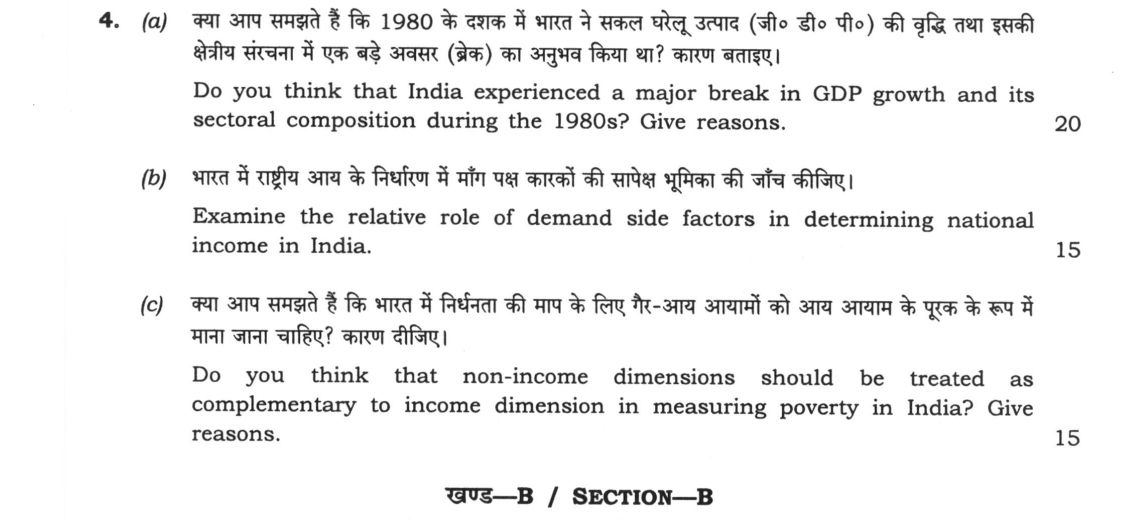
Do you think that India experienced a major break in GDP growth and its sectoral composition during the 1980s? Give reasons. 20 marks
Examine the relative role of demand side factors in determining national income in India. 15 marks
Do you think that non-income dimensions should be treated as complementary to income dimension in measuring poverty in India? Give reasons. 15 marks
हिंदी में प्रश्न पढ़ें
क्या आप समझते हैं कि 1980 के दशक में भारत ने सकल घरेलू उत्पाद (जी. डी. पी.) की वृद्धि तथा इसकी क्षेत्रीय संरचना में एक बड़े अवसर (ब्रेक) का अनुभव किया था? कारण बताइए। (20 अंक)
भारत में राष्ट्रीय आय के निर्धारण में मांग पक्ष कारकों की सापेक्ष भूमिका की जांच कीजिए। (15 अंक)
क्या आप समझते हैं कि भारत में निर्धनता की माप के लिए गैर-आय आयामों को आय आयाम के पूरक के रूप में माना जाना चाहिए? कारण दीजिए। (15 अंक)
Model answer
Written by UPSC Answer Check against this question's marking rubric, to the expected length. UPSC does not publish answers for Mains — this is one way to score well, not an official key.
1980s break India’s 1980s did show a partial break, but not a clean structural rupture. The “break” thesis, associated with DeLong and Rodrik-Singh, stresses a pro-business attitudinal shift: easier industrial approvals, tax and regulatory easing, greater private investment, and a more growth-friendly state. Virmani locates the break in 1981, while Srivastava sees acceleration from 1979-80, suggesting the 1980s were a continuation of an earlier upturn. Nayyar’s counter is that the state-led, licensing-and-public-sector model persisted, so the change was one of degree. The evidence supports a qualified yes: growth rose from around 4.5 per cent in the 1970s to about 5.5 per cent in the 1980s, but the sectoral shift was uneven. Agriculture’s share of GDP and employment began to fall, yet rural distress persisted; agricultural growth was uneven, with foodgrain output rising but rural incomes lagging. Industry expanded, but without a matching productivity surge, while services showed the beginnings of tertiarisation, though employment remained agriculture-heavy. Thus the 1980s were a break in growth momentum and sectoral mix, not a full liberalisation break.
Demand-side role In the Keynesian AD-AS framework, with short-run sticky prices and spare capacity, aggregate demand determines output and national income. AD = private consumption + public consumption + gross fixed capital formation + inventory changes + net exports. In India, private consumption is the largest and most stabilising component, while public consumption acts as a counter-cyclical floor. Investment is the volatile component: GFCF rose to about 32-34 per cent of GDP in 2007-08, while total GCF including inventories and valuables was near 38 per cent; thereafter investment slowed due to credit constraints, capacity utilisation and policy uncertainty. Inventory changes are small but signal business confidence. Net exports became more important after 1991, with exports and remittances cushioning domestic demand. Sectoral demand multipliers matter: infrastructure and industry demand tend to pull up upstream and downstream activity more than final consumption alone. Empirically, India has often grown in a consumption-led manner, but sustained income expansion requires investment-led capacity creation. The 2016-19 rural demand collapse, linked to farm distress and weak rural consumption, shows how demand-side shocks can transmit to national income.
Non-income poverty Non-income dimensions should be treated as complementary, not substitutive, to income. Income lines—Tendulkar, which moved away from explicit calorie anchoring, and Rangarajan, which used calorie-protein-fat norms—capture purchasing power but miss capability deprivation in Sen’s sense. The Alkire-Foster MPI, used in NITI Aayog’s 2021 baseline, applies a dual cutoff to a set of indicators—ten in the standard formulation, expanded in NITI’s baseline—across health, education and living standards. This captures informal vulnerability: households above the income line may lack sanitation, electricity, schooling or nutrition. The complementarity is visible in convergence/divergence cases: Kerala shows low multidimensional poverty despite modest income, while several BIMARU states show income growth coexisting with health and education gaps; MPI also reveals intra-state inequality. Operationally, however, MPI faces data-frequency limits, weighting controversies and targeting trade-offs: BPL cards require a binary income/consumption cutoff, whereas MPI gradation may exclude marginal households or dilute welfare targeting, though it can guide district-level service delivery. Hence income remains essential for transfers, while MPI should complement it for capability-based poverty reduction.
Conclusion The three issues are linked by the measurement-policy nexus. The 1980s break was real but incomplete; demand-side management must combine consumption support with investment and external demand; and poverty measurement must pair income lines with MPI to target both transfers and capabilities. This integrated view improves both macro stability and social outcomes. A policy that relies only on GDP, only on aggregate demand, or only on income poverty will miss structural, cyclical and welfare dimensions.
What "Examine" is asking you to do
Test the proposition the question puts to you and return a finding on how far it holds. Examine stems carry a claim, or ask whether something has happened, and expect evidence weighed both ways before the extent is stated — often with remedial measures attached.
Structure that answers it
Restate the claim as the question frames it → evidence that supports it → evidence that undercuts it → the conditions under which it holds → verdict on how far it stands
Where marks are lost
Stopping at description. An examination has to reach a finding, and “examine with justification” means the extent must be stated, not implied.
How this answer will be evaluated
Approach
Framework: UPSC Economics Paper II. (a) discuss: intro > 3-4 dimensions > example > balanced close | (b) examine: intro > how/why with reasoning > evidence > conclusion | (c) justify: claim > 3-4 reasons > evidence > conclusion Full marks: Comprehensive analysis with data, models, and policy links
Key points expected
- Define 'break' in GDP growth context
- Compare 1980s growth rate with 1970s
- Analyze shift in sectoral composition (agriculture vs industry)
- Link growth to policy changes (liberalization)
- Define demand-side factors (C, I, G, X-M)
- Explain role of consumption in Indian economy
- Analyze investment demand and its drivers
- Discuss government expenditure impact
Evaluation rubric
Each sub-part is marked on its own, against the marks and word limit printed on the paper.
- (a) Assess the 1980s growth break and sectoral shift with data. 20 marks
discuss— intro → 3-4 dimensions → example → balanced close
Must cover
- Define 'break' in GDP growth context
- Compare 1980s growth rate with 1970s
- Analyze shift in sectoral composition (agriculture vs industry)
- Link growth to policy changes (liberalization)
Loses marks
- Verbal answer without growth data
- Ignoring sectoral composition aspect
- Failing to link growth to policy
Earns more
- Cite specific GDP growth figures for 1980s
- Mention 'Hindu rate of growth' vs 1980s
- Reference structural transformation in industry
- Discuss role of public sector expansion
Extra mark
- Reference specific 5th/6th Plan data
- Mention specific economist's view on 1980s growth
- (b) Analyze demand-side factors in determining national income. 15 marks
examine— intro → how/why with reasoning → evidence → conclusion
Must cover
- Define demand-side factors (C, I, G, X-M)
- Explain role of consumption in Indian economy
- Analyze investment demand and its drivers
- Discuss government expenditure impact
Loses marks
- Ignoring supply-side factors entirely
- No mention of specific demand components
- Verbal answer without economic framework
Earns more
- Reference IS-LM model or AD-AS framework
- Mention specific demand-side policy measures
- Discuss multiplier effect in Indian context
- Analyze role of private investment
Extra mark
- Cite specific RBI or NITI Aayog data on demand
- Reference specific economist's demand-side analysis
- (c) Argue for non-income dimensions in poverty measurement. 15 marks
justify— claim → 3-4 reasons → evidence → conclusion
Must cover
- Define non-income dimensions of poverty
- Explain limitations of income-only measurement
- Justify need for complementary dimensions
- Provide examples of non-income poverty indicators
Loses marks
- Ignoring income dimension entirely
- No specific non-income indicators mentioned
- Verbal answer without theoretical framework
Earns more
- Reference Multidimensional Poverty Index (MPI)
- Mention specific non-income indicators (health, education)
- Discuss capability approach (Sen/Nussbaum)
- Reference specific Indian poverty measurement studies
Extra mark
- Cite specific UNDP or NITI Aayog MPI data
- Reference specific economist's capability approach work
Practice this exact question
Write your answer and it is marked point by point against the model answer above — what you covered, what you missed, what you got wrong.
Evaluate my answer →More from Economics 2021 Paper II
- Q1 Answer the following questions in about 150 words each: (a) Examine the factors that faci…
- Q2 (a) Compare the main features of development of jute and cotton textile industry in India…
- Q3 (a) Do you think that effective land reforms are necessary but not sufficient conditions…
- Q4 (a) Do you think that India experienced a major break in GDP growth and its sectoral comp…
- Q5 Answer the following questions in about 150 words each: (a) Examine the arguments to expl…
- Q6 (a) What are the major components of public expenditure on agriculture in India? Would yo…
- Q7 (a) Analyse the sectoral inflows of FDI in India during the post-liberalisation period. (…