Paper II — Q8
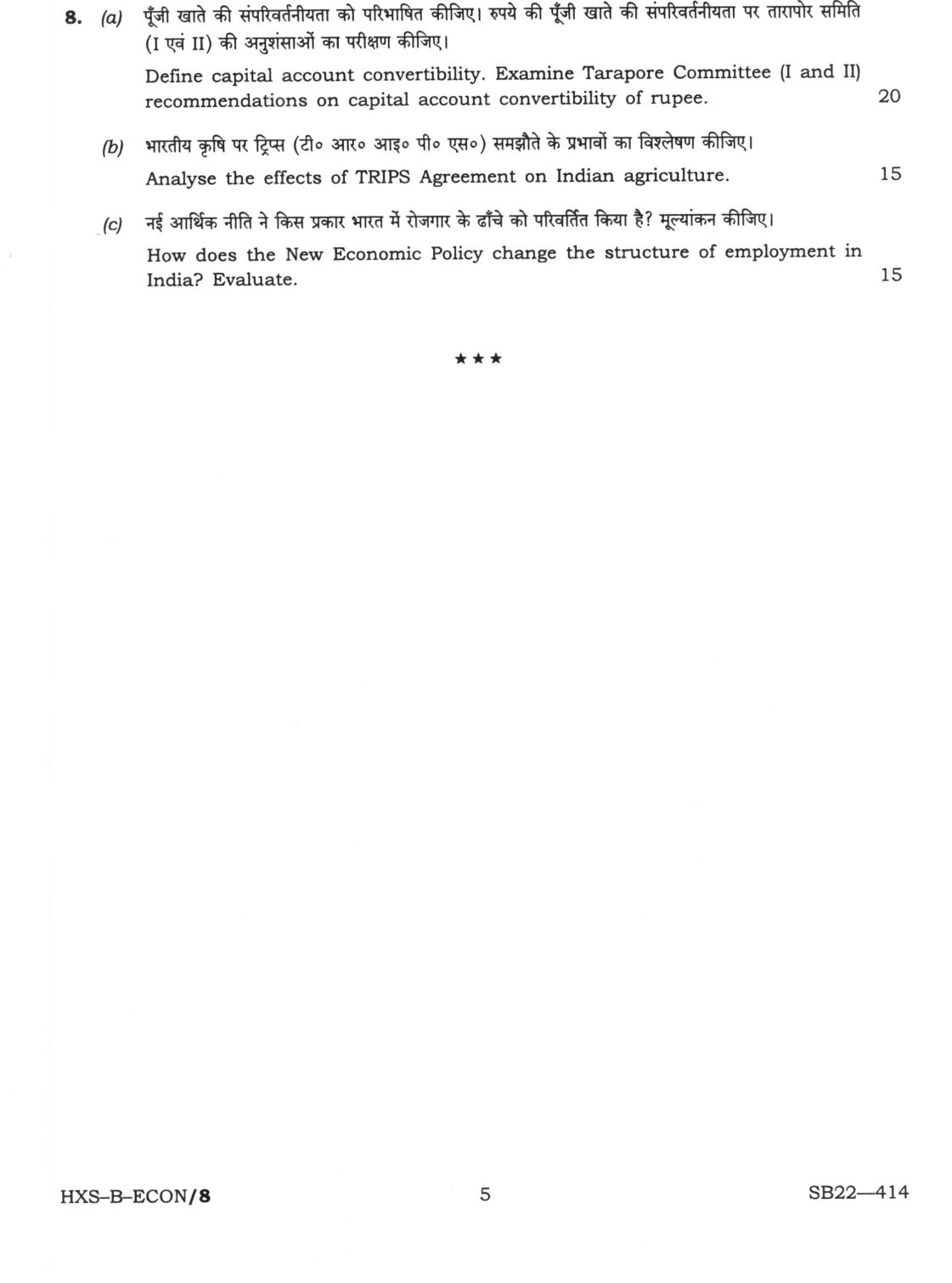
(a) Define capital account convertibility. Examine Tarapore Committee (I and II) recommendations on capital account…
Define capital account convertibility. Examine Tarapore Committee (I and II) recommendations on capital account convertibility of rupee. 20 marks
Analyse the effects of TRIPS Agreement on Indian agriculture. 15 marks
How does the New Economic Policy change the structure of employment in India? Evaluate. 15 marks
हिंदी में प्रश्न पढ़ें
पूँजी खाते की संपरिवर्तनीयता को परिभाषित कीजिए। रुपये की पूँजी खाते की संपरिवर्तनीयता पर तारापोर समिति (I एवं II) की अनुशंसाओं का परीक्षण कीजिए। (20 अंक)
भारतीय कृषि पर ट्रिप्स (टी० आर० आई० पी० एस०) समझौते के प्रभावों का विश्लेषण कीजिए। (15 अंक)
नई आर्थिक नीति ने किस प्रकार भारत में रोजगार के ढाँचे को परिवर्तित किया है? मूल्यांकन कीजिए। (15 अंक)
Model answer
Written by UPSC Answer Check against this question's marking rubric, to the expected length. UPSC does not publish answers for Mains — this is one way to score well, not an official key.
(a) Capital account convertibility and Tarapore Committees Capital account convertibility means the freedom to convert domestic financial assets into foreign financial assets and vice versa, including cross-border borrowing, lending, portfolio investment and direct investment, without quantitative restrictions. The First Tarapore Committee (1997) treated CAC as a staged process: first convertibility for non-residents, then residents, and finally full convertibility. It linked each stage to preconditions—fiscal deficit below 3.5 per cent of GDP, inflation in the 3–5 per cent range, and a sustained reduction in bank NPAs—so that macroeconomic stability would precede liberalization. The first committee’s caution reflected the Asian financial crisis; the second added exchange-rate discipline after the 2004–05 capital inflow boom. The Second Tarapore Committee (2006) accepted the same logic but tightened the preconditions: fiscal deficit below 3.5 per cent, inflation 3–5 per cent, current account deficit around 3 per cent, gross NPAs reduced to 1 per cent by 2008–09 and net NPAs to 0.5 per cent, stronger financial-sector regulation, and an ERM II-style monitoring band to guard against exchange-rate overshooting. Examined critically, the recommendations were prudent because they recognized that CAC amplifies capital-flow volatility and can constrain monetary autonomy under the impossible trinity. Yet full CAC was not implemented because the 2008 global financial crisis showed how quickly portfolio inflows can reverse, and because India’s exchange-rate management and capital controls remained useful for stabilizing growth. Thus the committees’ verdict was sound, but the sequencing was too dependent on preconditions that India has not fully met.
(b) TRIPS and Indian agriculture TRIPS changed Indian agriculture by embedding intellectual-property rules in the agrarian economy. Although India retained a sui generis system under the Plant Varieties and Farmers’ Rights Act, 2001, TRIPS increased pressure to move toward a patent regime for plant varieties, biotech inputs and gene sequences. This raised seed and input costs, as in the Monsanto–Mahyco Bt cotton dispute, where royalty litigation and high seed prices squeezed small farmers. The tension between farmer’s privilege and breeder’s rights became central: farmers’ rights to save, exchange and use seeds are limited by exclusive breeder rights, weakening traditional seed networks. TRIPS also intensified bio-piracy concerns, seen in the turmeric, neem and basmati patent controversies, where foreign firms sought protection for traditional knowledge. The Article 27.3(b) debate over excluding plants, animals and essentially biological processes from patentability remains unresolved, leaving Indian agriculture exposed to IP claims while limiting public-interest exceptions.
(c) NEP and employment structure The New Economic Policy of 1991 altered employment by shifting growth from state-led, organised manufacturing to market-led services and informal activity. Organised-sector employment declined relative to the total workforce, while informalisation and casualisation rose. NSSO and PLFS data show that informal employment now exceeds 90 per cent of the workforce; PLFS 2017–18 records casual workers at about 39 per cent, indicating precarious employment. Growth in the 1990s–2000s was often jobless: NSSO estimates show a low employment elasticity with respect to GDP growth, and the sectoral shift moved labour from agriculture to services, bypassing manufacturing. In agriculture, feminization increased as male outmigration left women with a larger share of farm work, often without commensurate wages or social security. The trickle-down assumption that liberalization would create formal jobs is therefore not supported; instead, employment became more flexible, low-paid and unregulated. This weakens bargaining power, limits social protection and makes households more vulnerable to shocks.
Conclusion The integrated lesson is sequencing: CAC requires macro and financial preconditions, TRIPS compliance needs stronger farmers’ rights and anti-bio-piracy safeguards, and NEP-style growth must be paired with manufacturing, social security and formalization to convert employment into stable livelihoods, without which reforms risk deepening inequality.
What "Examine" is asking you to do
Test the proposition the question puts to you and return a finding on how far it holds. Examine stems carry a claim, or ask whether something has happened, and expect evidence weighed both ways before the extent is stated — often with remedial measures attached.
Structure that answers it
Restate the claim as the question frames it → evidence that supports it → evidence that undercuts it → the conditions under which it holds → verdict on how far it stands
Where marks are lost
Stopping at description. An examination has to reach a finding, and “examine with justification” means the extent must be stated, not implied.
How this answer will be evaluated
Approach
Framework: UPSC Economics Paper II. (a) examine: intro > how/why with reasoning > evidence > conclusion | (b) analyse: intro > causes > effects > stakeholders/linkages > way forward | (c) evaluate: criteria > evidence > balanced judgment Full marks: Precise definitions, clear distinction between Tarapore I/II, specific TRIPS provisions, and data-backed evaluation of employment shifts.
Key points expected
- Define capital account convertibility (current vs capital distinction)
- Distinguish Tarapore I (1993) vs Tarapore II (1998) scope
- Explain rationale for phased approach (macro stability)
- Assess impact on FDI and RBI monetary autonomy
- Explain TRIPS provisions on plant variety protection (UPOV)
- Analyze impact on seed industry (commercialization vs farmer rights)
- Discuss 'farmer's privilege' and seed saving rights
- Evaluate impact on agri-biotech and IP rights
Evaluation rubric
Each sub-part is marked on its own, against the marks and word limit printed on the paper.
- (a) Define capital account convertibility and assess Tarapore Committee I & II recommendations. 20 marks
examine— intro → how/why with reasoning → evidence → conclusion
Must cover
- Define capital account convertibility (current vs capital distinction)
- Distinguish Tarapore I (1993) vs Tarapore II (1998) scope
- Explain rationale for phased approach (macro stability)
- Assess impact on FDI and RBI monetary autonomy
Loses marks
- Confusing current account with capital account convertibility
- Treating Tarapore I and II as identical
- Ignoring the 'phased' nature of the recommendations
Earns more
- Mention specific instruments (FPI limits, FDI sectoral caps)
- Reference 1991 crisis context for Tarapore I
- Mention 1998 Asian crisis context for Tarapore II
- Link to current RBI capital account management
Extra mark
- Cite specific FDI limit changes (e.g., 40% to 100% in some sectors)
- Reference specific RBI circulars or dates
- (b) Analyze the impact of TRIPS Agreement on Indian agriculture. 15 marks
analyse— intro → causes → effects → stakeholders/linkages → way forward
Must cover
- Explain TRIPS provisions on plant variety protection (UPOV)
- Analyze impact on seed industry (commercialization vs farmer rights)
- Discuss 'farmer's privilege' and seed saving rights
- Evaluate impact on agri-biotech and IP rights
Loses marks
- Confusing TRIPS with TRIMs or GATT
- Ignoring the 'farmer's privilege' aspect
- Focusing only on trade, ignoring IP implications
Earns more
- Mention Protection of Plant Varieties and Farmers' Rights Act (PPV&FR)
- Reference specific crops (e.g., Bt cotton, hybrid rice)
- Discuss impact on small vs large farmers
- Mention WTO dispute cases (e.g., US-India cotton subsidies)
Extra mark
- Cite specific UPOV convention versions (1978 vs 1991)
- Reference specific Supreme Court judgments on seed rights
- (c) Evaluate how New Economic Policy changed India's employment structure. 15 marks
evaluate— criteria → evidence → balanced judgment
Must cover
- Define 'New Economic Policy' (1991 reforms context)
- Analyze shift from agriculture to services (structural change)
- Evaluate 'jobless growth' phenomenon
- Assess impact of liberalization on organized vs unorganized sector
Loses marks
- Ignoring the 'jobless growth' critique
- Focusing only on GDP growth, not employment
- Confusing 'New Economic Policy' with general economic policy
Earns more
- Reference PLFS or NSSO data on employment trends
- Mention specific sectors (IT, manufacturing, agriculture)
- Discuss impact of FDI on employment
- Reference specific policies (industrial policy, labor laws)
Extra mark
- Cite specific PLFS data points (e.g., % in services)
- Reference specific economists (e.g., Kalyan Sanyal, Arvind Panagariya)
Practice this exact question
Write your answer and it is marked point by point against the model answer above — what you covered, what you missed, what you got wrong.
Evaluate my answer →More from Economics 2021 Paper II
- Q5 Answer the following questions in about 150 words each: (a) Examine the arguments to expl…
- Q6 (a) What are the major components of public expenditure on agriculture in India? Would yo…
- Q7 (a) Analyse the sectoral inflows of FDI in India during the post-liberalisation period. (…
- Q8 (a) Define capital account convertibility. Examine Tarapore Committee (I and II) recommen…