Paper II — Q6
(a) What are the major components of public expenditure on agriculture in India? Would you recommend any changes in the pattern…
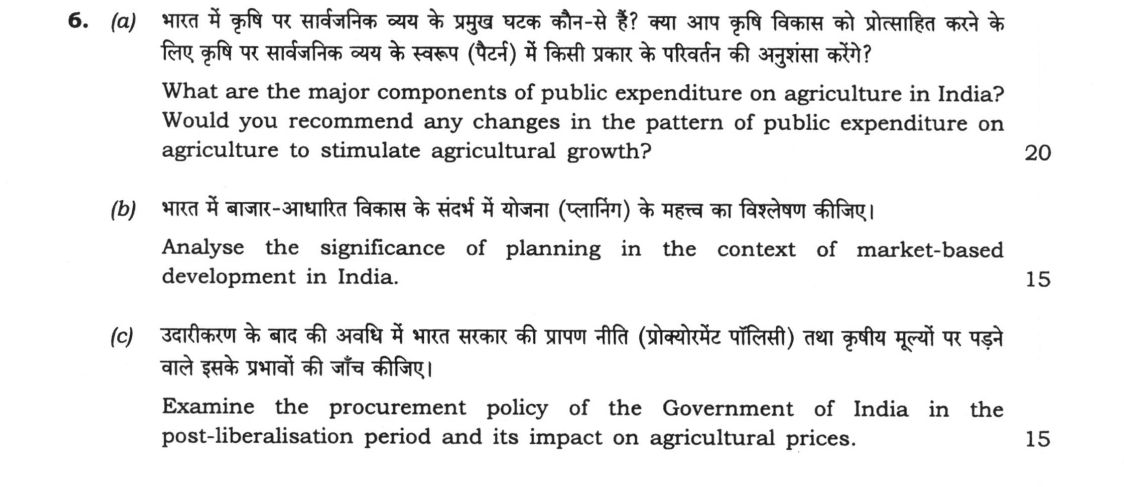
What are the major components of public expenditure on agriculture in India? Would you recommend any changes in the pattern of public expenditure on agriculture to stimulate agricultural growth? 20 marks
Analyse the significance of planning in the context of market-based development in India. 15 marks
Examine the procurement policy of the Government of India in the post-liberalisation period and its impact on agricultural prices. 15 marks
हिंदी में प्रश्न पढ़ें
भारत में कृषि पर सार्वजनिक व्यय के प्रमुख घटक कौन-से हैं? क्या आप कृषि विकास को प्रोत्साहित करने के लिए कृषि पर सार्वजनिक व्यय के स्वरूप (पैटर्न) में किसी प्रकार के परिवर्तन की अनुसंशा करेंगे? (20 अंक)
भारत में बाजार-आधारित विकास के संदर्भ में योजना (प्लानिंग) के महत्व का विस्तरण कीजिए। (15 अंक)
उदारीकरण के बाद की अवधि में भारत सरकार की प्रापण नीति (प्रोक्योरमेंट पॉलिसी) तथा कृषीय मूल्यों पर पड़ने वाले इसके प्रभावों की जाँच कीजिए। (15 अंक)
Model answer
Written by UPSC Answer Check against this question's marking rubric, to the expected length. UPSC does not publish answers for Mains — this is one way to score well, not an official key.
Public Expenditure on Agriculture: Components and Reorientation
Public expenditure on Indian agriculture comprises two distinct streams: capital expenditure (productive investment in major and medium irrigation, agricultural research and development, soil conservation, and rural infrastructure) and revenue expenditure (current transfers, input subsidies on fertilizers, power, canal water, credit interest subventions, and farm loan waivers). Data from the Central Economic Advisory and National Accounts Statistics indicate a structural imbalance: while total budgetary allocations to agriculture have grown, the share of Gross Capital Formation (GCF) financed by the public sector has stagnated below twenty percent of total agricultural spending, overshadowed by rapidly escalating revenue subsidies.
To stimulate sustainable agricultural growth, public expenditure requires systematic rebalancing. As demonstrated by Ramesh Chand and the Chand-Radhakrishnan framework, the marginal returns on investment in agricultural R&D, extension services, and rural infrastructure exceed the returns on input subsidies by a factor of five to ten. Input subsidies for power, water, and fertilizers have reached a point of diminishing returns, causing widespread soil nutrient imbalances and groundwater depletion. Policy must redirect resources from distortionary open-ended input subsidies towards high-yielding capital assets: scaling public investment in agri-R&D from the current 0.4 percent of agricultural GDP to at least 1.0 percent, expanding micro-irrigation under PM Krishi Sinchayee Yojana, and modernizing post-harvest storage through the Agriculture Infrastructure Fund.
Significance of Planning in Market-Based Development
In a liberalized economy, planning has transitioned from command-and-control resource allocation to indicative and strategic planning. The market mechanism alone fails to optimize long-term investments in rural public goods, manage ecological commons, or address severe information asymmetries faced by fragmented smallholders. Indicative planning, operationalized through NITI Aayog’s Strategic Frameworks and Action Agendas, provides long-term policy predictability, corrects market failures, and aligns private investment with national development priorities.
An analytical tension persists between decentralized market price signals and centralized planning priorities. While market forces reflect short-term scarcity, they often exacerbate regional inequality and environmental degradation. As articulated in the Twelfth Five Year Plan’s inclusive growth framework and highlighted by M.S. Swaminathan, planning must act as a corrective countervailing force. Decentralized, agro-ecological planning coordinates public investments across states, rectifies market-driven regional disparities, and ensures that market-led growth does not compromise ecological sustainability or food security for marginal producers.
Post-Liberalisation Procurement Policy and Agricultural Prices
Post-1991 procurement policy evolved from ad-hoc state intervention toward targeted Minimum Support Price (MSP) operations. Key structural shifts included the introduction of the Decentralised Procurement Scheme (DCP) in 1997 to decentralize state-level grain handling, the launch of the Electronic National Agriculture Market (e-NAM) to foster unified price discovery, and the PM-AASHA umbrella framework comprising the Price Support Scheme (PSS), Price Deficiency Payment Scheme (PDPS), and pilot Private Procurement and Stockist Scheme (PPSS).
However, procurement operations remain heavily skewed toward open-ended buying of paddy and wheat in select northwestern and southern states. This creates significant price distortions:
- Crowding Out Private Trade: Open-ended procurement at above-market clearing prices disincentivizes private participation in grain trade, storage, and processing.
- Regional Price Divergence: Concentrated procurement artificially inflates farm-gate prices in the northwest, while farmers in eastern states, lacking effective state procurement machinery, frequently face distressed sales below the declared MSP.
- Fiscal and Cropping Distortions: The open-ended system ties up public resources in excessive buffer stocks, generating high carrying costs for the Food Corporation of India and biasing cropping patterns away from water-efficient pulses, oilseeds, and nutri-cereals.
A sustainable agricultural strategy demands shifting expenditure from input subsidies to public capital formation, utilizing indicative planning to mitigate market failures, and replacing open-ended physical grain procurement with decentralized price deficiency mechanisms to preserve competitive market dynamics.
What "Analyse" is asking you to do
Break the subject into its working parts and show how they act on each other. The marks are in the interconnections — which factor drives which, and what the resulting structure explains — not in the inventory of factors.
Structure that answers it
Define the whole → separate it into its parts → show which part drives which → what that interaction produces → what the structure implies
Where marks are lost
A flat list of causes with no account of which drives which. An answer of neatly separated headings, each self-contained, scores as description.
How this answer will be evaluated
Approach
Framework: UPSC Economics Paper II. (a) suggest: the problem in one line > implementable measures > who acts > conclusion | (b) analyse: intro > causes > effects > stakeholders/linkages > way forward | (c) examine: intro > how/why with reasoning > evidence > conclusion Full marks: Precise components, specific policy changes, clear planning-market linkages, evidence-based price analysis
Key points expected
- List major components (irrigation, credit, subsidies, R&D, marketing)
- Identify current pattern's structural weaknesses
- Propose specific changes in expenditure pattern
- Link proposed changes to agricultural growth stimulation
- Define planning in market-based context
- Identify causes/need for planning despite markets
- Explain effects of planning on development
- Discuss linkages with market mechanisms
Evaluation rubric
Each sub-part is marked on its own, against the marks and word limit printed on the paper.
- (a) Identify major components of public agri-expenditure and propose pattern changes for growth. 20 marks
suggest— the problem in one line → implementable measures → who acts → conclusion
Must cover
- List major components (irrigation, credit, subsidies, R&D, marketing)
- Identify current pattern's structural weaknesses
- Propose specific changes in expenditure pattern
- Link proposed changes to agricultural growth stimulation
Loses marks
- Listing components without analysis
- Vague recommendations without mechanism
- Ignoring the 'pattern' aspect of expenditure
Earns more
- Cite specific budget allocation figures
- Reference NITI Aayog or CAG reports
- Discuss input vs output subsidy shift
- Mention MSP and procurement costs
Extra mark
- Reference specific 5th/11th Plan allocations
- Cite specific economist's recommendation
- (b) Analyse the role and significance of planning in market-based development context. 15 marks
analyse— intro → causes → effects → stakeholders/linkages → way forward
Must cover
- Define planning in market-based context
- Identify causes/need for planning despite markets
- Explain effects of planning on development
- Discuss linkages with market mechanisms
Loses marks
- Treating planning as obsolete
- Ignoring market-based context
- No linkages between planning and markets
Earns more
- Reference NITI Aayog's shift from planning
- Discuss market failures planning addresses
- Mention specific planning instruments
- Reference specific development outcomes
Extra mark
- Cite specific NITI Aayog document
- Reference specific economist's view
- (c) Examine post-liberalisation procurement policy and its impact on agricultural prices. 15 marks
examine— intro → how/why with reasoning → evidence → conclusion
Must cover
- Describe post-liberalisation procurement policy
- Explain how/why policy changed
- Provide evidence of price impact
- Draw conclusion on policy effectiveness
Loses marks
- Confusing pre/post-liberalisation policies
- No evidence of price impact
- Ignoring the 'examine' requirement for reasoning
Earns more
- Reference specific MSP changes
- Cite specific crop price data
- Mention FCI procurement volumes
- Discuss market liberalisation effects
Extra mark
- Reference specific Supreme Court judgment
- Cite specific year's procurement data
Practice this exact question
Write your answer and it is marked point by point against the model answer above — what you covered, what you missed, what you got wrong.
Evaluate my answer →More from Economics 2021 Paper II
- Q3 (a) Do you think that effective land reforms are necessary but not sufficient conditions…
- Q4 (a) Do you think that India experienced a major break in GDP growth and its sectoral comp…
- Q5 Answer the following questions in about 150 words each: (a) Examine the arguments to expl…
- Q6 (a) What are the major components of public expenditure on agriculture in India? Would yo…
- Q7 (a) Analyse the sectoral inflows of FDI in India during the post-liberalisation period. (…
- Q8 (a) Define capital account convertibility. Examine Tarapore Committee (I and II) recommen…