Paper I — Q1
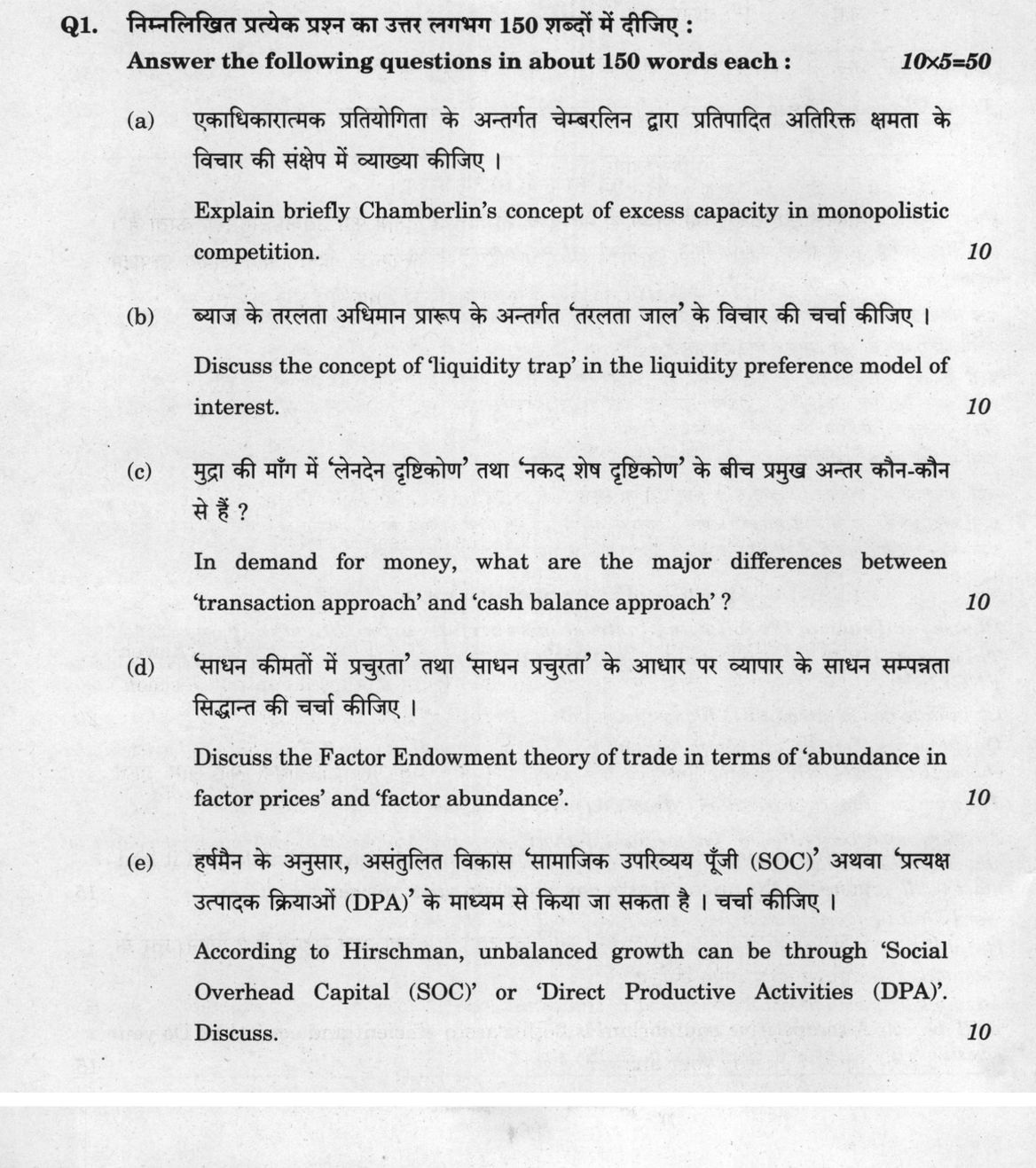
Answer the following questions in about 150 words each: (a) Explain briefly Chamberlin's concept of excess capacity in…
Answer the following questions in about 150 words each:
Explain briefly Chamberlin's concept of excess capacity in monopolistic competition. 10 marks
Discuss the concept of 'liquidity trap' in the liquidity preference model of interest. 10 marks
In demand for money, what are the major differences between 'transaction approach' and 'cash balance approach'? 10 marks
Discuss the Factor Endowment theory of trade in terms of 'abundance in factor prices' and 'factor abundance'. 10 marks
According to Hirschman, unbalanced growth can be through 'Social Overhead Capital (SOC)' or 'Direct Productive Activities (DPA)'. Discuss. 10 marks
हिंदी में प्रश्न पढ़ें
निम्नलिखित प्रत्येक प्रश्न का उत्तर लगभग 150 शब्दों में दीजिए :
एकाधिकारात्मक प्रतियोगिता के अंतर्गत चैम्बरलिन द्वारा प्रतिपादित अतिरिक्त क्षमता के विचार की संक्षेप में व्याख्या कीजिए । 10
ब्याज के तरलता अधिमान प्रारूप के अंतर्गत 'तरलता जाल' के विचार की चर्चा कीजिए । 10
मुद्रा की मांग में 'लेनदेन दृष्टिकोण' तथा 'नकद शेष दृष्टिकोण' के बीच प्रमुख अंतर कौन-कौन से हैं ? 10 marks
'साधन कीमतों में प्रचुरता' तथा 'साधन प्रचुरता' के आधार पर व्यापार के साधन सम्प्रदा सिद्धांत की चर्चा कीजिए । 10
हर्शमैन के अनुसार, असंतुलित विकास 'सामाजिक उपरिव्यय पूंजी (SOC)' अथवा 'प्रत्यक्ष उत्पादक क्रियाओं (DPA)' के माध्यम से किया जा सकता है । चर्चा कीजिए । 10
Model answer
Written by UPSC Answer Check against this question's marking rubric, to the 150-word length. UPSC does not publish answers for Mains — this is one way to score well, not an official key.
(a) Chamberlin's Concept of Excess Capacity
Edward Chamberlin’s theory of monopolistic competition demonstrates that free entry of firms producing differentiated products leads to long-run equilibrium at the tangency between the downward-sloping demand curve (AR) and the Long-Run Average Cost curve (LAC). Because the demand curve is downward-sloping due to product differentiation and brand loyalty, this tangency inevitably occurs on the falling segment of the LAC, to the left of its minimum point.
The firm therefore produces an output level (Qₘ) that falls short of the socially optimal Minimum Efficient Scale (Q_c) where LAC is minimised. The difference (Q_c - Qₘ) represents excess capacity—unexploited economies of scale and underutilised plant size.
`` Price/Cost ^ | LAC | Pm (Tangency) | / | / (MES: Qc, Pc) | / \ | AR \ +-------------------> Output Qm Qc ``
This structural underutilisation arises not from entry barriers, but because consumers value variety. The resulting higher price (Pₘ > P_c) and idle capacity reflect the economic cost of providing product differentiation. In emerging markets like India, this manifests in the proliferation of underutilised retail and consumer-tech service outlets, trading productive efficiency for consumer choice.
(b) Liquidity Trap in the Liquidity Preference Model
In Keynes's liquidity preference framework, the rate of interest is determined by the intersection of the money supply and the demand for money, which comprises transaction, precautionary, and speculative motives. The speculative demand for money is inversely related to the interest rate because lower interest rates increase bond prices and raise the risk of capital losses.
A liquidity trap occurs when the nominal interest rate falls to a critically low threshold where the public expects it can only rise, driving bond prices down. Consequently, the expected return on bonds turns negative relative to holding cash. The speculative demand for money becomes infinitely interest-elastic, making the liquidity preference schedule and the corresponding LM curve perfectly horizontal.
`` Interest Rate (r) ^ | \ | Liquidity Preference (Md) | \ | r* +================== (Horizontal Trap) +-------------------------> Money Balances (M) ``
Any open-market purchase or expansion of the monetary base is absorbed entirely as idle cash balances rather than being invested in bonds. As a result, monetary policy completely loses its traction to lower yields, raise investment, or stimulate aggregate demand. Under these conditions, direct fiscal expansion (as seen in post-crisis public capex pushes) is the only effective macroeconomic tool to revive growth.
(c) Transaction Approach vs. Cash Balance Approach to Demand for Money
Irving Fisher’s Transaction Approach (MV = PT) and the Cambridge Cash Balance Approach (M = kPY) analyze the demand for money from contrasting analytical standpoints.
Fisher views money strictly as a flow concept and a mechanical medium of exchange. The demand for money is derived entirely from the volume of transactions (T) occurring over a time period, with transactions velocity (V) assumed fixed in the short run due to structural and institutional payment practices.
In contrast, the Cambridge economists (Marshall, Pigou) conceptualize money as a stock of liquid assets demanded at a single point in time. Money serves not only as a medium of exchange but also as a store of value. The parameter k (= 1/V) is a behavioural, utility-maximizing choice of the proportion of nominal national income (PY) that individuals choose to hold as purchasing power.
Cambridge’s approach incorporates subjective human choice, opportunity costs, wealth, and interest rates into k. By shifting the focus from structural velocity to the psychology of asset holding, the Cambridge school laid the microeconomic foundations for Keynes’s speculative demand for money and modern portfolio theory.
(d) Factor Endowment Theory: Price Abundance vs. Factor Abundance
The Heckscher-Ohlin (H-O) theory explains comparative advantage based on national differences in factor endowments, using two distinct definitions: the physical criterion and the price criterion.
The physical criterion defines factor abundance in purely physical terms: Country A is capital-abundant relative to Country B if: (K/L)_A > (K/L)_B This criterion depends strictly on factor supplies, ignoring the structure of domestic demand. If domestic consumers strongly prefer capital-intensive goods, high domestic demand can drive the pre-trade price of capital higher in Country A, contradicting the expected cost advantage.
The price criterion defines abundance through pre-trade relative factor prices: Country A is capital-abundant if: (P_K / P_L)_A < (P_K / P_L)_B This definition integrates both supply and demand, ensuring that the relatively abundant factor is unambiguously cheaper.
`` Autarky: (Pk/Pl)_A < (Pk/Pl)_B --> Trade: Country A exports Capital-intensive goods --> Trade: Country B exports Labour-intensive goods --> Outcome: Factor Price Equalization (w/r converge) ``
Trade expands the output of the good intensive in the cheaper factor, raising derived demand for that factor and leading to Factor Price Equalization (FPE). For labour-abundant economies like India, this framework provides the analytical justification for promoting labour-intensive manufacturing to absorb surplus farm labour and raise real wages.
(e) Hirschman's Unbalanced Growth: SOC vs. DPA
Albert Hirschman argued that developing economies face an acute shortage of decision-making ability and capital, making balanced growth unviable. He proposed deliberate, strategic unbalancing between Social Overhead Capital (SOC)—basic infrastructure such as power, transport, and education—and Direct Productive Activities (DPA)—direct industrial and agricultural production.
``` Development via Excess SOC: SOC Investment ---> Lowers DPA Costs ---> Induces Private DPA Investment
Development via SOC Shortage: DPA Expansion ---> Infrastructure Bottlenecks ---> Compels Public SOC Investment ```
Development via Excess Capacity of SOC involves public investment in large, lumpy infrastructure projects. This creates external economies, reduces input costs, and induces private entrepreneurs to invest in DPA.
Development via Shortage of SOC involves expanding DPA first. The resulting structural bottlenecks, power shortages, and transport delays generate political and economic pressures that compel the state to build the required SOC.
Hirschman preferred the path that maximizes induced decision-making through backward linkages (derived demand for intermediate inputs) and forward linkages (supplying inputs to downstream industries). In India, initiatives like the PM Gati Shakti and the National Infrastructure Pipeline (NIP) represent deliberate SOC-led unbalancing, aimed at reducing logistics costs and crowding in private corporate DPA investment.
What "Explain" is asking you to do
Make the working of something clear — what sets it off, what follows from what, and what it produces. Explain is the Commission's mechanism word: it dominates the technical papers and the “explain why” stems, where the marks sit in the causal chain and not in the label.
Structure that answers it
State what it is → the initiating condition → the chain of cause, step by step → an instance where it plays out → what the chain produces
Where marks are lost
Describing what something looks like instead of why it works that way. Naming the stages without linking them reads as description too.
How this answer will be evaluated
Approach
Framework: Chamberlin's Monopolistic Competition. (a) explain: definition/context > points in order > small example > short close | (b) discuss: intro > 3-4 dimensions > example > balanced close | (c) compare: paired headings or table > key differences > significance > conclusion | (d) discuss: intro > 3-4 dimensions > example > balanced close | (e) discuss: intro > 3-4 dimensions > example > balanced close Full marks: Clear model/diagram, precise definitions, correct derivation, policy implication, named economist
Key points expected
- Define excess capacity as difference between full capacity and equilibrium output
- Explain tangency of demand curve to average cost curve
- State that equilibrium output is less than minimum average cost output
- Mention product differentiation as the cause
- Define liquidity trap as horizontal LM curve at low interest rates
- Explain that money demand becomes infinitely elastic
- State that monetary policy becomes ineffective
- Mention Keynes' original context of high unemployment
Evaluation rubric
Each sub-part is marked on its own, against the marks and word limit printed on the paper.
- (a) Definition of excess capacity and its derivation from Chamberlin's model. 10 marks · 150 words
explain— definition/context → points in order → small example → short close
Must cover
- Define excess capacity as difference between full capacity and equilibrium output
- Explain tangency of demand curve to average cost curve
- State that equilibrium output is less than minimum average cost output
- Mention product differentiation as the cause
Loses marks
- Confusing excess capacity with deadweight loss
- Failing to link to product differentiation
- Verbal description without model logic
Earns more
- Reference to Chamberlin's 'Product Differentiation and Monopolistic Competition'
- Mention of 'kink' in the demand curve
- Comparison with perfect competition output
Extra mark
- Labeled diagram showing tangency and capacity gap
- Reference to 'kinked demand curve' hypothesis
- (b) Concept of liquidity trap and its implications for monetary policy. 10 marks · 150 words
discuss— intro → 3-4 dimensions → example → balanced close
Must cover
- Define liquidity trap as horizontal LM curve at low interest rates
- Explain that money demand becomes infinitely elastic
- State that monetary policy becomes ineffective
- Mention Keynes' original context of high unemployment
Loses marks
- Confusing with liquidity preference in general
- Failing to state policy implication
- Verbal answer without model reference
Earns more
- Reference to Keynes' 'General Theory'
- Mention of 'speculative motive' for holding money
- Link to fiscal policy effectiveness
Extra mark
- Labeled diagram showing horizontal LM curve
- Reference to modern examples (e.g., Japan, post-2008)
- (c) Major differences between transaction and cash balance approaches to money demand. 10 marks · 150 words
compare— paired headings or table → key differences → significance → conclusion
Must cover
- Define transaction approach (Fisher's equation of exchange)
- Define cash balance approach (Cambridge equation)
- Contrast focus on velocity vs. money holding
- Contrast focus on flow vs. stock of money
Loses marks
- Confusing the two approaches
- Failing to state the key equations
- Verbal comparison without structural contrast
Earns more
- Mention of Fisher's 'MV=PT'
- Mention of Cambridge's 'M=kPY'
- Reference to 'real balance' in Cambridge approach
Extra mark
- Table comparing the two approaches
- Reference to 'transaction demand' vs. 'asset demand'
- (d) Factor Endowment theory in terms of factor prices and factor abundance. 10 marks · 150 words
discuss— intro → 3-4 dimensions → example → balanced close
Must cover
- Define factor endowment theory (Heckscher-Ohlin)
- Explain 'factor abundance' as relative supply of factors
- Explain 'factor prices' as relative cost of factors
- State that countries export goods using their abundant factor
Loses marks
- Confusing factor abundance with factor price
- Failing to state the core theorem
- Verbal answer without model logic
Earns more
- Reference to Heckscher-Ohlin theorem
- Mention of 'factor price equalization'
- Example of labor-abundant vs. capital-abundant countries
Extra mark
- Labeled diagram showing factor intensity
- Reference to 'Leontief paradox'
- (e) Hirschman's unbalanced growth through SOC and DPA. 10 marks · 150 words
discuss— intro → 3-4 dimensions → example → balanced close
Must cover
- Define unbalanced growth strategy
- Explain 'Social Overhead Capital' (SOC) as infrastructure
- Explain 'Direct Productive Activities' (DPA) as industrial investment
- State that unbalanced growth creates linkages and spillovers
Loses marks
- Confusing SOC with DPA
- Failing to explain the linkage mechanism
- Verbal answer without model reference
Earns more
- Reference to Hirschman's 'The Strategy of Economic Development'
- Mention of 'backward and forward linkages'
- Example of infrastructure-led industrialization
Extra mark
- Reference to 'ratchet effect' in Hirschman's model
- Comparison with balanced growth strategy
Practice this exact question
Write your answer and it is marked point by point against the model answer above — what you covered, what you missed, what you got wrong.
Evaluate my answer →More from Economics 2022 Paper I
- Q1 Answer the following questions in about 150 words each: (a) Explain briefly Chamberlin's…
- Q2 (a) Consider a duopoly market, P = 100 – 2Q, MC = 10 and Q = q₁ + q₂ where P : Market pri…
- Q3 (a) IS curve is the locus of equilibrium points in the commodity market. What do the poin…
- Q4 (a) State the canons of taxation. Do you think that direct taxes are less burdensome than…