Paper I — Q2
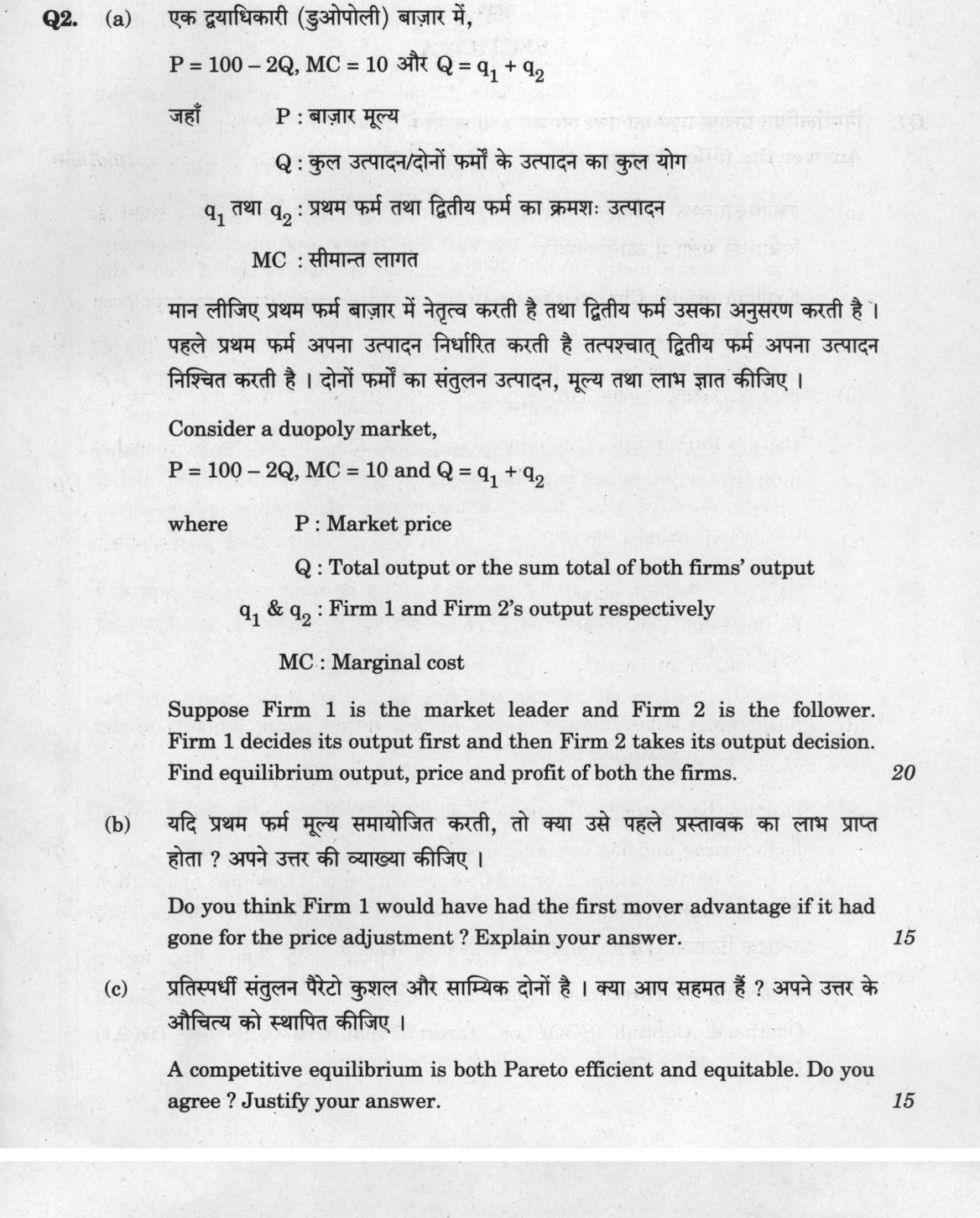
(a) Consider a duopoly market, P = 100 – 2Q, MC = 10 and Q = q₁ + q₂ where P : Market price Q : Total output or the sum total…
Consider a duopoly market,
P = 100 – 2Q, MC = 10 and Q = q₁ + q₂
where P : Market price
Q : Total output or the sum total of both firms' output
q₁ & q₂ : Firm 1 and Firm 2's output respectively
MC : Marginal cost
Suppose Firm 1 is the market leader and Firm 2 is the follower. Firm 1 decides its output first and then Firm 2 takes its output decision. Find equilibrium output, price and profit of both the firms. 20 marks
Do you think Firm 1 would have had the first mover advantage if it had gone for the price adjustment? Explain your answer. 15 marks
A competitive equilibrium is both Pareto efficient and equitable. Do you agree? Justify your answer. 15 marks
हिंदी में प्रश्न पढ़ें
एक द्व्याधिकारी (डुओपोली) बाजार में,
P = 100 – 2Q, MC = 10 और Q = q₁ + q₂
जहाँ P : बाजार मूल्य
Q : कुल उत्पादन/दोनों फर्मों के उत्पादन का कुल योग
q₁ तथा q₂ : प्रथम फर्म तथा द्वितीय फर्म का क्रमशः उत्पादन
MC : सीमांत लागत
मान लीजिए प्रथम फर्म बाजार में नेतृत्व करती है तथा द्वितीय फर्म उसका अनुसरण करती है । पहले प्रथम फर्म अपना उत्पादन निर्धारित करती है तत्पश्चात् द्वितीय फर्म अपना उत्पादन निश्चित करती है । दोनों फर्मों का संतुलन उत्पादन, मूल्य तथा लाभ ज्ञात कीजिए । 20
यदि प्रथम फर्म मूल्य समायोजित करती, तो क्या उसे पहले प्रस्तावक का लाभ प्राप्त होता ? अपने उत्तर की व्याख्या कीजिए । 15
प्रतिस्पर्धी संतुलन पैरेटो कुशल और साम्यिक दोनों है । क्या आप सहमत हैं ? अपने उत्तर के औचित्य को स्थापित कीजिए । 15
Model answer
Written by UPSC Answer Check against this question's marking rubric, to the expected length. UPSC does not publish answers for Mains — this is one way to score well, not an official key.
(a) Use the Stackelberg duopoly model, solved by backward induction. Since MC = 10, total cost of firm i is 10qᵢ, so profit is πᵢ = (P − 10)qᵢ. Let q₁ and q₂ be in units of output; prices and profits are in monetary units.
Firm 2 is the follower. Given q₁, π₂ = (100 − 2q₁ − 2q₂ − 10)q₂ = (90 − 2q₁ − 2q₂)q₂. FOC: ∂π₂/∂q₂ = 90 − 2q₁ − 4q₂ = 0. SOC: ∂²π₂/∂q₂² = −4 < 0, so this is a maximum. Thus the reaction function is q₂ = (90 − 2q₁)/4 = (45 − q₁)/2.
Firm 1 is the leader and anticipates this. Therefore Q = q₁ + q₂ = q₁ + (45 − q₁)/2 = (q₁ + 45)/2. Then π₁ = (90 − 2Q)q₁ = [90 − (q₁ + 45)]q₁ = (45 − q₁)q₁. FOC: dπ₁/dq₁ = 45 − 2q₁ = 0, so q₁ = 45/2 = 22.5. SOC: d²π₁/dq₁² = −2 < 0, so maximum.
Then q₂ = (45 − 45/2)/2 = 45/4 = 11.25. Total output: Q = 45/2 + 45/4 = 135/4 = 33.75. Price: P = 100 − 2(135/4) = 100 − 135/2 = 65/2 = 32.5.
Profits: π₁ = (P − MC)q₁ = (65/2 − 10)(45/2) = (45/2)(45/2) = 2025/4 = 506.25. π₂ = (P − MC)q₂ = (65/2 − 10)(45/4) = (45/2)(45/4) = 2025/8 = 253.125.
Validity requires q₂ ≥ 0, i.e. q₁ ≤ 45, which is satisfied. Firm 1 earns more than Firm 2, so it has a first-mover advantage in quantity.
Final equilibrium: q₁ = 45/2, q₂ = 45/4, Q = 135/4, P = 65/2, π₁ = 2025/4, π₂ = 2025/8.
(b) If Firm 1 instead moved first in price, in a homogeneous-product Bertrand duopoly with identical MC = 10, it would not enjoy a first-mover advantage. Suppose Firm 1 sets price P₁ first. Firm 2 observes P₁ and chooses P₂.
If P₁ > 10, Firm 2 can set P₂ slightly below P₁, capture the whole market, and earn positive profit. Hence P₁ > 10 cannot be sustained by Firm 1. If P₁ = 10, Firm 2 can set P₂ = 10; both earn zero profit. If P₁ < 10, Firm 1 makes losses. Therefore the only viable outcome is P = MC = 10. Then from demand, 10 = 100 − 2Q, so Q = 45. Industry profit is zero. The follower’s ability to undercut destroys the leader’s advantage; in fact, price leadership may be a disadvantage because the follower can free-ride on the leader’s price and undercut it.
Thus, in the given homogeneous model, Firm 1 would not have had the first-mover advantage if it had chosen price first. If products were differentiated or capacity constraints existed, a price leader might gain an advantage, but not here.
(c) I agree only partially. Under standard assumptions, a competitive equilibrium is Pareto efficient. This is the First Fundamental Theorem of Welfare Economics: if markets are complete and competitive, there are no externalities or public goods, information is perfect, and preferences satisfy local nonsatiation, then no feasible reallocation can make someone better off without making another worse off. The equilibrium exhausts all mutually beneficial trades.
However, a competitive equilibrium is not necessarily equitable. Efficiency concerns the size and allocation of the total surplus; equity concerns its distribution. The competitive equilibrium depends on initial endowments of resources and factor ownership. If one agent owns almost all resources and another owns very little, the equilibrium can still be Pareto efficient but highly unequal. Many Pareto-efficient allocations lie on the contract curve; competitive equilibrium selects one determined by initial endowments and prices.
If initial endowments are equal, then at equilibrium all agents have equal incomes, so each can afford the other’s bundle; hence the equilibrium may be envy-free. But equal endowments are a special condition, not a general property. The Second Welfare Theorem says any chosen Pareto-efficient allocation can be supported as a competitive equilibrium by suitable lump-sum redistribution of endowments. Yet such transfers may be administratively difficult and may distort incentives if not truly lump-sum.
Therefore, in general, competitive equilibrium is Pareto efficient under ideal conditions, but it is not automatically equitable. Equity requires separate normative choices and redistribution.
What "Solve" is asking you to do
Choose the method, then carry it through to a final answer. Identifying what kind of problem this is and why that method applies is the first thing marked; a correct figure arrived at invisibly earns almost nothing.
Structure that answers it
Given data and what is required → method chosen, with the reason it applies → set-up (equation, circuit, free body, trial balance) → working, step by step → answer with units and any condition of validity
Where marks are lost
Doing the middle steps mentally and writing only the result. In mathematics papers, a further loss comes from giving a decimal where the exact value in surds or fractions was wanted, or from skipping the justification a part explicitly asks for.
How this answer will be evaluated
Approach
Framework: Stackelberg Duopoly Model. (a) calculate: given > formula > substitution > result with units > interpretation | (b) explain: definition/context > points in order > small example > short close | (c) justify: claim > 3-4 reasons > evidence > conclusion Full marks: Full derivation with all steps, clear model comparison, rigorous theoretical justification
Key points expected
- Derive Firm 2's reaction function from profit maximization
- Substitute reaction function into Firm 1's profit function
- Solve for Firm 1's optimal output (q1)
- Calculate q2, total Q, price P, and profits for both
- Define price leadership vs output leadership
- Explain how follower reacts to price signal
- Compare profit outcomes of both strategies
- State conditions under which advantage holds
Evaluation rubric
Each sub-part is marked on its own, against the marks and word limit printed on the paper.
- (a) Derive Stackelberg equilibrium outputs, price, and profits for both firms. 20 marks
calculate— given → formula → substitution → result with units → interpretation
Must cover
- Derive Firm 2's reaction function from profit maximization
- Substitute reaction function into Firm 1's profit function
- Solve for Firm 1's optimal output (q1)
- Calculate q2, total Q, price P, and profits for both
Loses marks
- Asserting equilibrium values without derivation
- Confusing leader and follower roles
- Failing to substitute reaction function correctly
Earns more
- Explicitly state Firm 1's profit function
- Show first-order condition for Firm 2
- Verify second-order condition for maximum
- State assumption of simultaneous cost structure
Extra mark
- Draw reaction curve diagram with axes labeled
- Compare results to Cournot equilibrium
- (b) Explain whether price leadership preserves first-mover advantage. 15 marks
explain— definition/context → points in order → small example → short close
Must cover
- Define price leadership vs output leadership
- Explain how follower reacts to price signal
- Compare profit outcomes of both strategies
- State conditions under which advantage holds
Loses marks
- Verbal answer without model comparison
- Confusing price and output leadership
- Failing to address follower's response
Earns more
- Reference Stackelberg vs Bertrand models
- Discuss information asymmetry implications
- Mention real-world examples of price leadership
- Note strategic commitment aspects
Extra mark
- Cite specific economist on price leadership
- Reference recent market example
- (c) Justify whether competitive equilibrium is Pareto efficient and equitable. 15 marks
justify— claim → 3-4 reasons → evidence → conclusion
Must cover
- Define Pareto efficiency and equity
- Prove or disprove Pareto efficiency claim
- Argue for or against equity claim
- State assumptions underlying the argument
Loses marks
- Conflating efficiency with equity
- Failing to state assumptions
- Verbal answer without theoretical grounding
Earns more
- Reference First Fundamental Theorem of Welfare
- Discuss distributional neutrality of efficiency
- Mention Arrow's impossibility theorem
- Note role of initial endowments
Extra mark
- Cite specific economist on equity-efficiency tradeoff
- Reference recent policy debate
Practice this exact question
Write your answer and it is marked point by point against the model answer above — what you covered, what you missed, what you got wrong.
Evaluate my answer →More from Economics 2022 Paper I
- Q1 Answer the following questions in about 150 words each: (a) Explain briefly Chamberlin's…
- Q2 (a) Consider a duopoly market, P = 100 – 2Q, MC = 10 and Q = q₁ + q₂ where P : Market pri…
- Q3 (a) IS curve is the locus of equilibrium points in the commodity market. What do the poin…
- Q4 (a) State the canons of taxation. Do you think that direct taxes are less burdensome than…
- Q5 Answer the following questions in about 150 words each: (a) Stating major assumptions in…