Paper I — Q6
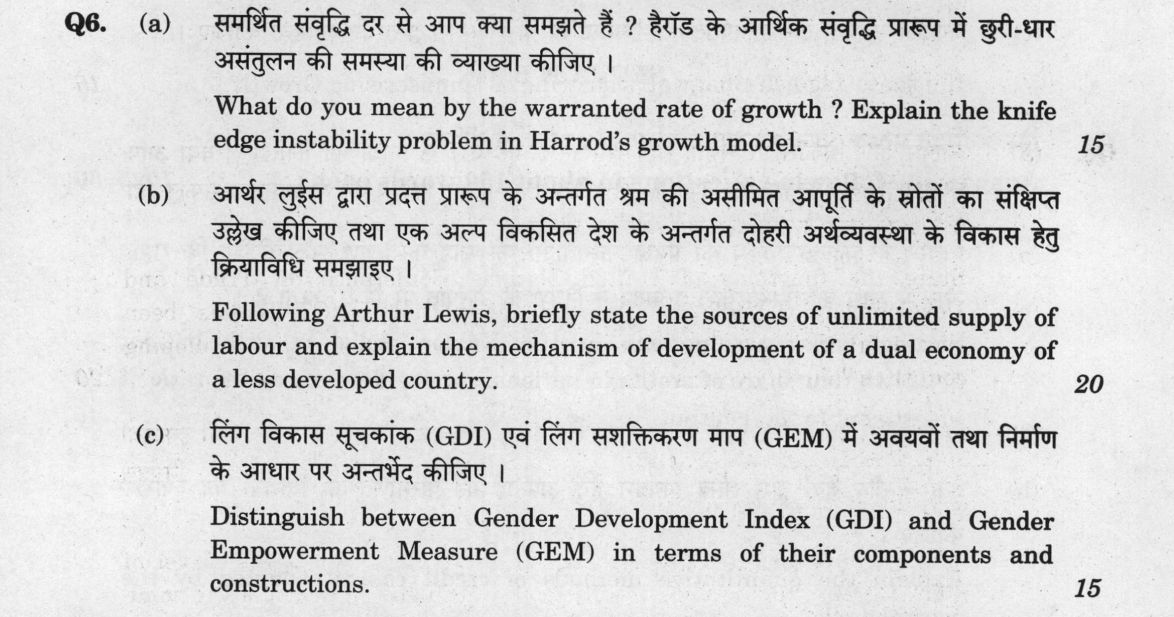
(a) What do you mean by the warranted rate of growth ? Explain the knife edge instability problem in Harrod's growth model. (15…
What do you mean by the warranted rate of growth ? Explain the knife edge instability problem in Harrod's growth model. 15 marks
Following Arthur Lewis, briefly state the sources of unlimited supply of labour and explain the mechanism of development of a dual economy of a less developed country. 20 marks
Distinguish between Gender Development Index (GDI) and Gender Empowerment Measure (GEM) in terms of their components and constructions. 15 marks
हिंदी में प्रश्न पढ़ें
समर्थित संवृद्धि दर से आप क्या समझते हैं ? हैरोड के आर्थिक संवृद्धि प्रारूप में छुरी-धार असंतुलन की समस्या की व्याख्या कीजिए । (15 अंक)
आर्थर लुईस द्वारा प्रदत्त प्रारूप के अन्तर्गत श्रम की असीमित आपूर्ति के स्रोतों का संक्षिप्त उल्लेख कीजिए तथा एक अल्प विकसित देश के अन्तर्गत दोहरी अर्थव्यवस्था के विकास हेतु क्रियाविधि समझाइए । (20 अंक)
लिंग विकास सूचकांक (GDI) एवं लिंग सशक्तिकरण माप (GEM) में अवयवों तथा निर्माण के आधार पर अन्तर्भेद कीजिए । (15 अंक)
Model answer
Written by UPSC Answer Check against this question's marking rubric, to the expected length. UPSC does not publish answers for Mains — this is one way to score well, not an official key.
Harrod’s warranted rate and knife-edge instability. In Harrod’s model, the warranted rate, Gw, is the growth rate at which planned investment exactly matches the capital stock implied by the desired capital-output ratio: Gw = s/Cr, where s is the saving-investment ratio and Cr the desired capital-output ratio. Actual G is realised growth, while natural Gn is the maximum growth allowed by labour-force growth and technology. The knife-edge problem is causal: if G > Gw, the capital-output ratio falls below Cr, firms perceive excess demand for capital, raise investment, and G rises further; if G < Gw, the ratio is above Cr, firms cut investment, and G falls further. Deviations are cumulative, not self-correcting. A diagram would show Gw and Gn as horizontal lines; within the corridor between them, paths above Gw have upward arrows and paths below have downward arrows, so only G = Gw is stable. Since Gw and Gn usually differ, full employment also needs G = Gn, making stability a knife-edge coincidence.
Lewis’s dual economy and unlimited labour supply. Lewis explains development in a less developed country as a shift from a subsistence sector to a capitalist sector. Unlimited labour supply comes from the subsistence sector, where marginal productivity of labour is zero or below the subsistence wage, so workers can be withdrawn without reducing output. Population growth, seasonal underemployment, and institutional factors such as landlessness and weak rural mobility reinforce the surplus. The capitalist sector pays an institutional wage, typically about 30 per cent above subsistence, not the marginal product, to attract labour. In the labour-supply diagram, the curve is horizontal at this wage and kinks upward at the turning point, when surplus labour is exhausted and marginal productivity rises. The mechanism is cumulative: the capitalist sector hires surplus labour at a constant wage, earns profits, reinvests them, expands capital and output, and creates further labour demand. As labour moves out, the industrial sector’s growing share changes terms of trade and raises national income. At the turning point, wages must rise with marginal productivity, the horizontal supply curve ends, and the dual economy becomes modern. India’s rural-urban migration illustrates this transition.
GDI and GEM: components and construction. The Gender Development Index measures the gender gap in HDI-based human development. Its components are life expectancy, education, and income; the income component compares female and male estimated earned income in PPP US$, not shares of income. For each dimension, the female-to-male achievement ratio is calculated; if female achievement exceeds male, the ratio is capped at 1.05, imposing a 5 per cent penalty. The GDI averages the three ratios, recording welfare outcomes. The Gender Empowerment Measure measures inequality in power and agency. Its components are political participation (share of parliamentary seats), economic participation (share of professional and technical positions), and power over economic resources, using female and male estimated earned income in PPP US$ to compute the relevant share. Its construction is different: for each dimension, female and male shares are converted into an equally distributed equivalent percentage, calculated as 100 times one minus the Gini coefficient of the two-group distribution; the three equally distributed equivalent percentages are then averaged to obtain GEM. Thus GDI measures gaps in development achievements, while GEM measures gaps in control over political and economic resources.
Conclusion. Harrod and Lewis show that growth requires structural balance: Harrod’s knife-edge shows instability without coordinated investment, labour and technology; Lewis shows surplus labour and reinvestment transform a dual economy until the turning point. Gender indices extend this to distribution: GDI records welfare gaps, GEM records empowerment gaps, so inclusive growth requires raising women’s achievements and agency.
What "Explain" is asking you to do
Make the working of something clear — what sets it off, what follows from what, and what it produces. Explain is the Commission's mechanism word: it dominates the technical papers and the “explain why” stems, where the marks sit in the causal chain and not in the label.
Structure that answers it
State what it is → the initiating condition → the chain of cause, step by step → an instance where it plays out → what the chain produces
Where marks are lost
Describing what something looks like instead of why it works that way. Naming the stages without linking them reads as description too.
How this answer will be evaluated
Approach
Framework: Harrod-Domar Growth Model. (a) explain: definition/context > points in order > small example > short close | (b) explain: definition/context > points in order > small example > short close | (c) compare: paired headings or table > key differences > significance > conclusion Full marks: Complete model with derivation, all components named, clear distinctions
Key points expected
- Define warranted rate of growth (Gw)
- State Harrod's model assumptions
- Explain knife-edge instability mechanism
- Derive or state Gw = s/v
- Define dual economy structure
- State sources of unlimited labour supply
- Explain labour transfer mechanism
- Describe development process
Evaluation rubric
Each sub-part is marked on its own, against the marks and word limit printed on the paper.
- (a) Define warranted rate and explain knife-edge instability in Harrod's model. 15 marks
explain— definition/context → points in order → small example → short close
Must cover
- Define warranted rate of growth (Gw)
- State Harrod's model assumptions
- Explain knife-edge instability mechanism
- Derive or state Gw = s/v
Loses marks
- Verbal answer without model
- Unstated assumptions
- Confusing warranted with natural rate
Earns more
- Mention actual vs warranted growth
- Reference to Harrod's 1939 paper
- Diagram of instability
- Mention Domar's contribution
Extra mark
- Reference to Kaldor's critique
- Mention of Harrod's 1948 paper
- (b) State sources of unlimited labour supply and explain dual economy development mechanism. 20 marks
explain— definition/context → points in order → small example → short close
Must cover
- Define dual economy structure
- State sources of unlimited labour supply
- Explain labour transfer mechanism
- Describe development process
Loses marks
- Verbal answer without mechanism
- Unstated assumptions
- Confusing unlimited with unemployed
Earns more
- Reference to Lewis 1954 paper
- Mention subsistence wage
- Explain surplus labour concept
- Describe industrial sector growth
Extra mark
- Reference to Ranis-Feldstein extension
- Mention of Lewis turning point
- (c) Distinguish GDI and GEM in terms of components and constructions. 15 marks
compare— paired headings or table → key differences → significance → conclusion
Must cover
- Define GDI components
- Define GEM components
- Explain GDI construction method
- Explain GEM construction method
Loses marks
- Verbal answer without components
- Confusing GDI with GEM
- Unstated construction method
Earns more
- Mention GDI health/education dimensions
- Mention GEM political/economic dimensions
- Reference to UNDP
- Explain ratio-based construction
Extra mark
- Mention GDI replacement by GII
- Reference to specific UNDP report
Practice this exact question
Write your answer and it is marked point by point against the model answer above — what you covered, what you missed, what you got wrong.
Evaluate my answer →More from Economics 2022 Paper I
- Q3 (a) IS curve is the locus of equilibrium points in the commodity market. What do the poin…
- Q4 (a) State the canons of taxation. Do you think that direct taxes are less burdensome than…
- Q5 Answer the following questions in about 150 words each: (a) Stating major assumptions in…
- Q6 (a) What do you mean by the warranted rate of growth ? Explain the knife edge instability…
- Q7 (a) Examine whether in Ricardian model, the theory of comparative advantage actually beco…
- Q8 (a) State the functions of United Nations Conference on Trade and Development (UNCTAD). D…