Paper I — Q8
(a) State the functions of United Nations Conference on Trade and Development (UNCTAD). Do you think that UNCTAD has been…
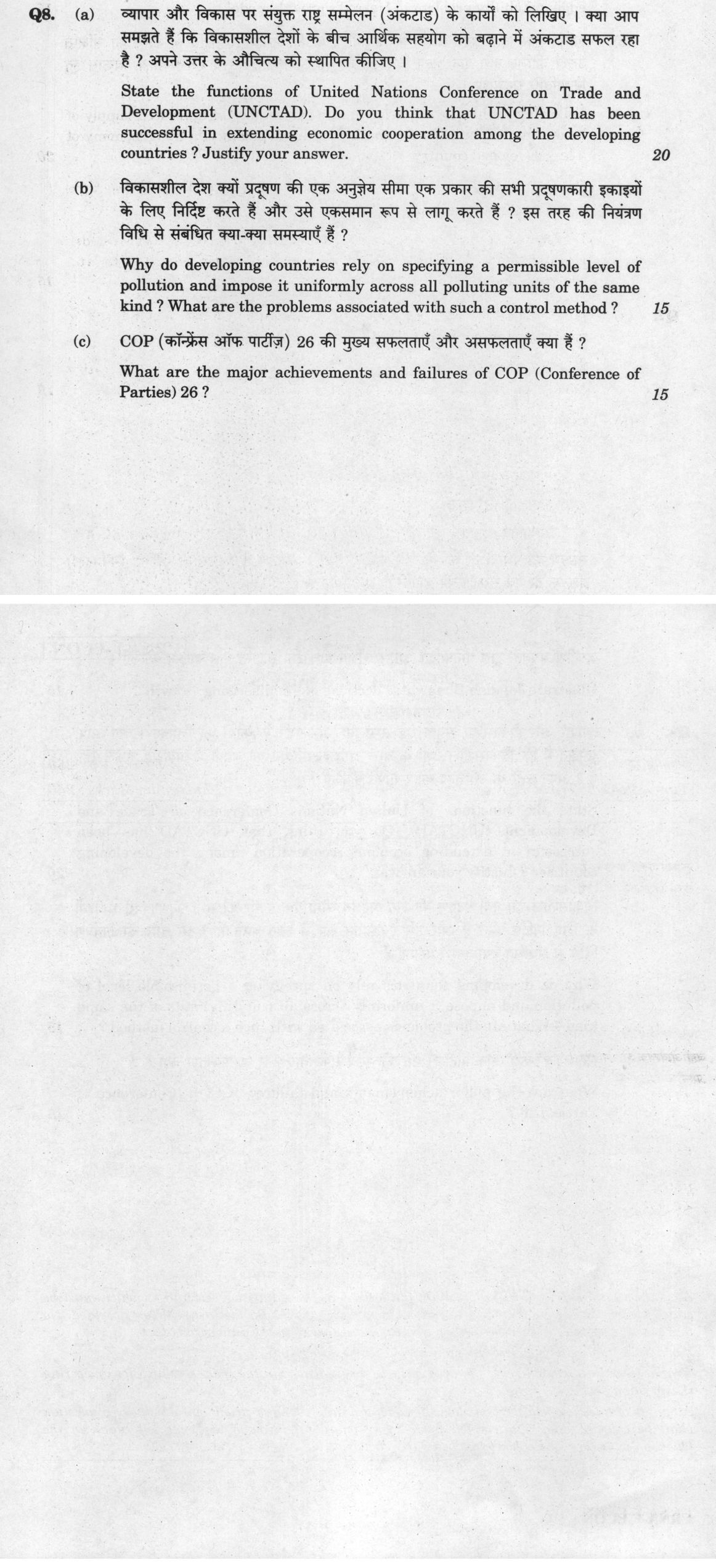
State the functions of United Nations Conference on Trade and Development (UNCTAD). Do you think that UNCTAD has been successful in extending economic cooperation among the developing countries ? Justify your answer. 20 marks
Why do developing countries rely on specifying a permissible level of pollution and impose it uniformly across all polluting units of the same kind ? What are the problems associated with such a control method ? 15 marks
What are the major achievements and failures of COP (Conference of Parties) 26 ? 15 marks
हिंदी में प्रश्न पढ़ें
व्यापार और विकास पर संयुक्त राष्ट्र सम्मेलन (अंकटाड) के कार्यों को लिखिए । क्या आप समझते हैं कि विकासशील देशों के बीच आर्थिक सहयोग को बढ़ाने में अंकटाड सफल रहा है ? अपने उत्तर के औचित्य को स्थापित कीजिए । 20 marks
विकासशील देश क्यों प्रदूषण की एक अनुमेय सीमा एक प्रकार की सभी प्रदूषणकारी इकाइयों के लिए निर्दिष्ट करते हैं और उसे एकसमान रूप से लागू करते हैं ? इस तरह की नियंत्रण विधि से संबंधित क्या-क्या समस्याएँ हैं ? 15 marks
COP (कॉन्फ्रेंस ऑफ पार्टीज़) 26 की मुख्य सफलताएँ और असफलताएँ क्या हैं ? 15 marks
Model answer
Written by UPSC Answer Check against this question's marking rubric, to the expected length. UPSC does not publish answers for Mains — this is one way to score well, not an official key.
International economic and environmental governance is shaped by the tension between North–South equity and South–South cooperation. UNCTAD and the UNFCCC COPs show whether cooperation becomes binding outcomes.
(a) UNCTAD UNCTAD’s functions include promoting trade and development, providing technical cooperation, monitoring trade and investment, LDC support mechanisms, facilitating trade negotiations, assisting countries in using GSP schemes, debt management, and developing investment policy frameworks. It also supports the Integrated Framework for Trade-Related Technical Assistance and provides a forum for developing countries, especially through the Group of 77 and the Global System of Trade Preferences among Developing Countries (GSTP).
UNCTAD has had partial success in extending economic cooperation among developing countries. It gave the South a collective voice, helped coordinate G77 positions, and promoted South–South preferences through GSTP. Its technical assistance, LDC support and investment policy frameworks have improved policy capacity; its support for GSP utilization has helped developing countries access preference schemes; and the Integrated Framework has helped vulnerable countries build trade capacity. However, UNCTAD is not fully successful as an engine of deep South–South integration. It lacks binding dispute resolution, unlike the WTO, and remains marginalised in global trade architecture. GSP schemes are administered by developed countries, not UNCTAD; UNCTAD only provides technical support and analysis, so preferences remain conditional and politically variable. South–South trade and investment remain limited. Thus, UNCTAD has been more successful as a consultative and capacity-building platform than as an institution that transforms developing-country cooperation into enforceable economic integration.
(b) Uniform pollution standards Developing countries often specify a permissible level of pollution and impose it uniformly on similar units because administrative simplicity, limited regulatory capacity, information asymmetries and the political economy of standard-setting make uniform rules easier to adopt and enforce. A single standard avoids complex cost-benefit calculations and reduces discretion, which is useful where monitoring institutions are weak.
The problems are significant. Uniform standards ignore heterogeneity in abatement costs and therefore violate the equimarginal principle: the same emission limit may be cheap for a large modern plant but prohibitively costly for a small older unit. This creates inefficiency, may force exit of smaller firms, and can raise prices. Monitoring and verification remain difficult, especially where data systems are weak. Uniform standards are also static and may not capture technological progress, because they do not reward firms that can abate cheaply or innovate. In India, uniform emission norms can simplify regulation, but they may not achieve the same environmental outcome at minimum cost as differentiated or market-based instruments.
(c) COP26 COP26 achieved several outcomes. The Glasgow Climate Pact included explicit language on coal phase-down and phase-out of inefficient fossil-fuel subsidies. It completed the Paris Rulebook, including Article 6, and secured pledges on methane reduction, deforestation, and enhanced NDCs, with parties requested to revisit and strengthen 2030 targets by end-2022.
Its failures were equally important. The $100 billion climate finance commitment was not fulfilled. Loss and damage remained weak: the Santiago Network was established at COP25, while COP26 only launched the Glasgow Dialogue and did not create a dedicated funded facility. Article 6.4 carbon market rules contained loopholes that raised concerns about double counting and environmental integrity. Overall ambition remained inadequate for a 1.5°C pathway.
In conclusion, UNCTAD and COP26 show that international institutions can build cooperation and technical capacity, but without binding finance, dispute resolution and credible enforcement, their outcomes remain partial. Developing countries need stronger South–South coordination, efficient but differentiated environmental regulation, and climate governance that closes the North–South equity gap.
What "Evaluate" is asking you to do
Judge how well something has performed against the standard it set for itself — its stated aim, mandate or promise — and commit to a verdict. Name the yardstick before you judge; an unanchored judgement reads as opinion.
Structure that answers it
Name the yardstick — stated aim, mandate or benchmark → performance against it → shortfall against it → why the gap exists → verdict
Where marks are lost
Presenting both sides and then declining to decide, or delivering a verdict against a standard you never stated, which makes it look arbitrary.
How this answer will be evaluated
Approach
Framework: Standard UPSC Economics Paper 1 Rubric. (a) justify: claim > 3-4 reasons > evidence > conclusion | (b) explain: definition/context > points in order > small example > short close | (c) highlight: name the salient points > one line of substance each > close Full marks: Precise definitions, clear logical flow, specific examples, and balanced evaluation.
Key points expected
- Define UNCTAD's mandate (trade, investment, development).
- List 3-4 specific functions (e.g., GSP, commodity agreements).
- State a clear claim on its success/failure.
- Provide 3-4 specific reasons/evidence to justify the claim.
- Define 'permissible level of pollution' (standard).
- Explain the rationale for uniformity (e.g., administrative simplicity).
- Identify 2-3 specific problems (e.g., cost asymmetry, lack of incentives).
- Link problems to economic efficiency or equity.
Evaluation rubric
Each sub-part is marked on its own, against the marks and word limit printed on the paper.
- (a) List UNCTAD functions and evaluate its success in promoting South-South cooperation. 20 marks
justify— claim → 3-4 reasons → evidence → conclusion
Must cover
- Define UNCTAD's mandate (trade, investment, development).
- List 3-4 specific functions (e.g., GSP, commodity agreements).
- State a clear claim on its success/failure.
- Provide 3-4 specific reasons/evidence to justify the claim.
Loses marks
- Listing functions without a clear evaluative judgment.
- Vague assertions of success without specific evidence.
- Confusing UNCTAD with WTO or IMF functions.
Earns more
- Mention specific mechanisms like the GSP or LDC Fund.
- Reference the 'New International Economic Order' (NIEO).
- Cite specific examples of South-South cooperation initiatives.
Extra mark
- Mention the 'Doha Development Agenda' or specific recent UNCTAD reports.
- Reference the 'Bali Package' or specific trade facilitation agreements.
- (b) Explain the rationale for uniform pollution standards and identify associated problems. 15 marks
explain— definition/context → points in order → small example → short close
Must cover
- Define 'permissible level of pollution' (standard).
- Explain the rationale for uniformity (e.g., administrative simplicity).
- Identify 2-3 specific problems (e.g., cost asymmetry, lack of incentives).
- Link problems to economic efficiency or equity.
Loses marks
- Failing to distinguish between 'standard' and 'tax'.
- Listing problems without linking them to the 'uniform' aspect.
- Ignoring the 'developing country' context (e.g., lack of monitoring capacity).
Earns more
- Mention 'Command and Control' regulation.
- Reference the 'Polluter Pays Principle' or its absence.
- Discuss the 'abatement cost' curve differences.
Extra mark
- Mention 'Emissions Trading' or 'Cap and Trade' as an alternative.
- Reference specific environmental economists (e.g., Baumol, Oates).
- (c) List major achievements and failures of COP26. 15 marks
highlight— name the salient points → one line of substance each → close
Must cover
- Identify 2-3 major achievements (e.g., Glasgow Climate Pact).
- Identify 2-3 major failures (e.g., 'phase down' vs 'phase out').
- Briefly explain the significance of each point.
- Maintain a balanced view of both sides.
Loses marks
- Listing only achievements or only failures.
- Vague statements without specific policy references.
- Confusing COP26 with COP27 or COP28 outcomes.
Earns more
- Mention the 'Loss and Damage' fund agreement.
- Reference the '1.5 degree' target reaffirmation.
- Mention the 'Coal' and 'Subsidies' language changes.
Extra mark
- Mention specific country commitments (e.g., India's 2070 target).
- Reference the 'Glasgow Climate Pact' by name.
Practice this exact question
Write your answer and it is marked point by point against the model answer above — what you covered, what you missed, what you got wrong.
Evaluate my answer →More from Economics 2022 Paper I
- Q5 Answer the following questions in about 150 words each: (a) Stating major assumptions in…
- Q6 (a) What do you mean by the warranted rate of growth ? Explain the knife edge instability…
- Q7 (a) Examine whether in Ricardian model, the theory of comparative advantage actually beco…
- Q8 (a) State the functions of United Nations Conference on Trade and Development (UNCTAD). D…