Paper I — Q5
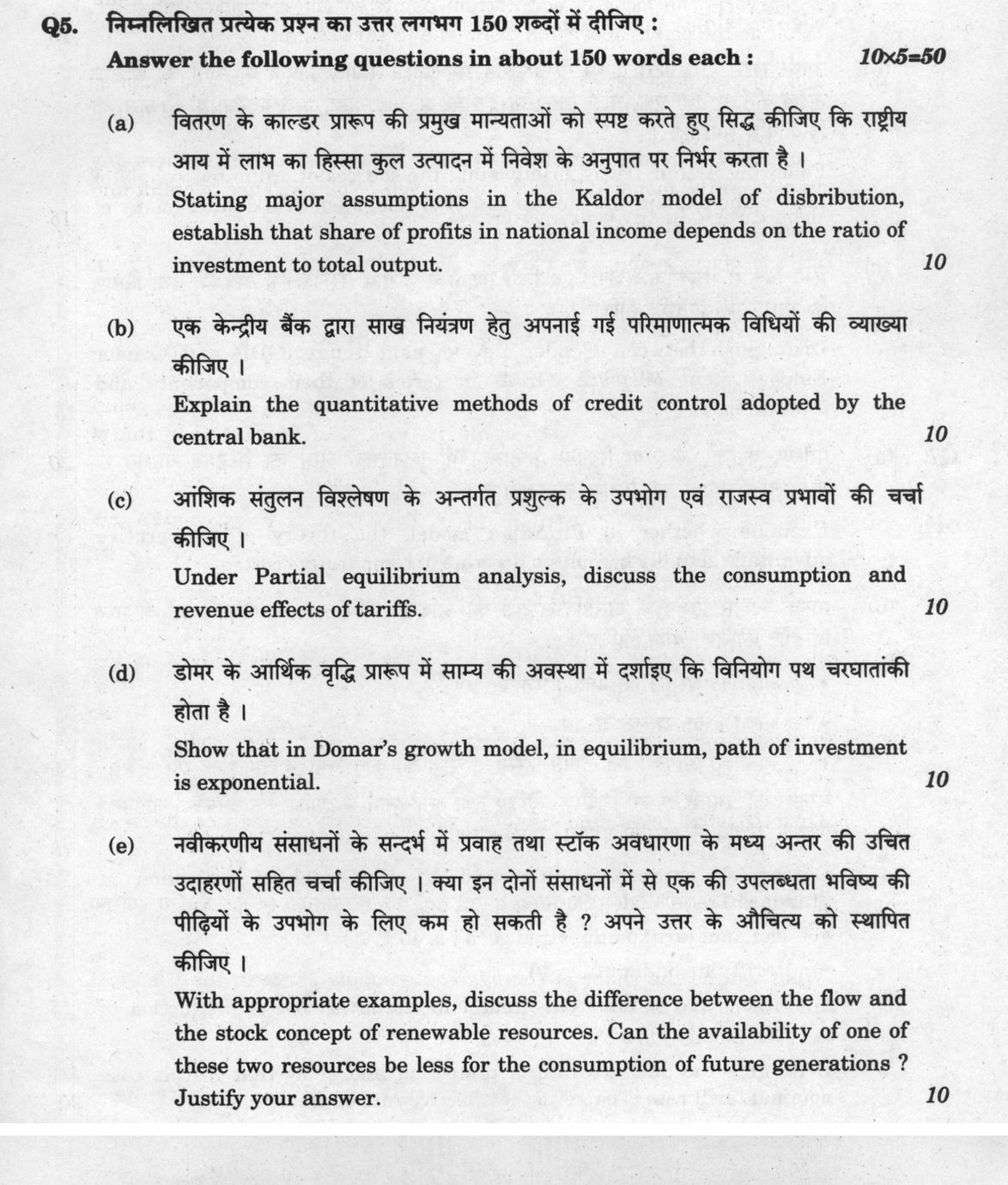
Answer the following questions in about 150 words each: (a) Stating major assumptions in the Kaldor model of distribution…
Answer the following questions in about 150 words each:
Stating major assumptions in the Kaldor model of distribution, establish that share of profits in national income depends on the ratio of investment to total output. 10 marks
Explain the quantitative methods of credit control adopted by the central bank. 10 marks
Under Partial equilibrium analysis, discuss the consumption and revenue effects of tariffs. 10 marks
Show that in Domar's growth model, in equilibrium, path of investment is exponential. 10 marks
With appropriate examples, discuss the difference between the flow and the stock concept of renewable resources. Can the availability of one of these two resources be less for the consumption of future generations ? Justify your answer. 10 marks
हिंदी में प्रश्न पढ़ें
निम्नलिखित प्रत्येक प्रश्न का उत्तर लगभग 150 शब्दों में दीजिए :
वितरण के काल्डर प्रारूप की प्रमुख मान्यताओं को स्पष्ट करते हुए सिद्ध कीजिए कि राष्ट्रीय आय में लाभ का हिस्सा कुल उत्पादन में निवेश के अनुपात पर निर्भर करता है । (10 अंक)
एक केन्द्रीय बैंक द्वारा साख नियंत्रण हेतु अपनाई गई परिमाणात्मक विधियों की व्याख्या कीजिए । (10 अंक)
आंशिक संतुलन विश्लेषण के अन्तर्गत प्रशुल्क के उपभोग एवं राजस्व प्रभावों की चर्चा कीजिए । (10 अंक)
डोमर के आर्थिक वृद्धि प्रारूप में साम्य की अवस्था में दर्शाइए कि विनियोग पथ चरघातांकी होता है । (10 अंक)
नवीकरणीय संसाधनों के सन्दर्भ में प्रवाह तथा स्टॉक अवधारणा के मध्य अन्तर की उचित उदाहरणों सहित चर्चा कीजिए । क्या इन दोनों संसाधनों में से एक की उपलब्धता भविष्य की पीढ़ियों के उपभोग के लिए कम हो सकती है ? अपने उत्तर के औचित्य को स्थापित कीजिए । (10 अंक)
Model answer
Written by UPSC Answer Check against this question's marking rubric, to the 150-word length. UPSC does not publish answers for Mains — this is one way to score well, not an official key.
(a) Kaldor's Model of Income Distribution
Nicholas Kaldor’s distribution model rests on key assumptions: a two-class economy comprising workers receiving wages (W) and capitalists receiving profits (P), such that total income Y = W + P; full employment where aggregate output is given; constant marginal propensities to save with capitalists saving more than workers (0 ≤ s_w < sₚ ≤ 1); and exogenous investment (I).
Total savings (S) comprises savings from wages and profits: S = s_w W + sₚ P
Substituting W = Y - P: S = s_w (Y - P) + sₚ P = s_w Y + (sₚ - s_w) P
In macroeconomic equilibrium, aggregate investment equals aggregate saving (I = S): I = s_w Y + (sₚ - s_w) P (sₚ - s_w) P = I - s_w Y
Dividing both sides by (sₚ - s_w) Y yields: P/Y = 1/(sₚ - s_w) (I/Y) - (s_w)/(sₚ - s_w)
If workers consume their entire income (s_w = 0), the relation simplifies to: P/Y = 1/(sₚ) (I/Y)
Since sₚ > s_w, the coefficient 1/(sₚ - s_w) is positive, proving that the share of profits in total national income depends directly on the investment-output ratio.
(b) Quantitative Methods of Credit Control
Quantitative credit control tools regulate the overall supply, cost, and availability of credit across the banking sector without sectoral preference.
Cash Reserve Ratio (CRR): The statutory fraction of Net Demand and Time Liabilities (NDTL) that commercial banks must hold as cash balances with the central bank. Raising the CRR contracts the money multiplier, reducing the liquidity base and lending capacity of banks.
Statutory Liquidity Ratio (SLR): The proportion of NDTL banks must maintain in unencumbered liquid assets, predominantly government securities. Altering the SLR affects the allocation of bank funds between sovereign paper and commercial credit.
Open Market Operations (OMOs): The outright sale or purchase of government securities by the central bank. Selling securities absorbs primary liquidity from the banking system, raising short-term money market rates.
Policy Repo and Bank Rate: The benchmark rates at which the central bank lends against collateral or rediscounts bills. Under the Reserve Bank of India’s monetary policy framework (such as its "withdrawal of accommodation" stance maintaining the repo rate at 6.50%), raising policy rates directly escalates the marginal cost of funds, transmitting into higher lending rates and dampening inflationary credit expansion.
(c) Partial Equilibrium Analysis of Tariffs
Under partial equilibrium for a small importing country facing a perfectly elastic world supply at price P_w, imposing a specific tariff t raises the domestic price to Pₜ = P_w + t.
Consumption Effect: The domestic price rise causes consumer demand to contract from D₁ to D₂. The total loss in consumer surplus is the area (a + b + c + d). Here, triangle d represents the pure consumption distortion loss (deadweight loss), as consumers either forgo utility-maximizing consumption or substitute toward higher-cost alternatives.
Revenue Effect: Captured by rectangle c, calculated as the volume of post-tariff imports (D₂ - S₂) multiplied by the tariff rate t. This constitutes a pure transfer of purchasing power from domestic consumers to the fiscal exchequer, causing no net loss in aggregate national welfare.
A prohibitive tariff eliminates imports, driving tariff revenue to zero while maximizing domestic distortion. India’s 2022 customs duty rationalization aimed to balance these effects by lowering duties on critical intermediate inputs to minimize deadweight production and consumption losses, while retaining strategic protective tariffs on finished goods.
(d) Domar's Growth Model and Investment Path
Evsey Domar highlights the dual character of investment: generating aggregate demand via the multiplier and expanding productive capacity.
Demand Side (Multiplier Effect): (dY_d)/dt = 1/s dI/dt where s is the marginal propensity to save.
Supply Side (Capacity Effect): (dYₛ)/dt = σ I where σ is the potential social average productivity of investment and I = dK/dt.
For dynamic equilibrium with continuous full capacity utilization, the growth of demand must equal the growth of productive capacity: (dY_d)/dt = (dYₛ)/dt 1/s dI/dt = σ I implies 1/I dI/dt = s σ
This is a first-order differential equation. Integrating both sides with respect to time t: ∫ 1/I dI = ∫ s σ dt ln I(t) = s σ t + C
Taking antilogs and setting the initial investment at t = 0 as I(0) = I₀: I(t) = I₀ e^s σ t
Thus, in Domar’s equilibrium, the time path of investment must expand exponentially at the constant rate g = s σ.
(e) Flow vs. Stock Renewable Resources and Intergenerational Equity
Flow renewable resources are continuous, non-storable energy streams whose current availability is entirely invariant to past human consumption, such as solar insolation, wind kinetic energy, and tidal flows. Stock renewable resources possess an exhaustible physical inventory that regenerates over time through biological or ecological cycles, such as unconfined groundwater aquifers, timber forests, and topsoil fertility.
The availability of stock renewable resources can be diminished for future generations if the rate of harvest (H) exceeds the resource's natural regeneration or recharge rate (R). When H > R, the stock shrinks. Persistent over-exploitation drives the resource below critical biological thresholds, leading to irreversible depletion. In contrast, flow resources cannot be depleted for future generations because unutilized flows dissipate naturally.
In the Green Revolution belts of Punjab and Haryana, excessive tube-well extraction driven by subsidized power has pushed groundwater draft to over 160% of annual replenishable recharge. This has permanently lowered the water table, exhausted deeper fossil aquifers, and compromised intergenerational resource access.
What "Explain" is asking you to do
Make the working of something clear — what sets it off, what follows from what, and what it produces. Explain is the Commission's mechanism word: it dominates the technical papers and the “explain why” stems, where the marks sit in the causal chain and not in the label.
Structure that answers it
State what it is → the initiating condition → the chain of cause, step by step → an instance where it plays out → what the chain produces
Where marks are lost
Describing what something looks like instead of why it works that way. Naming the stages without linking them reads as description too.
How this answer will be evaluated
Approach
Framework: Kaldor Model of Distribution. (a) derive: given > assumptions > stepwise derivation > result > check | (b) explain: definition/context > points in order > small example > short close | (c) discuss: intro > 3-4 dimensions > example > balanced close | (d) derive: given > assumptions > stepwise derivation > result > check | (e) discuss: intro > 3-4 dimensions > example > balanced close Full marks: Rigorous derivation, clear diagrams, precise terminology, and strong policy linkages.
Key points expected
- State distinct savings propensities for workers and capitalists
- Define the investment-output ratio (v) as the exogenous variable
- Derive the equation for the profit share (π)
- Show that π is a function of v
- Define the Bank Rate (policy rate) mechanism
- Explain the operation of the Cash Reserve Ratio (CRR)
- Explain the operation of the Statutory Liquidity Ratio (SLR)
- Describe Open Market Operations (OMO)
Evaluation rubric
Each sub-part is marked on its own, against the marks and word limit printed on the paper.
- (a) Derive the Kaldorian result that profit share is a function of the investment-output ratio. 10 marks · 150 words
derive— given → assumptions → stepwise derivation → result → check
Must cover
- State distinct savings propensities for workers and capitalists
- Define the investment-output ratio (v) as the exogenous variable
- Derive the equation for the profit share (π)
- Show that π is a function of v
Loses marks
- Assuming equal savings propensities (Keynesian model)
- Failing to link investment to the profit share
Earns more
- Mention the 'Kaldorian paradox' (higher investment raises profit share)
- Reference the 'Kaldor-Hicks' or 'Kaldor-Pasinetti' context
- Mention the assumption of full employment
Extra mark
- Reference to Nicholas Kaldor's 1956 paper
- Mention of the 'Pasinetti paradox' as a critique
- (b) Describe the quantitative instruments used by the central bank to control credit volume. 10 marks · 150 words
explain— definition/context → points in order → small example → short close
Must cover
- Define the Bank Rate (policy rate) mechanism
- Explain the operation of the Cash Reserve Ratio (CRR)
- Explain the operation of the Statutory Liquidity Ratio (SLR)
- Describe Open Market Operations (OMO)
Loses marks
- Confusing quantitative with qualitative methods (e.g., moral suasion)
- Failing to explain the transmission mechanism
Earns more
- Mention the 'Repo Rate' and 'Reverse Repo Rate'
- Explain the 'Money Multiplier' effect of CRR/SLR
- Mention 'Variable Reserve Ratio' as a tool
Extra mark
- Reference to the 'MPLC' (Marginal Standing Facility)
- Mention of the 'Liquidity Adjustment Facility' (LAF)
- (c) Analyze the welfare effects of a tariff using partial equilibrium analysis. 10 marks · 150 words
discuss— intro → 3-4 dimensions → example → balanced close
Must cover
- Show the 'Consumption Effect' (reduction in quantity demanded)
- Show the 'Revenue Effect' (government tariff receipts)
- Identify the 'Deadweight Loss' (efficiency loss)
- Distinguish between 'Consumption Loss' and 'Production Loss'
Loses marks
- Failing to show the 'Deadweight Loss' triangles
- Confusing 'Revenue' with 'Welfare'
Earns more
- Mention the 'Terms of Trade' effect (if large country)
- Reference to 'Harberger' or 'Chenery' analysis
- Mention the 'Incidence' of the tariff
Extra mark
- Reference to the 'Lerner Symmetry Theorem'
- Mention of the 'Specific' vs 'Ad Valorem' tariff
- (d) Derive the exponential path of investment in the Domar growth model. 10 marks · 150 words
derive— given → assumptions → stepwise derivation → result → check
Must cover
- State the 'Capital-Output Ratio' (k) as constant
- State the 'Savings Rate' (s) as constant
- Derive the relationship between Investment (I) and Output (Y)
- Show that the growth rate of I is constant (exponential)
Loses marks
- Failing to show the 'Exponential' nature of the path
- Confusing 'Growth Rate' with 'Level' of investment
Earns more
- Mention the 'Domar Coefficient' (1/k)
- Reference to 'E. D. Domar' (1946)
- Mention the 'Harrod-Domar' model as an extension
Extra mark
- Reference to the 'Knife-Edge' stability problem
- Mention of the 'Golden Rule' of accumulation
- (e) Differentiate between flow and stock concepts of renewable resources and their intergenerational implications. 10 marks · 150 words
discuss— intro → 3-4 dimensions → example → balanced close
Must cover
- Define 'Flow' concept (sustainable yield)
- Define 'Stock' concept (biomass/capital)
- Explain the 'Intergenerational' equity issue
- Provide an example (e.g., fishery, forest)
Loses marks
- Failing to distinguish between 'Flow' and 'Stock'
- Failing to address the 'Intergenerational' aspect
Earns more
- Mention the 'Tragedy of the Commons'
- Reference to 'Common Property Resources' (CPR)
- Mention the 'Maximum Sustainable Yield' (MSY)
Extra mark
- Reference to 'Hartwick's Rule' (sustainable development)
- Mention of the 'Precautionary Principle'
Practice this exact question
Write your answer and it is marked point by point against the model answer above — what you covered, what you missed, what you got wrong.
Evaluate my answer →More from Economics 2022 Paper I
- Q2 (a) Consider a duopoly market, P = 100 – 2Q, MC = 10 and Q = q₁ + q₂ where P : Market pri…
- Q3 (a) IS curve is the locus of equilibrium points in the commodity market. What do the poin…
- Q4 (a) State the canons of taxation. Do you think that direct taxes are less burdensome than…
- Q5 Answer the following questions in about 150 words each: (a) Stating major assumptions in…
- Q6 (a) What do you mean by the warranted rate of growth ? Explain the knife edge instability…
- Q7 (a) Examine whether in Ricardian model, the theory of comparative advantage actually beco…
- Q8 (a) State the functions of United Nations Conference on Trade and Development (UNCTAD). D…