Paper I — Q7
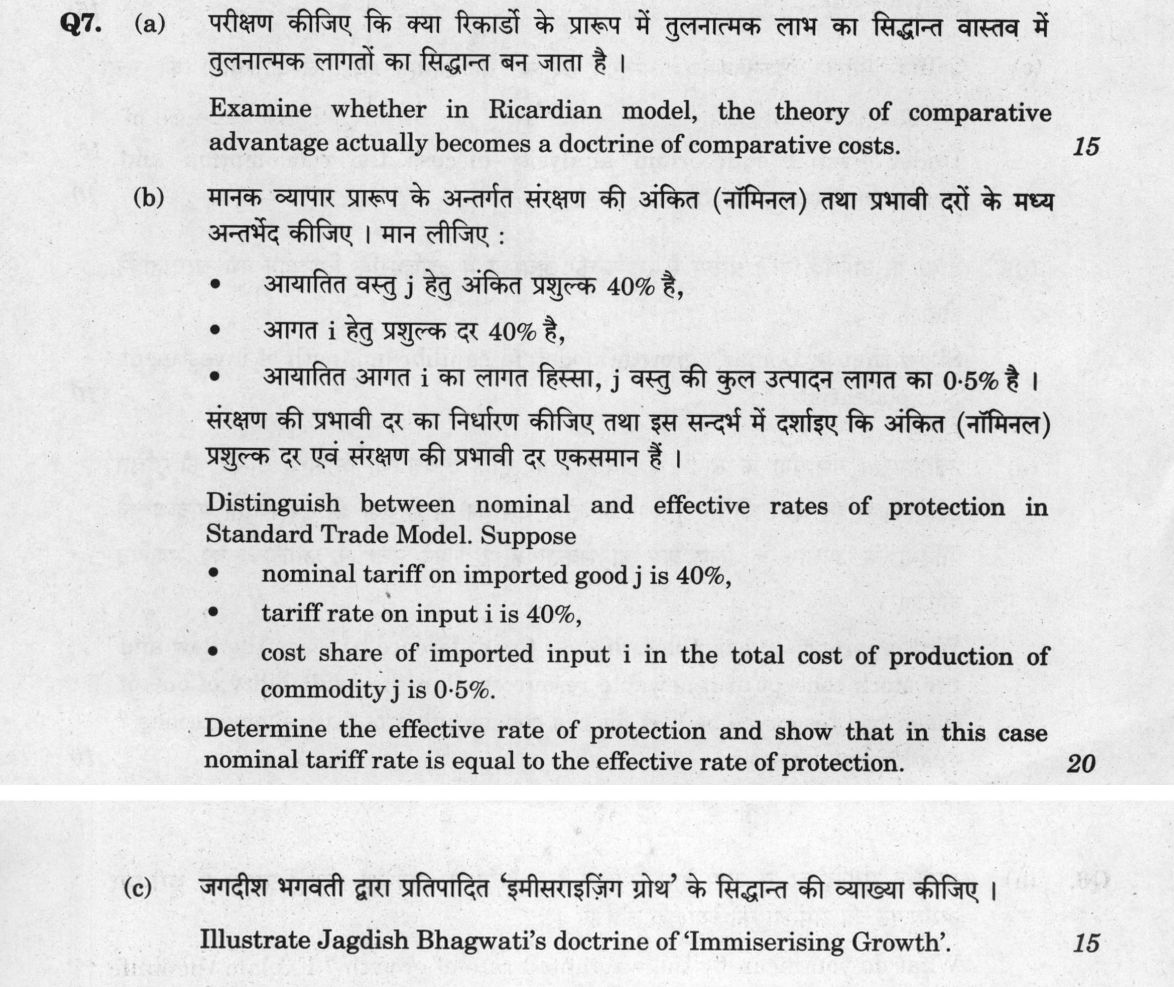
(a) Examine whether in Ricardian model, the theory of comparative advantage actually becomes a doctrine of comparative costs. (15…
Examine whether in Ricardian model, the theory of comparative advantage actually becomes a doctrine of comparative costs. 15 marks
Distinguish between nominal and effective rates of protection in Standard Trade Model. Suppose • nominal tariff on imported good j is 40%, • tariff rate on input i is 40%, • cost share of imported input i in the total cost of production of commodity j is 0·5%.
Determine the effective rate of protection and show that in this case nominal tariff rate is equal to the effective rate of protection. 20 marks
Illustrate Jagdish Bhagwati's doctrine of 'Immiserising Growth'. 15 marks
हिंदी में प्रश्न पढ़ें
परीक्षण कीजिए कि क्या रिकार्डो के प्रारूप में तुलनात्मक लाभ का सिद्धान्त वास्तव में तुलनात्मक लागतों का सिद्धान्त बन जाता है । 15 marks
मानक व्यापार प्रारूप के अन्तर्गत संरक्षण की अंकित (नॉमिनल) तथा प्रभावी दरों के मध्य अन्तर्भेद कीजिए । मान लीजिए : • आयातित वस्तु j हेतु अंकित प्रशुल्क 40% है, • आगत i हेतु प्रशुल्क दर 40% है, • आयातित आगत i का लागत हिस्सा, j वस्तु की कुल उत्पादन लागत का 0·5% है ।
संरक्षण की प्रभावी दर का निर्धारण कीजिए तथा इस सन्दर्भ में दर्शाइए कि अंकित (नॉमिनल) प्रशुल्क दर एवं संरक्षण की प्रभावी दर एकसमान हैं । 20 marks
जगदीश भगवती द्वारा प्रतिपादित 'इमिसराइजिंग ग्रोथ' के सिद्धांत की व्याख्या कीजिए । 15 marks
Model answer
Written by UPSC Answer Check against this question's marking rubric, to the expected length. UPSC does not publish answers for Mains — this is one way to score well, not an official key.
Classical trade theory remains a lens for India’s tariff and export policy because it asks whether gains from trade survive distortions, large-country effects and biased growth.
Ricardian comparative advantage as comparative costs. In Ricardo’s model labour is the only factor, so the cost of a commodity is simply labour required. Comparative advantage therefore reduces to comparing labour cost ratios: a country exports the good with lower relative labour cost. This is not absolute advantage; even if a country is less efficient in both goods, it can gain by specialising in the good where its labour cost disadvantage is smaller. The doctrine is thus a doctrine of comparative costs. Later economists, especially Haberler, reframed it in opportunity-cost terms: the relevant cost is the value of the next best alternative foregone, not physical labour alone. Viner and others argued that calling it a “cost” doctrine can be misleading when multiple factors, capital, land and technology matter; in the Ricardian case the simplification makes comparative advantage and comparative labour-cost ratios identical, but in general opportunity cost is the more general criterion.
Nominal and effective protection. In the standard trade model, the nominal rate of protection is the ad valorem tariff on an imported final good, t_j. The effective rate of protection measures the increase in value added in the protected industry relative to value added at world prices. If an imported input i has cost share a_i and tariff t_i, ERP_j = (t_j - a_i t_i)/(1 - a_i). Here t_j=0.40, t_i=0.40, a_i=0.005. ERP = (0.40 - 0.005×0.40)/(1-0.005) = (0.40-0.002)/0.995 = 0.398/0.995 = 0.40. Thus the nominal and effective rates are equal. More generally, if t_j=t_i, ERP = t_j(1-a_i)/(1-a_i)=t_j, so the equality does not depend on the input share; the very small share merely makes the numerical difference negligible. India’s pre-1991 tariff structure often used ERP to expose how high tariffs on final goods combined with lower tariffs on inputs could overprotect some industries while underprotecting others.
Immiserising growth. Bhagwati showed that growth can lower welfare if terms of trade deteriorate more than output expands. The case requires a large country whose export-biased growth shifts the production possibility frontier outward mainly toward the export good. If foreign demand for exports is inelastic, the extra exports depress the export price. The domestic marginal propensity to consume exportables must be low, so growth adds little home absorption and much more export surplus; a compact condition is that the foreign elasticity of demand for exports plus the domestic marginal propensity to consume exportables is below one, e_f + m_X < 1. An initial tariff-distorted equilibrium can strengthen the effect by making the terms-of-trade response sharper. Diagrammatically, the PPF shifts outward; the export offer curve moves so that the terms-of-trade line rotates against the country; the new consumption possibility line may touch a lower indifference curve than before. India’s historical dependence on primary exports such as cotton, jute and tea illustrates the risk: world demand inelastic and prices volatile, so export-led growth could worsen terms of trade.
Verdict. The Ricardian model is best read as a comparative-cost doctrine only under its single-factor assumption; in richer models opportunity cost generalises it. ERP shows that nominal tariffs can misstate protection, which is why India’s trade reforms needed value-added analysis. Bhagwati’s doctrine warns that growth is not automatically immiserising, but for large, export-dependent economies it can be; policy should therefore diversify exports, manage terms-of-trade exposure and design tariffs with effective, not merely nominal, protection in mind. It also explains India’s later preference for export diversification and tariff rationalisation.
What "Examine" is asking you to do
Test the proposition the question puts to you and return a finding on how far it holds. Examine stems carry a claim, or ask whether something has happened, and expect evidence weighed both ways before the extent is stated — often with remedial measures attached.
Structure that answers it
Restate the claim as the question frames it → evidence that supports it → evidence that undercuts it → the conditions under which it holds → verdict on how far it stands
Where marks are lost
Stopping at description. An examination has to reach a finding, and “examine with justification” means the extent must be stated, not implied.
How this answer will be evaluated
Approach
Framework: Ricardian Model, Standard Trade Model (Effective Rate of Protection), Immiserising Growth. (a) examine: intro > how/why with reasoning > evidence > conclusion | (b) calculate: given > formula > substitution > result with units > interpretation | (c) explain: definition/context > points in order > small example > short close Full marks: Clear definitions, correct derivations/calculations, and well-illustrated concepts with diagrams.
Key points expected
- Define comparative advantage and comparative costs
- State Ricardian model assumptions (labor as sole factor)
- Derive opportunity cost from labor requirements
- Conclude on the equivalence of the two concepts
- Define nominal and effective rates of protection
- State the formula for effective rate of protection
- Substitute given values (40%, 40%, 0.5%) correctly
- Show the calculation steps leading to the final result
Evaluation rubric
Each sub-part is marked on its own, against the marks and word limit printed on the paper.
- (a) Analyze the relationship between comparative advantage and comparative costs in the Ricardian model. 15 marks
examine— intro → how/why with reasoning → evidence → conclusion
Must cover
- Define comparative advantage and comparative costs
- State Ricardian model assumptions (labor as sole factor)
- Derive opportunity cost from labor requirements
- Conclude on the equivalence of the two concepts
Loses marks
- Confusing absolute advantage with comparative advantage
- Failing to link labor productivity to costs
Earns more
- Mention specific labor coefficients (aLx, aLy)
- Reference David Ricardo's original formulation
- Discuss the role of relative wages
Extra mark
- Include a simple numerical example of labor requirements
- (b) Distinguish nominal vs effective protection and calculate the effective rate given specific tariff and cost data. 20 marks
calculate— given → formula → substitution → result with units → interpretation
Must cover
- Define nominal and effective rates of protection
- State the formula for effective rate of protection
- Substitute given values (40%, 40%, 0.5%) correctly
- Show the calculation steps leading to the final result
Loses marks
- Using the wrong formula for effective rate
- Arithmetic errors in the calculation
- Failing to distinguish between nominal and effective rates
Earns more
- Explain the economic intuition behind the formula
- Discuss the impact of input tariffs on final goods
- Mention the significance of the cost share
Extra mark
- Provide a diagram illustrating the price wedge
- (c) Illustrate Jagdish Bhagwati's doctrine of 'Immiserising Growth' with a clear explanation. 15 marks
explain— definition/context → points in order → small example → short close
Must cover
- Define 'Immiserising Growth' as per Bhagwati
- Explain the mechanism (terms of trade deterioration)
- Describe the conditions under which it occurs
- Illustrate with a diagram or example
Loses marks
- Confusing with other types of growth (e.g., Harrod-Domar)
- Failing to explain the terms of trade mechanism
- Vague or general description without specific reference to Bhagwati
Earns more
- Mention the role of capital accumulation
- Discuss the impact on real income
- Reference Bhagwati's specific paper or model
Extra mark
- Include a diagram showing the shift in production and consumption
Practice this exact question
Write your answer and it is marked point by point against the model answer above — what you covered, what you missed, what you got wrong.
Evaluate my answer →More from Economics 2022 Paper I
- Q4 (a) State the canons of taxation. Do you think that direct taxes are less burdensome than…
- Q5 Answer the following questions in about 150 words each: (a) Stating major assumptions in…
- Q6 (a) What do you mean by the warranted rate of growth ? Explain the knife edge instability…
- Q7 (a) Examine whether in Ricardian model, the theory of comparative advantage actually beco…
- Q8 (a) State the functions of United Nations Conference on Trade and Development (UNCTAD). D…