Paper I — Q3
(a) IS curve is the locus of equilibrium points in the commodity market. What do the points above and below the IS curve signify…
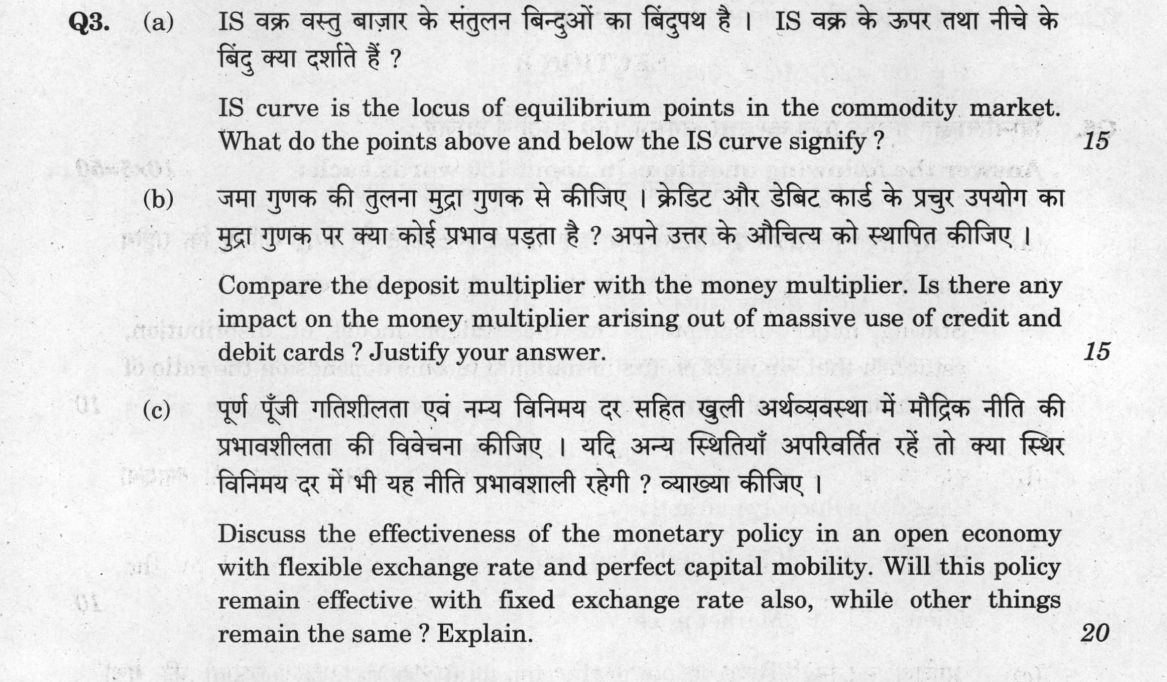
IS curve is the locus of equilibrium points in the commodity market. What do the points above and below the IS curve signify ? 15 marks
Compare the deposit multiplier with the money multiplier. Is there any impact on the money multiplier arising out of massive use of credit and debit cards ? Justify your answer. 15 marks
Discuss the effectiveness of the monetary policy in an open economy with flexible exchange rate and perfect capital mobility. Will this policy remain effective with fixed exchange rate also, while other things remain the same ? Explain. 20 marks
हिंदी में प्रश्न पढ़ें
IS वक्र वस्तु बाजार के संतुलन बिन्दुओं का बिन्दुपथ है । IS वक्र के ऊपर तथा नीचे के बिन्दु क्या दर्शाते हैं ? (15 अंक)
जमा गुणक की तुलना मुद्रा गुणक से कीजिए । क्रेडिट और डेबिट कार्ड के प्रचुर उपयोग का मुद्रा गुणक पर क्या कोई प्रभाव पड़ता है ? अपने उत्तर के औचित्य को स्थापित कीजिए । (15 अंक)
पूर्ण पूंजी गतिशीलता एवं नम्य विनिमय दर सहित खुली अर्थव्यवस्था में मौद्रिक नीति की प्रभावशीलता की विवेचना कीजिए । यदि अन्य स्थितियाँ अपरिवर्तित रहें तो क्या स्थिर विनिमय दर में भी यह नीति प्रभावशाली रहेगी ? व्याख्या कीजिए । (20 अंक)
Model answer
Written by UPSC Answer Check against this question's marking rubric, to the expected length. UPSC does not publish answers for Mains — this is one way to score well, not an official key.
IS curve disequilibrium. In an open economy the IS curve is Y = C(Y-T) + I(r) + G + X - M, equivalently S + T + M = I + G + X, or S + T = I + G + NX. A point above the IS curve has, for a given output, a higher interest rate than goods-market equilibrium requires. Investment is lower, aggregate demand is below output, and leakages exceed injections: S + T + M > I + G + X, or S + T > I + G + NX. This signifies excess supply of goods and unintended inventory accumulation; with T = G it is S > I. A point below the IS curve has a lower interest rate, higher investment, aggregate demand above output, and injections exceed leakages: S + T + M < I + G + X, or S + T < I + G + NX. This signifies excess demand and inventory depletion; with T = G it is I > S. If the point is also on the LM curve, output adjusts: excess supply lowers output, moving the economy down along LM toward IS; excess demand raises output, moving it up along LM. More generally, equilibrium is restored by changes in r and Y, with r falling above IS or rising below IS.
Deposit and money multipliers. The deposit multiplier is 1/rr, or 1/(rr+er) with excess reserves; it shows how deposits expand from reserves. The money multiplier is m = (1+c)/(rr+c+er), where c = C/D; it shows how total money expands from the base B = C + R and includes currency held by the public. Massive use of credit and debit cards reduces cash demand, lowering c. Credit cards are not money, but their settlement and debit-card use reduce cash holdings. Since rr + er is normally less than one, a lower c raises m, so the same base supports a larger money stock. The effect is clearest for narrow money, M1, where currency and demand deposits dominate. For broad money, M3, the multiplier also depends on time deposits, reserve requirements and credit demand, so the increase may be smaller. In India, UPI and digital payments have reduced cash intensity and can raise the narrow-money multiplier, though RBI liquidity management moderates the transmission.
Monetary policy under exchange-rate regimes. In the IS-LM-BP diagram, with flexible exchange rates and perfect capital mobility, BP is horizontal at the world interest rate. Expansionary monetary policy shifts LM right, lowering the domestic rate below the world rate. Capital outflows depreciate the currency, raise net exports and shift IS right. Output rises and the interest rate returns to the world rate; monetary policy is fully effective through the exchange-rate channel. With a fixed exchange rate and the same perfect capital mobility, the initial LM shift again lowers r and causes capital outflows. To prevent depreciation, the central bank sells foreign reserves, contracting the monetary base and shifting LM back to its original position. Output and the interest rate are unchanged; monetary policy is completely ineffective. The constraint is the offsetting reserve operation needed to defend the peg. India’s post-1991 managed float is not a fixed peg, but it shows the same logic: with high capital mobility, exchange-rate and reserve movements can offset or amplify monetary actions, and the RBI uses sterilization to manage reserve swings and liquidity. Thus, in globalized economies, monetary policy is most effective where the exchange rate can adjust, and least effective where a fixed rate must be defended while capital moves freely.
What "Discuss" is asking you to do
Lay the issue out from more than one side — how it arose, what is claimed for it, what is held against it, and where it now stands. UPSC attaches discuss to broad topics with several live dimensions, so coverage of the dimensions earns more than the strength of your opinion.
Structure that answers it
Set the issue up → the case as it is made → the case against → the dimension both sides leave out → where the balance now lies
Where marks are lost
Listing facts with no thread between them, or arguing one side throughout and calling it a discussion.
How this answer will be evaluated
Approach
Framework: IS-LM-FF Model (Mundell-Fleming). (a) explain: definition/context > points in order > small example > short close | (b) compare: paired headings or table > key differences > significance > conclusion | (c) discuss: intro > 3-4 dimensions > example > balanced close Full marks: Rigorous application of IS-LM-FF model with clear diagrams and precise definitions of multipliers.
Key points expected
- Define IS curve as locus of goods market equilibrium
- State condition for points above IS curve (I > S)
- State condition for points below IS curve (S > I)
- Explain the resulting inventory adjustment mechanism
- Define deposit multiplier (1/rr)
- Define money multiplier (m = (1+c)/(rr+e+c))
- Identify key difference (currency vs deposits)
- Analyze impact of cards on currency demand (c)
Evaluation rubric
Each sub-part is marked on its own, against the marks and word limit printed on the paper.
- (a) Define IS curve and interpret points above/below it in terms of commodity market disequilibrium. 15 marks
explain— definition/context → points in order → small example → short close
Must cover
- Define IS curve as locus of goods market equilibrium
- State condition for points above IS curve (I > S)
- State condition for points below IS curve (S > I)
- Explain the resulting inventory adjustment mechanism
Loses marks
- Confusing IS with LM curve
- Verbal answer without defining I and S
- Failing to distinguish above vs below
Earns more
- Draws IS-LM diagram with points labeled
- Mentions interest rate and income axes
- Links disequilibrium to movement toward equilibrium
Extra mark
- References Hicks-Hansen model
- (b) Compare deposit and money multipliers and analyze the impact of credit/debit cards on the money multiplier. 15 marks
compare— paired headings or table → key differences → significance → conclusion
Must cover
- Define deposit multiplier (1/rr)
- Define money multiplier (m = (1+c)/(rr+e+c))
- Identify key difference (currency vs deposits)
- Analyze impact of cards on currency demand (c)
Loses marks
- Treating deposit and money multipliers as identical
- Ignoring the currency component (c)
- No justification for the impact of cards
Earns more
- Explains how cards reduce cash holdings
- Mentions electronic money or M1/M2 distinction
- Justifies the direction of multiplier change
Extra mark
- References RBI data on digital payments
- Mentions specific card networks (Visa/Mastercard)
- (c) Discuss monetary policy effectiveness under flexible vs fixed exchange rates with perfect capital mobility. 20 marks
discuss— intro → 3-4 dimensions → example → balanced close
Must cover
- State Mundell-Fleming assumptions (perfect mobility)
- Analyze flexible rate: policy is effective (IS/LM shift)
- Analyze fixed rate: policy is ineffective (sterilization failure)
- Explain the mechanism of capital flows and exchange rate adjustment
Loses marks
- Confusing flexible and fixed rate outcomes
- Ignoring the perfect capital mobility assumption
- Failing to explain the transmission mechanism
Earns more
- Draws IS-LM-FF diagrams for both cases
- Mentions the 'impossible trinity' or 'trilemma'
- Explains the role of central bank intervention
Extra mark
- References specific country examples (e.g., India vs Eurozone)
- Mentions Mundell or Fleming by name
Practice this exact question
Write your answer and it is marked point by point against the model answer above — what you covered, what you missed, what you got wrong.
Evaluate my answer →More from Economics 2022 Paper I
- Q1 Answer the following questions in about 150 words each: (a) Explain briefly Chamberlin's…
- Q2 (a) Consider a duopoly market, P = 100 – 2Q, MC = 10 and Q = q₁ + q₂ where P : Market pri…
- Q3 (a) IS curve is the locus of equilibrium points in the commodity market. What do the poin…
- Q4 (a) State the canons of taxation. Do you think that direct taxes are less burdensome than…
- Q5 Answer the following questions in about 150 words each: (a) Stating major assumptions in…
- Q6 (a) What do you mean by the warranted rate of growth ? Explain the knife edge instability…