Paper I — Q4
(a) State the canons of taxation. Do you think that direct taxes are less burdensome than indirect taxes in generating equal…
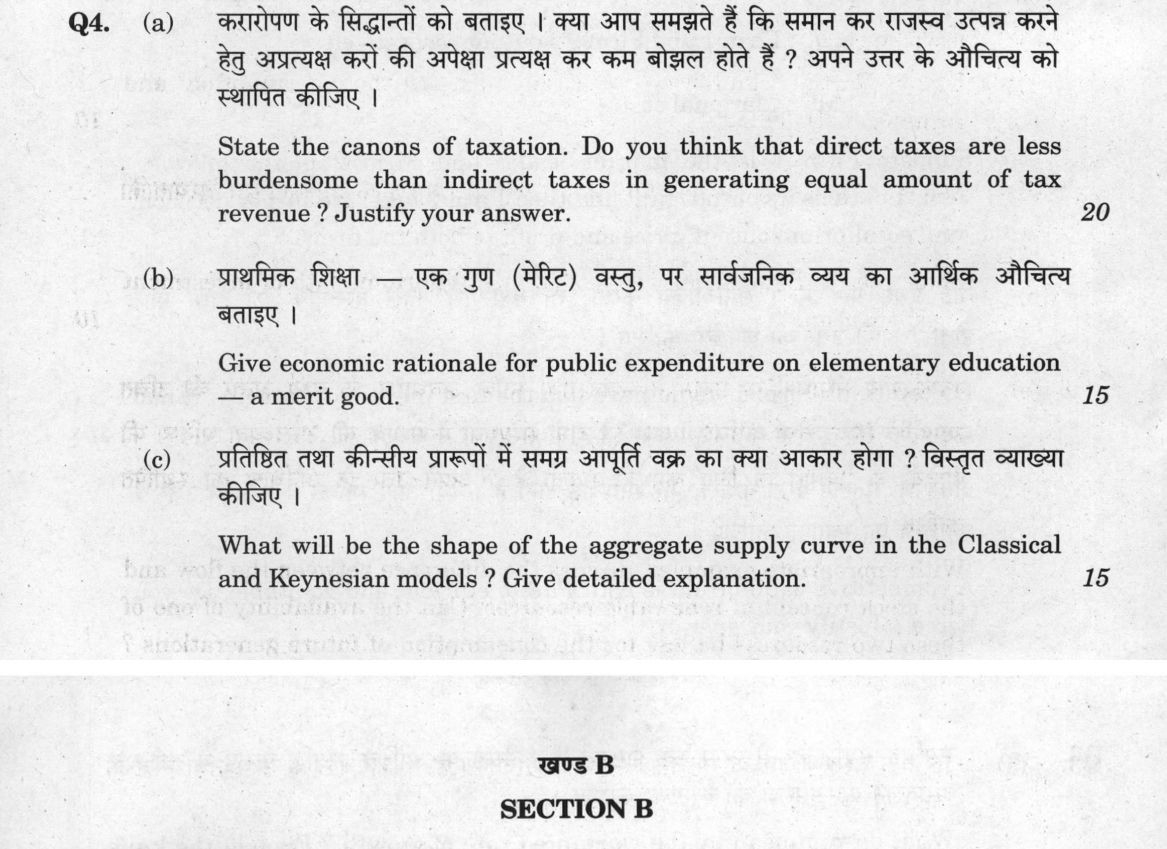
State the canons of taxation. Do you think that direct taxes are less burdensome than indirect taxes in generating equal amount of tax revenue ? Justify your answer. 20 marks
Give economic rationale for public expenditure on elementary education — a merit good. 15 marks
What will be the shape of the aggregate supply curve in the Classical and Keynesian models ? Give detailed explanation. 15 marks
हिंदी में प्रश्न पढ़ें
करारोपण के सिद्धांतों को बताइए । क्या आप समझते हैं कि समान कर राजस्व उत्पन्न करने हेतु अप्रत्यक्ष करों की अपेक्षा प्रत्यक्ष कर कम बोझिल होते हैं ? अपने उत्तर के औचित्य को स्थापित कीजिए । (20 अंक)
प्राथमिक शिक्षा — एक गुण (मेरिट) वस्तु, पर सार्वजनिक व्यय का आर्थिक औचित्य बताइए । (15 अंक)
प्रतिबिंत तथा कीन्सीय प्रारूपों में समग्र आपूर्ति वक्र का क्या आकार होगा ? विस्तृत व्याख्या कीजिए । (15 अंक)
Model answer
Written by UPSC Answer Check against this question's marking rubric, to the expected length. UPSC does not publish answers for Mains — this is one way to score well, not an official key.
Canons of Taxation and Comparative Tax Burden
Adam Smith formulated four classical canons of taxation: equity (taxation according to ability to pay), certainty (clear terms of liability, timing, and manner), convenience (levied when most convenient for the taxpayer), and economy (minimizing the cost of collection relative to revenue). Modern public finance augments these with the canons of productivity (generating adequate revenue), elasticity and buoyancy (revenue automatically expanding with national income), simplicity, and diversity (a balanced tax mix).
To justify whether direct taxes impose less burden than indirect taxes in generating an equal volume of revenue, economic analysis contrasts equity with efficiency. Direct taxes, such as progressive personal income tax, align directly with the ability-to-pay principle. They satisfy vertical equity by capturing a higher proportion of income from richer individuals whose marginal utility of income is lower, and horizontal equity by treating equals equally. In contrast, indirect taxes on commodities (like GST) are inherently regressive, as poorer households spend a larger fraction of their income on basic consumption goods, violating vertical equity.
In terms of allocative efficiency and excess burden (deadweight loss), indirect taxes distort relative prices and consumption choices, creating Harberger triangles of welfare loss. Conversely, direct taxes avoid output-market distortions, though they may distort the work-leisure trade-off and savings behavior. However, the claim that direct taxes are universally less burdensome must be qualified: direct taxes entail substantial compliance and administrative costs, and are prone to evasion, particularly in developing economies with large informal sectors. Indirect taxes exhibit higher administrative convenience, broader tax bases, and lower collection costs. Following Musgrave’s optimal tax framework, direct taxes impose a smaller equity-adjusted social burden, but an optimal fiscal structure necessitates a balanced direct-indirect mix to minimize aggregate economic distortion.
Public Expenditure on Elementary Education as a Merit Good
Richard Musgrave defined merit goods as commodities that society deems inherently desirable, but which the free market systematically underprovides due to market failures and consumer myopia.
The economic rationale for state funding of elementary education rests on three pillars. First, elementary education yields extensive positive consumption externalities that market pricing ignores, including crime reduction, improved public health, informed civic participation, and social cohesion. Second, market provision fails due to information asymmetry and inter-temporal myopia: impoverished parents often underestimate long-term returns or face severe credit constraints, leading to socially sub-optimal investment. Third, under human capital theory (Schultz, Becker, and Lucas), foundational literacy and numeracy are fundamental inputs that elevate aggregate labor productivity, drive endogenous economic growth, and break the intergenerational transmission of poverty. In India, this rationale is operationalized through the Right to Education under Article 21A, supported by public outlays through Samagra Shiksha and PM-POSHAN.
Aggregate Supply Curve in Classical and Keynesian Models
In the Classical model, the aggregate supply (AS) curve is perfectly vertical at the full-employment output level (Y_f). Classical economics is founded on Say’s Law and absolute price-wage flexibility. In both the short run and long run, nominal wages (W) and general price levels (P) adjust instantaneously through competitive labor markets to clear any excess supply or demand, keeping the real wage (W/P) at its market-clearing equilibrium. Money remains neutral (the classical dichotomy); shifts in aggregate demand influence only the nominal price level, leaving real output unchanged at potential output.
The Keynesian AS curve, by contrast, rejects instantaneous market clearing and reflects a three-stage supply response. In the extreme Keynesian range (depression or liquidity trap), the AS curve is perfectly horizontal because widespread unutilized capacity and unemployment permit output expansion without upward pressure on prices. In the intermediate range, the AS curve slopes upward: nominal wage rigidities—caused by long-term labor contracts, minimum wage laws, or worker money illusion—mean that as aggregate demand rises, prices rise faster than nominal wages, reducing the real wage and inducing profit-maximizing firms to expand output. Finally, once full employment of all productive resources is attained, the Keynesian AS curve becomes perfectly vertical, where aggregate demand expansion generates purely inflationary pressures.
Conclusion
An optimal macroeconomic framework requires progressive direct taxation to finance merit goods like elementary education, building human capital and shifting the long-run Classical aggregate supply curve outward, while utilizing Keynesian demand management to stabilize output along the short-run aggregate supply schedule.
What "Justify" is asking you to do
Defend a position with reasons that carry evidence, and show why the contrary view does not hold. Where the stem runs as a question and asks you to justify your answer, the position is yours to choose and the marks lie wholly in the defence.
Structure that answers it
Position stated plainly → reason 1 with evidence → reason 2 with evidence → strongest objection, met → position restated as qualified
Where marks are lost
Reasons stated and none of them evidenced. The other standard loss is fence-sitting — an answer that finds merit on both sides and commits to neither has justified nothing.
How this answer will be evaluated
Approach
Framework: Adam Smith's Canons of Taxation. (a) justify: claim > 3-4 reasons > evidence > conclusion | (b) explain: definition/context > points in order > small example > short close | (c) explain: definition/context > points in order > small example > short close Full marks: Comprehensive, well-structured, with clear diagrams and specific examples.
Key points expected
- State all four canons (Equity, Certainty, Convenience, Economy)
- Define direct and indirect taxes clearly
- Compare burden using incidence and elasticity
- Provide a clear justification for the conclusion
- Define 'merit good' and 'positive externalities'
- Explain market failure (under-consumption) in education
- Link public expenditure to social welfare maximization
- Mention the role of government in correcting market failure
Evaluation rubric
Each sub-part is marked on its own, against the marks and word limit printed on the paper.
- (a) List canons of taxation and justify the comparative burden of direct vs indirect taxes. 20 marks
justify— claim → 3-4 reasons → evidence → conclusion
Must cover
- State all four canons (Equity, Certainty, Convenience, Economy)
- Define direct and indirect taxes clearly
- Compare burden using incidence and elasticity
- Provide a clear justification for the conclusion
Loses marks
- Confusing tax incidence with tax burden
- Failing to distinguish between direct and indirect taxes
- Listing canons without explaining them
Earns more
- Mention Adam Smith as the originator
- Discuss the concept of 'shifting' of tax burden
- Reference the Laffer curve or deadweight loss
- Mention the progressivity of direct taxes
Extra mark
- Cite specific Indian tax data (e.g., GST vs Income Tax share)
- Reference a specific economist (e.g., Musgrave)
- (b) Provide the economic rationale for public expenditure on elementary education as a merit good. 15 marks
explain— definition/context → points in order → small example → short close
Must cover
- Define 'merit good' and 'positive externalities'
- Explain market failure (under-consumption) in education
- Link public expenditure to social welfare maximization
- Mention the role of government in correcting market failure
Loses marks
- Treating education as a pure public good (it's a merit good)
- Failing to mention externalities
- Ignoring the 'merit' aspect of the question
Earns more
- Discuss human capital theory (Schultz/Becker)
- Mention the 'merit' aspect (social desirability)
- Reference the 'free market' failure argument
- Discuss the long-term economic growth benefits
Extra mark
- Cite specific Indian education data (e.g., ASER report)
- Reference a specific policy (e.g., RTE Act)
- (c) Explain the shape of the aggregate supply curve in Classical and Keynesian models. 15 marks
explain— definition/context → points in order → small example → short close
Must cover
- Describe the Classical AS curve (vertical)
- Describe the Keynesian AS curve (horizontal)
- Explain the assumptions behind each shape
- Contrast the two models clearly
Loses marks
- Confusing the AS curve with the AD curve
- Failing to explain the assumptions behind the shapes
- Not contrasting the two models
Earns more
- Mention the 'Classical dichotomy'
- Discuss the 'Keynesian trap' or 'liquidity trap'
- Reference the 'short-run' vs 'long-run' distinction
- Mention the 'neoclassical' synthesis
Extra mark
- Draw a diagram showing both curves
- Reference a specific economist (e.g., Friedman or Keynes)
Practice this exact question
Write your answer and it is marked point by point against the model answer above — what you covered, what you missed, what you got wrong.
Evaluate my answer →More from Economics 2022 Paper I
- Q1 Answer the following questions in about 150 words each: (a) Explain briefly Chamberlin's…
- Q2 (a) Consider a duopoly market, P = 100 – 2Q, MC = 10 and Q = q₁ + q₂ where P : Market pri…
- Q3 (a) IS curve is the locus of equilibrium points in the commodity market. What do the poin…
- Q4 (a) State the canons of taxation. Do you think that direct taxes are less burdensome than…
- Q5 Answer the following questions in about 150 words each: (a) Stating major assumptions in…
- Q6 (a) What do you mean by the warranted rate of growth ? Explain the knife edge instability…
- Q7 (a) Examine whether in Ricardian model, the theory of comparative advantage actually beco…