Paper II — Q1
Answer the following questions in about 150 words each: (a) Outline the factors that caused decline of handicrafts during British…
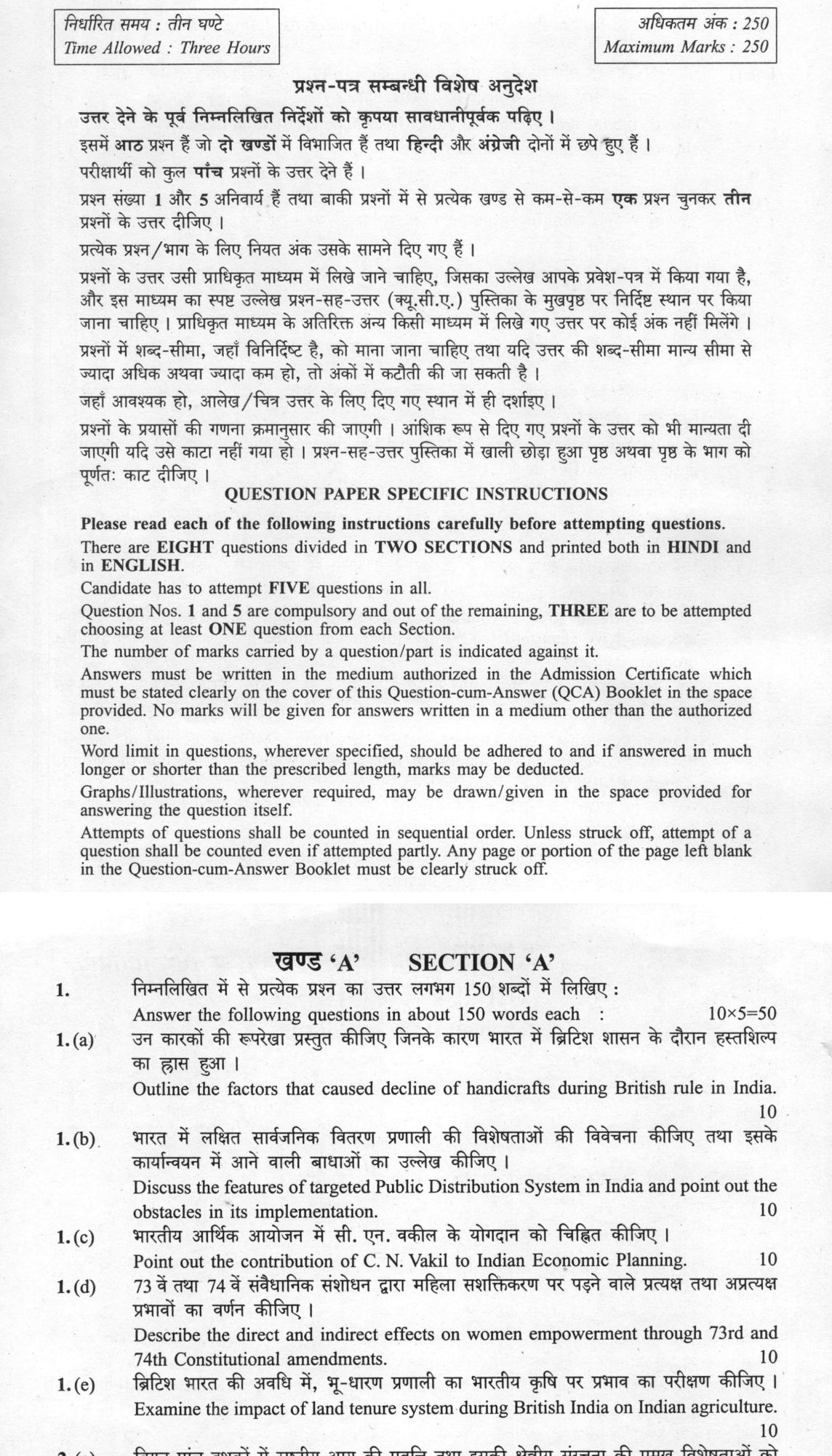
Answer the following questions in about 150 words each: Outline the factors that caused decline of handicrafts during British rule in India. 10 marks
Discuss the features of targeted Public Distribution System in India and point out the obstacles in its implementation. 10 marks
Point out the contribution of C. N. Vakil to Indian Economic Planning. 10 marks
Describe the direct and indirect effects on women empowerment through 73rd and 74th Constitutional amendments. 10 marks
Examine the impact of land tenure system during British India on Indian agriculture. 10 marks
हिंदी में प्रश्न पढ़ें
निम्नलिखित में से प्रत्येक प्रश्न का उत्तर लगभग 150 शब्दों में लिखिए : उन कारकों की रूपरेखा प्रस्तुत कीजिए जिनके कारण भारत में ब्रिटिश शासन के दौरान हस्तशिल्प का ह्रास हुआ । (10 अंक)
भारत में लक्षित सार्वजनिक वितरण प्रणाली की विशेषताओं की विवेचना कीजिए तथा इसके कार्यान्वयन में आने वाली बाधाओं का उल्लेख कीजिए । (10 अंक)
भारतीय आर्थिक आयोजन में सी. एन. वकील के योगदान को चिह्नित कीजिए । (10 अंक)
73 वें तथा 74 वें संवैधानिक संशोधन द्वारा महिला सशक्तिकरण पर पड़ने वाले प्रत्यक्ष तथा अप्रत्यक्ष प्रभावों का वर्णन कीजिए । (10 अंक)
ब्रिटिश भारत की अवधि में, भू-धारण प्रणाली का भारतीय कृषि पर प्रभाव का परीक्षण कीजिए । (10 अंक)
Model answer
Written by UPSC Answer Check against this question's marking rubric, to the 150-word length. UPSC does not publish answers for Mains — this is one way to score well, not an official key.
(a) Decline of Indian Handicrafts during British Rule
The systematic deindustrialization of India under British colonial rule dismantled the globally renowned indigenous handicraft sector. First, the influx of cheap, machine-made goods from Lancashire and Manchester severely undercut hand-spun Indian textiles in domestic markets. Second, the colonial state instituted a discriminatory tariff policy that permitted duty-free entry of British manufactured products into India while imposing prohibitive import duties on Indian finished goods entering Britain. Third, the annexation of princely states led to the rapid disappearance of royal courts, which had historically served as the primary patrons and consumers of luxury crafts like muslin, silks, and metalware. Fourth, the expansion of railways, financed by guaranteed British capital, opened the hinterland to foreign goods while redirecting vital raw materials, such as raw cotton, abroad. Consequently, the breakdown of the traditional village artisan-peasant nexus destroyed self-sufficient rural economies, forcing millions of displaced craftsmen into an already overcrowded agricultural sector.
(b) Targeted Public Distribution System: Features and Obstacles
Introduced in 1997 to focus food subsidies on the needy, the Targeted Public Distribution System (TPDS) shifted from universal provisioning to differentiated welfare. Its key features include household categorization into Below Poverty Line (BPL), Above Poverty Line (APL), and later Antyodaya Anna Yojana (AAY) for the poorest of the poor. It operates on a dual pricing mechanism, offering grains at subsidized Central Issue Prices (CIP) distinct from prevailing open market prices, while decentralizing the operational responsibility of beneficiary identification, quota allocation, and Fair Price Shop (FPS) licensing to state governments.
However, several operational obstacles impede its efficiency. High targeting errors, notably the exclusion of genuine beneficiaries alongside inclusion errors, dilute welfare delivery. The prevalence of bogus or ghost ration cards, combined with massive supply-chain leakages into the open market, undermines food distribution. Furthermore, the system imposes a substantial fiscal burden on public finances, compounded by severe interstate disparities in administrative capacity and digital infrastructure. Comprehensive end-to-end computerization and Aadhaar seeding have mitigated these gaps, but reforming last-mile delivery remains essential for sustainable food security.
(c) Contribution of C. N. Vakil to Indian Economic Planning
Professor C. N. Vakil made foundational contributions to Indian economic thought and the development of national planning frameworks. He offered a rigorous critique of colonial laissez-faire economics, demonstrating how unguided market forces perpetuated underdeveloped structural imbalances. Vakil actively engaged with early planning initiatives, contributing insights aligned with the 1944 Bombay Plan’s vision of state-directed resource allocation and infrastructure creation. In the post-independence era, along with P. R. Brahmananda, he formulated the alternative Wage-Goods Model of planning, which challenged the heavy-industry-centric Mahalanobis strategy by arguing that prioritizing wage goods, like agriculture and wage-generating consumer products, was vital for expanding employment, curbing inflationary pressures, and securing capital formation. As the Director of the School of Economics and Sociology at the University of Bombay, Vakil institutionalized economics as an empirical policy science, producing applied policy research on public finance, inflation management, and developmental planning that shaped generations of Indian planners.
(d) Direct and Indirect Effects of 73rd and 74th Amendments on Women Empowerment
The 73rd and 74th Constitutional Amendment Acts (1992) revolutionized local governance by institutionalizing political empowerment for women across Panchayati Raj Institutions (PRIs) and Urban Local Bodies (ULBs).
Directly, Articles 243D and 243T mandated a minimum 33 percent reservation for women in elected seats and offices of chairpersons, bringing over a million women into formal grassroots governance. These amendments granted women statutory participation in standing committees and functional devolved subjects, accompanied by financial and taxation powers that enabled local resource management.
Indirectly, political participation has catalyzed deep socio-cultural transformations. It has enhanced women’s intra-household bargaining power, elevated their role in domestic financial decisions, and accelerated political socialization among rural women. Over time, the initial proxy-leadership syndrome (Sarpanch Pati) has diminished, paving the way for autonomous female leadership. This active public presence has progressively challenged entrenched patriarchal norms and normalized female authority within rural and urban civic spaces.
(e) Impact of British Land Tenure Systems on Indian Agriculture
The introduction of colonial land tenure systems—the Permanent Settlement (Zamindari), Ryotwari, and Mahalwari systems—fundamentally restructured agrarian relations to maximize colonial revenue extraction.
These tenurial arrangements commodified land and drove the forced commercialization of agriculture. Peasants were coerced into shifting acreage from subsistence food grains to export-oriented cash crops like indigo, opium, cotton, and sugarcane, escalating famine vulnerability. The creation of absolute proprietary rights in Zamindari areas, paired with inflexible revenue demands, spawned aggressive rack-renting and complex layers of subinfeudation. Peasantry was pushed into chronic debt bondage to local moneylenders, causing widespread land alienation and the rise of landless agricultural laborers. Because absentee landlords and the colonial state extracted high rents without reinvesting in irrigation, soil conservation, or technological modernization, Indian agriculture suffered from profound structural stagnation, low productivity, and depleted capital formation throughout the colonial era.
What "Outline" is asking you to do
Set out a whole scheme from end to end in its main steps without going into any of them. It is the directive used for protocols and frameworks — a management plan, a reaction mechanism, a statutory scheme — where the mark lies in having the full sequence with nothing missing.
Structure that answers it
What the scheme is for → step one → step two → the remaining steps through to the end point → the condition on which the sequence turns
Where marks are lost
Depth in the wrong place: elaborating the first two steps and never reaching the end of the scheme, which is where completeness is checked.
How this answer will be evaluated
Approach
Framework: UPSC Economics Paper II. (a) highlight: name the salient points > one line of substance each > close | (b) discuss: intro > 3-4 dimensions > example > balanced close | (c) highlight: name the salient points > one line of substance each > close | (d) describe: define > structure or process in order > labelled diagram > significance | (e) examine: intro > how/why with reasoning > evidence > conclusion Full marks: Comprehensive, specific, and well-structured answers with clear reasoning and relevant examples.
Key points expected
- Import of cheap machine-made goods
- Destruction of traditional guilds
- High taxation on artisans
- Loss of export markets
- Definition of targeted PDS (TPDS)
- Identification of beneficiary categories (APL, BPL)
- Mention of specific obstacles (leakage, exclusion)
- Reference to ration card system
Evaluation rubric
Each sub-part is marked on its own, against the marks and word limit printed on the paper.
- (a) List factors causing decline of handicrafts during British rule. 10 marks · 150 words
highlight— name the salient points → one line of substance each → close
Must cover
- Import of cheap machine-made goods
- Destruction of traditional guilds
- High taxation on artisans
- Loss of export markets
Loses marks
- Vague generalizations without specific factors
- Ignoring the role of British policy
Earns more
- Mention of specific industries (textiles, iron)
- Reference to deindustrialization
Extra mark
- Citation of specific British tariff acts
- Reference to specific historical data
- (b) Features of targeted PDS and obstacles in implementation. 10 marks · 150 words
discuss— intro → 3-4 dimensions → example → balanced close
Must cover
- Definition of targeted PDS (TPDS)
- Identification of beneficiary categories (APL, BPL)
- Mention of specific obstacles (leakage, exclusion)
- Reference to ration card system
Loses marks
- Confusing PDS with general welfare schemes
- Ignoring the 'targeted' aspect
Earns more
- Mention of NFSA 2013
- Reference to Aadhaar integration
Extra mark
- Citation of specific leakage statistics
- Reference to specific state-level implementation issues
- (c) Key contributions of C.N. Vakil to Indian Economic Planning. 10 marks · 150 words
highlight— name the salient points → one line of substance each → close
Must cover
- Role in First Five Year Plan
- Advocacy for mixed economy
- Emphasis on industrialization
- Role in Planning Commission
Loses marks
- Confusing Vakil with other planners
- Vague statements without specific contributions
Earns more
- Mention of specific policy recommendations
- Reference to his economic philosophy
Extra mark
- Citation of specific reports authored by Vakil
- Reference to his debates with other economists
- (d) Direct and indirect effects of 73rd/74th Amendments on women empowerment. 10 marks · 150 words
describe— define → structure or process in order → labelled diagram → significance
Must cover
- Mention of 1/3rd reservation for women
- Direct effect: increased representation
- Indirect effect: policy influence
- Reference to Panchayati Raj and Municipalities
Loses marks
- Ignoring the 'indirect' effects
- Confusing with other constitutional amendments
Earns more
- Mention of specific outcomes (e.g., water, sanitation)
- Reference to leadership development
Extra mark
- Citation of specific studies on impact
- Reference to specific state-level examples
- (e) Impact of British land tenure system on Indian agriculture. 10 marks · 150 words
examine— intro → how/why with reasoning → evidence → conclusion
Must cover
- Identification of major systems (Zamindari, Ryotwari, Mahalwari)
- Impact on agricultural productivity
- Creation of a class of intermediaries
- Disruption of traditional farming practices
Loses marks
- Treating all systems as identical
- Ignoring the social impact on farmers
Earns more
- Mention of specific regions for each system
- Reference to long-term consequences
Extra mark
- Citation of specific revenue figures
- Reference to specific British administrative reports
Practice this exact question
Write your answer and it is marked point by point against the model answer above — what you covered, what you missed, what you got wrong.
Evaluate my answer →More from Economics 2022 Paper II
- Q1 Answer the following questions in about 150 words each: (a) Outline the factors that caus…
- Q2 (a) Highlight the major features of National Income trend and its sectoral composition du…
- Q3 (a) Do you think that Multi Dimensional Poverty Index (MPI) is a better measure of povert…
- Q4 (a) Do you subscribe to the view that private sector is a key driver to economic developm…