Paper II — Q6
(a) What is the objective of exchange rate management? Do you think that the present regime of exchange rate management has been…
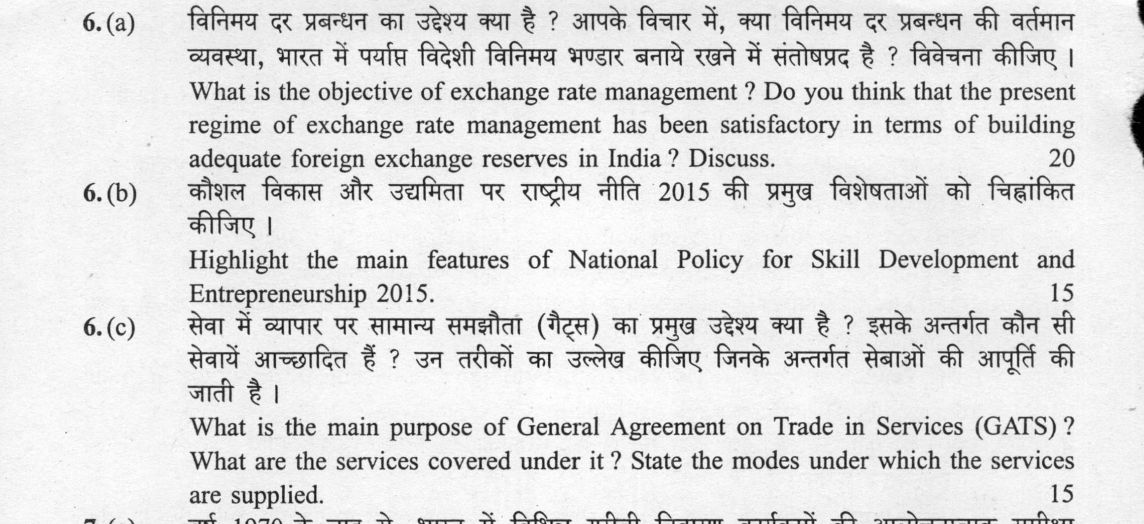
What is the objective of exchange rate management? Do you think that the present regime of exchange rate management has been satisfactory in terms of building adequate foreign exchange reserves in India? Discuss. 20 marks
Highlight the main features of National Policy for Skill Development and Entrepreneurship 2015. 15 marks
What is the main purpose of General Agreement on Trade in Services (GATS)? What are the services covered under it? State the modes under which the services are supplied. 15 marks
हिंदी में प्रश्न पढ़ें
विनिमय दर प्रबंधन का उद्देश्य क्या है ? आपके विचार में, क्या विनिमय दर प्रबंधन की वर्तमान व्यवस्था, भारत में पर्याप्त विदेशी विनिमय भंडार बनाये रखने में संतोषप्रद है ? विवेचना कीजिए । (20 अंक)
कौशल विकास और उद्यमिता पर राष्ट्रीय नीति 2015 की प्रमुख विशेषताओं को चिह्नांकित कीजिए । (15 अंक)
सेवा में व्यापार पर सामान्य समझौता (गैट्स) का प्रमुख उद्देश्य क्या है ? इसके अंतर्गत कौन सी सेवायें आच्छादित हैं ? उन तरीकों का उल्लेख कीजिए जिनके अंतर्गत सेवाओं की आपूर्ति की जाती है । (15 अंक)
Model answer
Written by UPSC Answer Check against this question's marking rubric, to the expected length. UPSC does not publish answers for Mains — this is one way to score well, not an official key.
Exchange-rate management The objective of exchange-rate management is to keep the external sector stable without sacrificing macroeconomic adjustment. It seeks price stability by preventing disorderly rupee moves that feed inflation; competitiveness by avoiding persistent overvaluation or depreciation; reserve adequacy by maintaining buffers against balance-of-payments shocks; and crisis prevention by reducing vulnerability to sudden capital-flow reversals. India’s present regime is a managed float: after LERMS in 1992 and unification of the exchange rate in March 1993, the RBI has allowed the rupee to be market-determined while intervening to smooth excessive volatility.
Reserve accumulation has been broadly satisfactory. Reserves have risen to about $600 billion, giving import cover well above the traditional three-month benchmark and comfortable short-term external debt coverage. Under the IMF’s Assessing Reserve Adequacy framework, India’s reserves-to-ARA metric has generally been at or above the upper bound in recent years, indicating a strong buffer. This helped India weather the 2008 crisis, 2013 taper tantrum, and 2020 pandemic without a balance-of-payments emergency.
Critically, RBI’s interventions have not been a simple accumulation strategy. It has used open-market forex operations, verbal guidance, and the Liquidity Adjustment Facility to influence rates and capital flows; forex swaps have managed liquidity. Large reserve accumulation has costs: opportunity cost, sterilisation costs when domestic liquidity is absorbed, and quasi-fiscal balance-sheet effects. Adequacy is not only a stock measure. Capital-account vulnerability, external commercial borrowings, portfolio outflows, and global dollar strength can make even large reserves less protective if not backed by fiscal discipline and flexible policy. Thus the regime has been satisfactory in building reserves, but success depends on prudent intervention, transparent communication, and avoiding excessive dependence on reserves as a shock absorber.
Skill Development and Entrepreneurship The National Policy for Skill Development and Entrepreneurship, 2015, sought to make India’s workforce industry-ready and promote self-employment. Its main features include the institutional architecture of Skill India, the National Skill Development Mission, and Sector Skill Councils to set industry-specific standards. It introduced the National Skill Qualification Framework for a common ladder of skills and credentials. The policy promoted apprenticeship as a bridge between training and employment, with later reforms such as the National Apprenticeship Promotion Scheme, 2016, operationalising the thrust. It also launched the Pradhan Mantri Kaushal Vikas Yojana for targeted training and certification. Entrepreneurship was treated as a parallel objective, with support for incubation, mentoring, and linkage with Startup India, so that skill development would create wage employment and new enterprises.
GATS The main purpose of the General Agreement on Trade in Services is to provide a multilateral framework for progressive liberalisation of services trade, with transparency, non-discrimination through MFN, and predictable rules. It covers twelve service sectors: business services; communication; construction; distribution; education; environment; financial services; health; tourism; recreation, cultural and sports services; transport; and other services not elsewhere classified. Services are supplied in four modes: cross-border supply (Mode 1), such as Indian IT and BPO exports delivered from India; consumption abroad (Mode 2), such as medical tourism where foreign patients come to India; commercial presence (Mode 3), such as TCS or Infosys setting up offices abroad; and presence of natural persons (Mode 4), such as Indian software engineers working temporarily in foreign firms. GATS commitments on market access and national treatment are sector-specific and negotiated, not automatic across all services.
Taken together, exchange-rate stability, skill competitiveness, and services-trade openness are linked. A stable rupee and adequate reserves support services exports and foreign investment, while skilled human capital and a credible services-trade framework help India move up the value chain. The way forward is to combine prudent exchange-rate management with skill and entrepreneurship policies that make services globally competitive.
What "Discuss" is asking you to do
Lay the issue out from more than one side — how it arose, what is claimed for it, what is held against it, and where it now stands. UPSC attaches discuss to broad topics with several live dimensions, so coverage of the dimensions earns more than the strength of your opinion.
Structure that answers it
Set the issue up → the case as it is made → the case against → the dimension both sides leave out → where the balance now lies
Where marks are lost
Listing facts with no thread between them, or arguing one side throughout and calling it a discussion.
How this answer will be evaluated
Approach
Framework: UPSC Economics Paper II. (a) discuss: intro > 3-4 dimensions > example > balanced close | (b) highlight: name the salient points > one line of substance each > close | (c) explain: definition/context > points in order > small example > short close Full marks: Precise definitions, accurate policy names, and clear distinction between modes/regimes.
Key points expected
- Define objectives: stability, competitiveness, reserves
- Identify current regime: Managed Floating
- Link RBI policy to reserve accumulation
- Balanced judgment on 'satisfactory' status
- Mention 'One Nation One Skill Mission'
- Reference 'Skill India' mission
- Mention 'National Skill Development Corporation'
- Focus on 'Entrepreneurship' as a skill
Evaluation rubric
Each sub-part is marked on its own, against the marks and word limit printed on the paper.
- (a) Define objectives of exchange rate management and evaluate India's current regime's success in building reserves. 20 marks
discuss— intro → 3-4 dimensions → example → balanced close
Must cover
- Define objectives: stability, competitiveness, reserves
- Identify current regime: Managed Floating
- Link RBI policy to reserve accumulation
- Balanced judgment on 'satisfactory' status
Loses marks
- Confusing fixed vs floating regimes
- Ignoring the 'satisfactory' evaluation aspect
- Verbal answer without policy mechanism
Earns more
- Mention 1991/2016 policy shifts
- Reference specific RBI instruments (SWAPs)
- Data on current reserve levels
- Mention 'Inflation Targeting' framework
Extra mark
- Cite specific RBI Governor's policy stance
- Reference specific crisis period (e.g., 2013 Taper Tantrum)
- (b) List and explain the key features of the National Policy for Skill Development and Entrepreneurship 2015. 15 marks
highlight— name the salient points → one line of substance each → close
Must cover
- Mention 'One Nation One Skill Mission'
- Reference 'Skill India' mission
- Mention 'National Skill Development Corporation'
- Focus on 'Entrepreneurship' as a skill
Loses marks
- Confusing with older 2010 policy
- Listing generic skill points without policy context
- Ignoring the 'Entrepreneurship' component
Earns more
- Mention 'Skill Development Mission' (SDM)
- Reference 'National Skill Development Agency'
- Mention 'Skill Councils' (Sectoral/National)
- Reference 'National Apprenticeship Promotion Society'
Extra mark
- Mention specific target numbers (e.g., 400 million)
- Reference 'Skill India' portal
- (c) State the purpose of GATS, list covered services, and define the four modes of supply. 15 marks
explain— definition/context → points in order → small example → short close
Must cover
- Define GATS purpose: liberalization of trade in services
- List 12 sectors (e.g., Business, Telecom, Finance)
- Define Mode 1: Cross-border supply
- Define Mode 2: Consumption abroad
Loses marks
- Confusing GATS with GATT (goods)
- Missing any of the 4 modes of supply
- Vague definition of 'services covered'
Earns more
- Define Mode 3: Commercial presence
- Define Mode 4: Presence of natural persons
- Mention 'Most Favored Nation' (MFN) principle
- Mention 'National Treatment' principle
Extra mark
- Mention 'WTO' context
- Reference specific 'Annexes' to GATS
Practice this exact question
Write your answer and it is marked point by point against the model answer above — what you covered, what you missed, what you got wrong.
Evaluate my answer →More from Economics 2022 Paper II
- Q3 (a) Do you think that Multi Dimensional Poverty Index (MPI) is a better measure of povert…
- Q4 (a) Do you subscribe to the view that private sector is a key driver to economic developm…
- Q5 Answer the following questions in about 150 words each: (a) Do you think that Indian deve…
- Q6 (a) What is the objective of exchange rate management? Do you think that the present regi…
- Q7 (a) Critically examine the various poverty alleviation programmes in India since 1970's.…
- Q8 (a) What are the various methods of privatisation? Point out the methods adopted by the g…