Paper II — Q3
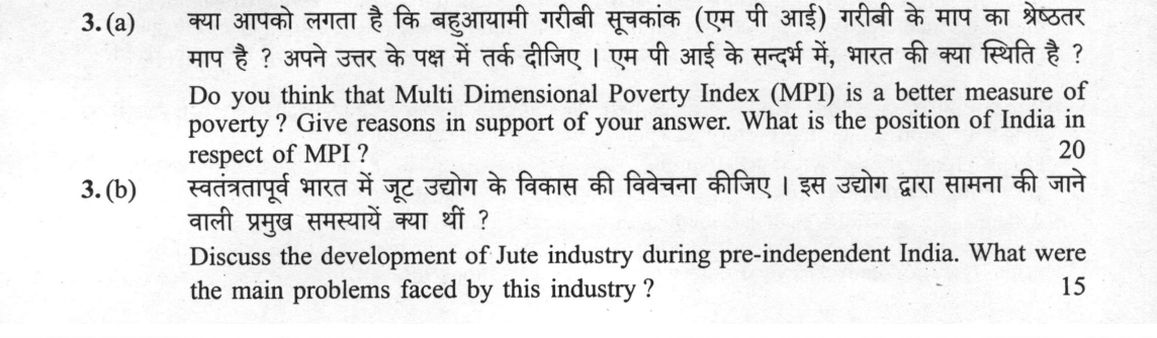
(a) Do you think that Multi Dimensional Poverty Index (MPI) is a better measure of poverty? Give reasons in support of your…
Do you think that Multi Dimensional Poverty Index (MPI) is a better measure of poverty? Give reasons in support of your answer. What is the position of India in respect of MPI? 20 marks
Discuss the development of Jute industry during pre-independent India. What were the main problems faced by this industry? 15 marks
'The small and cottage industries promote indigenous entrepreneurship'. Comment on the statement with respect to India. 15 marks
हिंदी में प्रश्न पढ़ें
क्या आपको लगता है कि बहुआयामी गरीबी सूचकांक (एम पी आई) गरीबी के माप का श्रेष्ठतर माप है ? अपने उत्तर के पक्ष में तर्क दीजिए । एम पी आई के संदर्भ में, भारत की क्या स्थिति है ? (20 अंक)
स्वतंत्रतापूर्व भारत में जूट उद्योग के विकास की विवेचना कीजिए । इस उद्योग द्वारा सामना की जाने वाली प्रमुख समस्याएं क्या थीं ? (15 अंक)
'लघु तथा कुटीर उद्योग देशज उद्यमिता को बढ़ावा देते हैं'। भारत के संदर्भ में, इस कथन पर टिप्पणी कीजिए। (15 अंक)
Model answer
Written by UPSC Answer Check against this question's marking rubric, to the expected length. UPSC does not publish answers for Mains — this is one way to score well, not an official key.
Multidimensional Poverty Index versus Monetary Measures
The Multidimensional Poverty Index (MPI), formulated by OPHI and UNDP using the Alkire-Foster methodology, represents a distinct conceptual advance over traditional monetary poverty lines, such as those formulated by the Tendulkar and Rangarajan Committees. Monetary measures rely on an income or consumption expenditure threshold to define a minimum basket of goods. In contrast, the MPI measures overlapping deprivations across ten indicators grouped into three equally weighted dimensions: Health (nutrition, child mortality), Education (years of schooling, school attendance), and Standard of Living (cooking fuel, sanitation, drinking water, electricity, housing, assets).
The MPI is a superior diagnostic tool because it identifies deprivation intensity at the individual household level, reflecting the lived experience of poverty where income does not automatically translate into access to basic public goods. It enables targeted policy interventions by disaggregating data across social groups and districts. However, the MPI has limitations: it is subject to data lags due to reliance on periodic survey cycles such as the National Family Health Survey (NFHS), uses debatable normative indicator weightings, masks intra-household allocation inequalities, and excludes non-material dimensions such as political voice and subjective well-being.
According to the Global MPI 2023, India has achieved a notable reduction in multidimensional poverty, recording an MPI value of 0.069 with a headcount poverty ratio of 16.4%, reflecting the lifting of roughly 415 million people out of poverty between 2005-06 and 2019-21.
Development and Problems of the Jute Industry in Pre-Independent India
The Indian mechanized jute industry originated with the establishment of the first spinning mill at Rishra, Bengal, in 1855 by George Acland. While Dundee in Scotland initially held a global monopoly on jute textile production, the locus of manufacturing shifted rapidly to the Hooghly basin due to direct proximity to raw jute acreage, low-cost river transport, and abundant cheap labor. British managing agency houses—collectively known as the "jute wallahs"—exercised cartelized control over the industry through the Indian Jute Mills Association (IJMA), extracting large export profits while suppressing the prices paid to raw jute cultivators.
The industry was impeded by multiple structural problems:
- Technological obsolescence, as British managing agencies prioritized short-term dividend extraction over capital reinvestment in modern spinning and weaving equipment.
- Protectionist trade barriers and industrial pressure from Dundee manufacturers.
- Discriminatory railway and sea freight structures that penalized Indian value-added exports.
- Monopolistic control of finance and marketing channels by foreign managing agencies.
- The 1947 Partition, which divided the sector by leaving over 75 percent of the high-grade raw jute-growing areas in East Pakistan, while all 108 processing mills remained in West Bengal, causing severe raw material shortages.
Small and Cottage Industries and Indigenous Entrepreneurship
Small and cottage industries serve as essential engines of indigenous entrepreneurship in India by lowering capital requirements, decentralizing production, and monetizing traditional craft skills. Across sectors like handlooms, handicrafts, and rural agro-processing, they democratize capital ownership and generate non-farm employment. Institutions like the Khadi and Village Industries Commission (KVIC) and cooperative networks such as the Amul model demonstrate how cottage enterprises build grassroots managerial capacity, utilize local raw materials, and foster self-reliant rural industrialization.
However, small enterprises face severe systemic constraints that impede sustained entrepreneurial growth. These units struggle with technological backwardness, volatile raw material supplies, inadequate institutional credit, and limited access to modern supply chains. Consequently, the Indian industrial landscape exhibits a persistent "missing middle," characterized by a vast base of micro-enterprises that remain informal and sub-scale to circumvent labor laws and taxation thresholds, alongside a few large corporations, with few dynamic, scaling medium-sized firms.
Way Forward
Addressing multidimensional deprivations captured by the MPI among rural artisans and industrial labor requires integrated industrial and welfare interventions. Schemes such as the Jute Technology Mission (JTM) and the Scheme of Fund for Regeneration of Traditional Industries (SFURTI) must focus on technological modernization, formal credit access, and cluster development, ensuring that traditional sectors transition from survivalist activities into scalable, modern entrepreneurial ecosystems.
What "Discuss" is asking you to do
Lay the issue out from more than one side — how it arose, what is claimed for it, what is held against it, and where it now stands. UPSC attaches discuss to broad topics with several live dimensions, so coverage of the dimensions earns more than the strength of your opinion.
Structure that answers it
Set the issue up → the case as it is made → the case against → the dimension both sides leave out → where the balance now lies
Where marks are lost
Listing facts with no thread between them, or arguing one side throughout and calling it a discussion.
How this answer will be evaluated
Approach
Framework: UPSC Economics Paper II. (a) justify: claim > 3-4 reasons > evidence > conclusion | (b) discuss: intro > 3-4 dimensions > example > balanced close Full marks: Precise definitions, clear contrast with HCR, specific data points, and a balanced view of the Jute industry's structural issues.
Key points expected
- Define MPI and its three dimensions (health, education, standard of living).
- Contrast MPI with Headcount Ratio (HCR) or BPL line.
- Explain the 'deprivation' and 'weighted' nature of MPI.
- State India's current MPI rank or score (e.g., NITI Aayog data).
- Trace the growth of the industry in Bengal (19th-20th century).
- Identify the 'Golden Age' of the industry (pre-1930s).
- List key problems: raw material shortage, labor unrest, competition.
- Mention the impact of the 1930s depression or WWII.
Evaluation rubric
Each sub-part is marked on its own, against the marks and word limit printed on the paper.
- (a) Justify MPI as a superior measure and state India's position. 20 marks
justify— claim → 3-4 reasons → evidence → conclusion
Must cover
- Define MPI and its three dimensions (health, education, standard of living).
- Contrast MPI with Headcount Ratio (HCR) or BPL line.
- Explain the 'deprivation' and 'weighted' nature of MPI.
- State India's current MPI rank or score (e.g., NITI Aayog data).
Loses marks
- Treating MPI as a simple income measure.
- Failing to distinguish between 'incidence' and 'intensity'.
- Ignoring the 'weighted' aspect of the index.
Earns more
- Mention the 12 indicators used in the Indian MPI.
- Reference the UNDP/OPHI Global MPI for international comparison.
- Discuss the 'poverty gap' or intensity of poverty.
- Mention the 2015-16 or 2019-21 NITI Aayog report.
Extra mark
- Cite specific state-level disparities (e.g., Bihar vs Kerala).
- Reference the 'Multidimensional Poverty Index' report by NITI Aayog.
- (b) Discuss pre-independence Jute industry development and its problems. 15 marks
discuss— intro → 3-4 dimensions → example → balanced close
Must cover
- Trace the growth of the industry in Bengal (19th-20th century).
- Identify the 'Golden Age' of the industry (pre-1930s).
- List key problems: raw material shortage, labor unrest, competition.
- Mention the impact of the 1930s depression or WWII.
Loses marks
- Confusing pre-independence with post-independence issues.
- Ignoring the 'raw material' bottleneck.
- Failing to mention the 'labor' issues (strikes).
Earns more
- Reference the 'Jute Mills Act' or specific legislation.
- Mention the role of the 'Jute Commission' or 'Jute Enquiry Committee'.
- Discuss the 'raw jute' vs 'manufactured jute' price gap.
- Mention the shift of industry to Pakistan post-1947.
Extra mark
- Cite specific mill names (e.g., Birla, Tatas).
- Reference the 'Jute Industry (Control) Act, 1947'.
Practice this exact question
Write your answer and it is marked point by point against the model answer above — what you covered, what you missed, what you got wrong.
Evaluate my answer →More from Economics 2022 Paper II
- Q1 Answer the following questions in about 150 words each: (a) Outline the factors that caus…
- Q2 (a) Highlight the major features of National Income trend and its sectoral composition du…
- Q3 (a) Do you think that Multi Dimensional Poverty Index (MPI) is a better measure of povert…
- Q4 (a) Do you subscribe to the view that private sector is a key driver to economic developm…
- Q5 Answer the following questions in about 150 words each: (a) Do you think that Indian deve…
- Q6 (a) What is the objective of exchange rate management? Do you think that the present regi…