Paper II — Q8
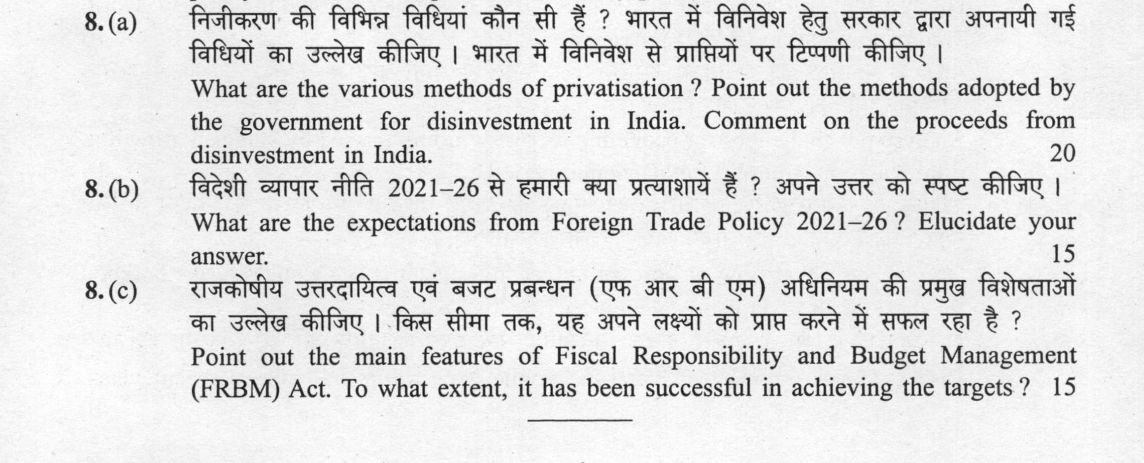
(a) What are the various methods of privatisation? Point out the methods adopted by the government for disinvestment in India…
What are the various methods of privatisation? Point out the methods adopted by the government for disinvestment in India. Comment on the proceeds from disinvestment in India. 20 marks
What are the expectations from Foreign Trade Policy 2021-26? Elucidate your answer. 15 marks
Point out the main features of Fiscal Responsibility and Budget Management (FRBM) Act. To what extent, it has been successful in achieving the targets? 15 marks
हिंदी में प्रश्न पढ़ें
निजीकरण की विभिन्न विधियां कौन सी हैं ? भारत में विनिवेश हेतु सरकार द्वारा अपनायी गई विधियों का उल्लेख कीजिए । भारत में विनिवेश से प्राप्तियों पर टिप्पणी कीजिए । (20 अंक)
विदेशी व्यापार नीति 2021-26 से हमारी क्या प्रत्याशायें हैं ? अपने उत्तर को स्पष्ट कीजिए । (15 अंक)
राजकोषीय उत्तरदायित्व एवं बजट प्रबंधन (एफ आर बी एम) अधिनियम की प्रमुख विशेषताओं का उल्लेख कीजिए । किस सीमा तक, यह अपने लक्ष्यों को प्राप्त करने में सफल रहा है ? (15 अंक)
Model answer
Written by UPSC Answer Check against this question's marking rubric, to the expected length. UPSC does not publish answers for Mains — this is one way to score well, not an official key.
India’s post-1991 reform trajectory transitioned the state from a dominant producer to a facilitator, anchoring fiscal stability and external competitiveness through disinvestment, trade policy revamping, and fiscal discipline frameworks.
Methods of Privatisation and India’s Disinvestment Experience
Privatisation involves transferring ownership, management, or control of public sector enterprises (PSEs) to the private sector. The primary methods include Initial Public Offerings (IPOs) and Further Public Offerings (FPOs), strategic sales with management control transfer, share buybacks, Employee Stock Ownership Plans (ESOPs), and direct asset sales or long-term concessioning.
In India, the Department of Investment and Public Asset Management (DIPAM) executes disinvestment through two distinct routes: minority stake sales (via Offer for Sale, CPSE Exchange Traded Funds, and Bharat-22 ETF) and strategic disinvestment, involving the transfer of 50% or more equity along with management control (such as Air India and NINL). The National Monetisation Pipeline (NMP) further supplements this via brownfield asset leasing.
Disinvestment proceeds are channeled into the National Investment Fund (NIF) to finance social infrastructure, capital expenditure, and Public Sector Bank (PSB) recapitalisation. However, proceeds have persistently missed Budget Estimates (BE). For instance, against a BE of ₹1.75 lakh crore in FY22, actual receipts stood at ₹13,534 crore, and in FY24, receipts yielded roughly ₹16,500 crore against a BE of ₹51,000 crore. Reliance on minority sales and cross-holdings between Central Public Sector Enterprises (CPSEs) often serves as a stop-gap for fiscal deficits without delivering true operational autonomy, underscoring the need for genuine strategic exits.
Expectations from Foreign Trade Policy (FTP) 2021-26
The Foreign Trade Policy (extended into FTP 2023) sets an ambitious target of $2 trillion in total exports (merchandise and services combined) by 2030, shifting from discretionary incentives to a remission- and dialogue-based regime. Key expectations include:
First, mainstreaming districts as export engines through the "Districts as Export Hubs" (DEH) initiative, linking grassroots artisans and MSMEs to global markets. Second, integrating cross-border e-commerce by raising consignment limits and creating designated e-commerce export zones. Third, rationalising the Special Chemicals, Organisms, Materials, Equipment and Technologies (SCOMET) licensing framework to facilitate high-tech exports and dual-use technology integration. Fourth, institutionalising rupee trade settlement mechanisms to navigate geopolitical currency risks and expanding the Authorized Economic Operator (AEO) scheme for trade facilitation.
Crucially, the FTP aligns with Atmanirbhar Bharat and the Production-Linked Incentive (PLI) schemes to enhance domestic manufacturing depth. Nonetheless, bridging non-tariff barriers, lowering logistics costs from ~14% to 8% of GDP, and addressing sectoral export gaps in labour-intensive segments remain vital.
FRBM Act: Features, Trajectory, and Fiscal Consolidation
The Fiscal Responsibility and Budget Management (FRBM) Act, 2003, established a statutory framework to institutionalise fiscal prudence. Its key features include mandating a fiscal deficit target of 3% of GDP, the elimination of the revenue deficit, statutory disclosures (Macroeconomic Framework Statement, Fiscal Policy Strategy Statement, and Medium-Term Fiscal Policy Statement), and reporting of contingent liabilities. Following the N.K. Singh Committee recommendations (2017), the framework shifted focus to general government debt (60% of GDP; 40% for the Centre) and introduced specific "escape clauses" permitting 0.5% deficit relaxation during structural reforms, national security emergencies, or severe natural calamities.
The Act witnessed initial success during 2003–2008, bringing the fiscal deficit down to 2.54% in FY08. However, the 2008 Global Financial Crisis triggered a counter-cyclical pause, and the COVID-19 pandemic necessitated extensive fiscal expansion, pushing the deficit to 9.2% of GDP in FY21. The framework is frequently critiqued for its procyclical nature and mechanical targets that squeeze capital expenditure during downturns. The Centre has since adopted a revised consolidation glide path targeting a fiscal deficit below 4.5% of GDP by FY26 (reaching 5.6% in FY24).
Ultimately, non-debt capital receipts from disinvestment directly support FRBM deficit compliance, while export growth under the FTP generates the revenue buoyancy necessary to achieve sustainable fiscal consolidation without compromising developmental expenditure.
What "Elucidate" is asking you to do
Make a stated proposition plain and then prove it with instances. Elucidate stems almost always carry a claim or a named concept, and very often the words “with examples” or “with suitable diagrams” — the illustration is part of the directive, not decoration.
Structure that answers it
Plain-language statement of what the proposition means → the part that is obscure, resolved → first illustration → second illustration → why the proposition holds
Where marks are lost
Adding terminology; elucidate rewards removing it. The commoner loss is a clean explanation with no example, when the stem asked for examples.
How this answer will be evaluated
Approach
Framework: UPSC Economics Paper II. (a) comment: context > arguments both sides > judgment > close | (b) explain: definition/context > points in order > small example > short close | (c) critically evaluate: positives > negatives/limits > conditions/safeguards > conclusion Full marks: Precise definitions, clear distinction between concepts, specific Indian examples, and a balanced critical assessment.
Key points expected
- Define privatization and distinguish it from disinvestment
- List methods: sale of stake, IPO, FPO, GDR, ADR
- Identify Indian modes: public offer, strategic sale, buyback
- Critique proceeds: use for deficit vs. capital investment
- State the goal: $1 trillion exports by 2030
- Mention the shift to a positive list regime
- Explain the 'Ease of Doing Business' measures
- Highlight the focus on MSMEs and women entrepreneurs
Evaluation rubric
Each sub-part is marked on its own, against the marks and word limit printed on the paper.
- (a) Contextualize privatization methods, detail Indian disinvestment modes, and judge the utility of proceeds. 20 marks
comment— context → arguments both sides → judgment → close
Must cover
- Define privatization and distinguish it from disinvestment
- List methods: sale of stake, IPO, FPO, GDR, ADR
- Identify Indian modes: public offer, strategic sale, buyback
- Critique proceeds: use for deficit vs. capital investment
Loses marks
- Confusing privatization with liberalization
- Listing methods without explaining the mechanism
- Ignoring the 'proceeds' aspect of the question
Earns more
- Mention specific disinvestments (e.g., BPCL, GAIL)
- Reference the 51% threshold debate
- Cite specific years of major IPOs
- Mention the role of NITI Aayog in disinvestment
Extra mark
- Cite specific disinvestment proceeds figures from recent Budgets
- Reference the 'Exit Policy' of 1991
- (b) Define the FTA 2021-26 objectives and elaborate on its key structural changes. 15 marks
explain— definition/context → points in order → small example → short close
Must cover
- State the goal: $1 trillion exports by 2030
- Mention the shift to a positive list regime
- Explain the 'Ease of Doing Business' measures
- Highlight the focus on MSMEs and women entrepreneurs
Loses marks
- Confusing FTA with FDI policy
- Listing features without explaining their impact
- Ignoring the 2021-26 timeframe
Earns more
- Mention the 100% FDI approval route
- Reference the 'One District One Product' scheme
- Discuss the role of e-commerce in the policy
- Mention the reduction in export documentation
Extra mark
- Cite specific export growth targets for sectors
- Reference the 'Make in India' linkage
- (c) Outline FRBM Act features and assess its success in meeting fiscal targets. 15 marks
critically evaluate— positives → negatives/limits → conditions/safeguards → conclusion
Must cover
- Define the FRBM Act (2003) and its objectives
- List key features: deficit targets, fiscal consolidation
- Assess success: reduction in fiscal deficit
- Critique: frequent amendments and waivers
Loses marks
- Confusing FRBM with the Budget process
- Listing features without assessing success
- Ignoring the 'critical evaluation' aspect
Earns more
- Mention the 4% fiscal deficit target
- Reference the 2018 amendment (4% to 3.5%)
- Discuss the 'Fiscal Responsibility' of states
- Mention the role of the FRBM Committee
Extra mark
- Cite specific fiscal deficit figures for recent years
- Reference the 'Fiscal Responsibility and Budget Management (Amendment) Act, 2018'
Practice this exact question
Write your answer and it is marked point by point against the model answer above — what you covered, what you missed, what you got wrong.
Evaluate my answer →More from Economics 2022 Paper II
- Q5 Answer the following questions in about 150 words each: (a) Do you think that Indian deve…
- Q6 (a) What is the objective of exchange rate management? Do you think that the present regi…
- Q7 (a) Critically examine the various poverty alleviation programmes in India since 1970's.…
- Q8 (a) What are the various methods of privatisation? Point out the methods adopted by the g…