Paper II — Q7
(a) Critically examine the various poverty alleviation programmes in India since 1970's. (20 marks) (b) Differentiate between…
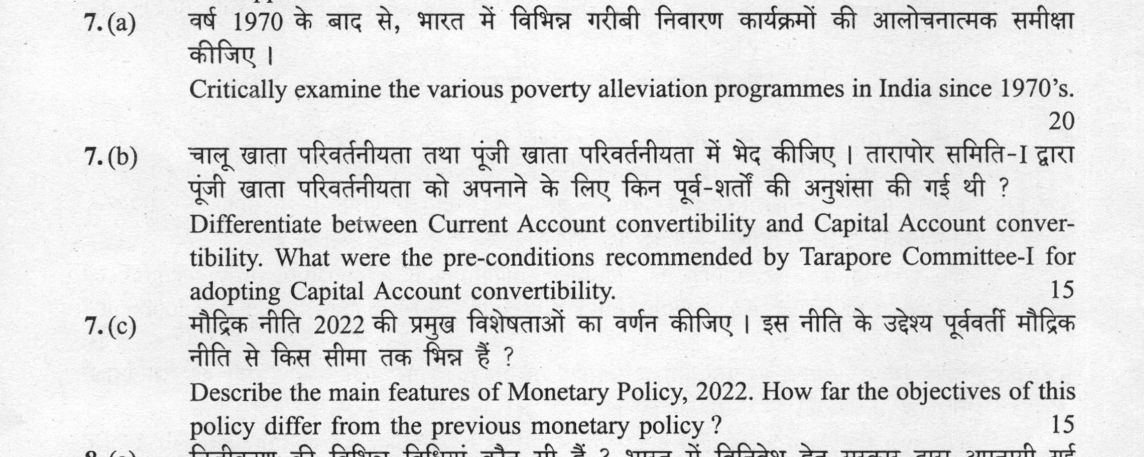
Critically examine the various poverty alleviation programmes in India since 1970's. 20 marks
Differentiate between Current Account convertibility and Capital Account convertibility. What were the pre-conditions recommended by Tarapore Committee-I for adopting Capital Account convertibility. 15 marks
Describe the main features of Monetary Policy, 2022. How far the objectives of this policy differ from the previous monetary policy? 15 marks
हिंदी में प्रश्न पढ़ें
वर्ष 1970 के बाद से, भारत में विभिन्न गरीबी निवारण कार्यक्रमों की आलोचनात्मक समीक्षा कीजिए । (20 अंक)
चालू खाता परिवर्तनीयता तथा पूंजी खाता परिवर्तनीयता में भेद कीजिए । तारापोर समिति-I द्वारा पूंजी खाता परिवर्तनीयता को अपनाने के लिए किन पूर्व-शर्तों की अनुशंसा की गई थी ? (15 अंक)
मौद्रिक नीति 2022 की प्रमुख विशेषताओं का वर्णन कीजिए । इस नीति के उद्देश्य पूर्ववर्ती मौद्रिक नीति से किस सीमा तक भिन्न हैं ? (15 अंक)
Model answer
Written by UPSC Answer Check against this question's marking rubric, to the expected length. UPSC does not publish answers for Mains — this is one way to score well, not an official key.
India’s post-1970 poverty policy moved from growth-led trickle-down to targeted welfare, but its success is uneven. Poverty programmes since the 1970s began with IRDP (1978), which aimed to lift poor families above the poverty line through self-employment, microcredit and asset creation. It was followed by JRY, SWS, DDC, and later MGNREGA (2005) and NFSA (2013). The shift was important: IRDP treated poverty as lack of assets, NREGA as lack of work, NFSA as entitlement to food. Yet critical examination shows persistent weaknesses. Targeting errors excluded the poorest while including non-poor; leakages, ghost beneficiaries and corruption reduced effective coverage; and graduation failure meant many remained dependent on wage or food support. Self-employment schemes often failed because credit, training and market access were weak, while wage schemes provided immediate income but did not always build durable assets. The Tendulkar (2013) and Rangarajan (2014) debates exposed how poverty estimates depend on consumption baskets and poverty lines, making policy evaluation difficult. Empirically, MGNREGA’s wage-productivity gap—statutory wages often below market or productivity in some states—limited incentives and made it a safety net rather than a path to higher productivity. Thus, the verdict is that programmes reduced acute deprivation but remain fragmented; wage protection is more reliable than self-employment for the poorest, but both need better targeting, digital accountability and asset creation.
Current and capital account convertibility differ in scope. Current account convertibility allows conversion of domestic currency for trade in goods and services, factor income and unilateral transfers at market rates; India has this. Capital account convertibility permits free conversion for cross-border financial flows such as FDI, FPI, external borrowing and portfolio investment. Tarapore Committee-I (1997) recommended staged CAC, but only after three preconditions: fiscal deficit reduction, inflation control, and financial-sector reforms, the last including NPA reduction and interest-rate deregulation. It treated forex reserves covering six months of imports and short-term debt limits as signposts, not preconditions. India has not moved to full CAC because these preconditions were not sustained, and external shocks exposed vulnerability. The 2013 taper tantrum, when FPI outflows and rupee depreciation triggered capital flight, showed that premature capital account opening could destabilise the financial system. Hence partial CAC remains rational: it allows market access while retaining macro-prudential controls.
Monetary Policy 2022 was defined by the MPC’s shift from accommodative to neutral and then withdrawal of accommodation, with repo-rate increases to contain CPI inflation. Its main features were inflation targeting under the 2016 framework (4% CPI with a ±2% band), tighter liquidity, attention to supply-side shocks, global commodity prices, rupee depreciation and inflation expectations. This differed from the 2016-2020 liquidity-surplus and COVID-era policy, which used low rates, liquidity injection and unconventional support to protect growth. The objectives are not wholly different—price stability, growth and financial stability remain—but the emphasis changed from growth support and exchange-rate management to price stability and macro stability. Inflation targeting had succeeded in keeping CPI within the band in much of 2017-2020, but its failure in 2022, when supply shocks pushed inflation above the band, showed the limits of demand-side policy.
The three areas are linked. Poverty programmes and financial inclusion—Jan Dhan, DBT, MGNREGA wage payments—improve monetary policy transmission by bringing households into the banking system and reducing cash dependence. Yet if poverty programmes suffer leakages and low productivity, their demand effects are weak, and if capital account remains partially open, external volatility can still disrupt inflation and growth. India’s evolving framework is therefore pragmatic: welfare entitlements, managed convertibility and inflation-targeting monetary policy are better than either laissez-faire or rigid controls, but they require stronger implementation, fiscal discipline and resilience to external shocks.
What "Critically examine" is asking you to do
Test the proposition the question puts to you and return a finding on how far it holds. Examine stems carry a claim, or ask whether something has happened, and expect evidence weighed both ways before the extent is stated — often with remedial measures attached. “Critically” is not a section added at the end: name the yardstick you are judging by — the evidence, the stated objective, a constitutional principle, a rival explanation — and let a verdict close each part of the body. Where the question quotes a claim, that verdict must land on the claim itself, accepted, qualified or rejected, and not on the theme in general.
Structure that answers it
Restate the claim as the question frames it → evidence that supports it → evidence that undercuts it → the conditions under which it holds → verdict on how far it stands
Where marks are lost
Merits in one paragraph, demerits in the next, and a conclusion calling for a balanced and holistic approach. That is a survey with the judgement left out and it holds the answer in the middle band. The opposite error is reading “critically” as permission to attack — and with the odd pairings, critically describe or critically explain, the exposition still carries most of the marks, the judgement being a layer on it rather than a substitute for it.
How this answer will be evaluated
Approach
Framework: UPSC Economics Paper II. (a) critically evaluate: positives > negatives/limits > conditions/safeguards > conclusion | (b) compare: paired headings or table > key differences > significance > conclusion | (c) describe: define > structure or process in order > labelled diagram > significance Full marks: Comprehensive, critical, and well-structured with specific data and named committees.
Key points expected
- Chronological coverage of schemes from 1970s to present
- Identification of specific programmes (e.g., NREP, MGNREGA, PMAY)
- Assessment of effectiveness and structural limitations
- Balanced conclusion on the evolution of policy
- Clear distinction between Current and Capital Account
- Definition of convertibility in both contexts
- Listing of Tarapore Committee-I pre-conditions
- Explanation of why pre-conditions are necessary
Evaluation rubric
Each sub-part is marked on its own, against the marks and word limit printed on the paper.
- (a) Critical examination of poverty alleviation programmes in India since the 1970s. 20 marks
critically evaluate— positives → negatives/limits → conditions/safeguards → conclusion
Must cover
- Chronological coverage of schemes from 1970s to present
- Identification of specific programmes (e.g., NREP, MGNREGA, PMAY)
- Assessment of effectiveness and structural limitations
- Balanced conclusion on the evolution of policy
Loses marks
- Listing schemes without critical analysis
- Ignoring the pre-1991 era (pre-reform) programmes
- Vague generalizations without naming specific acts
Earns more
- Reference to specific poverty line estimates (e.g., Tendulkar, Rangarajan)
- Mention of specific budget allocations or outturns
- Discussion of the shift from relief to development
Extra mark
- Citing specific data from the Economic Survey
- Mentioning the 'Mission Antyodaya' or 'NITI Aayog' role
- (b) Differentiation of Current vs Capital Account convertibility and Tarapore-I pre-conditions. 15 marks
compare— paired headings or table → key differences → significance → conclusion
Must cover
- Clear distinction between Current and Capital Account
- Definition of convertibility in both contexts
- Listing of Tarapore Committee-I pre-conditions
- Explanation of why pre-conditions are necessary
Loses marks
- Confusing current account with trade balance only
- Failing to list the specific pre-conditions
- Vague definitions without economic context
Earns more
- Mention of 'hot money' risks in capital account
- Reference to the 1993/1994 context of the committee
- Specific examples of current account items (trade, services)
Extra mark
- Mentioning the 'Tarapore Committee-II' for contrast
- Reference to the 'Liberalised Remittance Scheme' (LRS)
- (c) Features of Monetary Policy 2022 and comparison of objectives with previous policy. 15 marks
describe— define → structure or process in order → labelled diagram → significance
Must cover
- Description of the 2022 policy stance (e.g., neutral)
- Identification of the primary objective (inflation targeting)
- Comparison with previous policy objectives (e.g., growth focus)
- Mention of the 'Flexible Inflation Targeting' framework
Loses marks
- Failing to distinguish 2022 policy from general policy
- Ignoring the 'dual mandate' or 'inflation targeting' shift
- Vague description without specific policy tools
Earns more
- Reference to the 4% inflation target with +/- 2% band
- Mention of the 'Monetary Policy Committee' (MPC)
- Discussion of the 'transmission mechanism'
Extra mark
- Citing specific repo rate changes in 2022
- Mentioning the 'Liquidity Management' tools (LAF, SDF)
Practice this exact question
Write your answer and it is marked point by point against the model answer above — what you covered, what you missed, what you got wrong.
Evaluate my answer →More from Economics 2022 Paper II
- Q4 (a) Do you subscribe to the view that private sector is a key driver to economic developm…
- Q5 Answer the following questions in about 150 words each: (a) Do you think that Indian deve…
- Q6 (a) What is the objective of exchange rate management? Do you think that the present regi…
- Q7 (a) Critically examine the various poverty alleviation programmes in India since 1970's.…
- Q8 (a) What are the various methods of privatisation? Point out the methods adopted by the g…