Paper II — Q5
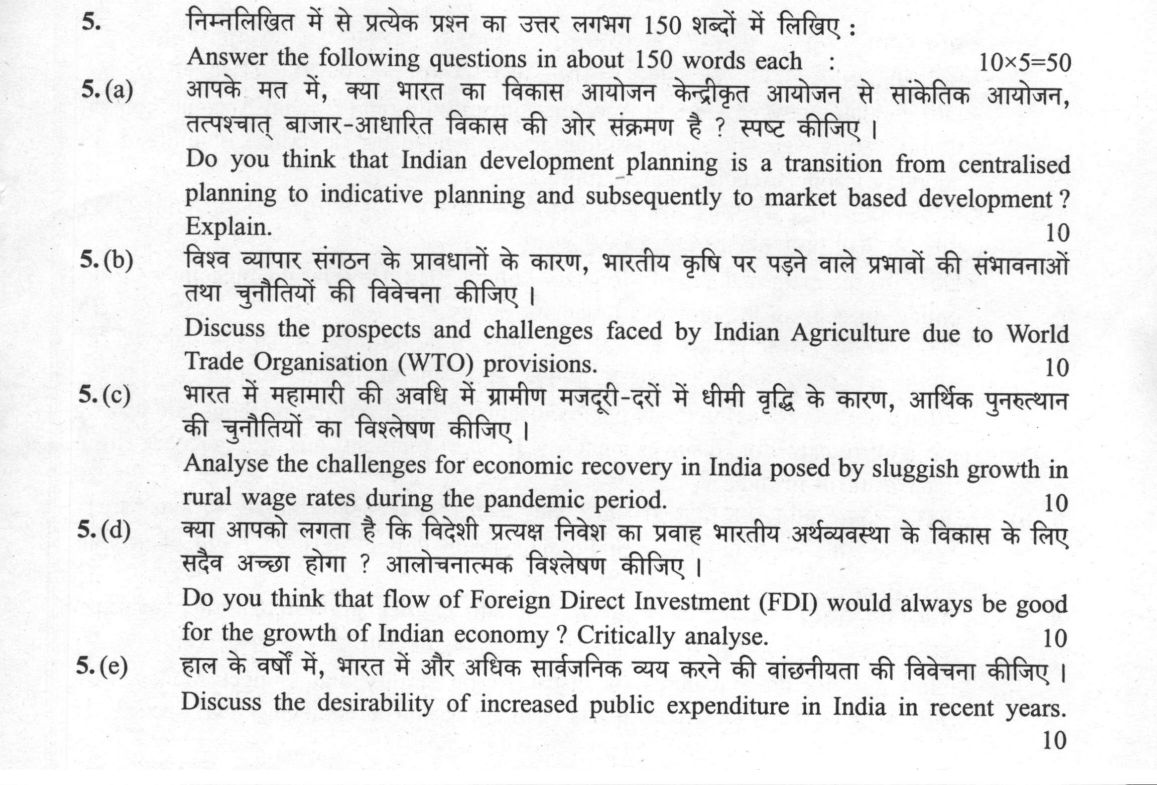
Answer the following questions in about 150 words each: (a) Do you think that Indian development planning is a transition from…
Answer the following questions in about 150 words each: Do you think that Indian development planning is a transition from centralised planning to indicative planning and subsequently to market based development? Explain. 10 marks
Discuss the prospects and challenges faced by Indian Agriculture due to World Trade Organisation (WTO) provisions. 10 marks
Analyse the challenges for economic recovery in India posed by sluggish growth in rural wage rates during the pandemic period. 10 marks
Do you think that flow of Foreign Direct Investment (FDI) would always be good for the growth of Indian economy? Critically analyse. 10 marks
Discuss the desirability of increased public expenditure in India in recent years. 10 marks
हिंदी में प्रश्न पढ़ें
निम्नलिखित में से प्रत्येक प्रश्न का उत्तर लगभग 150 शब्दों में लिखिए : आपके मत में, क्या भारत का विकास आयोजन केन्द्रीकृत आयोजन से सांकेतिक आयोजन, तत्पश्चात् बाजार-आधारित विकास की ओर संक्रमण है ? स्पष्ट कीजिए। (10 अंक)
विश्व व्यापार संगठन के प्रावधानों के कारण, भारतीय कृषि पर पड़ने वाले प्रभावों की संभावनाओं तथा चुनौतियों की विवेचना कीजिए। (10 अंक)
भारत में महामारी की अवधि में ग्रामीण मजदूरी-दरों में धीमी वृद्धि के कारण, आर्थिक पुनरुत्थान की चुनौतियों का विश्लेषण कीजिए। (10 अंक)
क्या आपको लगता है कि विदेशी प्रत्यक्ष निवेश का प्रवाह भारतीय अर्थव्यवस्था के विकास के लिए सदैव अच्छा होगा ? आलोचनात्मक विश्लेषण कीजिए। (10 अंक)
हाल के वर्षों में, भारत में और अधिक सार्वजनिक व्यय करने की वांछनीयता की विवेचना कीजिए। (10 अंक)
Model answer
Written by UPSC Answer Check against this question's marking rubric, to the 150-word length. UPSC does not publish answers for Mains — this is one way to score well, not an official key.
(a) Indian planning moved from centralised planning in the 1950s-80s to indicative planning in 1991-2014 and then market-based development, but gradually. The Second Five Year Plan and Planning Commission embodied centralised planning, with public investment, licensing and target-driven allocation. The 1991 liberalisation markers—trade reform, disinvestment, fiscal consolidation and market opening—converted plans into indicative frameworks, where government set priorities but left allocation to markets. The 2014 dismantling of the Planning Commission and creation of NITI Aayog in 2015 marked a structural break: cooperative federalism, competitive states and policy coordination replaced plan targets. The 2017 plan holiday shows India now relies more on market signals, institutional reforms and outcome-based policies. The shift was not linear; state and market roles changed with crises and reforms. Yet the state remains important in infrastructure, social spending and crisis management, so the transition is a move from command planning to market-led development with strategic state intervention.
(b) The WTO Agreement on Agriculture gives Indian agriculture prospects through market access, predictable export rules and discipline on other countries’ subsidies. India can benefit from global demand for rice, spices, dairy and processed foods, and from Green Box support for research, extension and infrastructure, which is non- or minimally trade-distorting. The challenge is that Amber Box Aggregate Measurement of Support is trade-distorting and subject to reduction commitments, limiting price support. India’s de minimis allowance of 10 per cent of the value of production is useful but narrow. Blue Box payments are exempt from reduction commitments, but constrained by fixed reference prices and historical base years, so they do not provide unlimited policy space. Thus WTO rules expand export opportunities and discipline trade barriers, yet compress room for direct price support, forcing India to shift towards input subsidies, crop insurance, irrigation, market infrastructure and Green Box measures while managing farmer income and food security.
(c) Sluggish rural wage growth during the pandemic weakened India's consumption base. The Periodic Labour Force Survey showed fragile rural wage trends: daily wages in agriculture and construction were depressed, and agricultural real wages fell in 2020-21 as prices rose and work opportunities shrank. MGNREGA provided a floor, but its wage support was effectively stagnant in real terms for many households, while job intensity remained uneven. Rural households are net food consumers and major buyers of low-value manufactured goods; when their wages stagnate, demand for food, clothing, durables and services falls. This matters because rural demand drives MSME output, local markets and the multiplier from public works. If rural wages do not recover, consumption-led recovery remains constrained, and higher urban growth may not translate into broad-based employment. Recovery therefore requires faster rural wage growth through public works, irrigation, rural non-farm activity and social protection, not merely aggregate GDP growth.
(d) FDI is not automatically good for Indian growth; its value depends on sector and scale. On the positive side, FDI brings technology transfer, export linkages and employment, especially in manufacturing, IT and infrastructure. Sector-specific patterns matter: 100 per cent automatic-route FDI in many sectors has eased investment, while restrictions in multi-brand retail have protected local traders. Yet FDI can crowd out domestic MSMEs when foreign firms use scale, branding and credit access to dominate markets. Profit repatriation can reduce domestic savings, and sectoral imbalances may concentrate investment in high-return services while leaving low-margin manufacturing or agriculture underinvested. If FDI is tied to local sourcing, skill development and technology spillovers, it can complement domestic capital. If treated as a substitute for domestic investment, it may create dependency and uneven growth. Thus FDI is beneficial when it raises productive capacity, but limited or harmful when it merely repatriates profits or displaces local firms.
(e) Increased public expenditure in recent years is desirable when it is productive and counter-cyclical. Post-COVID fiscal expansion—higher spending on health, food security, rural works and infrastructure—supported demand, consistent with Keynesian multiplier logic: government spending raises income and employment. In a liquidity-constrained economy, such spending can be more effective than private investment when private demand is weak. However, Ricardian equivalence concerns are not irrelevant: if households expect future tax rises or debt service, they may save more, weakening the multiplier. The quality of expenditure matters; recurrent subsidies and low-return assets can raise debt without raising growth. India’s FRBM targets show the tension between stimulus and debt sustainability. A prudent path is to expand capital expenditure, improve implementation and target social protection, while containing unproductive recurrent outlays. Thus higher public spending is desirable if it raises productive capacity and protects vulnerable groups, but not if it simply enlarges the deficit without growth.
What "Critically analyse" is asking you to do
Break the subject into its working parts and show how they act on each other. The marks are in the interconnections — which factor drives which, and what the resulting structure explains — not in the inventory of factors. “Critically” is not a section added at the end: name the yardstick you are judging by — the evidence, the stated objective, a constitutional principle, a rival explanation — and let a verdict close each part of the body. Where the question quotes a claim, that verdict must land on the claim itself, accepted, qualified or rejected, and not on the theme in general.
Structure that answers it
Define the whole → separate it into its parts → show which part drives which → what that interaction produces → what the structure implies
Where marks are lost
Merits in one paragraph, demerits in the next, and a conclusion calling for a balanced and holistic approach. That is a survey with the judgement left out and it holds the answer in the middle band. The opposite error is reading “critically” as permission to attack — and with the odd pairings, critically describe or critically explain, the exposition still carries most of the marks, the judgement being a layer on it rather than a substitute for it.
How this answer will be evaluated
Approach
Framework: UPSC Economics Paper II (Development Planning & Policy). (a) explain: definition/context > points in order > small example > short close | (b) discuss: intro > 3-4 dimensions > example > balanced close | (c) analyse: intro > causes > effects > stakeholders/linkages > way forward | (d) critically evaluate: positives > negatives/limits > conditions/safeguards > conclusion | (e) discuss: intro > 3-4 dimensions > example > balanced close Full marks: Comprehensive, well-structured, and uses specific examples and data.
Key points expected
- Define centralised vs indicative planning
- Identify the 1991 shift to market-based development
- Mention the role of the NITI Aayog
- Conclude on the current hybrid model
- Identify key WTO provisions (e.g., TRIPS, SPS)
- Discuss the impact on Indian agriculture
- Mention the challenges (e.g., competition, subsidies)
- Conclude on the prospects
Evaluation rubric
Each sub-part is marked on its own, against the marks and word limit printed on the paper.
- (a) Trace the evolution of Indian planning from centralised to market-based. 10 marks · 150 words
explain— definition/context → points in order → small example → short close
Must cover
- Define centralised vs indicative planning
- Identify the 1991 shift to market-based development
- Mention the role of the NITI Aayog
- Conclude on the current hybrid model
Loses marks
- Confusing centralised with indicative planning
- Ignoring the role of the state
- Failing to mention the 1991 reforms
Earns more
- Reference to the 11th Five Year Plan
- Mention of the 12th Plan's indicative nature
- Reference to the 15th Finance Commission
Extra mark
- Cite the 1991 LPG reforms
- Mention the 2015 NITI Aayog Act
- (b) Evaluate the impact of WTO provisions on Indian agriculture. 10 marks · 150 words
discuss— intro → 3-4 dimensions → example → balanced close
Must cover
- Identify key WTO provisions (e.g., TRIPS, SPS)
- Discuss the impact on Indian agriculture
- Mention the challenges (e.g., competition, subsidies)
- Conclude on the prospects
Loses marks
- Confusing WTO with other trade bodies
- Ignoring the impact on small farmers
- Failing to mention the 'Peace Clause'
Earns more
- Reference to the Doha Development Round
- Mention of the 'Peace Clause'
- Reference to the 'Special Safeguard Mechanism'
Extra mark
- Cite the 2015 WTO Ministerial Conference
- Mention the 'Agricultural Agreement'
- (c) Analyse the impact of sluggish rural wage growth on recovery. 10 marks · 150 words
analyse— intro → causes → effects → stakeholders/linkages → way forward
Must cover
- Define 'sluggish growth in rural wage rates'
- Identify the causes (e.g., pandemic, lockdowns)
- Discuss the impact on economic recovery
- Conclude on the way forward
Loses marks
- Confusing rural with urban wages
- Ignoring the role of MGNREGA
- Failing to mention the pandemic's impact
Earns more
- Reference to the 'MGNREGA' scheme
- Mention of the 'Rural Employment Guarantee Act'
- Reference to the 'National Sample Survey'
Extra mark
- Cite the 2020-21 NSO data
- Mention the 'Rural Livelihoods' report
- (d) Critically evaluate the role of FDI in Indian economic growth. 10 marks · 150 words
critically evaluate— positives → negatives/limits → conditions/safeguards → conclusion
Must cover
- Define FDI and its role in the economy
- Identify the benefits (e.g., capital, technology)
- Discuss the challenges (e.g., job losses, inequality)
- Conclude on the conditions for FDI to be beneficial
Loses marks
- Confusing FDI with FPI
- Ignoring the impact on domestic industries
- Failing to mention the 'Automatic Route'
Earns more
- Reference to the 'FDI Policy'
- Mention of the 'Automatic Route'
- Reference to the 'Sectoral Caps'
Extra mark
- Cite the 2020 FDI inflow data
- Mention the 'FDI Committee'
- (e) Discuss the desirability of increased public expenditure in India. 10 marks · 150 words
discuss— intro → 3-4 dimensions → example → balanced close
Must cover
- Define public expenditure and its components
- Identify the benefits (e.g., infrastructure, social services)
- Discuss the challenges (e.g., fiscal deficit, debt)
- Conclude on the desirability
Loses marks
- Confusing public expenditure with government revenue
- Ignoring the impact on the fiscal deficit
- Failing to mention the 'Fiscal Responsibility Act'
Earns more
- Reference to the 'Fiscal Responsibility and Budget Management Act'
- Mention of the 'Fiscal Deficit'
- Reference to the 'Public Debt'
Extra mark
- Cite the 2020-21 Budget data
- Mention the 'Fiscal Council'
Practice this exact question
Write your answer and it is marked point by point against the model answer above — what you covered, what you missed, what you got wrong.
Evaluate my answer →More from Economics 2022 Paper II
- Q2 (a) Highlight the major features of National Income trend and its sectoral composition du…
- Q3 (a) Do you think that Multi Dimensional Poverty Index (MPI) is a better measure of povert…
- Q4 (a) Do you subscribe to the view that private sector is a key driver to economic developm…
- Q5 Answer the following questions in about 150 words each: (a) Do you think that Indian deve…
- Q6 (a) What is the objective of exchange rate management? Do you think that the present regi…
- Q7 (a) Critically examine the various poverty alleviation programmes in India since 1970's.…
- Q8 (a) What are the various methods of privatisation? Point out the methods adopted by the g…