Paper II — Q2
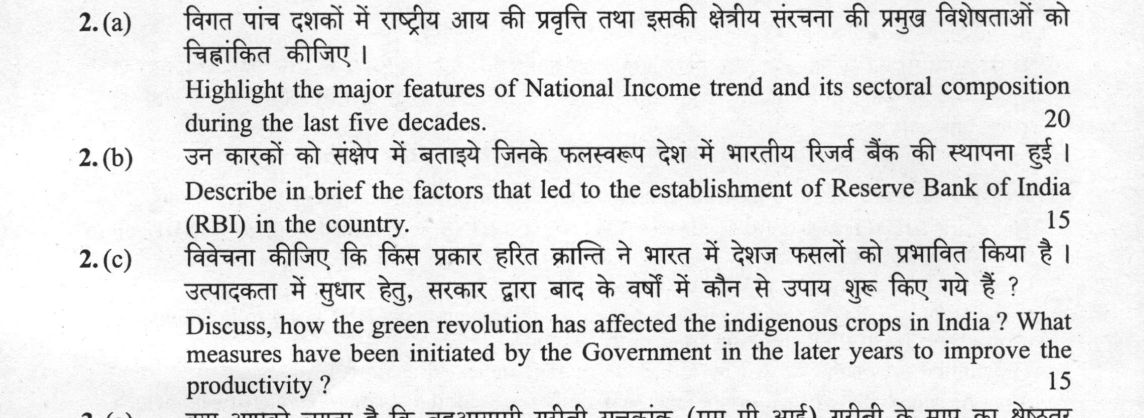
(a) Highlight the major features of National Income trend and its sectoral composition during the last five decades. (20…
Highlight the major features of National Income trend and its sectoral composition during the last five decades. 20 marks
Describe in brief the factors that led to the establishment of Reserve Bank of India (RBI) in the country. 15 marks
Discuss, how the green revolution has affected the indigenous crops in India? What measures have been initiated by the Government in the later years to improve the productivity? 15 marks
हिंदी में प्रश्न पढ़ें
विगत पांच दशकों में राष्ट्रीय आय की प्रवृत्ति तथा इसकी क्षेत्रीय संरचना की प्रमुख विशेषताओं को चिह्नांकित कीजिए । (20 अंक)
उन कारकों को संक्षेप में बताइये जिनके फलस्वरूप देश में भारतीय रिजर्व बैंक की स्थापना हुई । (15 अंक)
विवेचना कीजिए कि किस प्रकार हरित क्रांति ने भारत में देशज फसलों को प्रभावित किया है । उत्पादकता में सुधार हेतु, सरकार द्वारा बाद के वर्षों में कौन से उपाय शुरू किए गये हैं ? (15 अंक)
Model answer
Written by UPSC Answer Check against this question's marking rubric, to the expected length. UPSC does not publish answers for Mains — this is one way to score well, not an official key.
Part (a): National income trend and sectoral composition Over the last five decades, India’s national income trend shows a clear break from the low “Hindu rate of growth” of about 3.5 per cent in the pre-reform period to a faster, though uneven, expansion after the 1991 reforms. The major feature is not only rising GDP growth but a structural shift in sectoral composition: agriculture, which provided the base of income and employment, has steadily lost weight, while services have become the dominant engine of growth. In 1970-71, agriculture and allied activities accounted for about 44-45 per cent of GDP at constant prices, and the share was closer to half in the 1950s; today it is around 15 per cent. The tertiary sector, which was about 33 per cent in 1970-71, has risen to about 55 per cent, reflecting urbanisation, financial deepening, trade, transport and communication. Manufacturing has remained comparatively stagnant, hovering around 15-17 per cent, so the economy has moved from agriculture-led to services-led growth without a strong industrial middle. The trend is faster growth with persistent structural imbalance.
Part (b): Factors leading to RBI Before RBI, India lacked a central monetary authority. The colonial monetary system was fragmented, with multiple currency systems and provincial bank notes, and exchange-rate instability made trade and credit uncertain. The post-1919 boom and the 1929 depression exposed the absence of a lender of last resort and a coherent policy for bank notes, credit and foreign exchange. The need for a central bank also became urgent because commercial banks were not coordinated and currency issuance was not under a single authority. It also had to coordinate discount rates, rediscounting and reserve requirements, functions previously dispersed among the government and private banks. The Hilton Young Commission of 1926 examined these weaknesses and recommended the establishment of a central bank to issue currency, manage reserves and stabilise the rupee. On this basis the RBI Act was enacted in 1934, and the Reserve Bank of India commenced operations on 1 April 1935. Initially it was a shareholders’ bank, but after independence it was nationalised in 1949, making it a public institution responsible for monetary stability, banking supervision and development finance. This centralisation was essential for managing inflation, liquidity and the external value of the rupee.
Part (c): Green revolution, indigenous crops and productivity measures The Green Revolution, centred on high-yielding varieties of wheat and rice, improved foodgrain output but also affected indigenous crops. It displaced traditional millets such as jowar, bajra and ragi, and reduced the area of pulses and oilseeds, leading to a loss of crop diversity. Because the new varieties were concentrated in irrigated regions, they reinforced monoculture and created ecological concerns, especially water depletion and soil degradation. In later years, the Government has tried to improve productivity while correcting these imbalances. The National Food Security Mission, launched in 2007, focuses on rice, wheat and pulses to narrow yield gaps, while separate oilseeds missions address oilseed productivity. Rashtriya Krishi Vikas Yojana supports state-level crop diversification and productivity enhancement. Promotion of millets as nutri-cereals, organic farming initiatives and crop diversification programmes aim to restore indigenous crops and sustainable farming. Crop diversification programmes also encourage locally adapted varieties suited to rain-fed and dryland conditions. PM-KISAN, though not a direct productivity measure, provides indirect liquidity support to farmers, enabling investment in inputs and risk management.
Thus, the way forward is to pair faster growth with a stronger manufacturing base, and in agriculture to combine productivity with ecological and nutritional balance. A balanced strategy should therefore strengthen industry, stabilise financial policy, and make agriculture more productive, climate-resilient and nutrition-oriented.
What "Highlight" is asking you to do
Bring the notable features of the named material forward and make their weight visible — what each feature is, and what gives it importance. Highlight expects substantive coverage of the features, not a thin selection from them.
Structure that answers it
The material and what makes a feature notable within it → feature, with the point that gives it weight → the same for each further feature → the composite picture they form
Where marks are lost
Naming features flatly as a list and never showing why any one of them signifies.
How this answer will be evaluated
Approach
Framework: UPSC Economics Paper II. (a) highlight: name the salient points > one line of substance each > close | (b) describe: define > structure or process in order > labelled diagram > significance | (c) discuss: intro > 3-4 dimensions > example > balanced close Full marks: Comprehensive, data-driven, with specific policy references and clear structural analysis.
Key points expected
- Trend of National Income growth (e.g., 1950-2020)
- Sectoral composition: Primary, Secondary, Tertiary shares
- Structural transformation: shift from agriculture to services
- Key phases: pre-liberalization vs post-1991 growth
- Inadequacy of the Imperial Bank of India (1921)
- Need for a central bank for currency management
- Recommendations of the Hilton Young Commission (1926)
- Role of the RBI Act, 1934
Evaluation rubric
Each sub-part is marked on its own, against the marks and word limit printed on the paper.
- (a) Salient points of National Income trend and sectoral composition over 5 decades. 20 marks
highlight— name the salient points → one line of substance each → close
Must cover
- Trend of National Income growth (e.g., 1950-2020)
- Sectoral composition: Primary, Secondary, Tertiary shares
- Structural transformation: shift from agriculture to services
- Key phases: pre-liberalization vs post-1991 growth
Loses marks
- Listing sectors without discussing their changing shares
- Ignoring the 'trend' aspect (static description only)
- Confusing National Income with GSDP
Earns more
- Reference to specific 5-year plans or policy shifts
- Mention of 'Hindu rate of growth' vs post-reform growth
- Data on per capita income trends
- Reference to NSSO or RBI data sources
Extra mark
- Specific growth rate figures for key decades
- Reference to specific economic surveys
- (b) Factors leading to the establishment of the Reserve Bank of India (RBI). 15 marks
describe— define → structure or process in order → labelled diagram → significance
Must cover
- Inadequacy of the Imperial Bank of India (1921)
- Need for a central bank for currency management
- Recommendations of the Hilton Young Commission (1926)
- Role of the RBI Act, 1934
Loses marks
- Confusing RBI establishment with nationalization
- Failing to mention the Imperial Bank of India
- Vague statements without specific commissions or acts
Earns more
- Mention of the 1935 establishment date
- Reference to the transfer of currency issue from Government
- Mention of the 1949 nationalization of RBI
Extra mark
- Specific quote from Hilton Young Commission
- Reference to the specific section of RBI Act 1934
- (c) Impact of Green Revolution on indigenous crops and government measures for productivity. 15 marks
discuss— intro → 3-4 dimensions → example → balanced close
Must cover
- Decline in area and production of indigenous crops (e.g., millets, pulses)
- Shift to high-yielding varieties (HYVs) of wheat and rice
- Government measures: Mission for Development of Millets (2023)
- Promotion of organic farming and sustainable agriculture
Loses marks
- Failing to link Green Revolution to the decline of indigenous crops
- Listing measures without connecting them to productivity improvement
- Ignoring the 'indigenous crops' aspect of the question
Earns more
- Mention of specific indigenous crops (e.g., bajra, jowar, ragi)
- Reference to the 'Shree Anna' campaign
- Mention of the National Food Security Mission (NFSM)
- Reference to the 2023 International Year of Millets
Extra mark
- Specific data on decline in millet production
- Reference to specific state-level initiatives
Practice this exact question
Write your answer and it is marked point by point against the model answer above — what you covered, what you missed, what you got wrong.
Evaluate my answer →More from Economics 2022 Paper II
- Q1 Answer the following questions in about 150 words each: (a) Outline the factors that caus…
- Q2 (a) Highlight the major features of National Income trend and its sectoral composition du…
- Q3 (a) Do you think that Multi Dimensional Poverty Index (MPI) is a better measure of povert…
- Q4 (a) Do you subscribe to the view that private sector is a key driver to economic developm…
- Q5 Answer the following questions in about 150 words each: (a) Do you think that Indian deve…